Most “best wine cellar” lists are the same eight products in a different order, written by people who have never opened one. This is not that, but it is also not a lab test: we have not measured these cabinets. Everything below is the manufacturer’s published specification as it appeared in the listing, with the price checked on 10 September 2026, and the contradictions marked where we found them.
Every cabinet here is one we have read the full specification for, and every one has its own review on this site. That is the whole selection rule.
What changed, and why
An earlier version of this page recommended a different set: three Newair cabinets, a Whynter, a Zephyr and a EuroCave. We have replaced them, and it is only fair to say why rather than quietly swapping the table.
Those picks were chosen on specification alone, with no reviews behind them, and two of them had aged badly. The Newair 43-bottle was presented here as costing “a third of the price of the built-in options”; it is $550.88 today, against $719.98 for a built-in rated 52-bottle cabinet, so that argument no longer holds. The Newair 6-bottle now shows a one to two month shipping estimate, which is not something to send a reader towards. All three are still real products with working listings, they are simply no longer the ones we would point you at.
The short answer
- Best value in the whole category: the Antarctic Star 26-bottle, at $7.69 a bottle of storage. Freestanding only, single zone, and it has by far the longest review history here.
- If you want two zones that genuinely work: the Ivation 33-bottle. It is the only cabinet in this list that publishes a separate temperature range for each zone.
- If it has to go into cabinetry: the Yeego at 15 inches, or the Ca’Lefort at 24 inches. Nothing else here is built-in rated.
- If the room is quiet and small: a thermoelectric countertop unit, and accept that you are paying for the footprint rather than the bottles.
The comparison
| Model | Bottles | Zones | Cooling | Placement | Price | Per bottle |
|---|---|---|---|---|---|---|
| BLACK+DECKER BD60026 | 8 | 1 | Thermoelectric | Countertop | $150.51 | $18.81 |
| ROVSUN 18-bottle | 18 | 1 | Compressor | Freestanding | $179.99 | $10.00 |
| Antarctic Star 26-bottle | 26 | 1 | Compressor | Freestanding only | $199.99 | $7.69 |
| EUHOMY 25-bottle | 25 | 1 | Compressor | Freestanding | $219.99 | $8.80 |
| Cuisinart CWC-800CEN | 8 | 1 | Thermoelectric | Countertop | $229.95 | $28.74 |
| Ivation 12-bottle | 12 | 1 | Compressor | Freestanding | $249.99 | $20.83 |
| Schmécké 18-bottle | 18 | 1 | Compressor | Freestanding | $279.99 | $15.55 |
| Yeego 15-inch 33-bottle | 33 | 1 | Compressor | Built-in or free | $384.99 | $11.67 |
| Ivation 33-bottle dual zone | 33 | 2 | Compressor | Freestanding | $419.99 | $12.73 |
| Ca’Lefort 24-inch 52-bottle | 52 | 2 | Compressor | Built-in or free | $719.98 | $13.85 |
Prices checked 10 September 2026 and they move weekly, so check on the day. Each cabinet here also gets its own full review, publishing weekly through November, and the hub lists them as they land. Cost per bottle is the price divided by the stated capacity, and stated capacity is optimistic for everyone, so read it as a way of ranking rather than a real figure.
Noise and vibration are missing from this table on purpose. No manufacturer in this category publishes a vibration figure, and the decibel numbers that do get published are manufacturer claims from a test room rather than independent measurements.
Most people should buy one of these
Antarctic Star 26-bottle. The cheapest storage per bottle in the list and the longest track record, with over two thousand ratings. Single zone, 40 to 61 °F. That top figure is the catch: 61 °F is 16 °C, so it only just reaches the bottom of the red wine service band and cannot go higher. As a storage cabinet it is excellent, as a serving cabinet for reds it is short. Check the price
EUHOMY 25-bottle. The current number one seller, 41 to 64 °F so it does reach red serving temperature, and it publishes its annual energy use at 288 kWh, which almost nothing else does. Freestanding only, whatever the sales copy implies. Check the price
ROVSUN 18-bottle. The cheapest honest compressor cabinet here at $10 a bottle. The listing is the worst-documented of the ten, including a field that calls it thermoelectric when it is not, but the machine underneath is fine. Check the price
If you want two zones that actually work
Ivation 33-bottle dual zone. Upper zone 54 to 64 °F, lower zone 41 to 57 °F, both published separately, which is the test that separates a real two-zone cabinet from one that just says so. Four cabinets in this list are sold as dual zone and this is the only one that tells you what each half does. Check the price
If it has to be built in
Yeego 15-inch, 33 bottles. Thirty-three bottles in a 15-inch gap is unusual, and it has the front grille that makes built-in installation real rather than implied. One temperature range published, so treat it as single zone. Check the price
Ca’Lefort 24-inch, 52 bottles. The biggest and dearest here, and the only one with a warranty that suggests confidence: one year on the machine, two on parts, three on the compressor. Everything else in this list offers one year. Check the price
Built-in rating costs roughly $120 to $180 over an equivalent freestanding cabinet. Only pay it if the cabinet is genuinely going inside cabinetry, and see when do you need a built-in.
If the room is quiet, or very small
BLACK+DECKER BD60026, 8 bottles, thermoelectric. No compressor means no compressor cycle and effectively no vibration, which is the right trade for a bedroom or a study. Mechanical control rather than digital, so you cannot read what it is actually holding. Check the price
Cuisinart CWC-800CEN, 8 bottles, thermoelectric. A three-year warranty, by far the best here, from the only mainstream kitchen brand in the list. Against that, the listing publishes no temperature range anywhere, which for a wine cabinet is a strange thing to omit. Check the price
Both are around $19 to $29 per bottle of storage, two to three times the rate of a mid-size cabinet. You are buying the footprint, and that is a fair trade if there is only one place a cabinet can go.
If you have a narrow gap
Ivation 12-bottle. Just under ten inches wide, and a compressor rather than thermoelectric, which is rare at that width and means it still works in a warm kitchen. Check the price
Schmécké 18-bottle appears to be the same machine as the Ivation cabinets under a different badge: identical dimensions, identical refrigerant, the same part-number pattern and marketing copy that matches word for word. Compare the two prices on the day and buy the cheaper one. Check the price
Above this market
Two cabinets sit outside this list on purpose.
Zephyr Presrv PRW24C02CG, a 24-inch built-in rated dual zone, and EuroCave La Première, a single-zone ageing cabinet built to be serviced rather than replaced. Both are serious machines and neither has a clean, unambiguous Amazon listing we could point you at, so we do not link them. EuroCave in particular is what you buy when you are genuinely ageing wine for a decade, and it costs an order of magnitude more than anything above.
How we chose, and what we did not do
We started from the Amazon US best-seller ranking for wine cellars, then removed two products that are beverage fridges rated in cans rather than bottles, and three listings too new to judge on a few dozen ratings. What was left is this ten, and we then read every specification field on every listing.
That last step mattered more than expected. Six of the ten listings contradict themselves somewhere: comparison widgets reporting a different model’s capacity and price, one thermoelectric cabinet whose own table ticks “compressor”, one compressor cabinet whose cooling-method field says “thermoelectric”, and a shelf count Amazon itself labels “Estimated Only”. Each review says where.
We have not tested these. No noise reading was taken with a meter, no cabinet was run for 72 hours to see how far it drifts. If you see a site claiming otherwise about this same handful of products, ask where the measurements are.
Before you buy anything
Three things decide whether you are happy in two years, and only one appears on the box.
Stability, not the number. A cabinet holding 14 °C without moving keeps wine better than one oscillating around 12.
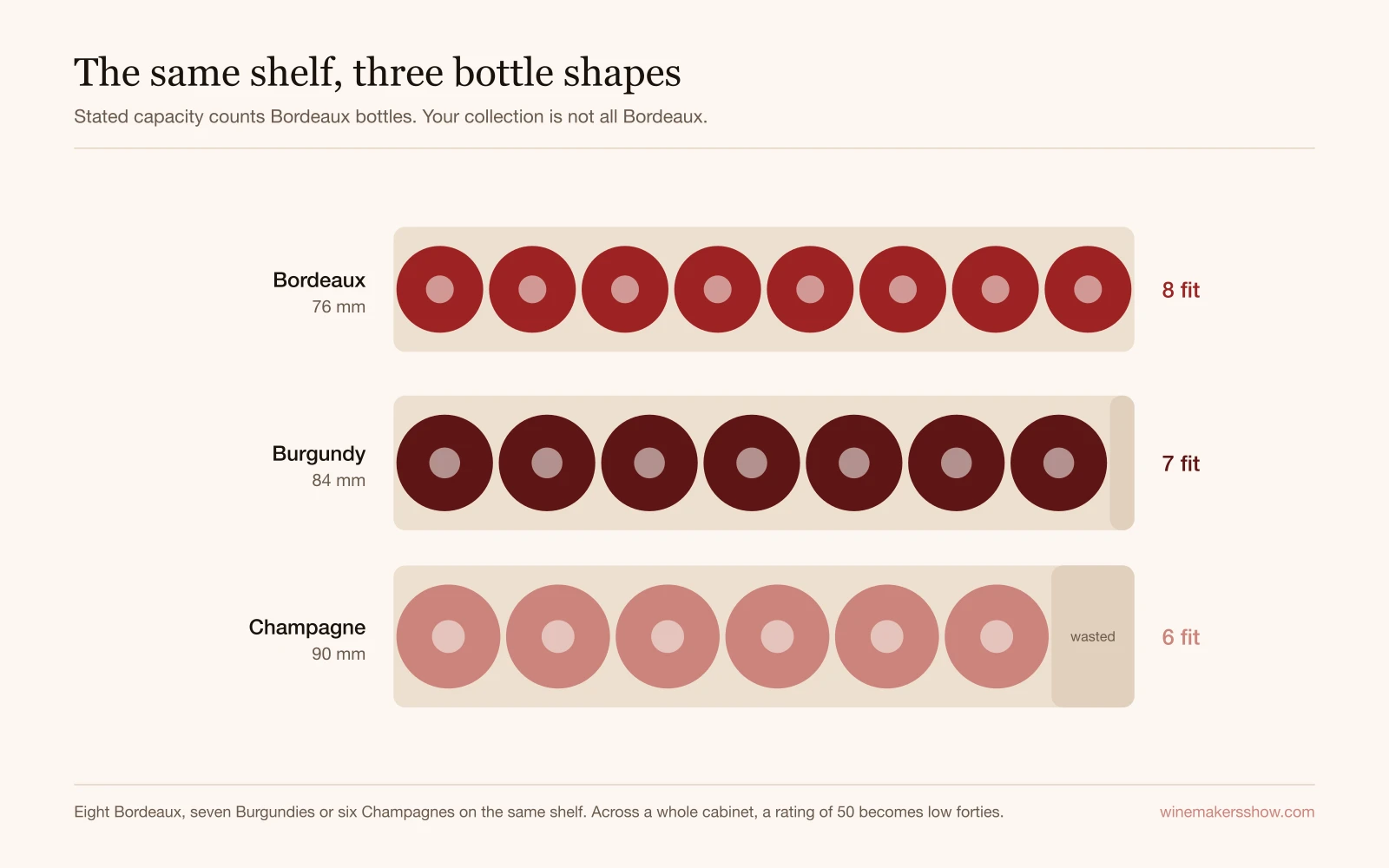
Capacity is optimistic. Stated capacity assumes Bordeaux bottles stacked perfectly. Burgundy and Champagne bottles are wider.
Vibration is the one nobody publishes. It is the real difference between a wine cellar and a fridge, and no manufacturer here gives a figure. Thermoelectric has none. Compressor units vary and the spec sheet will not tell you which you are getting.
The full reasoning, including humidity and why darkness is free, is in our wine cellar buying guide. If you just want the temperature settings, our guide to wine cellar temperature is the short version.
Amazon links on this page are affiliate links. They cost you nothing extra, and they help me keep this going.
Frequently asked questions
What is the best wine cellar to buy?
On cost per bottle of storage the Antarctic Star 26-bottle leads this list at $7.69, though it only reaches 16 °C so it is a storage cabinet rather than a serving one for reds. If you want two zones that genuinely work independently, the Ivation 33-bottle is the only cabinet here that publishes a separate range for each.
How much should a wine cellar cost?
The volume of the market sits between $180 and $280 for a freestanding single-zone compressor cabinet of 18 to 37 bottles, and that is where cost per bottle is lowest at roughly $8 to $12. Below about 12 bottles you pay two to three times as much per bottle for the small footprint.
Which specifications actually matter?
Temperature range, number of zones, compressor or thermoelectric, and whether it is rated for built-in installation. The two that decide whether you are happy in three years, stability and vibration, are published by no manufacturer in this category, which is why we do not put them in the table.