
Most people will tell you there are three kinds of wine: red, white and rosé. This is the fourth, and it is older than the other three.
It is called orange wine. Or amber wine. Or skin-contact wine. Three names for the same beautiful, slightly weird thing: a wine humans have been making for around eight thousand years, then almost completely forgot how to make, then quietly remembered about thirty years ago, thanks to two stubborn winemakers in a tiny village near the Slovenian border. If you have ever seen something glowing copper-orange on a natural wine bar’s by-the-glass list and wondered what on earth it was, this one is for you. Here is the whole story: what it is, where it came from, why it disappeared, why it is back, and whether you should be drinking it.
Watch the full breakdown
What orange wine actually is
The definition is deceptively simple, so let us get it out of the way.
To make red wine, you take red grapes and ferment the juice with the skins. The skins give red wine its colour, its tannin and its grip. To make white wine, you take white grapes and press the skins out immediately, so only the clear juice ferments. That is why white wine is pale and crisp and has no chewy texture.
Orange wine is the third move. You take white grapes and you do the red wine thing: you leave the juice in contact with the skins, for days, weeks, sometimes months. What comes out is a white wine that has been transformed: deeper in colour, full of tannin, with a structure and grip you have never tasted in a white.
That is the whole secret. Orange wine is not a grape, not a region, not even really a category in most wine laws. It is a technique, and a deeply ancient one: white grapes, treated like reds. The colour in the glass, anywhere from pale gold to deep amber to almost copper, comes entirely from how long the juice sits on the skins. A few days gives a gentle gold; a few months gives a colour that genuinely glows.
Why it’s called “orange” (and why Georgia says amber)
A quick bit of name nerdery, because there is a small civil war over what to call this stuff.
The term “orange wine” is surprisingly recent. It was coined in the early 2000s by a British wine importer named David Harvey, who needed an easy way to describe the strange amber bottles he was bringing in from northern Italy. It was catchy, it stuck, sommeliers loved it, and here we are.
But in Georgia, the country where the style was invented eight thousand years ago, they do not call it orange. They call it amber wine, and they have a good reason: “orange” already means a citrus fruit, and the last thing they want is people assuming this is wine made from oranges. Fair point. So you will hear all three names. “Orange wine” is what most of the world says, “amber wine” is what the inventors prefer, and “skin-contact wine” is what producers themselves often use because it is the most accurate. I will mostly say orange here, because that is the word on most labels, but know that the Georgians are watching and they are not thrilled.
The 8,000-year-old original: Georgia and the qvevri
To find the origin of orange wine you have to fly to Georgia. Not the US state, the country: a small, mountainous, fiercely proud nation in the Caucasus, between the Black Sea and the Caspian. By almost every measure we have, Georgia is the oldest winemaking country on earth. In 2015, archaeologists at a Neolithic site in the east found clay shards still carrying grape residue and carbon-dated them to around 6,000 BCE. Eight thousand years ago, give or take, roughly two thousand years before the pyramids.
And the way they did it then is, almost unbelievably, the way the most traditional Georgian winemakers still do it today. The secret is a vessel called a qvevri (say “kev-ree”).
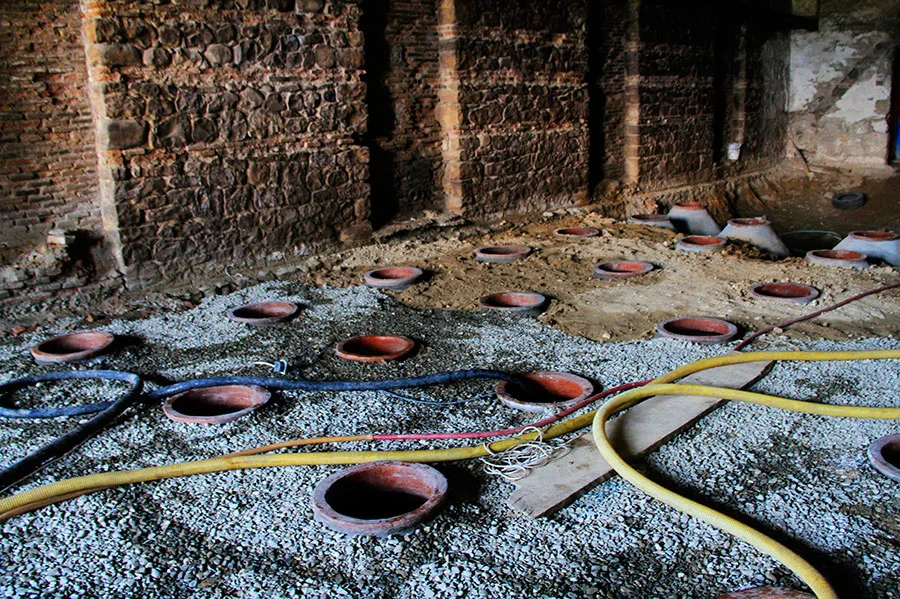
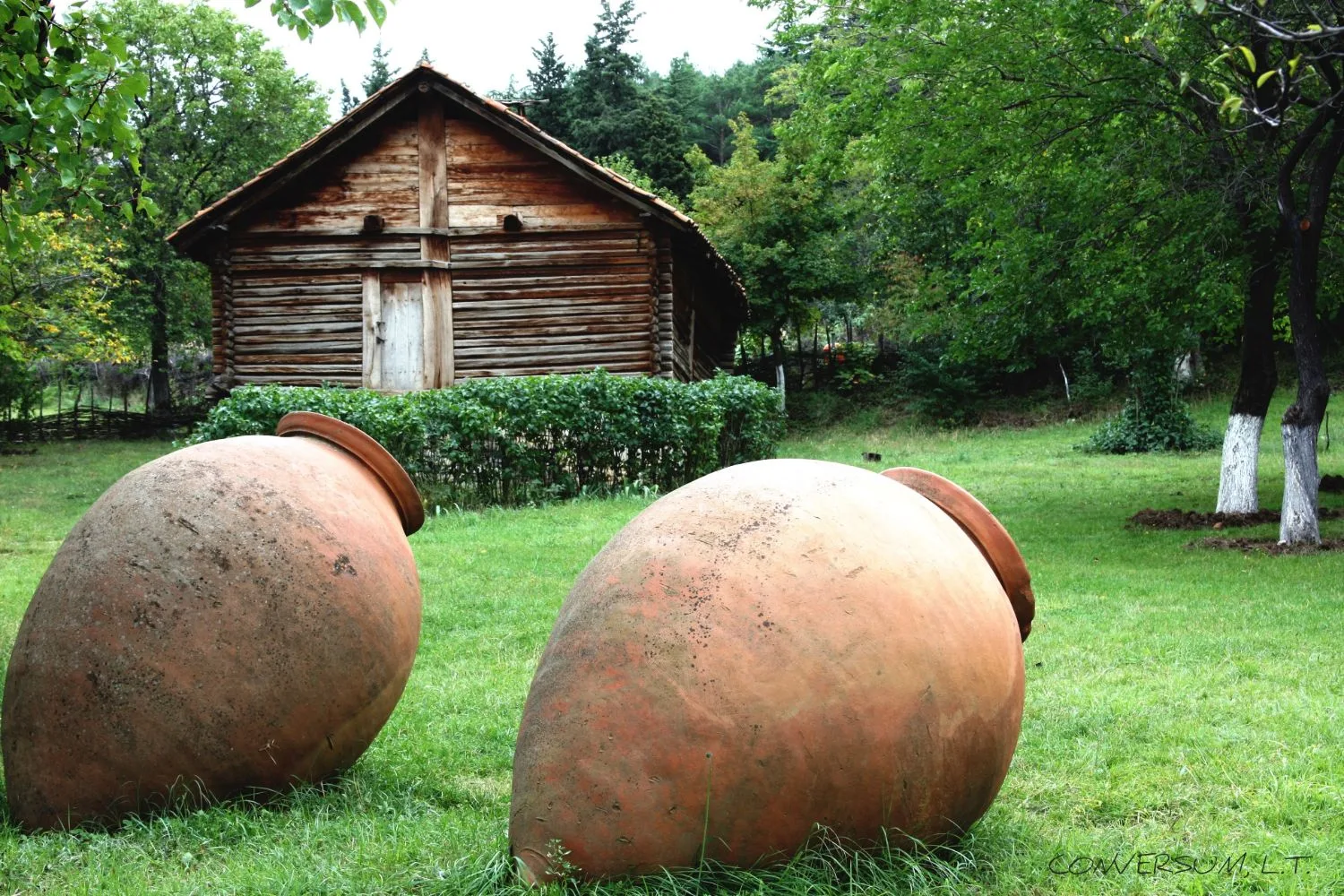
A qvevri is a giant egg-shaped clay amphora, sometimes the size of a small car, lined inside with beeswax. The move that defines Georgian winemaking is to bury it in the ground up to the neck, so its mouth sits flush with the cellar floor. Why bury it? Temperature. The earth is near-perfect natural climate control, cool in summer, warmer in winter, always stable. Into the qvevri go the crushed white grapes, with the skins, the seeds, sometimes the stems. They seal it and walk away. The wine ferments on the skins for weeks, then macerates for months, often through the whole winter. When they open it in spring, out comes something deep amber, tannic, savoury and alive.
Georgia has something like 525 native grape varieties; the ones that matter for amber wine are Rkatsiteli, Kisi and Mtsvane. And in 2013, UNESCO recognised the qvevri winemaking method as Intangible Cultural Heritage of Humanity. Eight thousand years, one method, officially declared a treasure of the species.
How orange wine is made, step by step
Bring it into the modern day and the process is beautifully simple.
- Harvest. White grapes, picked ripe. Any white can be used, but aromatic, thick-skinned grapes like Ribolla Gialla, Pinot Gris, Gewurztraminer and Sauvignon Blanc make particularly interesting orange wines.
- Crush. Lightly, just enough to break the skins so the juice and skins can mingle.
- The choice. The winemaker puts the crushed grapes, juice, skins, seeds and sometimes stems, into a vessel. That can be a clay qvevri, oak barrels, stainless steel, concrete eggs, even plastic. Different vessels, different results.
- Fermentation and maceration. Wild yeasts on the skins start the ferment, and the juice turns to wine while still in contact with everything else. The variable that defines the style is time: a few days gives a gentle, lightly textured wine; a few weeks gives real tannin and deeper colour; three to six months, full qvevri style, gives the extreme end, deep amber and intensely tannic, built to age for decades.
- Press and age. The wine is eventually pressed off its skins and aged, often in large neutral wood, before bottling.
Orange winemaking very often overlaps with the natural wine movement, wild yeasts, minimal sulphur, as little intervention as possible. But hold that thought, because the two are not the same, and we will come back to it.
Why the world forgot about it
If orange wine is so ancient and so universal, why had most of us never heard of it until about ten years ago? Because in the 1960s and 70s, modern winemaking essentially killed it.
The new gospel was stainless steel, cultured yeasts, sterile filtration and temperature control. White wine was meant to be pale, crisp, neutral and consistent; Pinot Grigio became the global standard for what a white was supposed to be. In that world, an amber-coloured, tannic, savoury white was an embarrassment, the sort of thing your grandfather made because he did not know any better. So across Italy, Slovenia and parts of France, the old skin-contact traditions were quietly abandoned.
Almost everywhere. Except Georgia, where, in the family cellars of tiny villages, the qvevri tradition simply never stopped. The grandfathers kept making it the way grandfathers always had. And that is where, in the 1990s, two stubborn winemakers came looking.
The 1990s revival: Gravner, Radikon and one tiny village
The setting is Oslavia, a village of about 600 people on the Italian-Slovenian border, in a region called Collio (or Brda on the Slovenian side, both words just mean “hills”). The border runs straight through the vineyards. Most families here are ethnic Slovenians with Italian passports, and by the 1980s the region was making clean, modern, technically perfect, frankly boring white wines.
Two men had had enough: Stanko Radikon and Josko Gravner, both already respected, both deeply frustrated. As Gravner put it later, the wine had become technically perfect and spiritually dead. So they looked backwards, and asked the old people how their grandfathers had made wine. The answers: long skin contact, big old wooden casks, wild yeasts, patience.
Radikon went first. In 1995 he made a Ribolla Gialla with extended skin maceration. It was amber, it was tannic, it looked like nothing modern, and people thought he had lost his mind. Gravner went further: around the year 2000 he travelled to Georgia, saw the qvevri tradition firsthand, came home and started importing actual Georgian qvevri to bury in his Italian cellar. From the 2001 vintage on, every wine he made was fermented in a clay vessel buried in Friulian soil.
For years almost nobody bought their wine; critics hated it and they were both nearly broke. Then the world caught up. Other producers in the village followed, the natural wine movement found them, sommeliers started talking, David Harvey coined the name, and by 2015 and 2016 the style had exploded onto wine lists from New York to Tokyo. Stanko Radikon died in September 2016, the same year the boom became impossible to ignore; his son Saša runs the winery now. So when you order a glass of orange wine tonight, that is the chain you are sipping at the end of: an eight-thousand-year-old Georgian tradition, kept alive through the Soviet decades by family cellars, picked up in the 1990s by two angry winemakers in a border village, and carried into the world by sommeliers who needed something genuinely new.
What orange wine tastes like
The honest answer: completely unlike any white you have had, and depending on the bottle, anywhere from “oh, that’s lovely” to “oh, that’s a lot.”
Expect dried fruit (apricot, orange peel, dried apple), nuts (walnut, almond), and savoury notes (black tea, dried herbs, salted caramel, sometimes honey or beeswax). And here is the surprise: a tannic grip on your gums, exactly like a red. That is the skin contact talking. The big mental shift is this, most white wine is built around freshness and acidity; orange wine is built around texture and tannin. It is a white that drinks like a red. Lighter versions (a few days of skin contact) are gentle introductions; hardcore qvevri wines (months of contact) are intense and almost meditative, not for casual sipping.
One practical note: serve it slightly warmer than a regular white. Fridge-cold mutes everything you came for. Cellar temperature, around 12 to 14°C, is the sweet spot.
What to eat with orange wine
This is where orange wine genuinely shines. Because it has the aromatic complexity of a white and the tannic structure of a red, it handles food that murders ordinary whites:
- Spice and aromatics: Indian and South Asian curries, Sichuan dishes, Moroccan tagines, Ethiopian food, Korean barbecue. Anything with bold spice, fermented elements, or sweet-and-savoury interplay.
- Hard aged cheeses: parmesan, aged gouda, aged gruyère.
- Savoury and rich: charcuterie, mushroom dishes, roast chicken, even some lighter red meats.
The sweet spot is any dish that is too aromatic for a red but too rich or spicy for a regular white. Orange wine slides right into that gap.
Is orange wine a natural wine?
One quick myth to bust before we land. Orange wine and natural wine get used almost interchangeably, and they should not be.
Natural wine is a philosophy: minimal intervention, native yeasts, no additives, little or no added sulphur. Orange wine is a technique: white grapes fermented on their skins. There is huge overlap, most orange producers are natural-minded, but you can absolutely make a clean, sulphur-stable, conventionally vinified orange wine, and plenty do. This matters because people try one funky natural orange wine, find it weird, and write off the whole style. If your first one had barnyard funk or felt unstable, that was the natural wine part, not the orange part. Try a cleaner one; it is a completely different experience.
Where to start with orange wine
Three quick paths, depending on how far you want to go.
- Your first bottle: go gentle. Look for only a few days to a few weeks of skin contact. Producers like Movia (Slovenia) and Foradori (in the Italian Dolomites, the Pinot Grigio Fontanasanta) make accessible entries, as do many California skin-contact bottlings.
- To go deeper: hunt down Friuli Collio or Slovenian Brda, the originals of the modern revival: Radikon, Princic, Skerk, Gravner. Bigger, more textured, more challenging wines, best drunk with food.
- To go all the way back: find a Georgian amber wine from Kakheti, a Rkatsiteli or a Kisi made in qvevri, and you are tasting essentially what people drank eight thousand years ago. Look for Pheasant’s Tears, Iago’s Wine, Lagvinari or Okro’s Wines.
The honest takeaway is that orange wine is not for everyone, and that is fine. Some people love the texture, the depth and the story; others find it too tannic or too oxidative for a white. Both are valid. But you owe it to yourself to try it at least once, from a good producer, served not too cold, with food. Eight thousand years of people making wine this way. The least we can do is taste it.
If you want to keep going, our guides to Bordeaux’s classifications and the wines of Burgundy cover the “classic” wine world that orange wine sits so happily outside of, and you can browse everything we have on learning wine from one place.
Image credits
- Qvevri set into a Georgian cellar floor: photo by Levan Totosashvili, CC BY-SA 2.0, via Wikimedia Commons.
- Qvevri amphorae in Kakheti, Georgia: photo by Levan Gokadze (Tbilisi, Georgia), CC BY-SA 2.0, via Wikimedia Commons.
Frequently asked questions
Is orange wine made from oranges?
No. Orange wine has nothing to do with the fruit. It is made from white grapes, and the colour comes from leaving the juice in contact with the grape skins. The name simply describes the amber-to-copper colour you get as a result.
What is orange wine, exactly?
Orange wine is white wine made like a red. You take white grapes and ferment the juice in contact with the skins for days, weeks or months, instead of pressing the skins out straight away. That skin contact gives it colour, tannin and texture. It is a technique, not a grape or a region.
What does orange wine taste like?
Completely unlike a normal white. Expect dried fruit (apricot, orange peel), nuts, and savoury notes like black tea, dried herbs and honey, plus a tannic grip on the gums that you usually only get from red wine. It is built around texture and tannin rather than freshness and acidity.
Is orange wine the same as natural wine?
No. Natural wine is a philosophy (minimal intervention, native yeasts, little or no added sulphur). Orange wine is a technique (white grapes fermented on their skins). They overlap a lot, but you can make a clean, sulphur-stable orange wine, and many producers do.
What do you eat with orange wine?
This is where it shines. With the aromatics of a white and the structure of a red, it handles dishes that defeat ordinary whites: Indian and Sichuan food, Korean barbecue, tagines, hard aged cheeses, charcuterie, mushrooms and roast chicken.
How should I serve orange wine?
Warmer than a normal white. Fridge-cold mutes everything you came for. Aim for cellar temperature, around 12 to 14°C, and ideally drink it with food rather than on its own.