In Bordeaux, the label tells you the château. In Burgundy, it tells you the vineyard. In Alsace, the label tells you the grape, big and front and centre: Riesling, Gewurztraminer, Pinot Gris. If you grew up on New World wine that sounds completely normal. In France it is almost unheard of, and it is the single best clue to everything that makes Alsace wine so different from the rest of the country.
Alsace is a thin strip of vineyards in the far northeast of France, pressed right up against the Rhine, with Germany on the other side. It has been French, then German, then French, then German, then French again, and that tug of war shaped everything: the grapes, the bottles, the village names, and yes, that grape on the label. It is also home to 51 grands crus, four “noble” grapes, two of the greatest sweet wines in the world, and a brand new classification tier being voted on right now. Here is how all of it fits together, and how to read any Alsace bottle in a couple of minutes.
Watch the full guide
Why Alsace wine looks so different
Start with the history, because it frames everything else. For most of the last 150 years the border here has been a moving target. Alsace was French for centuries, then German from 1871 to 1919 after the Franco-Prussian War, then French again after the First World War, then German once more under Nazi occupation, and finally French since 1945.
Imagine being a winemaker through all of that. Your grandfather worked in German, your father in French, and you under both. The villages have German names, Riquewihr, Eguisheim, Kaysersberg, Ribeauvillé. The grapes are largely German, Riesling and Gewurztraminer among them. The bottle itself is a tall, slim, green flûte, basically a German Rhine bottle. Even half the winemakers’ surnames are German. And yet the wines are made in a distinctly French way: typically dry, technically precise, focused on terroir.
So Alsace ends up neither quite German nor quite French. It is a third thing. If you have read our guides to Bordeaux and Burgundy, you know the French instinct is to label by place. Alsace does the opposite and puts the grape front and centre, which is a deeply Germanic habit. Hold on to that, because it explains the label.
The geography: between the Vosges and the Rhine
Geographically, Alsace is a long, narrow strip running roughly north to south for about 170 kilometres, pinched between two natural walls. To the west, the Vosges mountains. To the east, the Rhine valley opening into Germany. The magic is in the rain shadow those Vosges create. Wet weather rolls in from the Atlantic, the mountains catch it, and by the time the air spills onto the Alsace plain it is dry.
That makes Colmar, in the heart of the region, one of the driest cities in France. For grapes, that is gold: long, sunny, dry autumns let fruit hang late into the season and reach real ripeness without rotting.
The region splits into two halves. The Bas-Rhin in the north, around Strasbourg, is generally cooler with sandier soils. The Haut-Rhin in the south, around Colmar, is warmer and steeper, and it is where the majority of the great grands crus are concentrated. Threading through all of it is the Route des Vins d’Alsace, the Wine Route, formalised in 1953: around 170 kilometres of postcard villages strung along the foothills. If you have ever seen a French village that looked like a fairy tale, half-timbered, geraniums in every window, painted shutters, it was probably here.
One last geography fact, and it is a wild one. Alsace has one of the most soil-diverse wine landscapes on Earth. Granite, limestone, schist, sandstone, volcanic rock, gneiss, clay, marl, all crammed into this skinny strip. Grands crus a few kilometres apart can sit on completely different geology, and that diversity matters a lot when we get to the classification.
The eight grapes, and the four nobles
Alsace is overwhelmingly a white wine region, around 90% of everything made here, the only major white-dominant region in France. There are eight officially permitted grapes, and of those, four carry the “noble” title. The nobles are the elite, the ones allowed into the grands crus.
Riesling is the undisputed king, around a fifth of all plantings. Steely and dry, all citrus and stone fruit over a backbone of acidity that lets it age for ten, fifteen, even twenty years. Riesling is also Germany’s great grape, but where German Riesling plays across a sweetness spectrum, Alsace Riesling is mostly bone dry. Same grape, opposite philosophy.
Gewurztraminer, usually spelled here without the umlaut (a tiny visible act of French resistance), is wildly aromatic: lychee, rose petals, ginger, exotic spice. It is the most beginner-friendly Alsace wine because the aromas are unmistakable, and it is often just off-dry.
Pinot Gris is the same grape as Italian Pinot Grigio, but you would never guess. Where Grigio is light and crisp, Alsace Pinot Gris is rich, honeyed and full-bodied, sometimes with a smoky edge and a gentle phenolic grip you rarely find in a white. A completely different wine from the same grape.
Muscat, the fourth noble, smells uncannily of fresh grapes. Most of the world makes Muscat sweet; Alsace makes it dry, a classic apéritif.
Then the supporting cast: Pinot Blanc, clean and soft, the everyday workhorse and a backbone of Crémant; Sylvaner, fresh and simple; Chasselas, rare now and mostly blended; and the one red, Pinot Noir, Alsace’s only authorised red grape (more on that shortly, because its status just changed).
Here is the killer rule that defines Alsace. When you make a wine from one of these grapes, you bottle it as that single variety. No blending. The label just says “Riesling” or “Gewurztraminer.” Across the river in Germany that is exactly how labels work. Cross back into France and almost nowhere else does it. Alsace really is a halfway country.
AOC Alsace: the foundation
The base of the pyramid is AOC Alsace, created in 1962. That date alone tells you something: the appellation system here is young, decades behind most of France, because the wars and the constant change of country delayed everything.
AOC Alsace is the broad regional appellation and covers around three-quarters of all production. The wine has to come from within the Alsace vineyard, be one of the eight permitted grapes, and meet basic standards. The label shows “Alsace” plus the grape, and that is it. This is not lesser wine, by the way: a serious grower can make wonderful, fairly priced AOC Alsace Riesling. It is simply the entry point.
There is also a separate base-tier appellation, Crémant d’Alsace, the sparkling wine, created in 1976. It is made by the traditional method, the same as Champagne, mostly from Pinot Blanc, Pinot Auxerrois, Riesling and Chardonnay, and it is one of France’s most underrated sparklers.
The village tier: communales and lieux-dits
Step up and you reach a tier only formally added in 2011, one most casual drinkers do not know exists: the communales. These are specific villages whose names carry real identity, thirteen of them, including Bergheim, Wolxheim, Ottrott, Scherwiller, Rodern and Blienschwiller. If you see one of those village names on a label, the wine has to meet stricter rules than basic AOC Alsace, with lower yields and tighter standards. It is essentially the “village” tier, like Burgundy’s village wines, except Alsace got to it forty or fifty years later, having spent its energy building the grand cru system first.
Within and around those villages you also find lieux-dits, named single-vineyard sites. Alsace has somewhere between two and three hundred of them. If a wine carries a lieu-dit name, it has to come entirely from that named patch of land. They are an unofficial step between village and grand cru, and they sit right at the centre of the new Premier Cru proposal we will come to at the end.
The 51 grands crus
Now the summit: AOC Alsace Grand Cru. There are 51, split 14 in the Bas-Rhin and 37 in the Haut-Rhin. Each is a specifically delimited lieu-dit, a single named vineyard recognised for an exceptional combination of soil, exposure and microclimate. They sit on the best mid-slopes and range wildly in size, from tiny Kanzlerberg at about 3 hectares up to Schlossberg at around 80.
Two things about the system are unusual, and you need both.
First, the rollout was incredibly slow. The very first grand cru, Schlossberg, was recognised in 1975. Twenty-five more followed in 1983, more in 1992, and the last, Kaefferkopf, only joined in 2007. Where Bordeaux’s classification dates from 1855 and Burgundy’s framework was largely set decades ago, Alsace built its top tier piece by piece over thirty-two years, fighting through endless local disputes about which vineyards deserved to make the cut.
Second, and this is the clever structural bit, in 2011 all 51 grands crus became independent appellations in their own right. So “Alsace Grand Cru Schlossberg” is not really a sub-category; it is its own AOC, with its own rules on permitted grapes, yields and ripeness. Fifty-one separate rulebooks inside one collective system.
The rules are strict across the board: a maximum yield around 55 hectolitres per hectare, well below the roughly 80 allowed for basic AOC Alsace, mandatory hand-harvesting, and in general only the four noble grapes may be bottled as grand cru. But, Alsace being Alsace, there are exceptions that make great trivia. Zotzenberg may make grand cru Sylvaner, because Sylvaner has been farmed there brilliantly for centuries. Altenberg de Bergheim and Kaefferkopf are allowed to blend their noble grapes, breaking the single-variety rule, again because that is what they historically did. The system bends to honour local tradition rather than forcing everywhere to look the same.
Grands crus are only about 4% of total production here, small and serious. A few names to remember as you explore: Schlossberg, Brand, Hengst, Rangen de Thann, Zinnkoepflé, Goldert, Sommerberg, Altenberg de Bergheim. From a good producer in a good vintage, an Alsace grand cru is one of the great bargains in French wine, often a fraction of the price of a Burgundy grand cru.
Pinot Noir gatecrashes the grands crus
Here is the live news almost nobody outside the region talks about. For nearly fifty years, Alsace Grand Cru was a whites-only club: only the four noble white grapes allowed at the top. Then in May 2022 the rules cracked open. The INAO, France’s appellation authority, officially recognised Pinot Noir from two specific grand cru sites, Kirchberg de Barr and Hengst. For the first time ever, you can buy a red wine labelled Alsace Grand Cru.
This matters. It is a public acknowledgement that Alsace can make genuinely serious red wine, something the region has quietly worked towards for years as climate change makes its Pinot Noir richer and more structured. It is almost certainly the first of more to come. The whites-only fortress has its first breach.
The great sweet wines: Vendanges Tardives and Grains Nobles
Sitting alongside the regular classification, almost like a parallel track, Alsace has two designations for late-harvest sweet wines, both created in the early 1980s, and both world-class.
Vendanges Tardives means “late harvest.” The grapes are left on the vine well past normal picking, concentrating sugar and aroma into something richer and, often but not always, sweet: lush, intense, deeply perfumed.
Sélection de Grains Nobles means “selection of noble grains,” and it is the extreme version. Grapes are picked individually once they have been touched by noble rot, the same beneficial fungus that makes Sauternes, which shrivels the berries and concentrates everything to an almost unreal intensity. These are gorgeous honey-and-apricot dessert wines that can age for decades.
Both require strict minimum sugar levels, can only be made from the four noble grapes, and can be applied on top of an AOC Alsace or a grand cru. So an “Alsace Grand Cru Riesling Vendanges Tardives” is a very serious thing indeed. These are probably the most overlooked great sweet wines in France.
The missing tier: Premier Cru is coming
And now the live story. Alsace does not have a Premier Cru tier yet, but it is about to. This conversation has run for almost a decade. Burgundy has its premiers crus, a clear step between village and grand cru. Alsace has nothing in that gap: you jump from a communale or a lieu-dit straight to one of the 51 grands crus.
Since 2016 the INAO has been building a plan for an AOC Alsace Premier Cru, a new layer assembled from the best of the existing lieux-dits. Vineyards that have shown consistent quality over time would be promoted, with stricter rules: lower yields, tighter ripeness, and a requirement that the boundary form what the paperwork calls a “geological unity,” a continuous, coherent stretch of soil and exposure. The latest update, in June 2025, confirmed the methodology is approved and the first seven applications are now being formally evaluated. So it is happening, slowly, vineyard by vineyard, the same painstaking way Alsace built its grands crus.
When it lands, Alsace will have the cleanest four-tier pyramid in France, Regional, Village, Premier Cru and Grand Cru, the same structure Burgundy uses. It will be the moment the classification finally feels finished, and we are watching it happen in real time.
How to actually read an Alsace label
Three quick rules will get you through almost any Alsace bottle.
- Find the grape. It will almost always be there in big letters: Riesling, Gewurztraminer, Pinot Gris or Muscat among the nobles, plus Pinot Blanc, Sylvaner or the red Pinot Noir. That is your starting point.
- Look for a place. Just “Alsace”? Base tier. A village name like Bergheim or Ottrott? Communale level. A specific vineyard name (a lieu-dit)? You are stepping up. The magic words “Alsace Grand Cru” followed by a name, Schlossberg, Hengst, Brand, Rangen, mean you are at the summit, one of the 51.
- Look for the sweet-wine flags. “Vendanges Tardives” or “Sélection de Grains Nobles” anywhere on the label means something rich, late-harvested and built to age.
And the honest truth, same as Bordeaux and Burgundy: the label is a starting point, not a verdict. A great grower with a humble AOC Alsace Riesling can absolutely outshine a careless one sitting on a grand cru.
Producers worth knowing
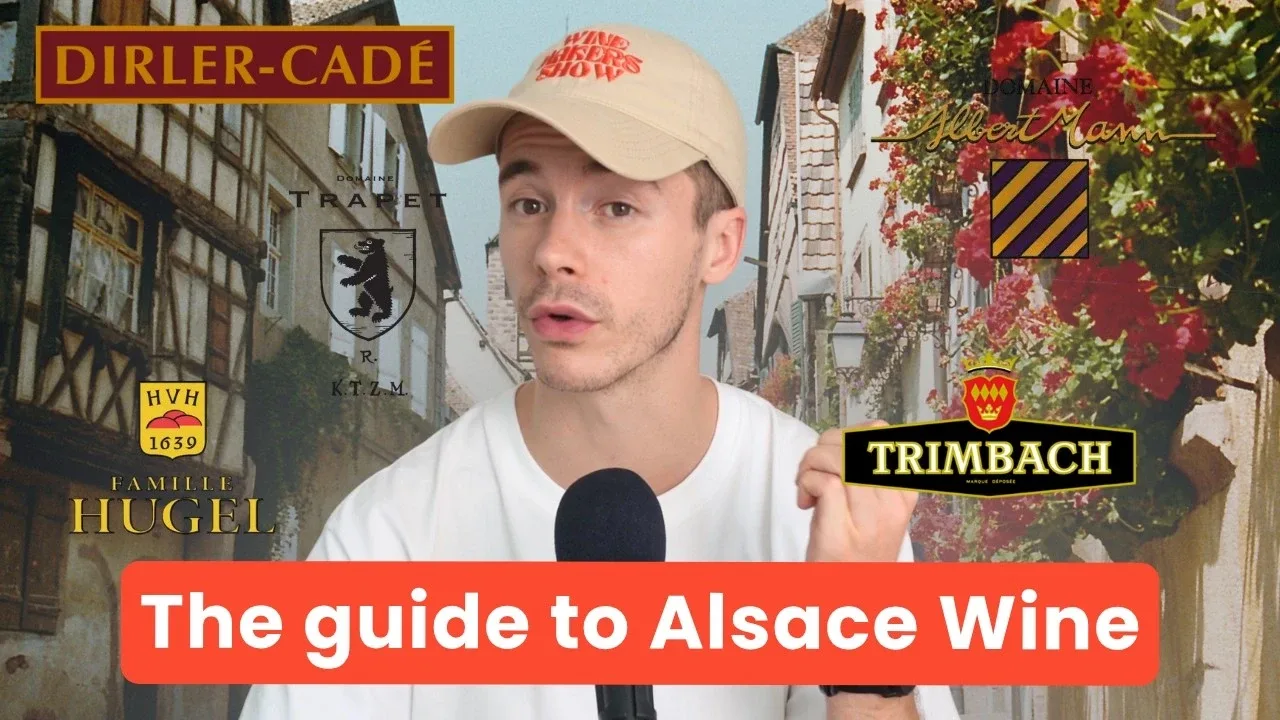
Names to build your map around: Trimbach, Hugel, Zind-Humbrecht, Domaine Weinbach, Albert Mann, Marcel Deiss, Trapet and Dirler-Cadé. Start with one bottle from a grower you like, then follow your own taste. The regional body, the CIVA, is a good place to dig into villages and the Wine Route if you want to visit.
Alsace is not quite French and not quite German. It is just Alsatian, and that is exactly what makes it one of the most interesting wine regions in Europe.
Frequently asked questions
What is Alsace wine known for?
Alsace wine is famous for dry, intensely aromatic white wines that are labelled by grape rather than by place. Riesling and Gewurztraminer are the signatures, alongside Pinot Gris and Muscat. Around 90% of the region's output is white, which is unusual for France, and the wines are prized for their purity, precision and ability to age.
Is Alsace wine sweet or dry?
Most Alsace wine is dry, despite the region's German heritage and heady aromatics. The confusion comes from the perfume: a bone-dry Gewurztraminer can smell sweet without being sweet. There are two genuinely sweet categories, Vendanges Tardives (late harvest) and Sélection de Grains Nobles (noble rot), and both say so clearly on the label.
What are the four noble grapes of Alsace?
The four noble grapes of Alsace are Riesling, Gewurztraminer, Pinot Gris and Muscat. These are the only varieties normally allowed into the grands crus and the late-harvest sweet wines. The other permitted grapes, Pinot Blanc, Sylvaner, Chasselas and the red Pinot Noir, make up the supporting cast.
What is an Alsace Grand Cru?
An Alsace Grand Cru is one of 51 specifically delimited vineyards recognised for an exceptional mix of soil, exposure and microclimate. Since 2011 each one is its own appellation with its own rules. They were added slowly between 1975 and 2007, account for only about 4% of production, and are some of the best-value top-tier wines in France.
Why does Alsace put the grape on the label?
It is a Germanic habit. Alsace has spent much of the last 150 years switching between France and Germany, and labelling a wine by its single grape variety, the way Germany does, stuck. Almost everywhere else in France labels by place instead. When an Alsace wine is made from one grape, it is bottled as that grape, with no blending.
What food pairs with Alsace wine?
Alsace wine is one of the most food-friendly styles around. The dry aromatic whites are brilliant with Asian food, from Thai and Indian to Sichuan, and with the region's own tarte flambée, choucroute and pungent Munster cheese. Off-dry Gewurztraminer and Pinot Gris handle spice and richness that flatten most other whites.