Twelve degrees. If you want one number and nothing else, that is the number.
But the number is the least interesting part of this question, and treating it as the whole answer is how people end up disappointed by an expensive cabinet. What actually decides whether your wine is any good in five years is whether it stayed at twelve, not whether it ever reached it.
The numbers, quickly
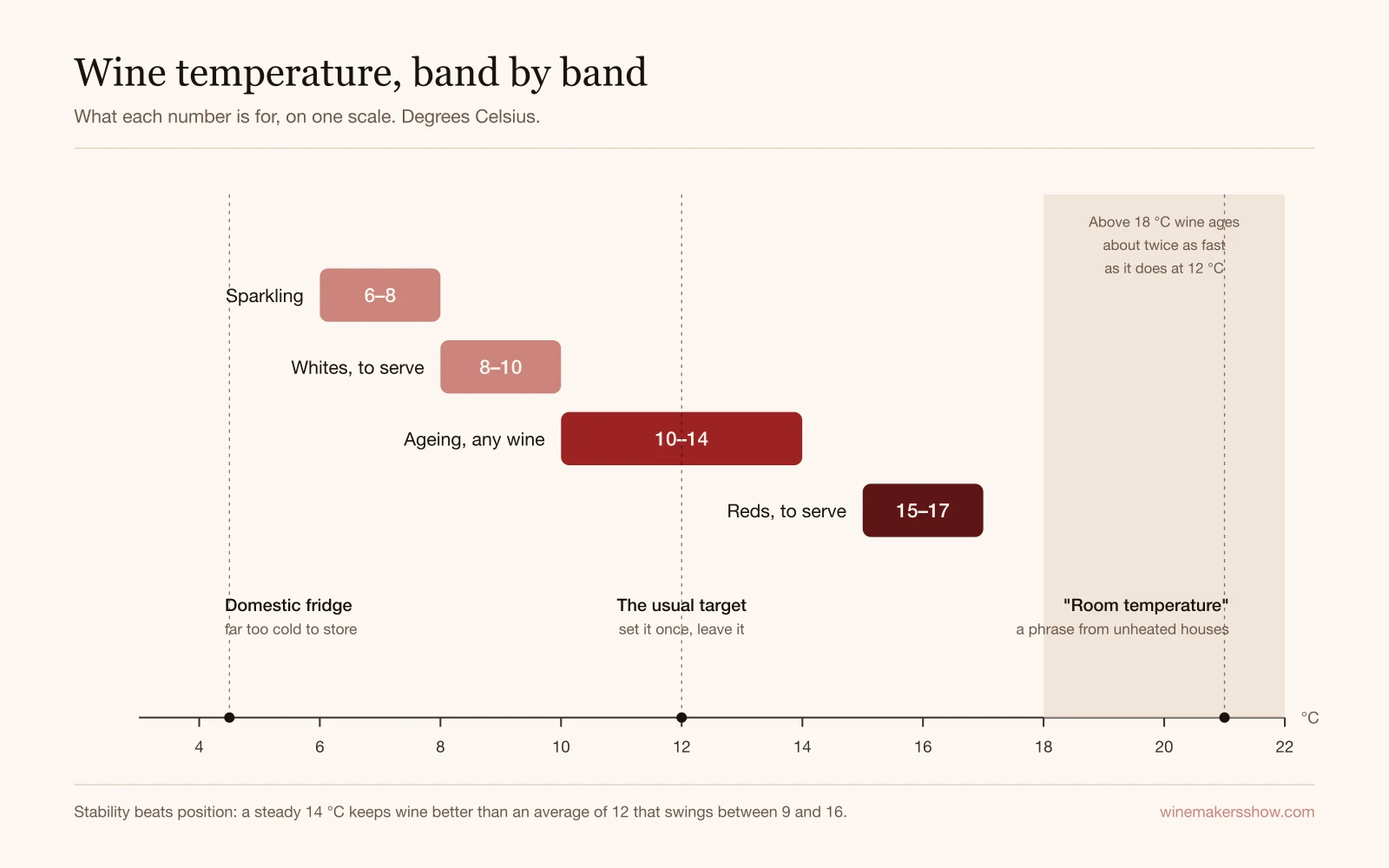
Ageing: 10 to 14 °C, with 12 as the target. One temperature, held, for years. You set it once and you never touch it again.
Service, whites: 8 to 10 °C. Cold enough to be refreshing, not so cold that the aromatics disappear. Straight from a domestic fridge at 4 °C is too cold, which is why a white often tastes better twenty minutes after you pour it.
Service, reds: 15 to 17 °C. Not “room temperature”. That phrase dates from houses without central heating, and a modern living room at 21 °C makes a red taste flabby and alcoholic.
Sparkling: 6 to 8 °C. Colder than still whites, because cold holds the bubbles.
Why stability beats the number
Here is the thing nobody selling you a cabinet will lead with: a cellar holding a rock-steady 14 °C keeps wine better than one that averages 12 while swinging between 9 and 16.
Wine minds movement more than position. Every time the temperature rises the liquid expands slightly, every time it falls it contracts, and that cycle works air past the cork. Do it a few hundred times over a few years and you get oxidation, seepage and the sticky neck you sometimes see on a badly stored old bottle.
A steady 14 is simply a slightly faster clock. A cellar that swings is actively damaging.
This is also why the daily cycle matters more than the seasonal one. A garage that drifts slowly from 8 °C in February to 20 °C in August is not ideal, but it is gentler than a kitchen cupboard that goes up five degrees every evening when you cook.
What temperature actually does to wine
Ageing is chemistry, and chemistry runs faster when it is warm. As a rough rule, the reaction rate roughly doubles for every 10 °C you go up.
Run that forward. A wine kept at 22 °C is ageing at something like twice the rate of the same wine at 12 °C. Not twice as gracefully: twice as fast, and heat pushes the wine toward stewed, jammy, prematurely tertiary flavours rather than the slow development you were paying for.
That is the real argument for a cellar over a cupboard. Not that 12 is magic, but that a cupboard in a heated house sits at 20 to 22 all winter.
Cold is more forgiving. Wine stored too cold ages very slowly, which mostly costs you time rather than quality. Below about 4 °C you risk tartrate crystals forming, which are harmless and look alarming, and at freezing you risk pushing the cork out.
The one everybody gets backwards
Cold firms tannin. Warmth rounds it off.
Chill a tannic young Bordeaux and it will taste harder, drier and more closed, not softer. Let it come up a few degrees and the tannins relax and the fruit arrives.
This is why the serving ladder runs the way it does: the more tannic the wine, the warmer you serve it. A light Beaujolais at 13 °C is right precisely because it has almost no tannin to firm up, not because the chill is doing something helpful to tannin.
If you have read that chilling a harsh red will tame it, that is exactly wrong, and it is one of the most repeated errors in wine writing. Our guide to red wine serving temperature goes further into it.
Getting it right in practice
Buy for stability, not for range. Almost every cabinet on the market covers the temperatures above. Almost none publishes how far it drifts, which is the specification that would actually separate them. Reviews mentioning temperature holding are worth more than any number in a listing.
Put it somewhere stable. A steady 20 °C room is a better home for a cabinet than one swinging between 14 and 28, because the cabinet can cool but it copes badly with chasing. See where to put a wine cellar.
Do not chase the dial. People set 12, check a thermometer, see 13.5 and adjust. The internal sensor and your thermometer are in different places, the compressor cycles, and the door has just been open. Set it and leave it alone for a week before judging.
One zone if you are ageing, more if you are serving. An ageing cabinet has one job and every extra zone is another thing to get wrong. A service cabinet needs two or three, because whites and reds want different numbers. That split is the whole of ageing versus service.
Watch the top of the range. Some cheaper cabinets stop at 16 °C, which sounds fine until you want a Châteauneuf at 17. Check the top figure before buying, not just the bottom.
Temperature is one of three things a cellar controls. The other two are humidity and light, and the reasoning behind all of them sits in our wine cellar buying guide. If you already know what you need, the current models are compared here.
Frequently asked questions
What temperature should a wine cellar be?
For ageing, a steady 10 to 14 degrees Celsius, with 12 as the usual target. For service, whites at 8 to 10 and reds at 15 to 17. Stability matters more than the exact figure: a cellar that holds 14 degrees all year ages wine better than one oscillating around 12.
Is 18 degrees too warm for a wine cellar?
For storage, yes. Wine ages roughly twice as fast for every 10 degree rise, so a cellar at 18 is running your bottles forward noticeably quicker than one at 12. For serving a big red it is fine, which is why service cabinets go that high and ageing cabinets do not.
Does cold make red wine taste more tannic?
Yes. Cold firms tannin up and makes a red taste more astringent and closed, and warmth rounds it off. That is why the more tannic the wine, the warmer you serve it, and why chilling a tannic red does not soften it.