Most people who think they want a wine cellar want a service cellar. They just have not been told the distinction exists.
A service cellar is not a smaller or cheaper ageing cellar. It is a different appliance for a different job, and once you know which job you have, the whole category stops being confusing.
The two jobs
An ageing cellar holds one temperature, around 12 °C, for years, and is barely opened. It is a bank vault.
A service cellar holds two or three temperatures, at drinking temperature, and is opened constantly. It is a wine rack that knows what it is doing.
Everything else follows from that. A service cabinet has more zones, a glass door so you can see what you have, interior lighting, and a design that assumes warm air rushes in several times a week.
The two numbers that matter
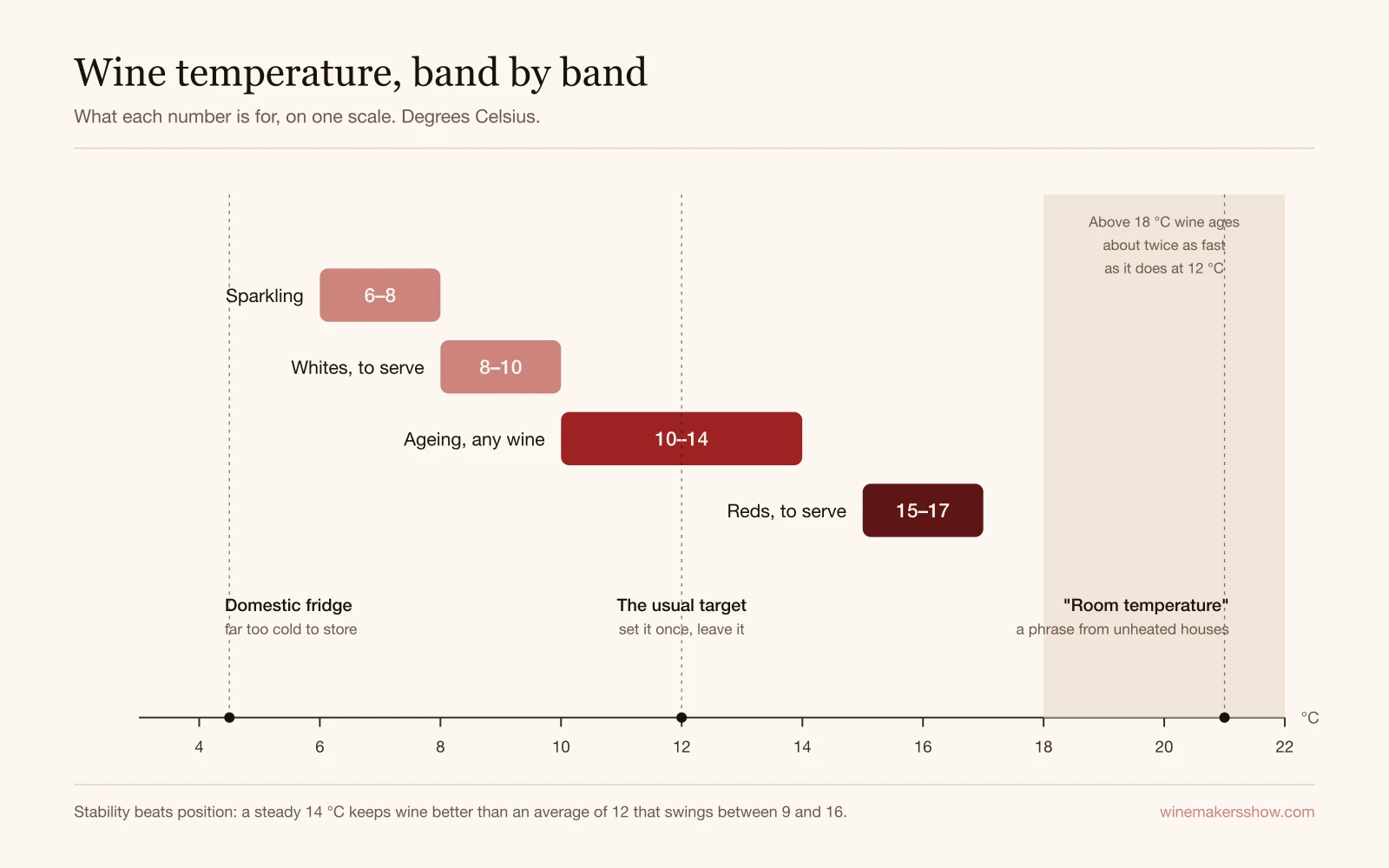
Whites: 8 to 10 °C. Cold enough to be refreshing, warm enough that the aromatics still show up. A white straight from a domestic fridge at 4 °C is too cold and tastes of very little for the first ten minutes.
Reds: 15 to 17 °C. Not room temperature. That expression comes from houses without central heating, and a modern living room at 21 °C makes a red taste soft, hot and vaguely alcoholic.
Those two bands do not overlap, which is precisely why service cabinets have more than one zone. One zone cannot do both, and a single-zone cabinet set to a compromise 13 °C serves your whites too warm and your reds too cold at the same time.
Sparkling wants 6 to 8 °C, colder still, and most two-zone cabinets can reach it at the bottom of their lower zone.
Two zones or three?
Two is enough for almost everybody. Whites and sparkling in the lower zone, reds in the upper, done.
Three is worth it if you drink a lot of both whites and sparkling and want them properly separated, or if you want one compartment running cooler as a small ageing section. Be honest about whether that describes you, because a third zone costs money and subdivides a cabinet that was probably already tight on space.
Check the published range per zone, not for the cabinet. This is the trick worth knowing. Most listings quote one range, something like 5 to 18 °C, and leave you to assume both compartments reach both ends. They usually do not. A manufacturer that publishes a separate range for each zone is telling you the zones are real, and one that publishes a single range is usually telling you, by omission, that they are less independent than they look.
Who should buy one
You, if you drink what you buy within a year or two. Which is most people, including most people who describe themselves as serious about wine.
You, if the frustration you actually have is temperature rather than storage. If your problem is that the red is always too warm and the white is always too cold, this is the machine that fixes it, and an ageing cabinet is not.
Not you, if bottles will sit for a decade. A service cabinet runs warmer, gets opened far more, and has more zones to drift. Nothing dramatic happens at four years, but you are running the clock faster than you need to.
What to look for
A top of range that actually reaches 17 °C. Some cheaper cabinets stop at 16, and a couple stop at 61 °F, which is 16.1. That sounds like nitpicking until you want a Châteauneuf at 17 and cannot get there. Check the top figure.
Compressor, not thermoelectric, unless the cabinet is going somewhere quiet and cool. A service cabinet usually lives in a kitchen, and a kitchen in August is exactly where thermoelectric gives up. See thermoelectric or compressor.
Capacity one size up from what you think. Stated capacity assumes Bordeaux bottles nested perfectly, and a service cabinet is full of half-drunk bottles standing upright and awkward shapes you bought on holiday. See what size do you need.
Built-in rating only if you are building it in. It costs meaningfully more and buys you nothing standing free in a corner. See when do you need a built-in.
The full set of criteria is in our wine cellar buying guide, and the current models are compared here.
Frequently asked questions
What is a wine service cellar?
A cabinet that holds wine at drinking temperature rather than storage temperature, usually with two or three zones so whites sit at 8 to 10 degrees and reds at 15 to 17. It is designed for a door that opens often, and it is what most people actually need.
What is the difference between a service cellar and an ageing cellar?
Purpose. A service cellar holds bottles ready to pour, across two or three temperatures, and gets opened constantly. An ageing cellar holds one steady temperature for years and is barely touched. A service cellar costs far less and suits anyone drinking what they buy within a couple of years.
Can a service cellar store wine long term?
For a year or two, comfortably. Beyond about three years you want an ageing cabinet, because a service cabinet runs warmer, gets opened more and has more zones to drift. Nothing dramatic happens at four years, but the clock is running faster than it needs to.