This is not a château. There is no tower, no gravel courtyard, no gates with gold lettering. It is a farmhouse on a small road out of Libourne, and you could drive past it without slowing down.
The wine made behind it averages around 4,000 euros a bottle, and great vintages go for tens of thousands.
It has no classification, because its region refuses to rank anything. It holds no title: no First Growth, no Grand Cru, nothing. It does not even make a second wine. And it is built entirely on Merlot, the grape people have spent decades sneering at.
This is Pétrus. The story of how a modest farm in a flat, unfashionable corner of Bordeaux came to out-price the palaces involves a widow in remarkable hats, a catastrophic frost, the Kennedy White House, something buried forty million years ago, and a trip to space.
Watch the guide
Pomerol, the appellation that refuses to rank itself
Pétrus sits in Pomerol, on Bordeaux’s Right Bank, hard against the Saint-Émilion border. Pomerol is an oddity. It is tiny, one of the smallest serious appellations in Bordeaux, and for most of its history it was a backwater: flat, rustic, ignored while the Médoc’s grand châteaux and Saint-Émilion’s pretty hill took the attention. There are no palaces here. Mostly modest farmhouses and small family plots.
And Pomerol is the one great Bordeaux region with no classification at all. It never had one and its growers have always refused. While the Médoc has its frozen 1855 list and Saint-Émilion has a ranking so contested that three of its four top estates walked out, Pomerol’s position has always been simple: the drinkers know, the market knows, nobody needs a piece of paper.
Which sets up the irony this whole story rests on. The wine at the summit of the entire Bordeaux price pyramid comes from the one region that never bothered to classify anything.
Saint Peter, and a gold medal in 1878
Pétrus is Latin for Peter, as in Saint Peter, keeper of the keys to heaven. His statue stands at the estate and his image has been on the label for generations. Nobody is certain how the vineyard got the name, and it most likely traces back to an old local place name. For a wine that would end up at the gates of fine-wine heaven, it is almost too neat.
The estate first appears in records in 1837, owned by the Arnaud family, who had held land here since the late eighteenth century. For decades it was simply a good local wine. Seven hectares. Respected in the neighbourhood and unknown past it.
The first flash of what was coming arrived in 1878, when Pétrus took a gold medal at the Paris Universal Exposition. That was a significant thing to win, and it did something no Pomerol wine had managed: it pushed the price up to the level of a Médoc Second Growth. For a wine from the unfashionable Right Bank, that was unheard of, and it was the first public signal that something in this particular patch of ground was different.
Pétrus was still a regional secret. To become a legend it needed somebody to believe in it unreasonably. In the 1920s, she arrived.
Madame Loubat, the widow who simply decided
Her name was Madame Edmond Loubat. A widow, and the owner of the best hotel in Libourne. She knew wine and she knew hospitality, and she was certain, in a way everyone around her found faintly absurd, that Pétrus did not merely lead Pomerol but belonged among the greatest wines in France.
From around 1925 she began buying shares in the estate. Piece by piece, for twenty years, until by 1945 she owned all of it.
Then she did the thing that made Pétrus what it is.
Remember the context. Pomerol had no classification, no prestige and no famous names, so by every rule of the Bordeaux game a wine from here should have been cheap. Madame Loubat refused to play. She priced Pétrus at the level of the First Growths, alongside Lafite, Latour and Margaux. She and her partners later held to a rule of beautiful simplicity: Pétrus would never sell for less than Cheval Blanc, the greatest name in neighbouring Saint-Émilion.
People thought she had lost her mind. Her logic was airtight: if it costs that much, people will assume it must be worth it. And the wine kept proving her right.
She was also a considerable showwoman. In 1947, when the Lord Mayor of London visited Pomerol, she sent him away with two magnums for the wedding of the future Queen Elizabeth II. For the Coronation in 1953 she crossed to England herself, hats and all, and a case of Pétrus found its way to Buckingham Palace. A hotelier from Libourne, placing her farmhouse wine by hand onto the most visible tables in the world.
Every great wine has a terroir. Pétrus also had a will, and it was hers.
Moueix, America, and the Kennedy White House
She still needed a partner to take it global, and she found one in Libourne: Jean-Pierre Moueix, a négociant. In 1945, a great vintage and the year she completed her ownership, Moueix secured the exclusive right to sell Pétrus.
Moueix saw something the grand old Bordeaux houses were slow to grasp. The future of fine wine was not only in London clubs, it was in America. He took Pétrus to the United States in the mid-1940s and worked it relentlessly.
Then came the endorsement money cannot buy. Pétrus became widely known as a favourite of the Kennedys and was served at the White House. In 1960s America that was rocket fuel: the young president’s family drinking an obscure, expensive French wine named after a saint. Pétrus went from connoisseur’s secret to status symbol, the bottle that announced who you were before you said anything.
After that the flywheel never stopped. Tiny production, ferocious demand, glamour, and underneath it a wine that genuinely delivered. Through blind tastings in the fifties and sixties this unclassified farmhouse wine kept quietly embarrassing the classified aristocracy of the Left Bank.
The frost of 1956, and the gamble that saved the vines
In February 1956 a catastrophic frost hit Bordeaux, among the worst in living memory. Temperatures collapsed and vines died across the region in their millions. At Pétrus the frost killed roughly two-thirds of the vineyard. The 1956 harvest came to almost nothing, the story going that the entire crop filled about one barrel, and that the cellar master joked he had eaten the vintage himself.
The obvious response was to pull out the dead vines and replant. Young vines, back in production within a few years.
Madame Loubat said no.
Her reasoning was that old vines are the soul of a great wine: deep roots, low yields, concentrated fruit. Replanting meant decades of mediocrity while young vines grew up. So she ordered a technique essentially untried in the region, recépage: cutting the damaged vines back hard and regrafting onto the old surviving rootstocks. Keep the ancient roots alive, grow new wood out of them.
It was a gamble and it worked. The vineyard came back with its old soul intact, and Pétrus still carries an unusually high average vine age because of what she started that winter. When people say great wine is farming plus stubbornness, this is the thing they mean.
Madame Loubat died in 1961, having spent thirty-five years dragging a farmhouse to the summit of the wine world. The Moueix family progressively took control over the following years, and in 1969 made one last shrewd move: buying five hectares of prime neighbouring vineyard from Château Gazin, taking Pétrus from seven hectares to its current 11.4. Almost all of it sitting on the actual secret.
The buttonhole of blue clay
Here is the question hanging over everything. Pomerol is small and flat, and Pétrus’s neighbours are metres away. Why does this farmhouse make a 4,000 euro wine while wine from down the lane costs a fraction of it?
The answer is a geological fluke.
Pétrus sits at the highest point of the Pomerol plateau, around forty metres up, which in this landscape counts as a summit. At that high point there is a strange island of soil roughly twenty hectares across that geologists call the boutonnière, the buttonhole. It is a raised pocket of blue clay, a dense iron-rich clay called smectite formed about forty million years ago, that somehow survived up top while erosion stripped it from everywhere else. Clay on a hilltop is geologically odd, because clay normally washes to the bottom. This pocket stayed.
Through the accidents of history and that 1969 purchase, most of the buttonhole sits inside Pétrus. Neighbouring vineyards touch its edges. Pétrus essentially is it.
Why does it matter? Two reasons.
Water. Smectite is dense and spongy, swelling shut when wet and holding moisture deep down. In hot dry summers, when vines elsewhere are stressed and shutting down, the roots here sip steadily from that reserve. Slow, even, unpanicked ripening, year after year, which is a large part of why Pétrus is so eerily consistent across vintages.
The grape. This cold heavy clay is hostile to Cabernet Sauvignon, which simply will not ripen properly on it. Merlot loves it. The clay stresses the vine just enough to give small, intensely concentrated berries carrying both the highest tannin levels in Pomerol and a texture that stays soft. That is the Pétrus paradox: enormous power wearing silk gloves.
Which is why the estate gradually stripped out its remaining Cabernet Franc, from roughly 20 percent in Madame Loubat’s time down to about 5 percent and then none. The last of it came out at the end of 2010, so from the 2011 vintage Pétrus has been 100 percent Merlot. One grape, one clay, one wine.
No château and no classification, but under that plain farmhouse, twenty of the most valuable hectares of dirt on earth. The real palace at Pétrus is underground.
How Pétrus is actually made
What do you do with a vineyard like that? Obsess, quietly, over every detail.
They pick only in the afternoon. Morning dew would very slightly dilute the grapes, so harvest waits for it to burn off. Because the Moueix operation has a large team across its properties, it can flood Pétrus with pickers at exactly the right moment: the whole estate comes in across about three afternoons, sometimes not even consecutive ones, each parcel at its own peak.
They pioneered green harvesting. Cutting away perfectly healthy bunches in summer so the rest concentrate. Christian Moueix was doing this in 1973, decades before it became standard practice at top estates.
They never make a second wine. Most great Bordeaux châteaux declassify their weaker vats into a cheaper second label. Pétrus does not. If it is not good enough to be Pétrus, it is not bottled under any name.
And there is almost none of it. From 11.4 hectares, roughly 30,000 bottles a year, about 2,500 cases. Lafite makes many times more. The scarcity is not a marketing position, it is arithmetic.
Ageing is restrained these days, around 18 to 20 months in oak with only about half of it new, on the sound principle that when the raw material is this good the job is to stay out of the way.
Where it stands today
The estate is still in Moueix hands, with Jean-Pierre’s son Jean-François Moueix and his children, although in 2018 the family sold a 20 percent stake to the Colombian-American billionaire Alejandro Santo Domingo. The widely reported read was that the deal implied a valuation for this farmhouse and its clay of well over a billion euros, though that figure is an inference rather than a published number. Winemaking passed from Jean-Claude Berrouet, who made more than forty consecutive vintages from 1964, to his son Olivier, who has made it since 2008.
And then the strangest chapter. In 2019, twelve bottles of Pétrus 2000 were sent to the International Space Station, where they aged in orbit for fourteen months as part of a research project into how microgravity affects wine. They came back in 2021, and one of them was offered for sale at a price reported at around one million dollars, packaged with an Earth-aged bottle of the same vintage so the buyer could compare. That was an asking price rather than a public hammer price, but it tells you something exact: when somebody wanted a bottle to carry the meaning of the first wine aged in space, this is the label they picked.
A wine named for the keeper of heaven’s gates, aged a little closer to heaven.
It is also one of the most faked wines in the world
This follows from everything above, and it is the practical warning worth ending on. A famous label, enormous value, tiny production, and a lot of bottles sitting in collections rather than being drunk, is precisely what counterfeiters want. Pétrus sits alongside Romanée-Conti and Lafite at the top of that unhappy list.
Recent vintages carry serial numbers and other authentication, which handles anything modern. The risk is in older bottles, where provenance is the only real protection: who owned it, where it was stored, whether the chain can be documented. Buy the seller before you buy the wine. If you want the scale of the problem, we wrote about the case where someone paid £500,000 for 55 bottles.
If you want the style without the price
The good news about an appellation with no classification is that no official rank is inflating the famous names, so the price curve is unusually honest.
Stay in Pomerol and go down the list. Good unclassified Pomerol comes from small family estates on the same plateau, often neighbours of Pétrus, at a fraction of the price.
Look at Lalande-de-Pomerol, the satellite just north. Same grape, similar ground, far gentler price. Coralie de Bouard, raised at Château Angélus, makes her wines there and next door in Montagne.
Or cross into Saint-Émilion and read our guide to the hill, particularly the part about its satellites.
Why Pétrus matters
Beyond the price, Pétrus is the great counterexample. Everything else we write about here, the 1855 classification, Saint-Émilion’s tiers, the Grand Cru pyramids, is the machinery of official prestige: titles, rankings, certificates. Pétrus has none of it. No classification, because Pomerol refused. No château, because nobody built one. No ancient aristocratic name either, because a hotel-owning widow and a local merchant built this within living memory.
What it had instead was twenty hectares of forty-million-year-old clay, and a chain of people who believed in it completely. Madame Loubat pricing a farmhouse wine like a palace wine. Moueix carrying it across the Atlantic. A decision to regraft frost-killed vines rather than surrender their age.
It is the same lesson every good bottle teaches, just written in its purest form. The ground and the people are the whole game. The titles are commentary.
For the rest of that argument, read the five Bordeaux classifications and our Saint-Émilion guide, the ranking that fell apart next door. And for the grape itself, mocked nearly everywhere except here, we wrote about Merlot.
Frequently asked questions
Why is there no Château on the Pétrus label?
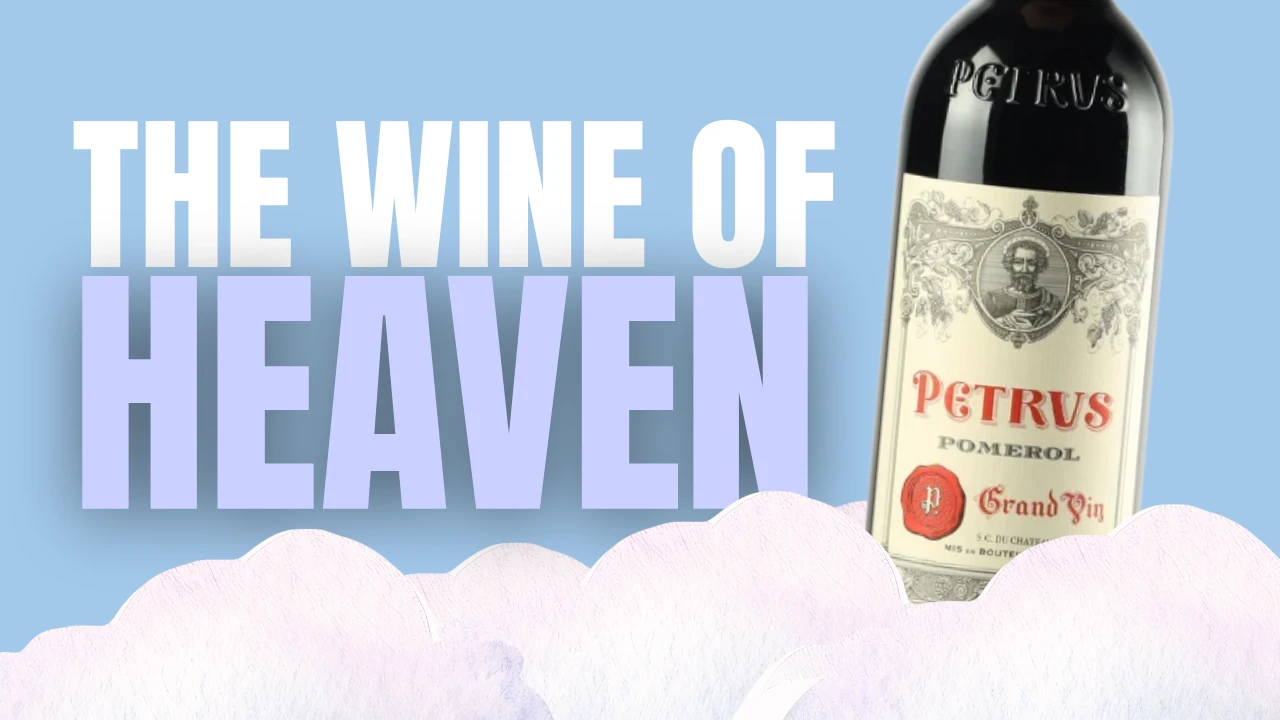
Because there is no château. Pétrus is a modest farmhouse beside the vines that you could drive past without slowing down, and nobody ever built anything grander. The label reads simply PETRUS, above POMEROL. Pétrus is the Latin for Peter, as in Saint Peter who keeps the keys to heaven; his statue stands at the estate and his image has been on the label for generations. The precise origin of the name is uncertain and most likely traces back to an old local place name.
Is Pétrus a Grand Cru Classé?
No, and it cannot be. Pomerol has never had a classification of any kind and its producers have always refused to create one. There is no 1855 list here, no Grand Cru Classé, no tiers, no revision. The wine at the very top of the Bordeaux price pyramid comes from the one serious region that never ranked anything.
What grape is Pétrus made from?
Merlot, and nothing else. The blend ran to roughly 20 percent Cabernet Franc in Madame Loubat's day and about 5 percent later, and the last of it came out at the end of 2010, so from the 2011 vintage Pétrus has been 100 percent Merlot. The cold heavy clay is the reason: it is hostile to Cabernet Sauvignon, which will not ripen properly on it, and Merlot thrives.
Why is Pétrus so expensive?
Scarcity, mostly. Eleven and a half hectares make around 30,000 bottles a year, roughly 2,500 cases, which is a fraction of a First Growth, and there is no second wine to stretch it. Add a terroir nobody can copy, a run of great vintages, and a deliberate pricing stance held since the 1940s, and a bottle averages around 4,000 euros.
What is the blue clay at Pétrus?
A raised island of dense clay, about 20 hectares across, sitting at the highest point of the Pomerol plateau some 40 metres up. Geologists call it the boutonnière, the buttonhole. The clay is smectite, formed roughly 40 million years ago, and it swells shut when wet, so it holds water deep down and releases it slowly through dry summers. Most of the buttonhole lies inside Pétrus. Clay on a hilltop is geologically odd, because clay normally washes to the bottom.
What should I drink instead of Pétrus?
Stay in Pomerol and go down the price list, because with no classification there is no official rank inflating the famous names. Lalande-de-Pomerol just north is the obvious value move, and good unclassified Pomerol is made by neighbours of Pétrus on the same plateau. Saint-Émilion next door, especially its satellites, is the other direction. You are buying Merlot grown on clay either way.