On 20 August, investigators from the Food Standards Agency’s National Food Crime Unit went to an address in Essex with the Metropolitan Police and arrested a 34-year-old man on suspicion of fraud by false representation. The allegation concerns 55 bottles of suspected counterfeit wine, sold to a single buyer for more than £500,000.
Do the division. That is over £9,000 a bottle. One person, 55 bottles, half a million pounds.
The man has been bailed and the investigation continues, so nothing here is proven and we are not going to write as though it is. Simon Ashwin, a senior investigator at the NFCU, put the principle simply: people expect to get what they pay for, not a possible fake bottle of wine.
A number worth checking before you repeat it
There have now been two separate £500,000 counterfeit wine cases in Essex in 2026, and they are already being blurred together.
In March, the NFCU seized more than 67,000 bottles of counterfeit wine and prosecco, 90 pallets of it, across three warehouses in north London and Essex. Estimated retail value: about £500,000. A 61-year-old man was arrested on suspicion of conspiracy to defraud and released under investigation. The FSA said there was no indication of a health risk, and Andrew Quinn, who heads the unit, framed it as a message to people profiting from deceiving consumers.
In August, a different case: 55 bottles, a different suspect, a different offence, and the same headline number.
Sixty-seven thousand bottles worth £500,000 works out at about £7.50 each. Fifty-five bottles worth £500,000 works out at over £9,000 each. Same county, same year, same figure in the headline, and a difference of more than a thousand times in what was actually being faked. If you see a piece that treats these as one story, it has not read either of them.
The arithmetic that explains every wine fraud ever committed
Here is the whole thing, and it takes one paragraph.
Faking a bottle of wine costs roughly the same regardless of what is on the label. You need a bottle of the right shape, a cork, a capsule, a printed label, and something drinkable inside. Call it fifty pounds if you are being careful, and a great deal less if you are not. That cost barely moves. What moves, enormously, is the price of the name you put on the front.
So the profit on a fake is essentially the price of the wine. At £12 a bottle, the margin is not worth the risk of a criminal record. At £9,000 a bottle, one afternoon’s work is a house deposit.
This is why wine fraud lives almost entirely at the top of the market, and why it always has. The March case is the interesting exception, and note how it had to work: to make mass-market forgery pay at all, you need 67,000 bottles and three warehouses, which is a logistics business with a fraud attached. The August case needed a suitcase.
The famous ones worked exactly the same way
Rudy Kurniawan is the case everybody knows. Through the 2000s he was one of the biggest buyers and sellers in the American fine wine auction world, and he was blending wine in the kitchen of his Los Angeles house, corking it, and applying labels he had printed himself. He was convicted of fraud in December 2013 and sentenced to ten years in 2014, ordered to forfeit $20 million and pay $28.4 million in restitution, and eventually deported to Indonesia.
What undid him was not chemistry. It was a catalogue. He offered vintages of Domaine Ponsot’s Clos Saint-Denis going back to the 1940s, and Laurent Ponsot knew perfectly well that his family had not made that wine until 1982. Ponsot flew to New York and had the lots pulled from the sale. The fraud survived years of expert tasting, and died the moment somebody checked a date.
Hardy Rodenstock and the Jefferson bottles are the older, stranger case: bottles engraved “Th.J.” and dated 1787, said to have belonged to Thomas Jefferson, one of which sold at Christie’s in 1985 for £105,000, then the most expensive bottle ever. The billionaire collector Bill Koch bought four, could not verify them, and spent years and a lot of money in court over it. Analysis of the engraving pointed at a modern power tool rather than an eighteenth-century hand.
Both frauds ran for years among the most experienced palates in the world. Neither was caught by tasting.
How fakes actually get caught
Since tasting does not do it, the trade relies on things that are harder to argue with:
Provenance. The single most powerful check there is. Where has this bottle been since it left the estate, and who can prove it? An unbroken chain of custody is worth more than any expert opinion, which is exactly why fraudsters invest so heavily in inventing one.
The physical bottle. Glass seams, punt shape, capsule embossing, the branding on the cork, the paper stock and print process of the label. Estates change these details over time, and a forger has to get every one of them right for the specific vintage claimed.
The date, checked against reality. Did this producer make this wine in this year? Did they use this label design? Was the wine even in bottle by then? This is unglamorous and it catches more fakes than anything else, as Laurent Ponsot demonstrated.
Caesium-137. The elegant one. Atmospheric nuclear testing from the mid-1940s onward left a trace of caesium-137 in everything grown since, including grapes. A wine genuinely bottled before 1945 should contain none. Low-background gamma spectrometry, developed for this by physicists in Bordeaux, can measure it through the glass without opening the bottle. It cannot tell you the wine is Lafite, but it can tell you it is not from 1787.
What any of this means if you are a normal person who likes wine
Almost nothing, and that is the point worth ending on.
If you spend fifteen or thirty or even sixty euros on a bottle, you are not in this market and nobody is coming for you. The economics do not work. The entire fraud industry is a tax on a very small number of people buying labels rather than wine, usually without opening them, frequently to resell.
And that is the uncomfortable bit. Wine fraud is not really a crime against wine. It is a crime that only becomes possible once a bottle’s value has floated free of what is inside it. When a wine is worth £9,000 because of the four words on the label, the four words are the product, and anybody who can print four words is in business. A wine that is worth twelve pounds because it tastes like twelve pounds of pleasure cannot be counterfeited profitably, because there is nothing to counterfeit except the wine itself.
Every fake in history has been an argument for drinking rather than collecting. We have never needed a better one.
“I find these stories genuinely fascinating, and I always have. There is something almost funny about a man in a Los Angeles kitchen fooling the best palates in the world with a funnel and a printer, right up until you remember what it says about how confidently people taste a label. I am going to do a YouTube video on the worst fakes and the worst moments in wine, because there are far more of them than anyone admits.” - Antoine
Sources: Food Manufacture on the August arrest, The Drinks Business on the same case, New Food Magazine on the March seizure, Food Standards Agency news
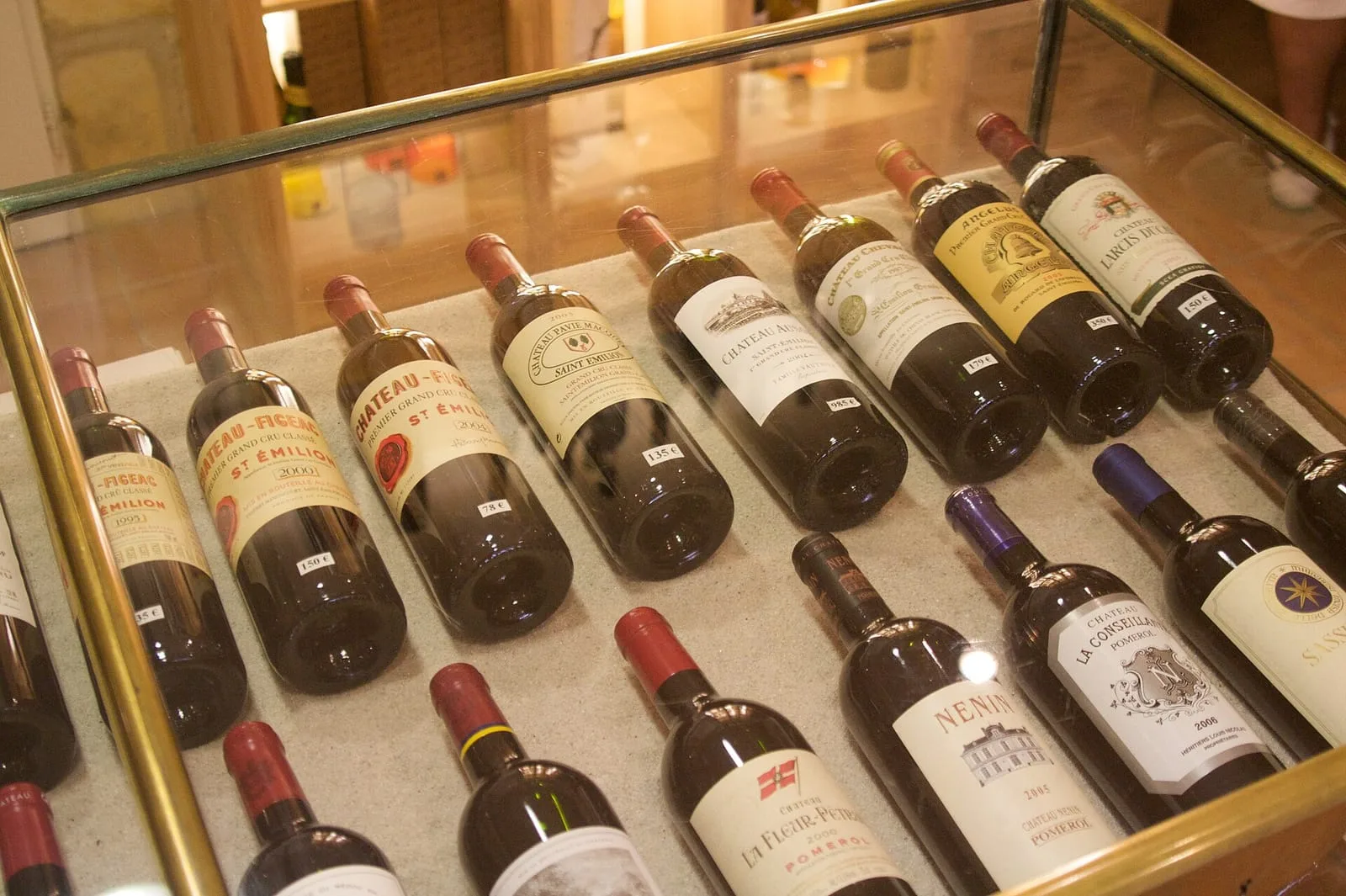
Hero photo: an assortment of Saint-Émilion and Pomerol in a retailer’s display case, by Julien Menichini, CC BY 2.0, via Wikimedia Commons. The bottles pictured are a legitimate retail display and have no connection to the case described above.