Five weeks ago we wrote that France had just made its smallest harvest since 1957, and that the first estimate was dated 1 September, before much of the country had finished picking. We said it would probably move.
It moved. The agriculture ministry’s statistics service, Agreste, published its second estimate on 7 October, based on the vineyard as of 1 October. France is now expected to make 34.9 million hectolitres, up from about 33.8 million in September. That is 2% below 2025 and 14% below the 2021 to 2025 average.
A million extra hectolitres sounds like good news after a brutal summer. Look at where it came from, and it is more complicated.
One region did almost all of it
In September, Agreste had the Languedoc-Roussillon at 9.58 million hectolitres, up 5% on 2025. In October, it has it at 10.59 million, up 20%.
That is an upward revision of about 1 million hectolitres in a single region. The national figure went up by about 1.1 million. In other words, nearly the whole revision is the Languedoc, and the rest of France barely changed.
A few things explain it:
- The late-summer rain. It arrived in time to fill out grapes in the south that had looked stuck in August.
- Different vineyard work. Jérôme Despey, a grower in the Hérault who chairs FranceAgriMer’s wine council, said growers had stripped fewer leaves and trimmed less, so the canopy shaded the bunches through the heat.
- Yields, not hectares. The region actually has about 5,000 fewer hectares in production than last year, down 3%. All of the gain is per-vine.
The result is lopsided. The Languedoc-Roussillon made roughly 30% of all French wine this year, against about a quarter in 2025. Take it out and the rest of France is down around 9% on last year.
Despey’s own summary was that he had never seen this much variation between regions in one vintage. On these numbers it is hard to disagree.
Why more wine is not good news down there
This is the uncomfortable part. The Languedoc did not need more wine in 2026. It needed buyers.
We wrote two weeks ago about Roussillon losing 47% of its sales and four co-operatives. The region has spent several years pulling up vines, much of it with public money, to shrink a surplus. A harvest back at its five-year average, in a market that is still contracting, puts the region right back where it was trying to leave.
The breakdown matters here. The region’s AOP wines are up 18%, to 1.93 million hectolitres, but that is a small slice of the 10.59 million. Most of the increase is IGP and wine without a geographical indication, the everyday categories, which is where prices are under the most pressure. Agreste’s national figure for IGP is up 11%, mostly from this one region.
So when you see “France’s harvest revised upward”, read it as “the south has more of the cheapest wine at the moment it is hardest to sell”. That is not a recovery. It is the same problem with a better-looking total.
The rest of the map barely moved
The other regions we have been following held roughly where September left them:
- Champagne is unchanged at 1.34 million hectolitres, down 48% on 2025. Its reserve system means you will not see that on the shelf, as we explained in September.
- Bordeaux slipped very slightly, from 3.52 to 3.50 million hectolitres, still up about 10% on its terrible 2025 and still below its average.
- Burgundy and Beaujolais went from 1.43 to 1.48 million hectolitres.
A note on that Burgundy figure, including our own
The Burgundy number deserves a warning, because the percentage moved far more than the wine did.
In September, the region was reported down 33% on 2025. In October, it is down 22%. But the actual volume only rose by about 50,000 hectolitres, around 3.5%. You cannot get from minus 33% to minus 22% with a 3.5% change in volume, so the 2025 figure being used as the comparison must have changed between the two tables, or the two percentages are being measured against different years.
We quoted the 33% in our piece on Burgundy asking growers to hold their prices. The volume behind it has not really changed, and the story has not either: Burgundy is short, and short against a five-year average it was already struggling to meet. Agreste now puts that gap at about 30%. When percentages jump around like this, trust the hectolitres.
What it means for what you pay
Very little has changed since September, and that is the point.
- Everyday Languedoc and Pays d’Oc are not going to get more expensive because of a “small French harvest”. In that part of the market there is more wine, not less.
- Burgundy is still where a short crop meets demand that has not gone away, which is why the interprofession is pleading for restraint.
- Champagne and Bordeaux are cushioned, by reserves in one case and a long-running surplus in the other.
The national headline, smallest in decades, revised up, will keep being quoted as if it describes one country. It describes at least two: a north that lost a lot of wine, and a south that made a normal amount and cannot sell it.
What we are watching
The final harvest declarations in November and December, which replace these estimates with what growers actually declared. And in the Languedoc, whether this year’s volumes bring back calls for crisis distillation, which would tell us more about the market than any harvest figure.
Sources: Vitisphere on the revised forecast, Vinabox on the Agreste 1 October table, Agri Mutuel on the regional contrasts, Réussir Vigne on the September estimate
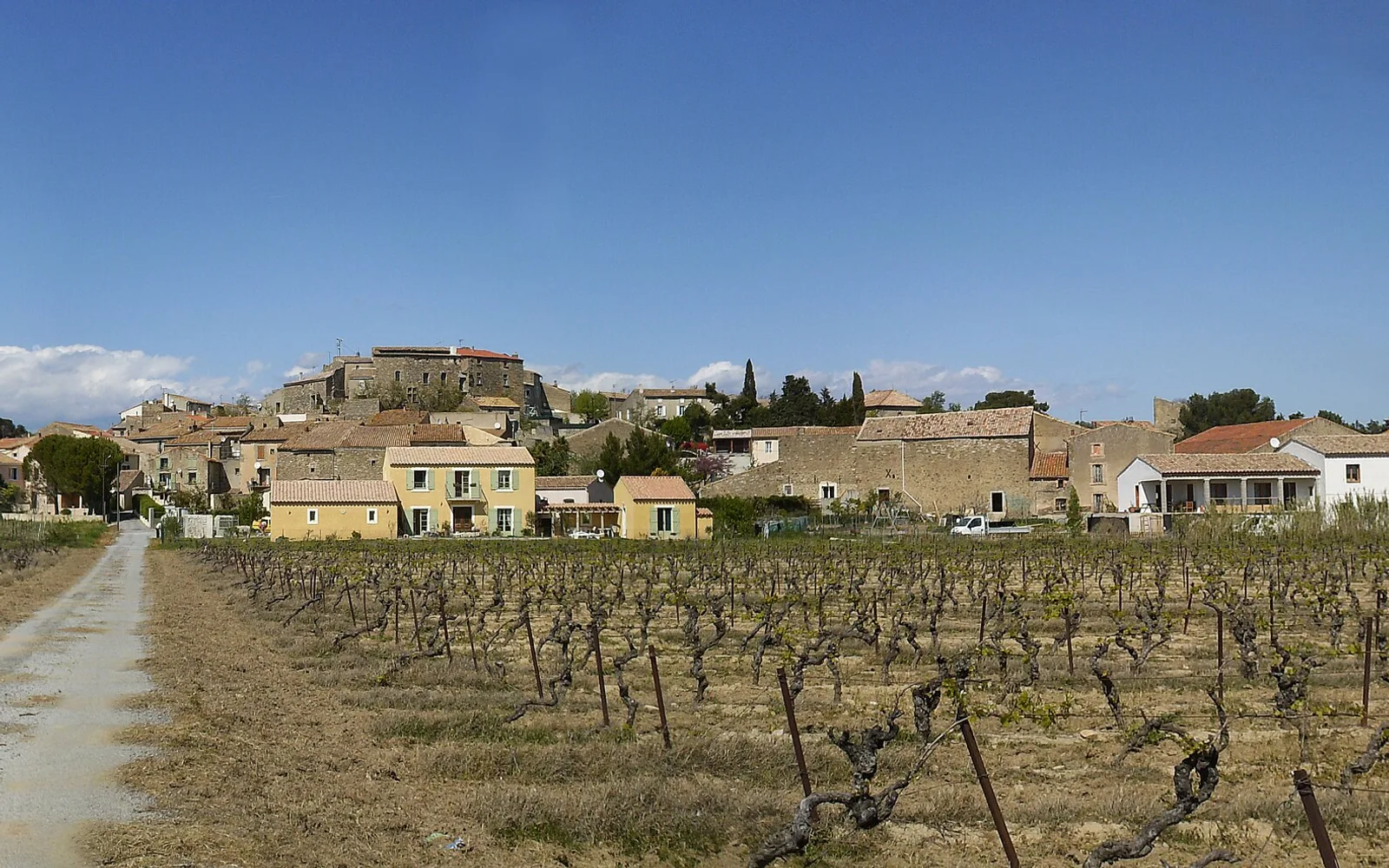
Hero photo: Pouzols-Minervois seen from the chemin de l’Horte, by Chnarlok, CC0, via Wikimedia Commons.