Three weeks ago we wrote about France’s smallest harvest since 1957 and said that Burgundy was the region to watch, because it is the one place where the harvest number and the shelf price are most directly connected. Small crop, no reserve system, demand that has not fallen anywhere near as fast as supply. We said the 2026s were going to hurt when they arrived.
On 23 September the Bureau Interprofessionnel des Vins de Bourgogne held a press conference and said something we did not expect.
Co-presidents Michel Barraud and Laurent Delaunay confirmed the crop is down roughly 30% against the five-year average, then asked their own producers not to put their prices up.
That is not what Burgundy normally does
It is worth sitting with how unusual this is. Burgundy is the region that has spent two decades proving that scarcity is a business model. A short vintage has historically been a reason to raise the release price, because the allocations will clear anyway and the merchant list is longer than the supply.
The interprofession asking growers to stay “reasonable” in a year they lost a third of the crop is close to an admission that the model has a ceiling, and that they think they found it.
Delaunay was explicit about why. The reference is 2021, the frost year, when Burgundy put prices up into a short vintage and lost market share for it. His point, roughly: we have been burned by that experience, because we raised prices and we lost placements.
Losing a placement is not the same as losing a sale. A sale comes back next year. A listing that a restaurant or an importer drops, and fills with something from the Jura or the Loire or Oregon, does not come back just because you have wine again. That is the lesson, and it is a more honest read of the market than most regions manage in public.
How big is the hole, actually
Careful with this number, because three different versions of it are circulating.
The BIVB figure is around 30% below the five-year average, and it is explicitly provisional. The official volume lands in mid-November.
Agreste, the French agriculture ministry’s statistics arm, put Burgundy and Beaujolais together down 33% in its 7 September estimate. That is a different scope, since Beaujolais is in there, and a different baseline.
So “Burgundy is down a third” is roughly right, and anyone quoting a precise figure before mid-November is quoting an estimate made while the grapes were still being picked. The shape is not in doubt. Burgundian Pinot Noir took the worst of it, hit by hail, then heat, then drought, in that order.
Will the growers actually listen
This is where we would caution against reading the press conference as a decision.
The BIVB is an interprofession, not a regulator. It can publish an estimate, run the generic marketing and make a recommendation. It cannot set a price, and it has no mechanism to stop a domaine in Chambolle deciding that 2026 is the year to go up 15%.
The request will land very differently depending on who you are:
- A grower selling to a négociant mostly does not control the final price anyway. The bulk market will do what the bulk market does.
- A co-operative or a large family domaine with distributors to keep happy has a real commercial interest in holding, because those are exactly the placements that were lost in 2021.
- A small, allocated, waiting-list domaine has no such pressure. Their wine sells out regardless, and a public appeal for restraint is not going to bind them.
So the most likely outcome is the one that is least satisfying to write about: the wines you can already barely get go up anyway, and the wines competing for shelf space hold. Which means the BIVB’s appeal mostly works where prices were not the problem, and mostly fails where they were.
What it means for what you pay
If you drink village Burgundy and regional Bourgogne, this is genuinely good news, and we would not have predicted it three weeks ago.
The honest version of our September piece was that village Burgundy was going to keep getting harder to justify. That still holds as a direction of travel, because the structural problem has not changed: the crop is small, the vineyard cannot expand, and the world has not stopped wanting Pinot Noir and Chardonnay. But an interprofession publicly asking for restraint is a real signal that the people selling it have noticed drinkers walking away, and that is the only thing that has ever disciplined a wine price.
The practical read for the next twelve months:
- Bourgogne regional and village whites are where the appeal has the best chance of holding, because that is the tier that competes directly with Chablis, the Mâconnais, the Loire and everything outside France. It is also the tier that loses listings first.
- Village and premier cru reds are the ones to expect movement on anyway. Pinot Noir lost more than half its crop in places.
- Grand cru is its own economy and has nothing to do with this conversation.
And the broader point we keep coming back to: if a region you love starts asking its own producers to hold the line, that is not weakness. That is a region that would rather be drunk than admired. We will take that every time.
What we are watching
The official November figure, and whether it confirms the 30%.
Then the 2026 price lists, which start circulating from late winter. The BIVB has made a public request, which means there is now a public record to check it against. We will check it.
Sources: Vinabox on the BIVB press conference, Bureau Interprofessionnel des Vins de Bourgogne, Vitisphere on the 2026 French harvest
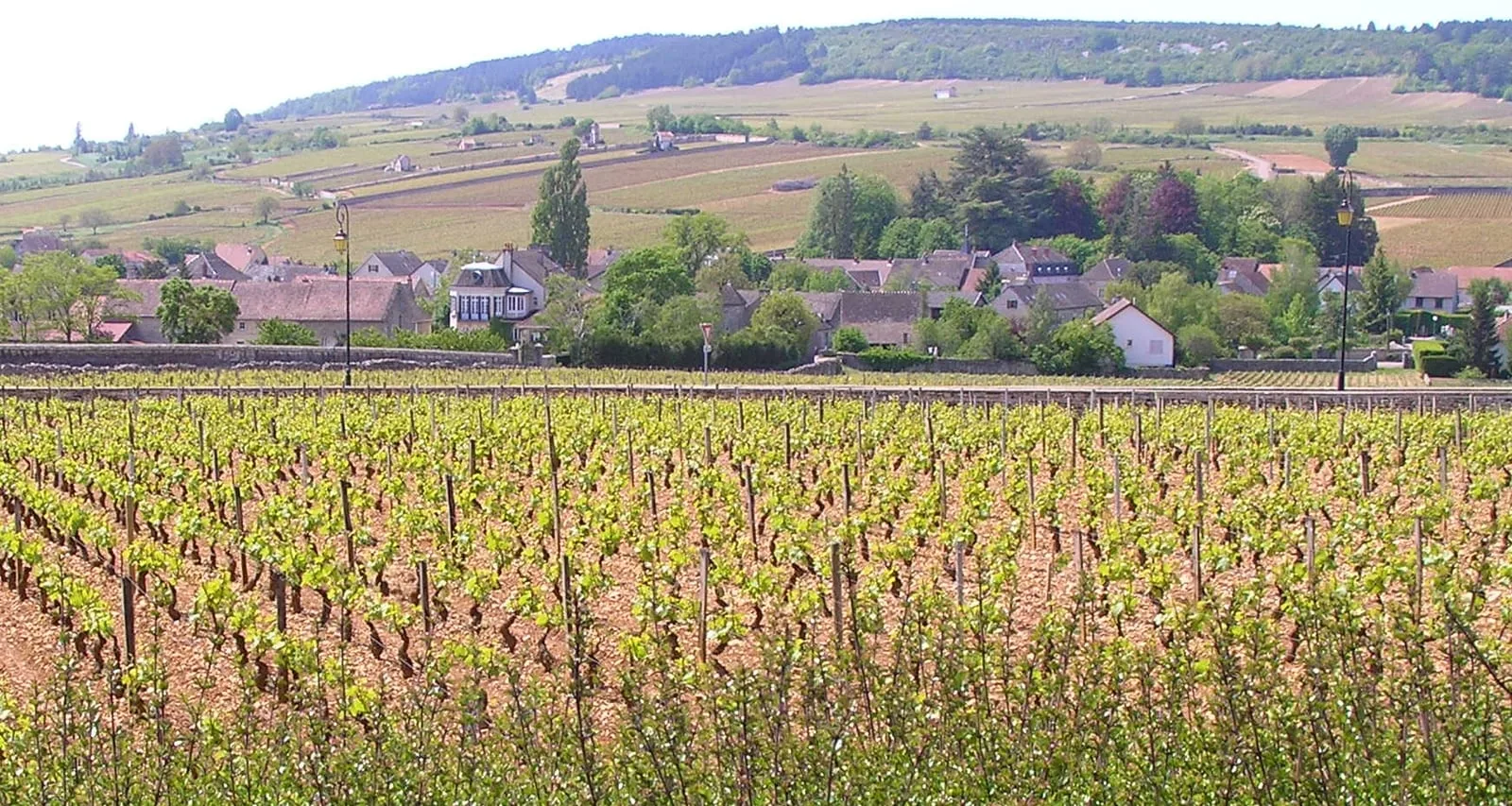
Hero photo: the village of Meursault on the Côte de Beaune, by Gavin Sherry, public domain, via Wikimedia Commons.