While the wine trade spent September arguing about Burgundy’s allocations and whether Champagne can legally reach 15% alcohol, the Chambre d’agriculture of the Pyrénées-Orientales published a set of numbers that got almost no coverage in English.
Roussillon has sold 47% less wine across eight campaigns, from 2018-19 to 2025-26.
That is 226,000 hectolitres that nobody bought. We did the conversion because the hectolitre is a unit designed to make a disaster sound administrative: it is about 30 million bottles.
Four co-operatives in twelve months
The structural number is worse than the sales number, because it is the one that does not come back.
The département went from 17 co-operative cellars to 13 in a single year. Four closed.
A co-operative is not a brand. It is the only route to market for growers who farm four, six, nine hectares and will never have a bottling line, a label designer or an export agent. When one closes, its members do not become independent winemakers. Most of them stop, or sell to a neighbour, or pull the vines out. The 2025-26 campaign alone saw cellar exits fall 17%, another 53,000 hectolitres that did not move.
The figures were presented to the regional prefect in September. The named voices around them are Jean-Christophe Bourquin at the CIVR, Guillaume Ribes for the co-operative union and Jean-Marie Fabre for the independent growers. The prefect’s response is to push for concrete cooperation between the remaining cellars and to structure a wine tourism consortium.
We are not going to be sarcastic about wine tourism. It genuinely works in some places. But a region that has lost 30 million bottles of demand is not going to recover it by improving its tasting-room signage, and everyone in that room knows it.
Why you have probably never thought about Roussillon
Here is the uncomfortable part, and it is partly our industry’s fault.
Roussillon is Catalan France. It sits against the Spanish border under the Albères and the Canigou, and it makes some of the most distinctive wine in the country:
- Banyuls and Maury, fortified reds that are one of the only genuinely great matches for chocolate, and which cost a fraction of what an equivalent port does
- Rivesaltes, including the white Muscat de Rivesaltes, an aperitif style that an entire generation stopped drinking
- Collioure, the dry red and rosé from the same terraced vineyards as Banyuls
- Côtes du Roussillon and Côtes du Roussillon Villages, old-vine Grenache, Carignan and Syrah off schist and granite, farmed on slopes nobody would plant today
Most of that is grown on terraces too steep for a machine, by people who are paid as if it were flat land. The terraced vineyards above Banyuls are among the hardest places to farm grapes in Europe.
And the market walked away for reasons that have almost nothing to do with quality. The fortified aperitif category collapsed across France as drinking habits changed. Bulk red lost its supermarket position. The region’s name means nothing to most export buyers, who read “Roussillon” and file it under Languedoc, which it is not.
The anti-snobbery reading
We write a lot about wine being over-priced. This is the opposite problem, and it is worth being clear that it is a problem.
When a region’s wine gets too cheap to farm, the response is not better value for you. The response is that the vines come out. Not the bad vines on the plain, necessarily. The expensive ones, on the slopes, that cost three times as much to work. Those go first, because they are the ones where the gap between the cost of production and the price on offer is widest.
What survives is whatever can be farmed by machine at scale. Which means the end state of a price collapse in a place like Roussillon is not cheap great wine. It is the disappearance of the great wine and the survival of the ordinary, and the ordinary was never why the region existed.
That is the thing we would want a normal drinker to take from this. A bottle being cheap is good. A bottle being cheap because the person who made it has given up is a countdown.
What to actually do about it, if you want to
This is the rare news story with a direct consumer action attached, so here it is.
- Buy a Banyuls or a Maury instead of a port this winter. They are between 15 and 30 euros for something seriously good, they keep for weeks after opening, and they are among the few wines that genuinely stand up to dark chocolate.
- Try a Collioure red if you like Grenache. Same vineyards, dry wine, and usually under 20 euros for a serious bottle.
- Look at Côtes du Roussillon Villages on a restaurant list where you would reflexively order a southern Rhône. Often half the price for the same style of warmth, and generally from older vines.
None of that fixes a 47% collapse. But it is the honest answer to the question of what one person can do, and it is a better glass of wine than the thing you were going to order anyway.
What we are watching
Whether the co-operative count holds at 13. Two cellars merging is consolidation. Two more closing is a different trajectory, and the gap between those outcomes is roughly one more bad campaign.
And whether any of the English-language wine press picks this up. Roussillon lost nearly a quarter of its co-operatives in a year and it did not make a single front page we saw. The regions that get covered are the ones with expensive wine to write about, which is exactly backwards from where the news is.
Sources: Vitisphere on the prefect’s plan for Roussillon, Vinabox on the Chambre d’agriculture figures, Conseil Interprofessionnel des Vins du Roussillon
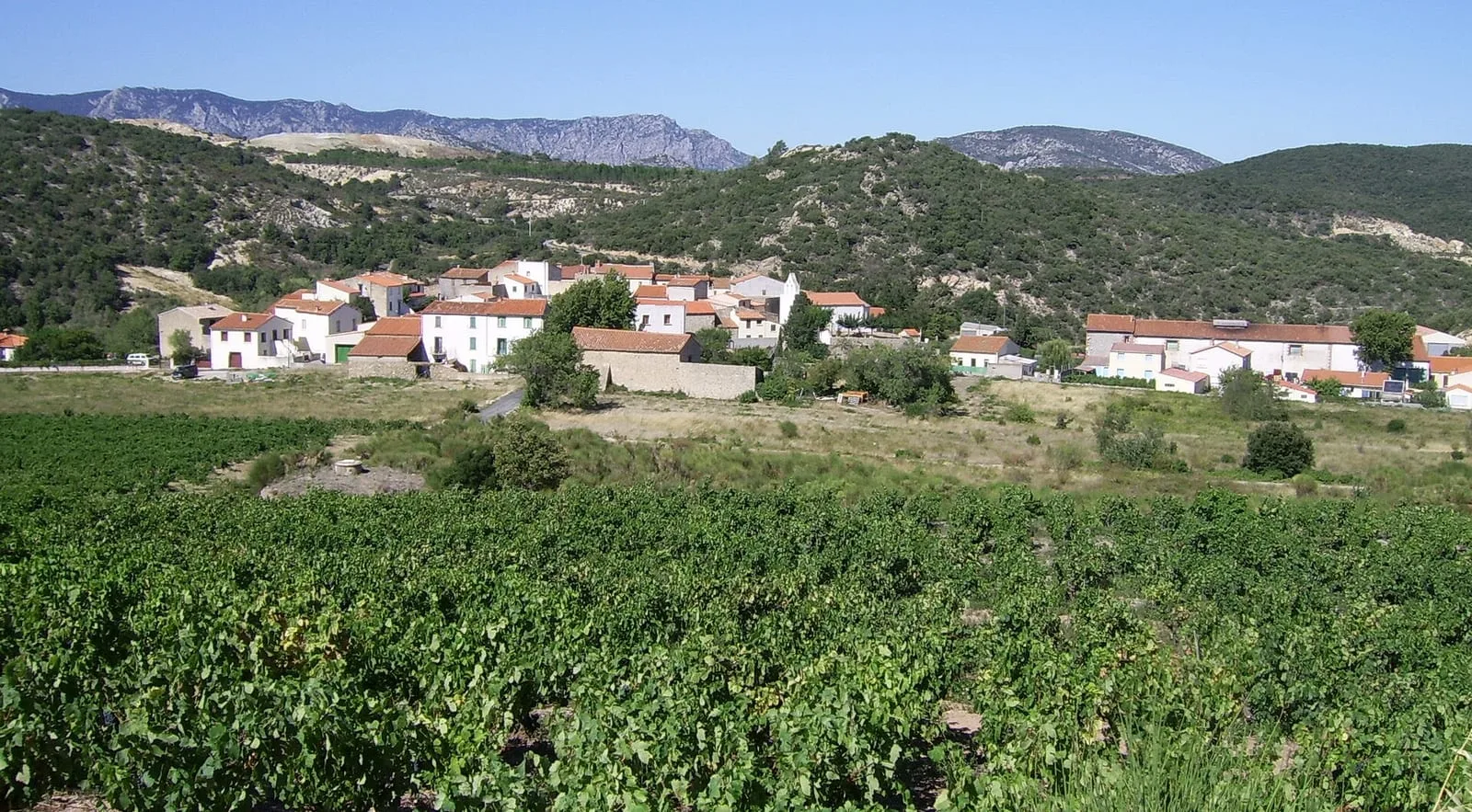
Hero photo: the village of Lansac in the Pyrénées-Orientales, by Babsy, public domain, via Wikimedia Commons.