On 21 November, Bonhams will sell twenty lots of Liber Pater in Hong Kong, straight from the estate’s own cellar. The sale marks the estate’s twentieth anniversary, and it is the first time Loïc Pasquet has opened his private reserves to collectors directly.
The lot making the headlines is a single 27-litre bottle of the 2019, signed by Prince Albert II of Monaco. Bonhams has estimated it at HK$6 million to HK$9 million, and the trade press has rounded the top of that range into “could fetch $1.15 million”.
We sat down with Loïc for episode 20 of the podcast back in 2020. So before the number takes over, here is what that bottle actually is, and why we think the price is the least interesting thing about it.
First, the number
The $1.15 million is the top of a pre-sale estimate converted into US dollars. Nothing has sold yet. Estimates are set by the auction house to attract bidders, and the hammer can land well above or below them.
It also helps to divide it. A 27-litre bottle, sometimes called a Primat, holds the equivalent of 36 standard 75 cl bottles, or roughly 216 glasses (our bottle-size guide has the full table). Spread across 36 bottles, the estimate works out at about US$21,000 to US$32,000 per bottle.
That is not a spike. Liber Pater released its 2015 at €30,000 a bottle back in 2019, so this estimate sits in the same territory the estate has asked for years. The giant bottle, the prince’s signature and the anniversary are the packaging. The underlying price is the one Liber Pater already charges.
The rest of the sale follows the same logic: seven groupings themed on the seven virtues and the seven deadly sins, each holding nine to thirteen standard bottles of red and white from 2006 to 2019.
Why it costs that much
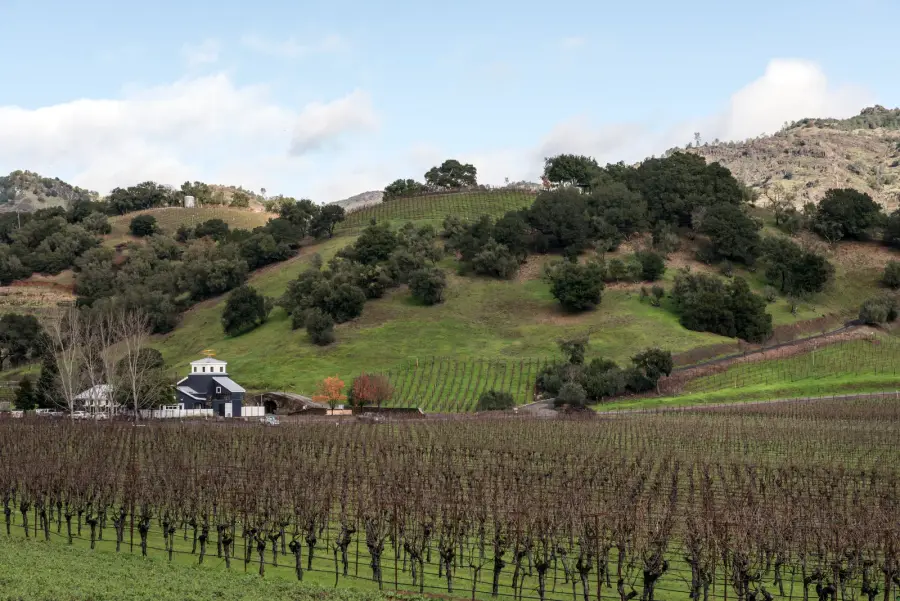
Liber Pater makes about 500 bottles a vintage from roughly a hectare in the Graves, at Landiras. Collectors are paying for that scarcity and the story behind it, not for anything a bottle of Bordeaux needs to cost to make.
When we asked Loïc how he sells something that rare, he described a network of ambassadors placing between 10 and 24 bottles per country, and barely using the négoce at all, because, in his words, the trade “sell scores more than a story or a place”. Whatever you think of the price, the model is consistent with that: tiny volumes, direct to people who already know the wine.
The part that matters
Here is what the headlines skip. Liber Pater exists to answer a question that is genuinely worth asking: what did Bordeaux taste like before phylloxera?
From the 1860s, an aphid from North America destroyed most of Europe’s vineyards. The fix was to graft European vines onto American rootstocks that resist it, and almost every vine in France is still grafted today. Loïc’s argument, when we met him, was that something was lost along the way. Bordeaux went from around twenty grape varieties down to a handful, and the ones that survived were chosen for yield and alcohol.
So he did something nobody else in Bordeaux was doing. He planted ungrafted vines, on their own roots, and brought back varieties that had almost disappeared from the region: Tarnay, Castets, the old “petite vidure” on the gravel. Because those grapes are not in the rulebook for the Graves appellation, the wine is sold as Vin de France, the most basic category on a French label. The most expensive wine in Bordeaux is not, legally, allowed to call itself Bordeaux.
The line from that conversation we keep coming back to is this one: when a whale washes up on a beach, everyone agrees it is a catastrophe, but “unlike a whale, a taste can’t be seen when it disappears.”
You do not have to buy his prices to take that seriously. Lost grape varieties and lost ways of growing vines are a real loss, and most of the time nobody notices.
A fair word of caution
Whether ungrafted vines make better wine is still debated. There is no clean scientific answer, partly because ungrafted vineyards tend to be old, low-yielding and farmed with obsessive care, so it is hard to separate the roots from everything else. The honest version is that Liber Pater is a fascinating experiment with a very loud price tag, not proof.
You can taste the idea for €20
This is the bit we care about most. You do not need a 27-litre bottle to find out what own-rooted vines taste like. Phylloxera never took hold in some places, usually because of sandy or volcanic soil, and their wines are on normal shelves:
- Etna, Sicily. Plenty of old vines here grow on their own roots in volcanic sand. Loïc’s own recommendation to us was Tenuta delle Terre Nere, whose Etna Rosso usually sits around 20 to 30 euros.
- Santorini, Greece. Assyrtiko grown in woven basket-shaped vines on volcanic soil where the aphid never established itself. Expect roughly 25 to 40 euros.
- Colares, Portugal. Ramisco vines planted deep in sand dunes by the Atlantic. Tiny production and a little harder to find, usually somewhere around 30 to 40 euros.
- Chile. The country largely escaped phylloxera, so most of its vines are ungrafted. An old-vine País from the south can cost under 15 euros.
None of those will taste like Liber Pater. All of them will tell you more about what grafting changed than reading about a $1.15 million bottle ever will. Like Pétrus, Liber Pater is worth understanding even if you never drink it. The difference is that the idea behind this one is available for the price of a Tuesday bottle.
What we are watching
The hammer price on 21 November, obviously. But mostly whether the attention brings anything back to the vineyard: more growers allowed to plant forgotten varieties, and an appellation system that makes room for them instead of pushing them out to Vin de France.
Sources: Vino Joy News on the Bonhams sale, Bonhams Hong Kong, Vitisphere on the €30,000 2015 release
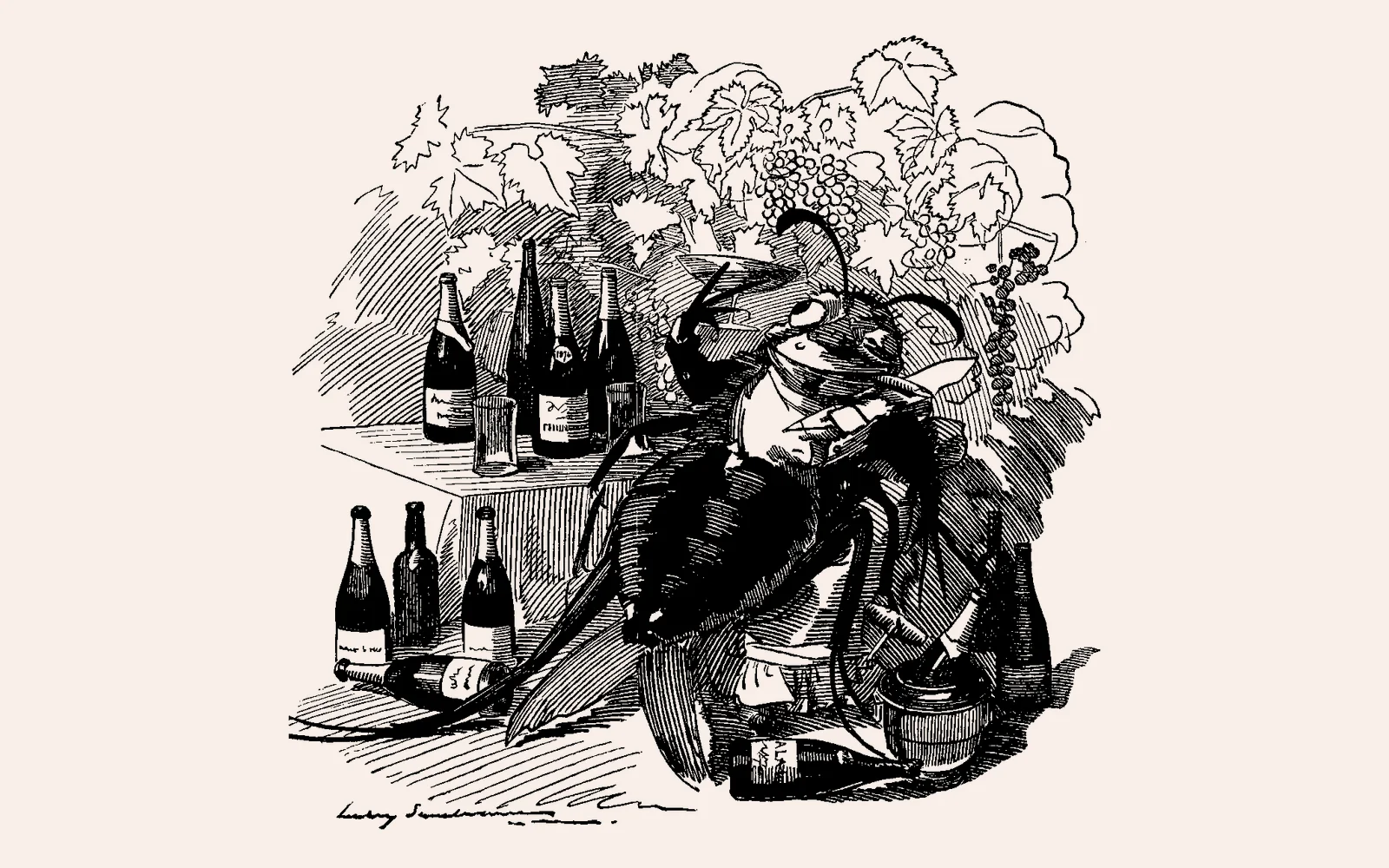
Hero illustration: “The Phylloxera, a true gourmet, finds out the best vineyards and attaches itself to the best wines”, by Edward Linley Sambourne for Punch, 6 September 1890, public domain, via Wikimedia Commons.