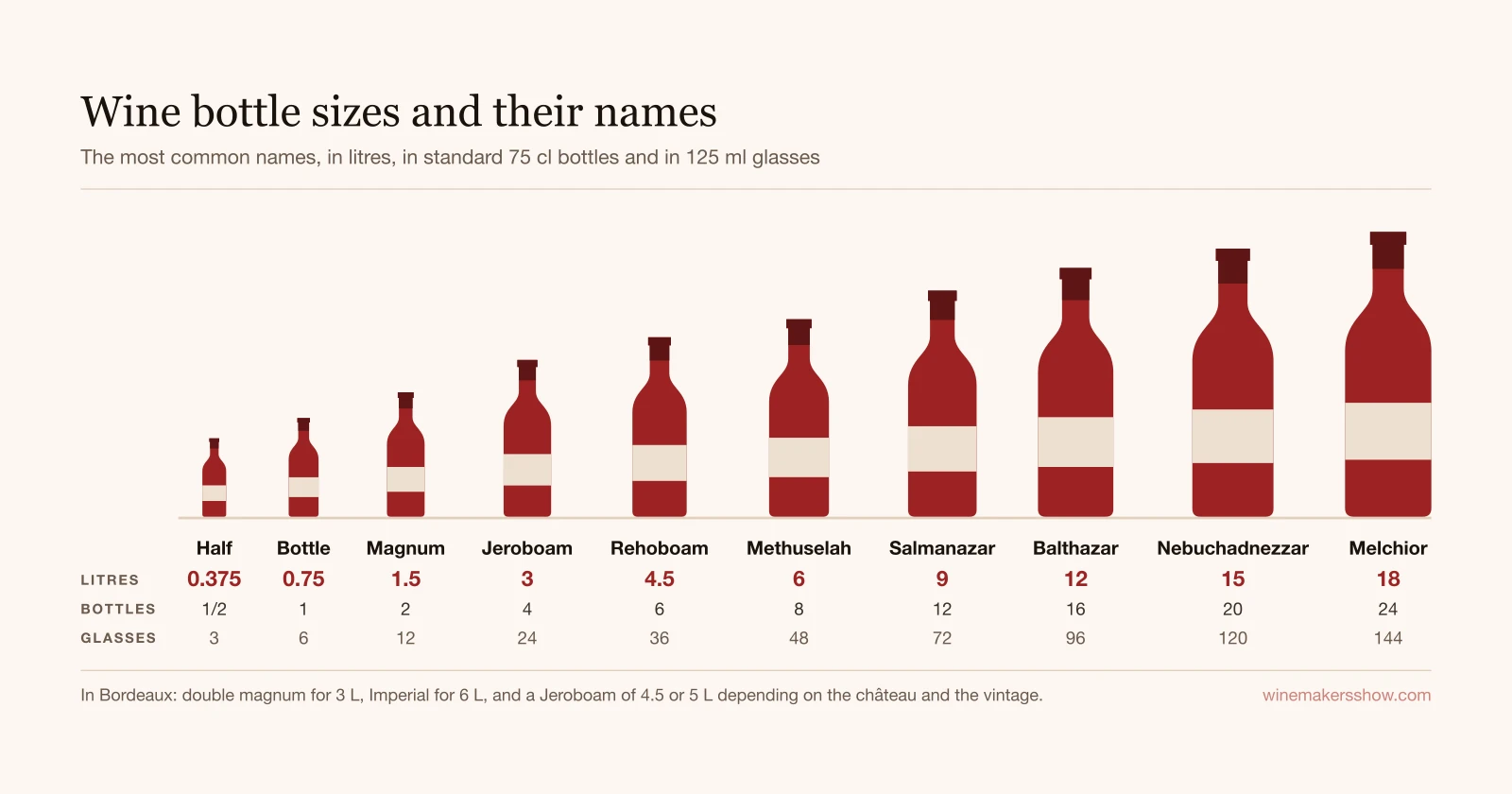
A standard bottle of wine holds 75 cl, or 750 ml. Above it come the magnum (1.5 litres), the Jeroboam (3 litres), the Rehoboam (4.5 litres), the Methuselah (6 litres), the Salmanazar (9 litres), the Balthazar (12 litres), the Nebuchadnezzar (15 litres) and the Melchior (18 litres), which Champagne itself calls a Salomon. Those are, give or take, the Champagne and Burgundy names. Bordeaux has its own, and we get to them below.
Looking for one size in particular? The chart has the main formats, and the questions people ask most, from how many bottles are in a magnum to what a 6 or 10 litre bottle is called, each get a short answer underneath.
Wine bottle sizes and names: the chart
| Name | Capacity | Standard 75 cl bottles | 125 ml glasses |
|---|---|---|---|
| Piccolo, split or quarter | 20 cl | about 1/4 | 1 to 2 |
| Chopine (traditional French name) | 25 cl | 1/3 | 2 |
| Half bottle or demi | 37.5 cl | 1/2 | 3 |
| Clavelin (vin jaune) | 62 cl | about 0.8 | 5 |
| Bottle | 75 cl | 1 | 6 |
| Magnum | 1.5 litres | 2 | 12 |
| Jeroboam | 3 litres | 4 | 24 |
| Rehoboam | 4.5 litres | 6 | 36 |
| Methuselah | 6 litres | 8 | 48 |
| Salmanazar | 9 litres | 12 | 72 |
| Balthazar | 12 litres | 16 | 96 |
| Nebuchadnezzar | 15 litres | 20 | 120 |
| Melchior or Salomon | 18 litres | 24 | 144 |
| Sovereign | 26.25 litres | 35 | 210 |
| Primat or Goliath | 27 litres | 36 | 216 |
| Melchizedek | 30 litres | 40 | 240 |
Glasses are counted at 125 ml, the smallest standard pour in a UK bar, which gives six per bottle. At a 175 ml pour you get just over four, and at the US standard drink of 5 oz, about 150 ml, you get five. In the US the little sparkling split is usually 187 ml rather than 20 cl. The Melchior closes the usual series. Champagne’s trade body, the Comité Champagne, calls it a Salomon, while the name Melchior is most often tied to Bordeaux. Beyond it, the Sovereign (26.25 litres), the Primat (27 litres) and the Melchizedek (30 litres) are rarities.
How many bottles in a magnum?
Two. A magnum holds 1.5 litres, which is two standard 75 cl bottles, or twelve 125 ml glasses. The next size up is 3 litres, four bottles, and that is where the regional names start to disagree.
What is a 3 litre wine bottle called?
In Champagne and Burgundy it is a Jeroboam: four standard bottles, 24 glasses. In Bordeaux the same 3 litres is called a double magnum, and the name Jeroboam goes to a bigger bottle of 4.5 or 5 litres, depending on the château and the vintage. If you are buying a Bordeaux Jeroboam, check the volume on the label, not the name. And if a crossword wants a 3 litre wine bottle in eight letters, the answer is JEROBOAM. For a plain “large wine bottle”, REHOBOAM fits the same eight squares, so check a crossing letter.
What is a 6 litre wine bottle called?
A Methuselah in Champagne and Burgundy, and an Imperial in Bordeaux. Both hold 6 litres, which is eight standard bottles or 48 glasses.
One catch: a bottle is 0.75 litres, not 1 litre, so 6 litres make eight bottles, not six.
Is there a 5 litre wine bottle?
Not in the Champagne series, which goes from the Jeroboam (3 litres) to the Rehoboam (4.5 litres) and then the Methuselah (6 litres). The name you are after is probably the Bordeaux Jeroboam, which holds 4.5 or 5 litres depending on the château and the vintage.
And if your 5 litres of wine come with a tap, it is a bag-in-box, not a bottle.
Is there a 10 litre wine bottle?
Not among the classic named bottle sizes. The series jumps from the Salmanazar (9 litres, twelve bottles) to the Balthazar (12 litres, sixteen bottles). Wine sold in 10 litre volumes almost always comes as a bag-in-box.
There is no 8 litre bottle either. If the number eight rings a bell, you are probably thinking of the Methuselah, which is worth eight bottles but holds 6 litres.
A big glass jar with a narrow neck that holds 10 litres or so is a demijohn, or a carboy in American English. It is a vessel for storing or moving wine, not a named wine bottle.
What is a 4.5 litre bottle called?
In Champagne it is a Rehoboam: six bottles, 36 glasses, the same as three magnums. Bordeaux is less tidy: its Jeroboam holds 4.5 or 5 litres, so a 4.5 litre Bordeaux bottle can go by that name. And in the UK, the 4.5 litre glass jug used for home winemaking is a demijohn, which holds one imperial gallon.
Bordeaux uses different names
Bordeaux has its own names for the formats it uses most, up to 6 litres. Above that, most charts borrow the Champagne names, with one common exception: the 18 litre bottle is often called a Melchior.
| Capacity | Champagne and Burgundy | Bordeaux |
|---|---|---|
| 75 cl | Bottle | Bottle |
| 1.5 litres | Magnum | Magnum |
| 2.25 litres | no common format | Marie-Jeanne |
| 3 litres | Jeroboam | Double magnum |
| 4.5 to 5 litres | Rehoboam (4.5 litres) | Jeroboam |
| 6 litres | Methuselah | Imperial |
The Marie-Jeanne, three bottles in one, is the odd one out, and you mostly see it in Bordeaux.
This short video shows the line-up at Château Bellefont-Belcier, a Saint-Émilion estate, so it uses the Bordeaux names: double magnum for the 3 litre and Imperial for the 6 litre. Same volumes as the Jeroboam and the Methuselah, different regional vocabulary, and both are correct.
Where do the names come from?
Magnum is simply Latin for “great”. Most of the others come from the Bible:
- Jeroboam, first king of the northern kingdom of Israel after it split from Judah
- Rehoboam, son of Solomon and king of Judah
- Methuselah, the patriarch in Genesis said to have lived 969 years
- Salmanazar, after Shalmaneser V, king of Assyria
- Nebuchadnezzar, king of Babylon
- Salomon, French for Solomon, king of Israel, son of David and father of Rehoboam
- Melchizedek, king of Salem, who brings bread and wine to Abram, the future Abraham, in Genesis
Balthazar and Melchior are, by tradition, two of the Three Wise Men, though some trace Balthazar to Belshazzar, the Babylonian king of the feast in the Book of Daniel. As for who first decided to name bottles after kings and patriarchs, nobody really knows, and the stories that go round are rarely sourced.
Why wine is said to age better in magnum
It is the most widely held view among sommeliers and collectors: the same wine evolves more slowly in a magnum than in a bottle. The explanation usually given is oxygen. The cork and the small pocket of air under it are about the same on a bottle and on a magnum, for twice as much wine, so the wine gets less oxygen per litre and moves more slowly. A larger volume of wine also takes longer to follow swings in temperature.
That does not mean bigger is always better. Beyond the magnum, opinions are more divided, and the giant formats are mostly about the party. To work out when to open what you are keeping, our guide to ageing wine and when to drink it will help.
How big is a wine bottle?
A 75 cl Bordeaux bottle is around 30 cm (about 12 inches) tall and about 76 mm (3 inches) across. A Burgundy bottle is wider, around 84 mm, and a Champagne bottle close to 90 mm. Heights vary by a few centimetres with the glassmaker and the model, and an Alsace flute is slimmer and noticeably taller.
The diameter is what matters when you store wine: a shelf that takes eight Bordeaux bottles takes only seven Burgundies or six Champagnes, as we explain in what size wine cellar you actually need. For a magnum or anything larger there is no standard size, since shapes and glassmakers differ, so measure the bottle before you find it a home.
Frequently asked questions
How many bottles are in a magnum?
Two. A magnum holds 1.5 litres, the same as two standard 75 cl bottles, which pours twelve 125 ml glasses.
What is a 3 litre wine bottle called?
A Jeroboam in Champagne and Burgundy, the equivalent of four standard bottles or 24 glasses. Bordeaux calls that size a double magnum and uses the name Jeroboam for a bigger bottle of 4.5 or 5 litres, depending on the château and the vintage.
What is a 6 litre bottle of wine called?
A Methuselah in Champagne and Burgundy and an Imperial in Bordeaux. It holds the equivalent of eight standard 75 cl bottles, or 48 glasses of 125 ml.
Is there a 10 litre wine bottle?
Not among the classic named bottle sizes: the series goes from the Salmanazar at 9 litres to the Balthazar at 12 litres. Wine sold in 10 litre volumes almost always comes as a bag-in-box, and a 10 litre glass jar with a narrow neck is usually a demijohn.
How many glasses of wine are in a bottle?
Six 125 ml glasses in a standard 75 cl bottle. At a 150 ml pour, close to the 5 oz US standard drink, you get five, and at a 175 ml pour just over four.
What is the largest wine bottle size?
The largest of the traditional named sizes is the Melchizedek, at 30 litres or 40 standard bottles, and it is rare. The 18 litre Melchior, which Champagne calls a Salomon, closes the usual series, and the Sovereign (26.25 litres) and the Primat (27 litres) sit between it and the Melchizedek. One-off giant bottles, some with names of their own, sit outside the series.