There is one question that settles most of this category, and it is not about wine at all.
Does the room your cabinet lives in ever get properly warm?
If the answer is no, a thermoelectric unit is quieter, stiller and cheaper. If the answer is yes, a thermoelectric unit will let you down in August, and you want a compressor.
Everything else is detail. Here is the detail.
How each one actually works
A compressor cabinet is a small refrigerator. There is a refrigerant, a compressor to pressurise it, a condenser to dump heat outside the cabinet and an evaporator to absorb it from inside. It is the same cycle as the fridge in your kitchen, scaled down and set to run much warmer.
A thermoelectric cabinet has no refrigerant and no moving parts in the cooling path at all. It uses a Peltier module: a solid-state plate that gets cold on one face and hot on the other when you pass current through it. A fan blows the heat away from the hot side. That is the whole mechanism.
That difference in mechanism produces every difference in behaviour.
The difference that decides it
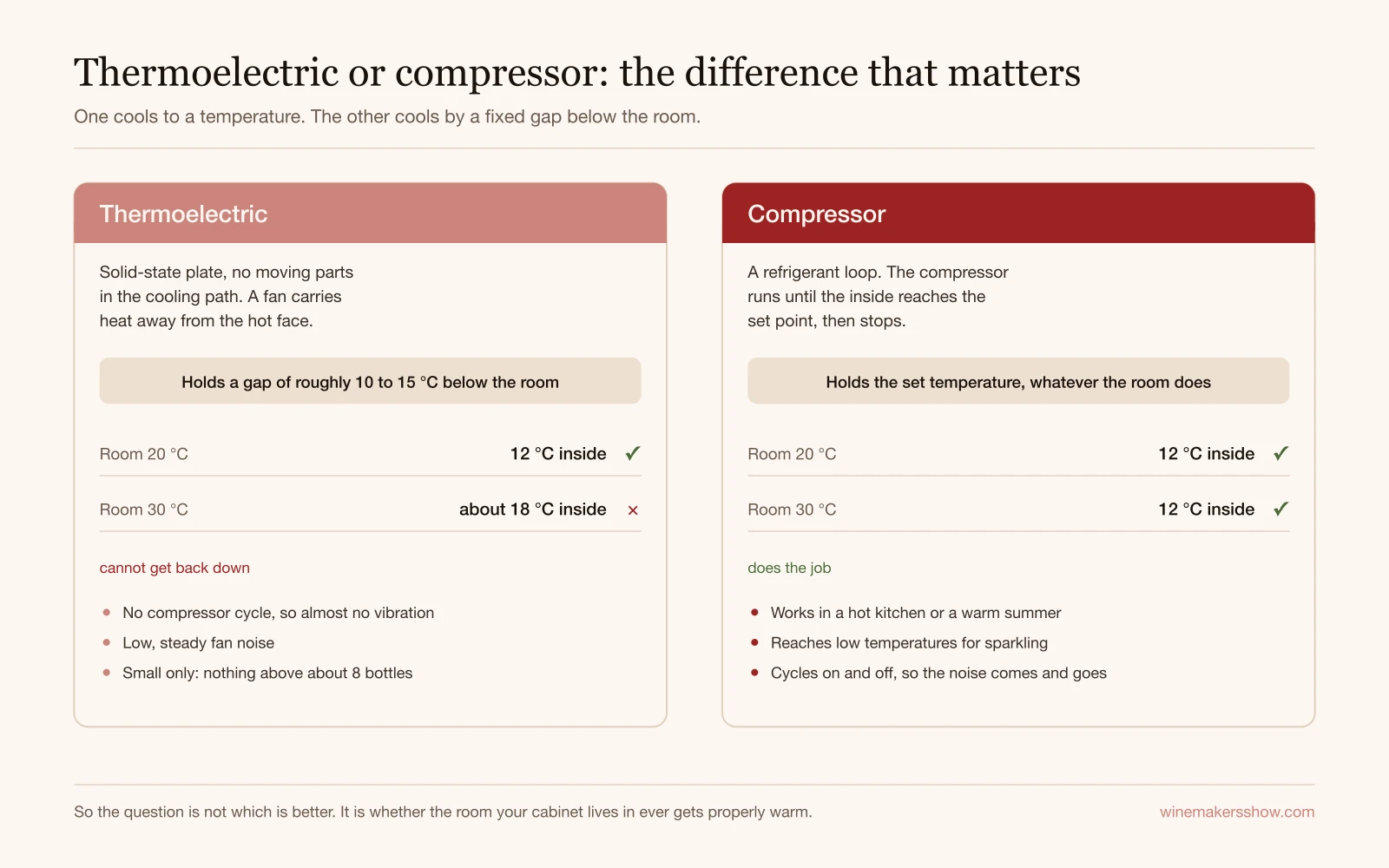
A compressor cools to a temperature. It runs until the inside reaches the set point, stops, and starts again when it drifts. Within the ambient range it is rated for, it does not much care how warm the room is.
A thermoelectric unit cools by a difference. It maintains a gap below the surrounding air, and that gap is roughly 10 to 15 degrees. It cannot choose to work harder.
Follow that through. In a 20 degree living room, a thermoelectric cabinet holding 8 degrees below ambient is sitting at a perfectly respectable 12 degrees. In a kitchen that hits 30 degrees during a heatwave, the same cabinet is now holding something closer to 18, and it has no way to get back down. It is not broken. It is doing exactly what it was designed to do, in a room it was not designed for.
And a heatwave is precisely the week your wine most needs the cabinet to hold.
This is why the honest rule is about the room, not about the wine.
What each one is good at
Thermoelectric wins on stillness. No compressor means no compressor cycle, which means effectively no vibration. Vibration is the specification nobody publishes and the real difference between a wine cabinet and a fridge, so a machine that structurally cannot produce it has a genuine advantage. If the cabinet is going in a bedroom, a study or a small flat where you will hear everything, this matters.
Thermoelectric wins on constancy of noise. The fan hum is low and steady. Some people find that far easier to live with than a compressor that is silent for twenty minutes and then audible for five.
Compressor wins on capability. It holds its set point in a warm room, it can reach genuinely low temperatures for sparkling, and it can cool a large volume. That is why nothing large is thermoelectric.
Compressor wins on scale. Cooling power from a Peltier module does not get cheaper as you make it bigger, so thermoelectric stops being economic quickly.
You can see that split in the market rather than take my word for it. In the Amazon US best sellers for wine cellars on 9 September 2026, every unit in the top thirty whose listing named thermoelectric cooling held eight bottles or fewer. Every unit of twelve bottles or more was a compressor. Nobody sells a 50-bottle thermoelectric cabinet, because it would not work.
What neither one tells you
Two things are missing from every specification sheet in this category, and they are the two that decide whether you are happy in three years.
Vibration. No manufacturer publishes a figure, for either technology. Thermoelectric has essentially none by construction. Compressor units vary, a lot, and the spec sheet will not tell you which one you are getting.
Stability. The number on the dial is not the number in the cabinet, and what matters for wine is the swing, not the setting. A cabinet holding a steady 14 degrees keeps wine better than one oscillating around 12. Nobody publishes drift either. We go into this in the buying guide.
The decibel figures that are published are manufacturer claims, not independent measurements, and they describe a machine sitting still in a test room rather than one in your kitchen with a full load and the door being opened.
So which should you buy
Buy thermoelectric if the cabinet is going somewhere quiet, you want fewer than about a dozen bottles, and the room stays under roughly 25 degrees all year. Bedroom, study, home office, a cool corner of a flat. See the mini cellar guide for what fits.
Buy compressor if the cabinet is going in a kitchen, a garage, a conservatory or anywhere that gets hot, or if you want more than a dozen bottles, or if you are storing rather than serving. That is most people.
Buy compressor if you are ageing wine, without exception. An ageing cabinet has to hold one temperature for years through every summer it meets, and a technology that gives up when the room gets warm cannot do that job.
One practical note for compressor units: they need to stand upright for a day before you first switch them on, so the oil settles back into the compressor after transport. It is in most manuals and almost nobody reads it.
If you want the shortlist rather than the theory, the current models are here, and the full set of criteria is in the wine cellar buying guide.
Frequently asked questions
Is a thermoelectric or a compressor wine cooler better?
Neither is better in general, they fail in different places. Thermoelectric has no compressor, so it has no compressor cycle and effectively no vibration, which makes it the better choice for a bedroom or a quiet study. A compressor unit can hold its set temperature regardless of how warm the room gets, which makes it the only sensible choice for a kitchen, a garage or anywhere that heats up in summer.
Why can a thermoelectric wine cooler not get cold enough?
Because it does not cool to a temperature, it cools by a difference. A thermoelectric module moves heat from inside to outside, and the gap it can maintain is roughly 10 to 15 degrees below the surrounding room. In a 22 degree room that is comfortably enough. In a 32 degree kitchen in August it is not, and the cabinet drifts upward exactly when you need it not to.
Are compressor wine coolers noisy?
They are quiet in absolute terms, usually rated around 38 to 43 decibels, but the noise is intermittent rather than constant because the compressor cycles on and off. A thermoelectric unit produces a lower, steadier fan noise. Which one bothers you more depends on the room, and no manufacturer publishes a vibration figure for either.