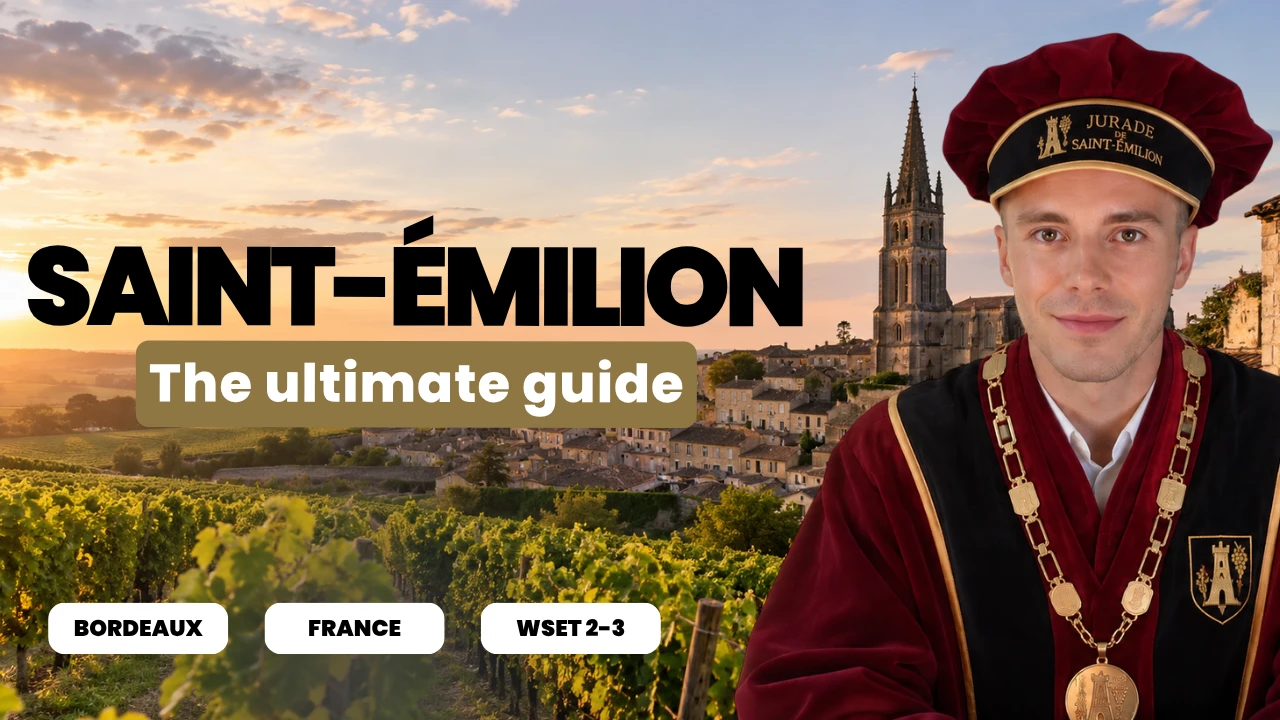
In 2012, this region had four estates at the summit of its official classification. By 2022, three of those four had quit. Not been demoted. Walked away, publicly, in protest, and the most famous names in the appellation were the ones doing the walking.
That is Saint-Émilion: the most beautiful wine town in Bordeaux, a honey-coloured medieval village carved into a limestone hill, named after a hermit who lived in a cave here thirteen hundred years ago, sitting on top of a literal underground city. It makes some of the greatest Merlot-based wine on earth, and it has the most dramatic classification story in wine.
Here is the whole thing: the history, the limestone, the grapes, the label trap that catches almost everyone, and the meltdown.
Watch the guide
The other Bordeaux
Bordeaux is split in two by a river, and the half everyone pictures is the Left Bank: gravel soils, Cabernet Sauvignon, the great Médoc châteaux, the 1855 classification. Margaux, Pauillac, all of that.
Saint-Émilion is the other one. It sits on the Right Bank, east of the water, in an area called the Libournais, and almost everything about it is the mirror image of the Médoc.
The soil is not gravel, it is limestone and clay. The king grape is not Cabernet Sauvignon, it is Merlot. The estates are not sprawling corporate châteaux but mostly small family properties, which is why the appellation is nicknamed the hill of a thousand estates. And where the Médoc is flat and businesslike, Saint-Émilion is a medieval village on a hill, beautiful enough that in 1999 it became the first vineyard landscape in the world inscribed as a UNESCO World Heritage Site. Not just the town: the town and its vineyards together, as one living thing.
If the Médoc is the buttoned-up aristocrat, Saint-Émilion is the older, artier cousin. And it is a lot older.
A hermit, the Romans, and a city under the vines
The Romans planted vines on this limestone as early as the 2nd century AD. The poet Ausonius, one of the great writers of the late empire, is associated with the area, and Château Ausone carries his name. The link between the poet and that exact site is traditional attribution rather than proven fact, but the point stands: we are talking about two thousand years of winegrowing.
The name, though, comes from a man who arrived much later. In the 8th century a Breton monk called Émilion, travelling as a confessor, stopped at a place then called Ascumbas, decided it suited a hermit’s life, and carved himself a cave into the rock. Legend says miracles followed. Disciples gathered, a community grew, and when he died around 767 the town renamed itself after him.
The monks who came next did two things that still shape the place. They turned the Roman vineyards into a serious commercial trade. And they started digging.
For centuries, builders quarried soft limestone out from under the village to construct the town above, and in doing so hollowed out an entire underground world. The crown jewel is the monolithic church, monolithic meaning single stone: carved from the 12th century directly into the hill, columns and arches and all, not built from blocks but excavated out of solid rock. At over 38 metres long it is the largest underground church in Europe, and the bell tower above it is 196 steps to a view over the whole sea of vines.
Beneath the village and its vineyards run something like 200 kilometres of galleries, the negative space left by a thousand years of quarrying. The town sits on a honeycomb.
Through the Middle Ages Saint-Émilion grew rich on the wine trade with England, and its wine brotherhood, the Jurade, was established in 1199 under John, King of England and Duke of Aquitaine, to govern the wine and vouch for its quality. It still exists, still in red and gold robes, still proclaiming each vintage from the top of the King’s Tower. I am not a member yet. I have not given up.
The limestone is the whole point
What separates a great Saint-Émilion from an ordinary one is underground, and the appellation has no single soil. It breaks into zones, and they are not equal.
The limestone plateau and its slopes. Right around the village sits a plateau of hard limestone with côtes, slopes, running off it in limestone and clay. This is the grand terroir, and here is the fact to hold onto: almost every classified estate sits on this plateau or its slopes. Ausone, Pavie, Canon, Troplong Mondot all cling to these hillsides. Limestone behaves like a sponge. In wet years it drains, in dry years it holds water deep down and feeds it back slowly. It is a natural climate regulator, and it is where the freshness and the ageing power come from.
The gravel. On the far side, bordering Pomerol, there is a patch of gravel. Château Cheval Blanc sits on it, and the gravel is why Cheval Blanc grows so much Cabernet Franc. The wine tastes like a bridge between Saint-Émilion and Pomerol.
The sandy plain. Lower down towards the river the soils turn sandy and alluvial. Softer wines, earlier drinking, rarely profound. Perfectly pleasant, and the same appellation name goes on the label.
So the rock under your feet sets the quality ceiling. Plateau near the village: potentially world class. Sandy plain at the bottom: everyday wine. Identical words on the bottle. Hold that thought, because it is precisely why a classification exists at all.
Merlot and Cabernet Franc, and no white wine
Saint-Émilion is red only. This surprises people. There is no white Saint-Émilion and no rosé. White grapes grow inside the boundaries, but that wine has to be sold as plain Bordeaux Blanc.
The red is a blend, and it is built very differently from the Médoc. Merlot leads by a mile, usually 60 to 80 percent across the region. It loves the cool limestone and clay, ripens early, and gives the wine its plush, generous core: plum, black cherry, round soft tannins. It is why Saint-Émilion is so often the more approachable, supple Bordeaux next to the firm Cabernet Sauvignon of the Left Bank.
Cabernet Franc is the key partner, and it brings the lift: violet, graphite, raspberry, a savoury leafy edge. The interplay of fleshy Merlot and fragrant Cabernet Franc is the signature of great Saint-Émilion. There is usually a little Cabernet Sauvignon, and traces of Malbec and Petit Verdot, but that partnership is the soul of it.
At its best the wine is rich and rounded young, all dark fruit and cocoa, and ages into something savoury: truffle, forest floor, leather, dried flowers. Less austere than a young Médoc and frankly more seductive, which is a large part of why these bottles cost what they cost.
The label trap: Grand Cru is not Grand Cru Classé
This is the single most useful thing in this guide, and it catches almost everyone.
Saint-Émilion has a two-tier appellation system. There is plain Saint-Émilion AOC, and there is Saint-Émilion Grand Cru AOC, which sounds grand and is barely grander. “Grand Cru” here is not a quality ranking. It is an appellation with slightly stricter rules: a little lower yield, a little longer ageing, slightly higher minimum ripeness. More than 200 estates qualify, and in a typical year more wine is made as Saint-Émilion Grand Cru than as plain Saint-Émilion. The phrase on its own tells you close to nothing.
Now the trap. There is a separate thing called Saint-Émilion Grand Cru Classé, and that one word, Classé, changes everything. Classé means classified, which means the estate is in the real ranking.
So: Grand Cru is a wide appellation hundreds of wines carry. Grand Cru Classé is a genuine top tier. One word separates a fifteen euro bottle from a two hundred euro one, and wine shops know perfectly well that people confuse the two.
The classification, and its three tiers
The real classification is the opposite of the 1855 list in one crucial way. The 1855 ranking is frozen and has barely changed in 170 years. When Saint-Émilion created its own in 1955 it built in a radical idea: revision roughly every ten years, with promotion and demotion both on the table. Alive, competitive, and as it turned out, dangerously political.
The 2022 edition, the seventh, has three tiers:
| Tier | What it means | Count in 2022 |
|---|---|---|
| Premier Grand Cru Classé A | The summit | 2 |
| Premier Grand Cru Classé B | Still first-growth level | 12 |
| Grand Cru Classé | The broad classified base | 71 |
That is 85 châteaux in total. There are more than 800 producers in Saint-Émilion, so the classification covers roughly a tenth of them, and only two sit at the top.
Getting to those two is where the story goes nuclear.
2022: the year the top of the pyramid walked out
As of the 2012 edition there were four estates at the A tier, the four most hallowed names in the appellation: Ausone, Cheval Blanc, Angélus and Pavie.
Then, in the run-up to the 2022 revision, it came apart.
In July 2021, the morning after applications closed, Cheval Blanc and Ausone announced they were withdrawing. Their objection was philosophical, and it is a genuinely interesting argument: the criteria had drifted away from wine. The system put real weight on marketing, social media presence, the quality of the tourism offer, the reception facilities, the website. Cheval Blanc’s position amounted to this: we have spent centuries on our terroir, and we will not be ranked on our Instagram.
In January 2022 a third, Angélus, pulled out too, with its own complication. Its co-owner had been caught up in a legal conviction over a conflict of interest in the previous, 2012, classification. The whole system was mired in litigation. A “B” estate, La Gaffelière, left in June.
So three of the four reigning top estates were gone, and only Pavie remained to defend its crown. A ranking meant to crown the best had been abandoned by its own royalty.
When the final list landed in September 2022, Pavie was joined at the top by one newly promoted estate, and this is the happy part of the story: Château Figeac, considered unfairly overlooked for decades and narrowly denied in 2012. Its promotion was celebrated across the wine world. The top tier went from four estates to two.
Here is the epilogue, and it is the interesting bit. Did Cheval Blanc, Ausone and Angélus suffer for leaving? Not even slightly. Prices held. Reputations held. Collectors kept paying. Their brands were so established that the classification needed them considerably more than they needed it.
Which leaves Saint-Émilion with a strange paradox. The official ranking has a hole at the top where three of its greatest names used to be, and the market has quietly built its own unofficial classification that puts them back at the summit anyway. A system designed to be the opposite of the frozen, flawed 1855 list has arguably ended up less reliable than the thing it was reacting against. Living and competitive turned out to also mean political and litigious.
There is a dry joke about this in Bordeaux. Neighbouring Pomerol has no classification at all, and therefore none of the drama. As one Saint-Émilion producer put it: we could end up like Pomerol, where everyone just knows who the best are and nobody needs a piece of paper.
The garagistes
One more story, because it shook the wine world in the 1990s.
In the early 90s a former banker and record-shop owner named Jean-Luc Thunevin bought a scrap of vineyard in Saint-Émilion, barely over half a hectare, and in 1991 made the first vintage of Château Valandraud. No grand château, no famous name. He made it in what was essentially a garage.
But he made it with obsessive attention: tiny yields, fanatical sorting, very ripe picking, a lot of new oak. The result was concentrated enough to stun critics, and Robert Parker scored it level with or above classified growths costing far more. A no-name wine from a shed started selling for a fortune.
The established châteaux were horrified and coined garagiste as an insult. It stuck, and became a movement. Dozens of micro-cuvées followed, proving you did not need centuries of history, just a good plot and relentless work. The craze cooled by the mid-2000s as the market filled up and tastes moved away from that super-ripe style, and Valandraud itself grew up and was promoted into the classification in 2012. But the garagistes permanently changed Bordeaux by showing that ambition on a tiny vineyard could beat inherited prestige.
The satellites, where the value hides
Saint-Émilion has become expensive. Still reasonable next to the Médoc’s grandest names, but expensive.
Just north, across a stream called the Barbanne, sit four villages legally allowed to hyphenate the Saint-Émilion name onto their own: Montagne-Saint-Émilion, Lussac-Saint-Émilion, Puisseguin-Saint-Émilion and Saint-Georges-Saint-Émilion. When the appellation system was drawn up in the 1930s they were split off as separate, more modest appellations so as not to dilute the name, but kept the suffix.
Same Merlot-led blends. Similar limestone and clay, especially in Montagne, the largest and generally the finest of the four. Often a fraction of the price. Tasted blind, a good satellite can be hard to separate from a true Saint-Émilion, and as the growers there like to say, it depends more on the grower than the appellation.
How to actually buy Saint-Émilion
Decode the label first. Plain Saint-Émilion or Saint-Émilion Grand Cru means the broad appellation and hundreds of wines, so judge by producer. The words that carry weight are Grand Cru Classé, with the Classé, and above that Premier Grand Cru Classé.
For the legends, the current top two are Pavie and Figeac, plus the three that left and still sit at the summit in everyone’s mind, Cheval Blanc, Ausone and Angélus, alongside names like Canon, Troplong Mondot, Valandraud and Clos Fourtet. Special-occasion money.
For value, go to the satellites, Montagne first, or find a good unclassified estate on the limestone slopes. Same style, far gentler price.
And the honest version, same as every guide we write: the label and the classification are a starting point, not a verdict. Saint-Émilion proves that harder than anywhere else, because this is a region whose own best estates rejected its own ranking. Trust the producer, trust the terroir, and trust your palate over any piece of paper.
A hermit’s cave, a limestone hill, two thousand years of wine, and a classification dramatic enough to make the news. Saint-Émilion really does have it all.
Keep exploring
We have been to Saint-Émilion more than once. Couvent des Jacobins is the estate with its own cloister in the middle of the village, Jean-Antoine Nony of Château Grand Mayne talks about running a classified family property, and Pauline Bich and Philippe Chandon-Moët of Château de Ferrand came to the show to explain what promotion into the classification actually changes.
For the other half of Bordeaux, read our guide to the five Bordeaux classifications. Saint-Émilion defines itself against everything in it.
Frequently asked questions
What is the difference between Saint-Émilion Grand Cru and Grand Cru Classé?
They sound almost identical and they are not remotely the same thing. Saint-Émilion Grand Cru is an appellation, open to any estate that meets slightly stricter rules on yields and ageing, and more than 200 estates use it. Saint-Émilion Grand Cru Classé means the estate sits in the actual classification, a ranking of 85 châteaux out of more than 800 producers. The single word Classé is the difference between a fifteen euro bottle and a two hundred euro one.
Why did Cheval Blanc and Ausone leave the Saint-Émilion classification?
Both withdrew in July 2021, and Angélus followed in January 2022. Their objection was that the judging criteria had drifted away from the wine itself and towards marketing, social media, websites and the quality of the visitor facilities. Cheval Blanc's position was essentially that an estate built over centuries on its terroir should not be ranked on its Instagram. Neither price nor reputation suffered for leaving.
Is there a white Saint-Émilion?
No. Saint-Émilion is red only, and so are the four satellite appellations. White grapes are grown inside the boundaries, but any white wine made there has to be sold as plain Bordeaux Blanc. If the label says Saint-Émilion, the wine in the bottle is red.
What grapes are used in Saint-Émilion?
Merlot leads, usually somewhere between 60 and 80 percent of the blend across the region, with Cabernet Franc as the main partner and smaller amounts of Cabernet Sauvignon, Malbec and Petit Verdot. Individual estates vary a lot: Cheval Blanc is famous for its unusually high proportion of Cabernet Franc, grown on a patch of gravel near the Pomerol border.
Which Saint-Émilion offers the best value?
Look north, across a stream called the Barbanne, to the four satellite appellations: Montagne, Lussac, Puisseguin and Saint-Georges, each of which hyphenates Saint-Émilion onto its own village name. Same Merlot-led blends, similar limestone and clay, often a fraction of the price. Montagne is the largest and generally the strongest. A good unclassified estate on the limestone slopes is the other smart buy.
How often is the Saint-Émilion classification revised?
Roughly every ten years, which is the opposite of the 1855 Left Bank list that has barely moved in 170 years. Saint-Émilion's was created in 1955 and the 2022 edition was its seventh. Estates can be promoted and demoted, which was meant to keep it honest. It also made it political enough to end up in court.