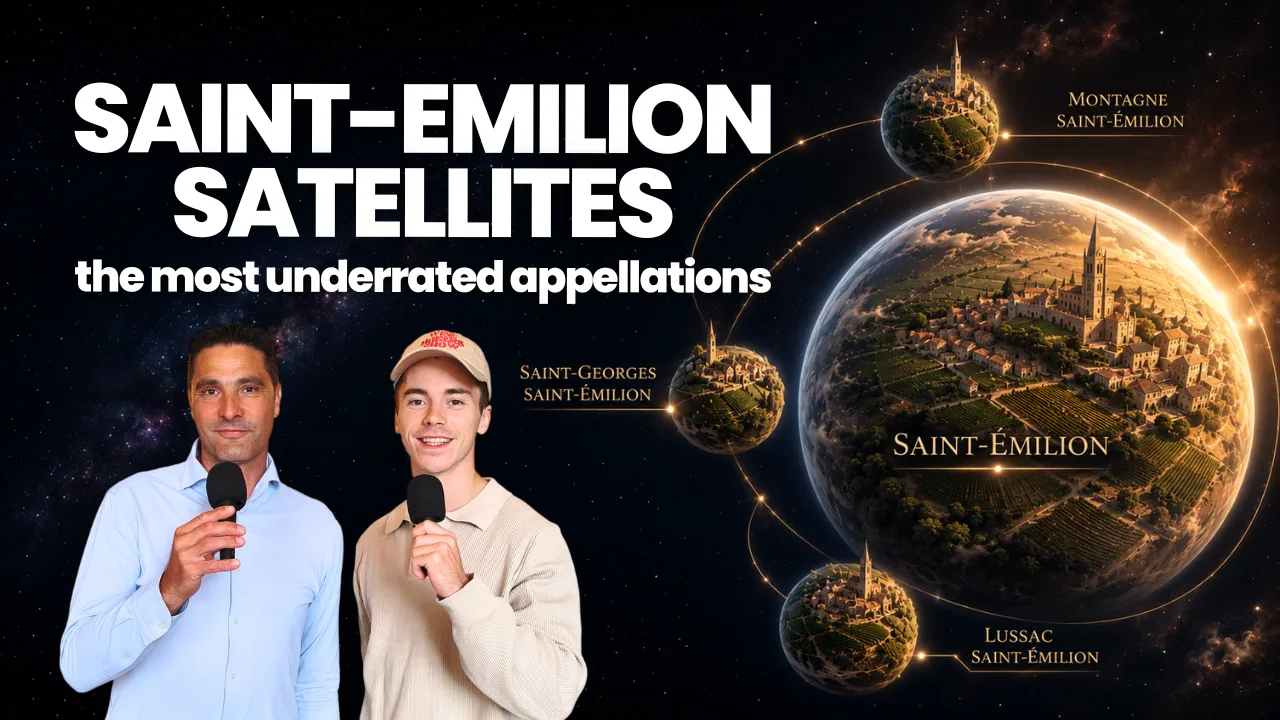
Ever wondered what it takes to turn Saint-Émilion’s overlooked neighbours into a destination in their own right? This episode takes us to Château de Lussac, flagship estate of a Bordeaux group that’s rebuilding itself château by château, and rethinking what a satellite appellation can be.
We sit down with Anthony Appollot, general manager of Sarments Vignobles, a sixth-generation Saint-Émilion winemaker who spent years as an independent vineyard consultant before assembling the group’s four estates in under a decade, to trace how it all came together and where he’s taking it next.
Anthony walks us through top-grafting Chenin Blanc onto decades-old Merlot vines, why he’s pulling up a third of Lussac’s vineyard to plant walnut trees and truffle oaks, and the disease-spotting drone he helped calibrate that kept the group’s harvest intact during 2024’s brutal mildew year.
Expect an 80-year-old field blend planted after a killer frost, a secret Italian grape variety, and a very candid read on the Bordeaux crisis from someone who’s still buying. Tune in!
Watch the full interview with Anthony Appollot
Listen to the podcast with Anthony Appollot
A recap of the conversation with Anthony Appollot
From vineyard childhood to agricultural engineer
Anthony Appollot is 49 and a sixth-generation winemaker from Saint-Émilion, from a family with wine on both sides. His earliest memory is being taken into the vines for manual work at age five. At 14, bored with regular school and drawn to nature, he woke up one morning and told his parents he wanted to become a wine grower. They were supportive, if realistic about how demanding the job is.
He followed the classic French path into the trade: a viticulture and oenology baccalaureate, internships in other regions and appellations, including Cognac and Champagne, to broaden his view early on, then a technical degree and finally agricultural engineering studies.
Consultant first, group builder later
At 22, Anthony joined the family estate, but quickly found working with family complicated. After three or four years, he left to build his own experience, joining a small group of three estates, a Pomerol, a Saint-Émilion Grand Cru Classé and a Lalande de Pomerol, first as vineyard manager, then estate director. It was there, back in 2007, that he launched an early wine tourism project, a bed-and-breakfast concept he’d first glimpsed during his Cognac internship. Five years later, he set up on his own as an independent phytosanitary consultant, advising estates on vine health and treatments, the subject he’s always been most drawn to.
Building Sarments Vignobles, one château at a time
Anthony joined the group as a consultant in 2018, when it was a single property: Château de Saint-Pey, bought in 2010 by owner Mr Stévenin. From 2018 to 2020, his focus was consolidating the estate’s best plots, at the foot of and on the slopes. Renovation of the winery buildings followed, delayed two years by COVID and finally inaugurated in 2024.
In parallel, Anthony was also consulting for the former owners of Château de Lussac and Château Vieux Maillet, a Pomerol, who were considering a sale. It took him two years to bring everyone to the table. In September 2022, the deal closed: Lussac and Vieux Maillet joined the fold, and Sarments Vignobles was born. A year later, in 2023, the group acquired four hectares from La Fleur Pétrus to reinforce Vieux Maillet’s terroir.
Four estates, four different wines
Château de Lussac is the group’s flagship, a Lussac Saint-Émilion aged in barrel the traditional way, alongside its fruitier, unoaked second wine, Marquis de Lussac. Château de Saint-Pey shares that same traditional ageing, but its new development cuverie is testing concrete and stainless steel vats to lean on fewer barrels.
Château Saint-Jean de Lavaud, in Lalande de Pomerol, is built around a tiny plot of vines over 80 years old, planted as a field blend of Merlot, Cabernet Franc and Cabernet Sauvignon after the killer frost of 1956, simply because that’s what was available to plant at the time. The previous owners vinified the three varieties separately. Anthony’s first vintage, blending them together, was disappointing, but in 2023 he tried again, this time hunting for the one harvest date that worked for both Merlot and Cabernet ripeness at once. The gamble paid off, and the wine has expressed itself completely differently ever since.
At Château Vieux Maillet, in Pomerol, the previous owners blended two distinct terroirs into a single wine. Anthony split them instead: Château Cantereau on sandy, gravelly soils, and Vieux Maillet itself on the blue clay of the Pomerol plateau, 200 metres from Château Gazin and 500 from Pétrus, a position the 2023 La Fleur Pétrus purchase was specifically chosen to reinforce.
How he decides what to buy
Anthony’s first filter when evaluating a property is the people: understanding what the owners or investors actually want. From there, his vineyard sensitivity does the rest, he says a two-hour first visit is usually enough to know whether a deal is worth pursuing. The group is currently in an active buying phase. Anthony’s conviction is simple: wine has existed for four thousand years, and however consumption habits shift, it isn’t going away. He’s candid that Bordeaux, his own region included, was slow to adapt to changing consumer tastes, a view sharpened by a recent trip to the United States.
Reinventing the satellites: what’s coming to Lussac
In 2026, Lussac will plant an Italian grape variety (Anthony’s keeping the name under wraps for now), aimed at easy, fruit-forward drinking, the kind of bottle opened at a bar in the early evening. A second Italian variety, better suited to ageing, follows in 2028, rounding out a range built to reach a broader, less traditional audience.
2025 already brought Chenin Blanc, planted at Lussac using top-grafting: grafting a new variety onto an existing rootstock and trunk rather than replanting from scratch. The advantage is speed, quality grapes from year one or two instead of the five to eight years a new planting needs to mature, because the root system is already established. It’s an old technique with real history behind it: after the 1956 frost split vine trunks in two, many Bordeaux properties survived by grafting new wood onto the surviving base. It’s still done entirely by hand, knife in hand, reading where the sap flows before making the cut. The team Anthony brings in for it, from Mexico, keeps a 99% success rate.
The case for the satellites
Lussac sits on clay-limestone soil from the same Cretaceous era as Saint-Émilion, with a touch more iron, which Anthony says works in its favour on pH. The wines can be remarkably close in style, yet the market, drawn to the Saint-Émilion name, consistently underprices its satellites. For consumers, that gap is genuinely good value. Anthony’s vision for appellations like Lussac and Montagne is that they need to reinvent themselves rather than betting everything on traditional wine production, as they largely did in recent decades.
Diversifying beyond the vine
The numbers behind that vision are stark: total annual sales across the Bordeaux region have fallen from roughly 80-90% down to around 30% for satellite appellations and 50% for the more prestigious ones. In response, Lussac is pulling up 12 of its 30 hectares in 2026. Around six will become walnut trees, feeding a planned walnut-oil project, alongside a return to the polyculture, livestock and cereals, that satellite plots practised 30 years ago, plus truffle oaks planted on suitable soil. A separate project aims to distil the group’s grape pomace into gin, paired with herbs grown on-site, for a product that’s entirely Château de Lussac’s own.
A hospitality project built to promote the wines
Château de Lussac itself was privately owned until the 2022 purchase. Anthony’s team quickly reopened its five existing guest rooms and launched an events business: weddings, seminars and year-round bed-and-breakfast stays, all doubling as a way to introduce guests to the group’s wines. Couples marrying at the château aren’t required to pour Sarments Vignobles wines, but so far, every single one has. A pool, a padel court, and electric bikes paired with a geolocation app called La Bulle Verte, for self-guided routes around Lussac and Saint-Émilion, round out the offer. 2026 is fully booked; 2027 is nearly there too.
Beyond Bordeaux: Burgundy, Loire and Italy
The group’s ambitions don’t stop at Bordeaux. The owner has a personal taste for white wines, particularly Burgundy and the Loire, which is shaping where Sarments Vignobles looks next. Italy is also on the radar: Anthony is convinced Italian wines will keep gaining ground internationally in the years ahead.
Spotting disease from the sky
Long before Sarments Vignobles existed, Anthony was already chasing a different kind of project. In 2016, he met Chouette, a company then developing a drone that flies over vine rows, using an infrared camera to read leaf colorimetry and an early neural-network model to spot downy mildew. Anthony spent three years helping calibrate that model across grape varieties and regions, pushing detection accuracy past 80%.
The idea didn’t stop there. Working with Chouette, he helped build a recommendation map that plugs straight into a tractor-mounted sprayer, treating vines automatically based on real disease pressure and current weather, rather than blanket-spraying an entire block. The benefits are both environmental, treating only what needs it, and economic, cutting treatment costs by 30 to 60% depending on the vintage. The system is now calibrated for downy mildew, black rot, powdery mildew, trunk diseases and flavescence dorée, and Chouette has added a return-on-investment calculator to help winemakers weigh up the cost of adopting it.
The technology proved its worth in 2024, a brutal mildew year that wiped out nearly all the harvest on some Bordeaux estates. On the group’s properties using it, early detection meant diseased vines were treated before the fungus could spread, and the group came close to a maximum yield in a vintage that devastated many of its neighbours.
If Bordeaux’s satellite appellations have you curious, our conversation with Valérie Befve on building the Saint-Émilion of tomorrow at Château Dassault is a natural companion listen, and our guide to Bordeaux’s wine classifications explains exactly how a declassified wine differs from an appellation wine. For more on vines built to survive disaster, our history of phylloxera covers the earlier crisis that made grafting essential to Bordeaux in the first place, and our episode with Laurent David on Château Edmus, wine angels and wine tech digs deeper into the technology reshaping vineyard work. And if the truffle-growing technique Anthony mentions has you intrigued, Ivan Massonnat of Domaine Belargus is the one who first told him about it.
Anthony Appollot’s recommendations
The estates:
- Sarments Vignobles
- Château de Lussac
- Château de Saint-Pey
- Château Saint-Jean de Lavaud
- Château Vieux Maillet
- Château Cantereau
Disease-spotting drones: Chouette
A book: The World Atlas of Wine, by Hugh Johnson and Jancis Robinson
Amazon links on this page are affiliate links. They cost you nothing extra, and they help me keep this going.