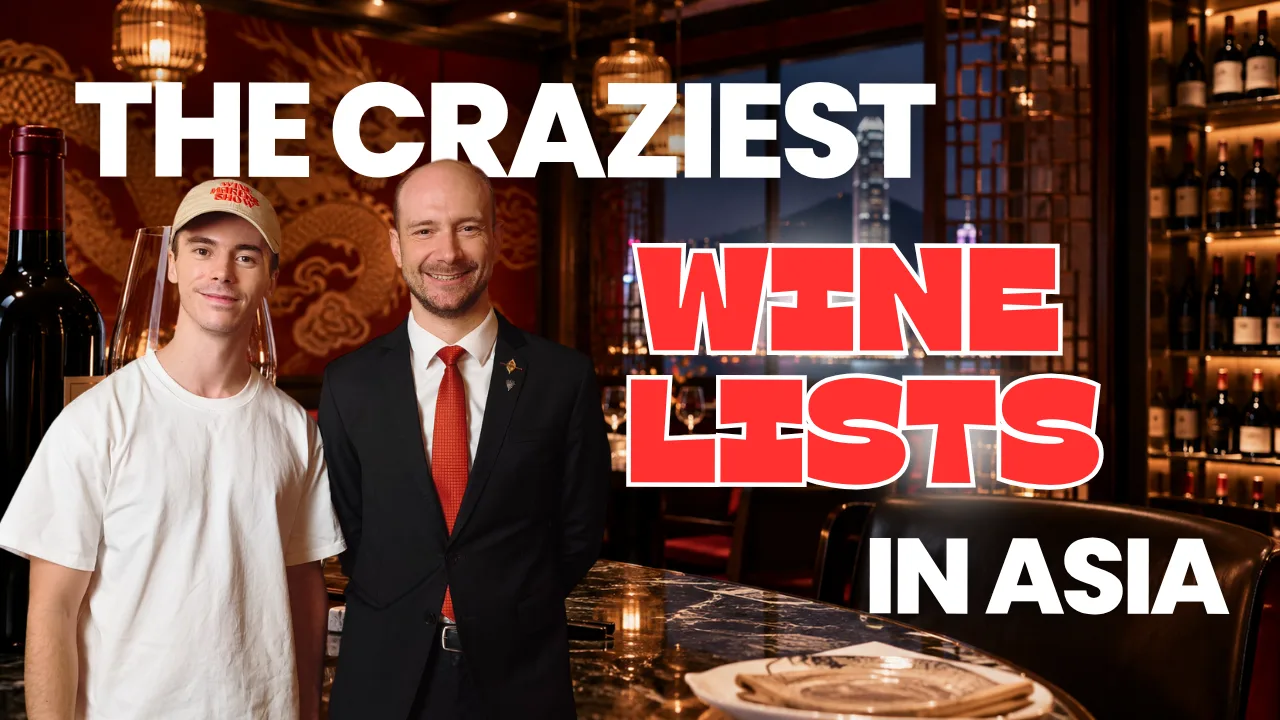
A wine list sorted by Chinese zodiac sign. A Cantonese dining room stocked almost entirely with wine grown in China. Both belong to the same Hong Kong restaurant group, and both came out of the same restless head. We sat down with the person who built them, inside the very restaurant he turned upside down.
Jean-Baptiste Copot is director of wine at Black Sheep Restaurants, the Hong Kong group now closing in on 40 addresses across the city, Singapore and Dubai.
In this interview, he traces his path from a teenage kitchen apprenticeship in France, to a Michelin-starred Lyon dining room with ceilings low enough to leave a mark; credits an English mentor who refused to speak a word of French to him; and recounts the hike where the zodiac idea struck him before he tore up Ho Lee Fook’s cellar to rebuild it almost entirely Chinese.
Press play and meet the sommelier rewriting Hong Kong’s rules!
Watch the full interview with Jean-Baptiste Copot
Listen to the podcast with Jean-Baptiste Copot
A recap of the conversation with Jean-Baptiste Copot
A cook first, a sommelier almost by accident
Jean-Baptiste Copot grew up in a French family that always kept good food and a little wine on the table, without either parent being especially passionate about it. He wanted to cook from the age of 11 or 12, and France’s system let him start early. At 15 he enrolled in a professional baccalaureate in cuisine, learning the trade while picking up weekend shifts in restaurants and at weddings.
Somewhere in those first jobs he realised he felt more at ease talking to guests on the floor than working the pass. He moved into restaurant management, discovered along the way that he loved wine too, and took an extra year to earn France’s state sommelier certification, the Mention Complémentaire Sommellerie. That year convinced him wine was never going to stay a side interest.
Two Michelin stars, low ceilings and Paul Bocuse’s old apprenticeship
His first job was at Brasserie 33 Cité, in Lyon, a Bocuse-style brasserie serving 120 to 250 covers a sitting with a list running 500 to 600 references, useful training in volume. He earned his sommelier certification at La Mère Brazier, the two-Michelin-star restaurant in Lyon’s old town where Paul Bocuse himself once served his own apprenticeship a lifetime earlier. The building’s ceilings run low throughout, a legacy of the silk workers who once hung silk from the rafters there to dry. And Jean-Baptiste, well over six feet tall, paid for it more than once. The wine list stayed almost entirely Burgundy and Rhône. Beaujolais needed a blind cheese-pairing tasting just to earn diners’ trust, a wine poured far more freely across Lyon today than it was back then.
Learning English the hard way, in the English countryside
At 21, wanting international experience before Brexit made it harder to get, Jean-Baptiste took a job at Le Manoir aux Quat’Saisons, Raymond Blanc’s two-Michelin-star restaurant in the Oxfordshire countryside. He admits today that his English was genuinely poor at the time. It was there, oddly enough at a French restaurant, that he first worked a wine list ranging properly across the world rather than staying almost entirely French. After roughly 20 months he asked for a promotion and was told, fairly he now agrees, that he wasn’t ready yet.
Sat Bains, the restaurant that unlearned his French reflexes
The move that changed him came next: Sat Bains in Nottingham, the two-Michelin-star restaurant Sat and Amanda Bains built from nothing over decades. He was hired by Laurent Richet, a Master Sommelier, who spoke to Jean-Baptiste only in English on the floor, on the theory that too many French colleagues speaking French to him would only slow his progress. Where Lyon and Oxfordshire had trained him toward a hushed, formal register, Sat and Amanda actively encouraged his naturally loud, expressive style. It was the first time anyone had told him hospitality wasn’t a single fixed recipe, and the realisation stuck.
A cold LinkedIn message and a move to Hong Kong
When Richet left for the Netherlands, Jean-Baptiste decided it was time to leave the UK too, before Brexit closed the door for good. He messaged sommeliers in Hong Kong, Bangkok, Singapore and Tokyo on LinkedIn asking what work was like. Most, including people already in Singapore, pointed him toward Hong Kong. His CV, forwarded through mutual contacts to fine-dining names across the city, reached Arnaud Bardary, then director of wine at Black Sheep Restaurants, before Jean-Baptiste had even applied there directly. He joined in January 2020 as head sommelier of Buenos Aires Polo Club, the group’s Argentine steakhouse, stepping into a wine team of 10 to 11 sommeliers already built by Bardary, a Master Sommelier himself.
Building a wine list with no local playbook to borrow from
Six months in, Jean-Baptiste picked up work at Carbone too, learning to handle serious formats, Jeroboams and Methuselahs among them. In December 2021, with Hong Kong still open while much of the world sat in lockdown, the group launched Chalet des Alpes, a month-and-a-half pop-up close to his own roots: his family lives in the Alps, and the raclette-and-fondue menu let him pour Savoie, Swiss, Alto Adige and Jura wines he genuinely loves on a personal level.
Around the same time came his first wine list of his own, for Grand Majestic Sichuan. His first instinct, reaching for a richer Riesling or a bigger Chenin Blanc or Chardonnay, collapsed against Sichuan cuisine’s complexity, a cuisine built on more than 20 distinct flavour notes rather than heat alone. The idea that solved it came to him on a hike: sort the list not by region but by vintage, mapped onto the 12 signs of the Chinese zodiac. Back at his desk, he combined the Carbone and Buenos Aires Polo Club cellars to test whether the concept could even fill all 12 signs. It could. Founder Syed Asim Hussain approved it on the condition it be treated as a long-term commitment rather than a launch gimmick. And it paid off: the list now runs past 300 references and won a special jury prize at Star Wine Asia. The team also discovered, almost by accident, that champagne’s freshness and bubble cut cleanly through mala spice and richness, and built out that selection accordingly.
Ho Lee Fook’s turn to an almost entirely Chinese wine list
Ho Lee Fook, the group’s Cantonese restaurant, is a decade old and was relaunched a few years back under chef ArChan Chan around a more authentic telling of Hong Kong’s own food story. Its wine list initially stayed eclectic and international, young winemakers from Australia, Sicily, California and Chile, and it worked well enough. Then Hussain relayed feedback from a partner: the list was missing a point of view. Around the end of 2022, the team committed to an all-Chinese wine list. It started narrow with Ningxia, Shandong and Yunnan and expanded with every reprint since, to now roughly 45 to 50 wineries across most of the country’s wine regions. The rule Jean-Baptiste holds to is the same discipline the group applies to its single-country lists elsewhere: never list a wine just because of where it’s from, only because it’s genuinely good.
Why Chinese wine works here, and one bottle he’s proud of
China’s fine-wine culture is only around 15 years old, young enough that quality still varies widely, from wines that could pass for an ordinary Bordeaux to a handful with real, distinct personality. Jean-Baptiste points to Ningxia’s grand chateaux, built within the last five years to look centuries old. This is both a source of pride as a Frenchman and proof that the best producers are now finding their own identity rather than copying Bordeaux technique wholesale, new oak and heavy extraction included.
One bottle on the Ho Lee Fook list captures that shift: a red from Puchang Vineyard in Xinjiang, represented in Hong Kong by Clara Wang. This wine is made from beichun, a grape bred locally in Xinjiang, alongside saperavi, a variety originally from Georgia.
He also flags something rarer than the wines themselves: Chinese producers often taste with sommeliers, whom they view as partners, and take their feedback very seriously.
Every list tells its own restaurant’s story
The zodiac list and the all-Chinese cellar are the boldest examples of a wider rule at Black Sheep: every wine list should extend its restaurant’s own identity rather than follow a single group-wide template.
- At Jean-Pierre, the French bistro, that means leaning into small, unglamorous French regions rather than only big names.
- At Prince and the Peacock, the group’s homage to India’s many regional cuisines, the list is loosely organised around the historic dynasties that shaped the country’s food.
- Elsewhere the group’s creative team pushes the sommeliers to lighten up entirely, writing playful one-line descriptions a career sommelier admits he would never have written himself.
None of it happens in isolation: Jean-Baptiste works closely with founder Syed Asim Hussain and the group’s design and communications teams on every new list, treating that extra layer of story as something to earn rather than bolt on.
Building the team, not just the cellar
Six and a half years into life in Hong Kong, Jean-Baptiste describes his current role as mostly about people: making sure everyone is on the right project with the right support, and acting as the connective tissue between the sommelier floor and the group’s marketing and finance teams.
Recruiting has gotten easier as Black Sheep’s reputation has grown, increasingly through referrals from people already on the team.
He pushes back hard on the idea that younger hospitality talent works less hard or cares less, calling it the opposite of what he sees day to day from a team drawn from hotels, cruise ships, fine dining and even winemaking backgrounds, classical and modern, conventional and biodynamic, arguing the finer points out over every tasting.
If Black Sheep’s bet on Chinese wine has you curious, our conversation with Cyrus Ho, hotel sommelier at Island Shangri-La Hong Kong, covers the same wager from across town. For a closer look at the country behind those bottles, Arthur Yeung on building Runaway Cow goes deep on one of the wineries putting Chinese wine on the map. And for the Master Sommelier who first brought Jean-Baptiste into Black Sheep, our episode with Arnaud Bardary traces his own path from the Jura to Hong Kong.
Jean-Baptiste Copot’s recommendations
A book: Inside Burgundy (second edition), by Jasper Morris MW
A recent wine he loved: a side-by-side tasting of around 14 cuvées from the Sadie Family, from Swartland in South Africa, poured together in a way he doubts even the estate itself offers
Next guest: Jefferson Liu, general manager for Hong Kong and Macau at East Meets West Fine Wines, and an early champion of Chinese wine in the market
Discover:
Amazon links on this page are affiliate links. They cost you nothing extra, and they help me keep this going.