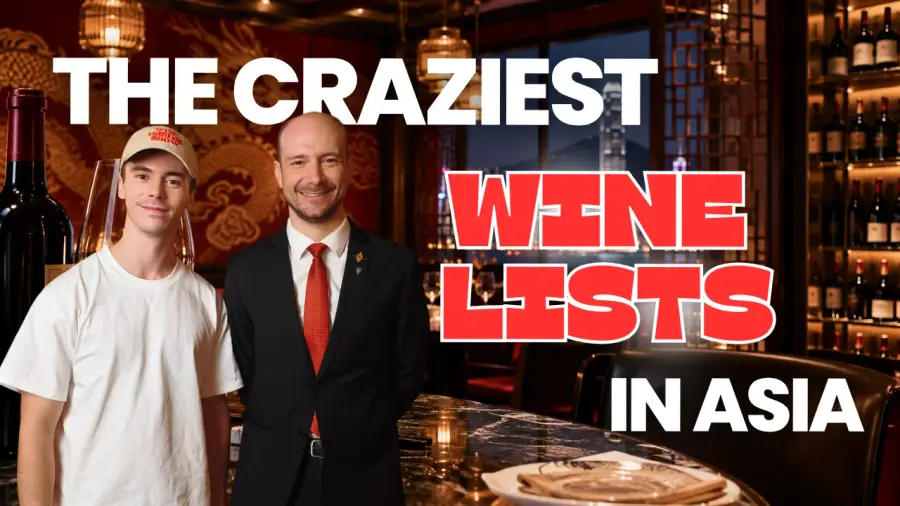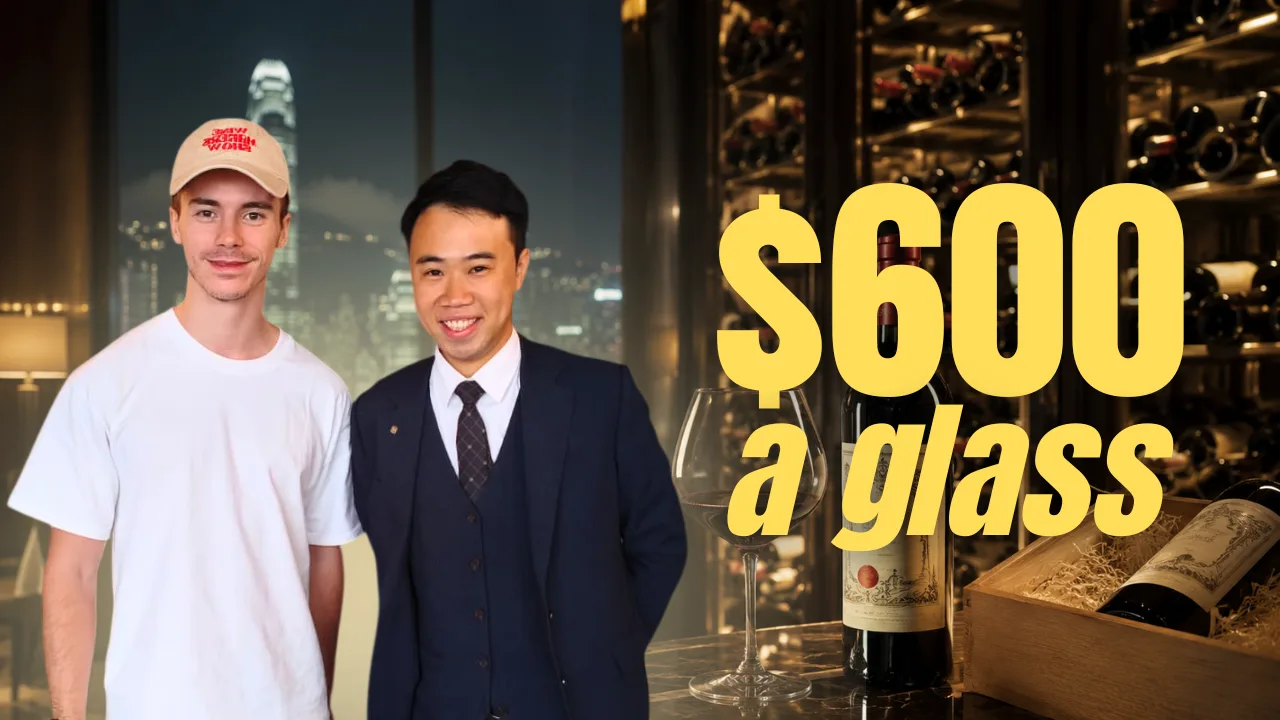
What does it take to run the wine programme for eight restaurants inside one of Hong Kong’s most storied hotel groups, and how do you earn a guest’s trust for a US$600 pour of 1975 Petrus? We sat down inside Petrus itself, the flagship restaurant at Island Shangri-La Hong Kong, high above Pacific Place at the heart of the city’s energy, to find out.
We’re joined by Cyrus Ho, hotel sommelier for the Shangri-La Group in Hong Kong, who oversees the wine programme across all eight of the group’s restaurants, from Cantonese fine dining to Japanese, French and everything in between.
Cyrus walks us through the week he spent doing nothing but refilling water glasses under his mentor’s watch, the vintage mix-up that taught him never to skip showing a label, and the six-hour mountain drive into Yunnan that convinced him Chinese Chardonnay deserves serious attention.
Expect back-vintage Petrus by the glass, a side career as a certified tea master, and a clear-eyed read on why the next generation isn’t reaching for wine. Tune in!
Watch the full interview with Cyrus Ho
Listen to the podcast with Cyrus Ho
A recap of the conversation with Cyrus Ho
From product design to Hong Kong’s wine cellars
Cyrus Ho trained as a product designer, but after graduating he never went into the design industry. Instead he picked up part-time waitering work at a Hong Kong hotel restaurant, with zero wine knowledge when he started. One order changed that: a well-known Hong Kong TV personality asked for a New Zealand Gewürztraminer, off-dry and gently sweet, exactly the kind of approachable bottle built for a first-time drinker. Cyrus couldn’t even pronounce the grape. Chasing down how to say it became the start of studying wine properly, first WSET Level 2, then Level 3, then onto the Court of Master Sommeliers path. Ten to twelve years later, he’s still at it, not the career he set out to have, more the one that found him after a family of trained designers kept asking why he wanted to change their layouts.
Yohann, the mentor who started him on water
Ten years ago, Cyrus joined Petrus as a sommelier, hired by Yohann Jousselin, a Master Sommelier building out the wine team for Shangri-La Group in Hong Kong. His first week on the job, Yohann gave him exactly one task: refill the water glasses. No wine, for a full week. The lesson, Cyrus says, is that service starts with the basics done properly, and water is the most basic of all.
Once he’d earned his way onto the floor with wine, the questions started, and they never really stopped. Mid-service, Yohann would ask him to name the exact appellation of whatever he was pouring and expect an answer within seconds. Get it wrong, and the studying continued through service until the next round of questions came at dinner.
Cyrus spent three and a half years at Petrus before Yohann promoted him to run the wine programme elsewhere in the Shangri-La portfolio, another three and a half years. When Yohann left the Shangri-La, Cyrus left too, spending three and a half years at The Fullerton Ocean Park Hotel Hong Kong. Six months ago, ten years after he first started, he came back to Island Shangri-La, now as hotel sommelier for the whole group.
The ritual of presenting a bottle
Cyrus always opens with the wine list itself, because taste is personal, and he needs to know where a guest actually sits before recommending anything. A guest who says they like something sweet, he’s learned, is usually really asking for something fruity rather than truly sweet, a distinction worth getting right before a bottle is ever opened. Once a wine is chosen, the ritual is fixed: bring the bottle from the cellar, show the label, open it, taste it, then pour and tell its story.
Showing the label matters more than guests often realize. Around nine years ago, early in his career, Cyrus skipped that step for a table that had ordered verbally. The vintage on the bottle had changed since the order, from 2015 to 2016, and nobody caught it before it was poured. The guests were upset, and the table refused to drink the 2016. It’s the anecdote he reaches for when explaining why the small ceremony of showing a label, however performative it can look to a first-time guest, exists in the first place.
Eight restaurants, one Bible
Shangri-La Group runs eight restaurants across its Hong Kong properties, and Cyrus deliberately avoids giving each one an identical, standalone list. The Chinese restaurant leans into Bordeaux; other outlets lean into wider still or sparkling ranges depending on cuisine and guest expectations. Every restaurant can also call on the Petrus wine list itself, nicknamed “the Bible” internally, when a guest wants something beyond the house selection.
Across the group, Cyrus manages roughly 2,500 wine labels, all of it his own call: what comes in, what gets pulled, what ages quietly in the cellar. Burgundy is the hardest category to plan for right now. Recent vintages, 2022 and 2023, are all that’s readily available and not yet ready to drink, so Cyrus has shifted to a five-year holding strategy: buy young, store it at Shangri-La, and let it come around naturally before pouring it as a “new” back vintage.
Petrus by the glass
Petrus restaurant carries a genuine back-vintage Château Petrus programme, poured by the glass. Bottles from 1965, 1975 and 1989 have all featured; the 1965 and 1989 are now sold out, leaving the 2005 as the current pour. A small taste of the 1975, when it was still available, ran roughly HK$5,000, around US$600, for a single glass, a price Cyrus is candid isn’t cheap but calls a rare opportunity to taste history rather than commit to a full bottle. There’s no formal partnership behind the restaurant’s name; a previous owner simply loved the wine enough to name the room after it, and the back-vintage collection grew from there.
How a small winery earns a spot on the list
Shangri-La Group buys almost exclusively through appointed distributors, not directly from producers, a group-wide policy Cyrus works within rather than around. When he tastes something promising from a small estate that isn’t yet represented in Hong Kong, his move is to point the producer toward a distributor he trusts and let that relationship form organically. VinExpo is one of his main scouting grounds for exactly this: small wineries looking for their first foothold in the market, hoping a taster like Cyrus will like what’s in the glass enough to make an introduction.
Betting on Chinese wine
Cyrus is candid that many guests still arrive skeptical of Chinese wine, and that the only real tool for changing a mind is tasting, ideally blind. He’s been putting in the legwork to make that case: a recent trip through Yunnan, six hours by mountain road from Lijiang at altitudes above 2,300 meters, and stops in Shandong at Long Dai, DBR Lafite’s estate, and Runaway Cow. Ningxia and Xinjiang are next on his list.
The wines that make Cyrus’s own lists are the top handful he’s personally tasted and trusts, never anything he wouldn’t stand behind. One Yunnan Chardonnay in particular, from a young winery called Domaine Muxin, struck him as genuinely Burgundian in style, remarkable for a wine region that’s only about twenty years old and still needs bottle-age to fully show what it can do. His approach with guests is simple: pour it blind, let them guess, and let the wine do the convincing rather than the sales pitch.
A second calling: tea master
Last year, Cyrus travelled to Guangzhou to sit the exam for a tea master certification, covering the processing and correct preparation of China’s five to six major tea categories, each demanding different water temperatures and techniques, plus how to judge leaf quality. He sees real parallels with wine: single-origin character, the ritual of decanting mirrored in rinsing an aged pu-erh before drinking it. A personal health issue that made him cut back on wine at home pushed him further into tea, and he now treats it as seriously as he does the cellar.
He also points to a broader shift behind the interest: Hong Kong’s younger drinkers are moving toward tea and other local beverages rather than wine, a trend he sees firsthand and takes seriously as a sommelier rather than dismissing.
Building a pairing menu for the no- and low-alcohol crowd
Shangri-La now runs a genuine non-alcoholic pairing menu alongside its wine pairings, built with the bar team and the group’s own in-house tea specialist. It opens with sparkling tea in place of Champagne, moves through mocktails built from unfermented grape juices, including Merlot, developed specifically to hold their own alongside the food rather than read as an afterthought.
Cyrus frames it as a response to where the next generation of drinkers already is: many young people in Hong Kong aren’t picking up wine at all, gravitating toward beer or other categories instead, something he calls “the problem” for the trade’s own long-term health. His fix is low-pressure: he keeps a stack of tasting cards on hand to hand out to curious guests and friends, entry-level pours meant to spark curiosity rather than intimidate, on the belief that if nobody is introducing wine casually to newcomers today, there won’t be anyone left to sell it to in ten years.
If Cyrus’s trip to Shandong has you curious, our conversation with Charles Treutenaere on running Domaine de Long Dai for DBR Lafite goes deep on that same estate, and Arthur Yeung on building Runaway Cow covers the winery next door. For more on why Cyrus is so confident about winning over skeptical drinkers, our look at China’s new generation of wine drinkers makes the same case with the data behind it. And if hotel sommellerie in Hong Kong is a world you want to spend more time in, our episode with Derek Li on training sommeliers across the city’s nightlife-turned-fine-dining scene is a natural companion listen.
Cyrus Ho’s recommendations
A book: Inside Burgundy (second edition), by Jasper Morris MW
A recent wine he loved: the Muxin Chardonnay, from a young Yunnan winery founded by a Chinese winemaker with years of experience making wine in Burgundy
Next guest: Yohann Jousselin, his mentor and the Master Sommelier who hired him at Petrus, now leading fine wine for another Hong Kong company
Discover also:
Amazon links on this page are affiliate links. They cost you nothing extra, and they help me keep this going.