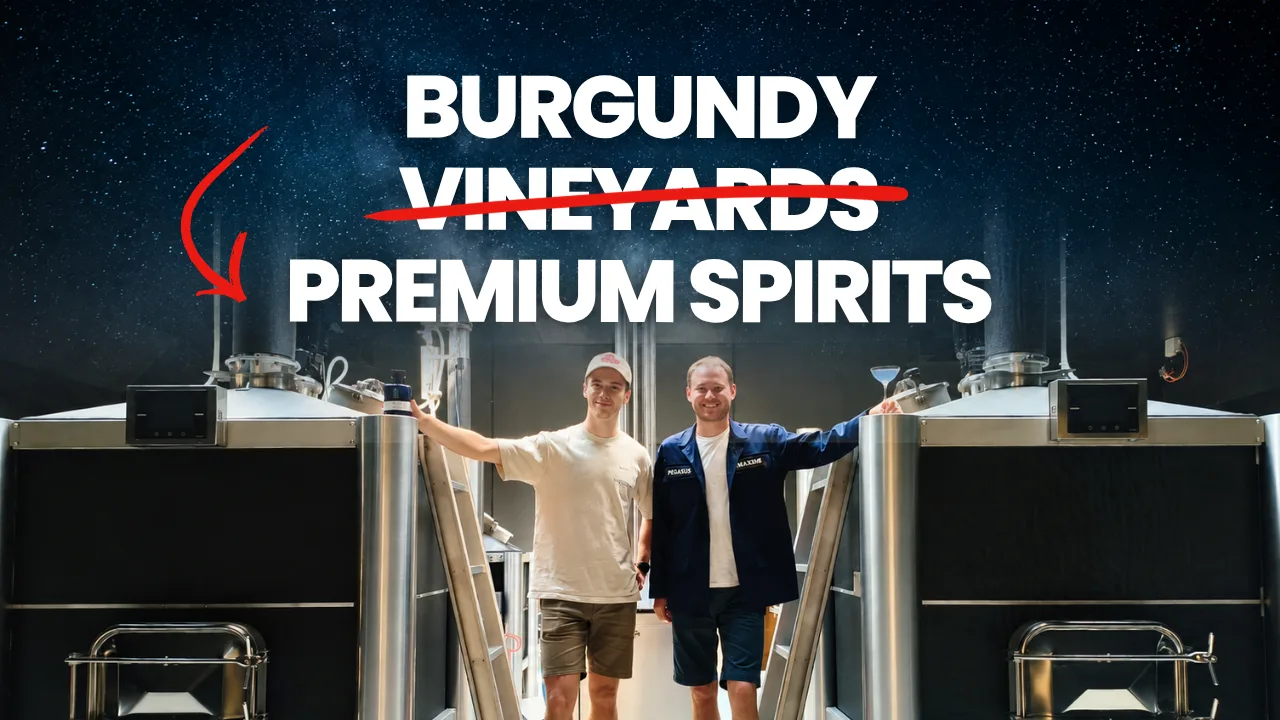
What makes the son of one of Burgundy’s best-known wine families walk away from the cellar to chase gin, vodka and liqueurs instead? We drove to Meursault, vineyards on every side, to sit down with Maxime Girardin and find out why he bet on spirits.
Maxime runs Pegasus, the distillery he built from scratch after a decade abroad in finance and trading. He walks us through the six-litre still in his parents’ garage, the Dutch technology that lets him scale without babysitting a boiler, and the reason the base spirit, the part most distillers ignore, decides everything.
Expect back-to-basics thinking, an obsession over organic wheat and Menton citrus, a clear read on why premium spirits keep growing while wine talks crisis, and a pilot’s licence earned before a driving one. Tune in!
Watch the full interview with Maxime Girardin
Listen to the podcast with Maxime Girardin
A recap of the conversation with Maxime Girardin
He grew up in the vines, and knew early it was not for him
Maxime was born and raised in Meursault, at the heart of Burgundy, into the Girardin family of winemakers. By 14 or 15 he had already told his parents the truth: he loved tasting and drinking wine, but he did not want to make it. His brother Pierre has since taken over the family business, the name carries on, and Maxime feels no regret. He studied accounting and finance in the UK, worked in oil trading, then spent about four years in a more engineering-focused industry before coming home. What pulled him back was not wine but the idea that he could build something just as exciting to sell, with far more room to create. For another view of the next generation weighing whether to step into a family Burgundy domaine, our conversation with Antonin Pillot in Chassagne-Montrachet sits on the other side of that same decision.
What London taught him about spirits
Coming from Burgundy, Maxime grew up seeing spirits as everything that sits below wine. London changed that point of view. During weekends away from university he discovered the city’s mixology bars, and what struck him was never just the drink: it was the craftsmanship, the show, the way a bartender explains what is in the glass, the room, the people you share it with. He still remembers the bar (Mr Fogg’s, on Pall Mall), the people around him, and the cocktail: an Aviation, still in his top three. Gin became his gateway, and it is still the category he reaches for first. The other lesson was freedom. In spirits, as someone told him early on, as long as the juice is good and the bottle looks good you can do almost anything, which is not true of wine in a place like Burgundy or Bordeaux.
Pegasus, built from a six-litre still in the garage
Maxime came back to Burgundy in June 2020, mid-COVID, with the idea already formed and none of the how. He spent months reading about what makes a spirits business succeed or fail before touching a still. The first tangible step was buying a small six-litre still (still in the lab today, used for new recipes) and teaching himself distillation in his parents’ garage. With no classes running during lockdown, it was online sessions and months of trial and error before anything drinkable came out. He went full-time on Pegasus in 2021. Spirits are more heavily regulated than wine: you register with customs (les douanes), get approved to produce, get approved to sell, and pay high duties upfront. The first client was a Beaune wine and spirits shop, and gin and vodka were the first bottles out the door.
How a spirit is actually made
For an audience fluent in fermentation, Maxime lays out the rest. Fermentation turns sugar into alcohol and CO2; distillation is the sorting step that follows. You turn a product’s starch into sugar, ferment the sugar into alcohol, then run a first distillation to concentrate it and a second to refine it or lift the strength. Distillation itself is about choosing which molecules to keep as the temperature climbs, which is where the cuts matter: you discard the heads, leave the tails in the still, and keep the heart. For gin and liqueurs, each botanical is macerated, that macerate is distilled for stability, then blended back into the neutral spirit, with sugar added for liqueurs. Pegasus works only with organic ingredients from France and Switzerland: organic wheat as the base for everything, and its own well water from Meursault, drinkable straight, no filtration needed.
The iStill bet: consistency over romance
Most distilleries run stills that are decades or a century old. Pegasus uses iStills, from a Dutch company founded around 2015, and is, Maxime believes, the largest distillery in France (probably Europe) working with them. In 2021 that was a risk, with little track record to lean on, but the machines gave him what he wanted: extreme precision, repeatable output, and computer control, so nobody has to stand by the still tasting every run. They also have a dual use, running as a column to refine neutral spirit and as a pot still for botanicals. That precision-after-creativity ethos runs through the brand. Maxime has flown since he was a teenager (he held a pilot’s licence at 15, before he could even drive), and Pegasus is named for the same mix of exploration up front and discipline once the system is set.
The base spirit is half the bottle
This is the point Maxime keeps returning to. Most distilleries buy neutral grain spirit in bulk and pour their attention into the flavours, the fun part. He compares it to a chef plating an excellent sauce over the cheapest possible chicken: the dish is still bad. The white spirit is roughly half of what is in the bottle, so Pegasus controls and refines it in-house rather than treating it as a commodity. It is the same lesson he grew up hearing in Burgundy, that you cannot make good wine from poor grapes, applied one category over. With natural ingredients, he says, you cannot cheat. Our explainers on organic wine and terroir cover the same instinct from the wine side.
A range built for the whole day
Vodka and gin came first because they are categories both the trade and the drinker already understand: more competition, but higher potential volume and less educating to do. The three liqueurs are the opposite, and take longer to place. Two are citrus-based, Eau d’Or (Gold Water) and Liqueur Royale, built from an 18th-century recipe once drunk at the French court that Pegasus had reprinted by the Bibliothèque nationale de France, keeping the original ingredient list (lemons and bitter oranges from Menton, orange blossom) and rewriting the method. The third, Minty, is a mint liqueur made from three mints grown in the Swiss Alps, designed so you do not taste the alcohol. The range is meant to cover different drinking moments across a day, from a citrus spritz in the afternoon to gin in the early evening to a digestif or a martini later. Vodka is now around 70% of sales, gin 15 to 20%, the liqueurs the rest. Maxime argues the premium vodka category is quietly healthy: still growing, few new brands trying to take a seat, and the big four (Grey Goose, Belvedere, Cîroc, Beluga) largely unchanged for 15 to 30 years while consumer values have moved on.
Selling from Burgundy when the world has never heard of it
The humbling discovery of going abroad: most people in wine and hospitality outside France do not know what or where Burgundy is. Grow up in Meursault, and Burgundy feels like the centre of the world; step outside, and that evaporates. So Burgundy has never been the sales pitch. Pegasus leads with French and Swiss heritage and with sourcing: Menton citrus, Alpine herbs and flowers, Burgundian water, French grain, everything from the best terroir within a three or four hour drive that gives you sea, mountains and plains. The pride, Maxime says, is taking the best of those terroirs and putting them in a bottle that someone on the other side of the world can enjoy. Pegasus sources locally and sells globally.
The US drinks differently, and premium is winning
The United States is far ahead of every other market for Pegasus, and it drinks unlike Europe. Martinis start at 11am, in fours and fives rather than ones and twos, and Americans are not comfortable sitting at a bar without a glass in hand, so the same room turns over far more products. When something is trendy they go all in; when it stops being trendy they drop it fast. Maxime sees the premium tier growing while entry and mid-market decline, and reads it simply: a cocktail in a big US city now runs 20 to 30 dollars before tax and tip, so drinkers want a real product and a real experience for that money. He frames the contrast with wine bluntly. Wine service still often feels old-school, and can read as looking down on anyone who does not know the labels; spirits are about the moment, not a quiz. For that same diagnosis from the wine side, see our piece on why wine’s problem is discovery, not demand.
His next big move is a vodka and martini campaign launching in February 2026, built on simple tools for simple execution. A less volatile vodka, he says, drinks smoother, almost sweet, and is less likely to give you a quick headache than a cheap one, a difference you can justify chemically and one bartenders can feel. The bartender is the last mile: the brand’s job is to hand them a good product and good ideas, then let them adapt it to the room and the guest. His conclusion for the episode: keep it simple, make it look good, and make the consumer happy.
If Maxime’s story makes you curious about the region behind the still, our ultimate guide to Burgundy wines is a good place to start. And if the cocktail thread is what caught you, our easy white wine cocktail recipes are a low-stakes way in.
Maxime Girardin’s recommendations
A book: The Savoy Cocktail Book, by Harry Craddock, longtime head bartender of the Savoy Hotel in London
A recent drink he loved: a simple, perfectly executed classic, poured tableside from a trolley at a bar in Portland, Oregon
Next guest: Félicien Roulot, a Meursault neighbour whose father built both a wine and a spirits business
Discover also the Pegasus Distillery
Amazon links on this page are affiliate links. They cost you nothing extra, and they help me keep this going.