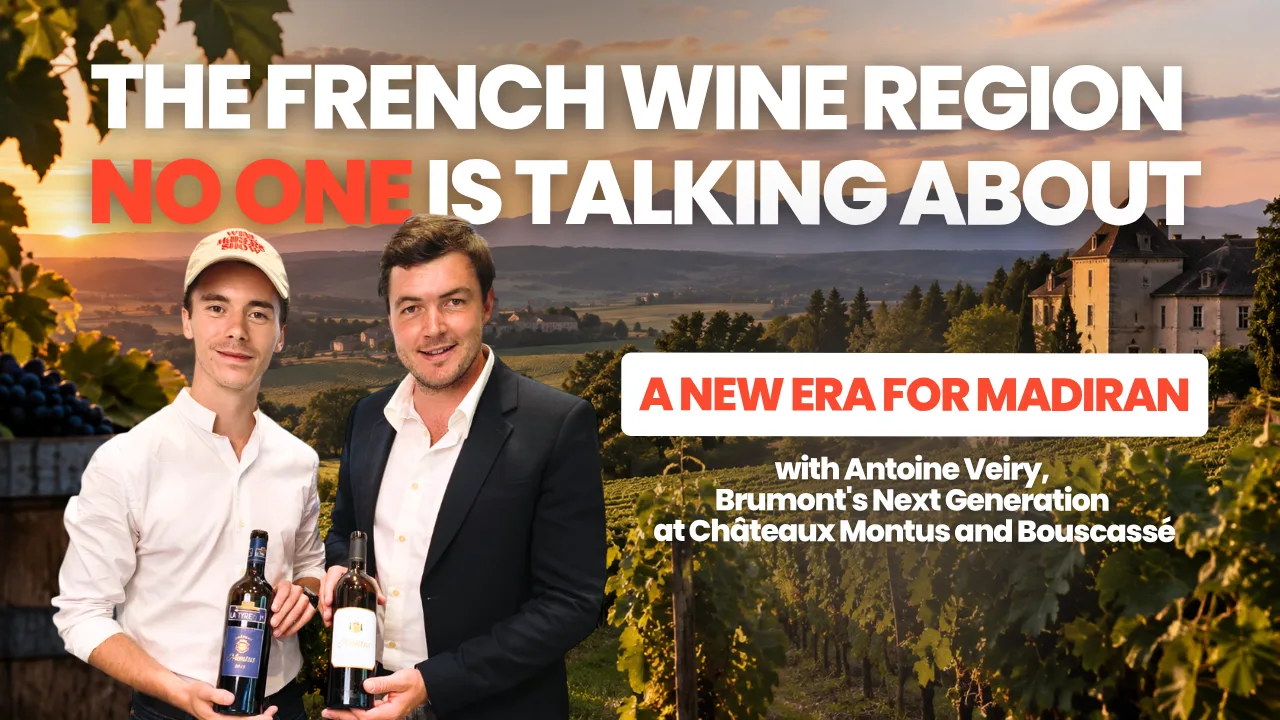
What does it take to inherit one of Southwest France’s most respected wine names, and then dare to change it? We caught Antoine Veiry on the last afternoon of VINEXPO Hong Kong, booths coming down all around us, to find out.
Antoine runs Château Montus and Château Bouscassé in Madiran, the two estates his mother and his stepfather, Alain Brumont, built from a nearly anonymous family vineyard into one of the region’s best-known names. He walks us through learning the trade from Anselme Selosse in Champagne and Guigal in the Rhône, the day he decided to start acting like he was already in charge, and why he now chases 13.5% alcohol instead of the 15% wines his parents once made.
Expect a crash course in Tannat, Petit Courbu and Manseng; a right bank and left bank comparison you have never heard applied to the foothills of the Pyrenees; a blind tasting of Château Figeac 1985; and a patient bet on vineyard land nobody has planted yet. Tune in!
Watch the full interview with Antoine Veiry
Listen to the podcast with Antoine Veiry
A recap of the conversation with Antoine Veiry
Growing up in the vines his parents were still building
Antoine Veiry arrived at Château Montus and Château Bouscassé when he was nine years old, one of five brothers and sisters, and the only one who went into the family wine business. Before Alain Brumont and Antoine’s mother built the modern domaine, Château Bouscassé was a family property with almost no brand and barely a tenth of its harvest ever bottled.
Antoine grew up working the vineyard, the cellar and the estate’s big storage warehouse through every summer, winter and school holiday. He received the same old-school education his four siblings shared, before deciding at 16 or 17 to make wine his job. For another take on a next generation weighing whether to step into a family domaine, our conversation with Antonin Pillot in Chassagne-Montrachet sits on the same question from a very different region.
Five regions, five styles, one philosophy taking shape
He studied five years at wine school in Bordeaux, spending part of every year on placements: Champagne, Burgundy, Côte-Rôtie, Roussillon and Bordeaux itself, then further stints in Australia and Oregon.
- In Champagne he worked for Anselme Selosse, one of the region’s most singular producers, and came away obsessed with long aging.
- In the Rhône, at Guigal, he saw the same patience applied to syrah, three to five years in oak before release.
- Bordeaux taught him how to soften tannin without losing structure, how to manage a vineyard so it is not under constant stress, and how the Place de Bordeaux actually sells wine.
- Australia and Oregon showed him viticulture already adapting to the climate stress Europe was only beginning to face.
All of it, he says, fed into the style he eventually built for Montus.
”I started acting like I was already in charge”
Antoine came home at 24 to parents with an old-school reflex: Alain Brumont tells you when something is wrong and stays quiet when it is right, so you learn to read the silence. Rather than wait to be handed the role, Antoine started shifting small details in the vineyard and the cellar, and set out to build his own team alongside the winemakers who had spent thirty years with his parents. He wanted the wine to move somewhere more contemporary, fresher, more elegant, easier to drink young, without losing the identity of Tannat or the ambition of a wine built to age for decades, not the kind you forget two years after buying it. He is 32 now, running what he estimates at 80 to 90% of the domaine, with his parents trusting him a little more each year.
Two estates, two soils, one grape running through both
Madiran sits at the foot of the Pyrenees, and Antoine traces the region’s whole geology back to the mountains: the clay, the limestone and the river stone in the appellation all washed down from the same uplift that shaped Jurançon, the Pays Basque and the Languedoc-Roussillon. The white grapes are local and little known outside the region: Petit Courbu, Petit Manseng and Gros Manseng. While the reds run on Tannat, Cabernet Franc and Cabernet Sauvignon.
Bouscassé sits on limestone and clay, which Antoine compares to Saint-Émilion’s right bank; Montus sits on clay and river gravel, closer to the Médoc’s left bank.
It is not the only Southwest estate worth knowing: just up the road in Saint-Mont, the cooperative behind Plaimont’s vineyards tells a very different story of the same region, built on scale rather than a single family name.
During the interview, Antoine poured us La Tyre, a single 2.5-hectare, 260-metre plot of 100% Tannat aged one year in barrel and two more in large-format oak, the clearest expression he makes of what this terroir alone can do.
Taming Tannat: from 15% powerhouses to 13.5% elegance
Climate change, Antoine says plainly, has made it easier every year to pick fully ripe fruit, to the point that the 2026 harvest started nearly three weeks early. What he is chasing is not concentration but balance: high-density planting, careful yield management, and a hand harvest that runs every berry over a sorting table so exacting the team calls it caviar.
In the cellar he favours cold maceration and gentle infusion over the twice-daily pigeage and remontage some producers still swear by, extracting only what the wine needs.
The result shows in the glass: where his parents made 15% wines in a vintage like 2019, Antoine is holding the line at 13 to 13.5%, arguing that the quality of the tannin, not its quantity, is what actually determines whether a wine ages well. Our own explainer on terroir digs further into why the same grape can read so differently a few kilometres apart.
The domaine’s own table, and a region built for gastronomy
Antoine quotes Alain Ducasse’s line that French gastronomy would lose 70% of its identity without the Southwest, and the estate’s own habits back it up.
Château Montus and Château Bouscassé welcome around 5,000 private visitors a year, close to 20 a day, and 15 to 20% of the domaine’s wine is sold directly at the cellar door.
A chef trained in two- and three-star kitchens cooks roughly 80% of what the table serves from produce the estate grows itself: vegetables, chickens, cattle and its own black pigs. At a table open daily to private customers, distributors, importers, journalists and staff alike. It is the same instinct behind our own piece on wine and foie gras, one of the Southwest’s signature pairings.
Selling an unknown region to a world that already knew the wine
Brumont wines built a following in Asia back in the 1980s and 90s, when the estate was pitched as a genuine challenger to Bordeaux’s grand crus. Back vintages still turn up in Hong Kong, Taiwan, Vietnam, Japan and Korea, kept alive by the sommeliers who discovered them the first time round.
Hong Kong itself is a fresh push, just a year old, and this trip was Antoine’s first time in the city. The historic strongholds are elsewhere: Quebec, where Alain Brumont, who speaks no English, built a market over 35 years simply by going where French was spoken, and Sweden.
The domaine is present in 46 markets today, but Antoine’s ambition is narrower, not wider, 15 to 20 markets, chosen for the sommeliers and the restaurants that will actually make customers passionate about the wine, rather than volume for its own sake.
What comes next: new land, more white wine, and a fifteen-year bet
A geologist recently pointed Antoine toward unplanted sites closer to the Pyrenees, with the same soil diversity as Madiran but without vines yet. Land that could make excellent wine in fifteen or twenty years as the climate keeps warming. At roughly 5,000 euros a hectare against a million in Burgundy, it is a bet he can afford to be patient about.
Closer to home, he wants to keep growing the white wine range, a category he believes Asian drinkers will discover well beyond chardonnay and sauvignon blanc.
Antoine is also looking to keep building the notoriety and distribution of Montus and Bouscassé without ever loosening the mandate his parents gave him: quality first.
Antoine Veiry’s recommendations
A book: La Gloire de mon père, by Marcel Pagnol
A recent wine that stayed with him: Château Figeac 1985, tasted blind, one of Saint-Émilion’s great names and, as Antoine notes, recently promoted from Premier Grand Cru Classé B to A
Next guest: Hugues Laborde, a friend and fellow winemaker from the region