With foie gras you have two good options. A sweet white, Sauternes, Jurancon or a late-harvest Riesling, meets the richness with sugar. A full-bodied dry white, dry Jurancon or Alsace Pinot Gris, or a low-dosage Champagne, cuts through it instead. Terrine leans sweet, pan-seared leans dry or sparkling.
Most guides open with the tradition and stop there, which is no help if you are cooking foie gras once and want to know what to buy. Start with the choice instead. It depends on three concrete things: how the foie gras is prepared, where it lands in the meal, and what else is on the plate.
Why is foie gras so hard to pair?
Three things make it tricky, and none of them is the flavour of the liver.
First, the fat. Foie gras is mostly fat that melts at body temperature and coats the palate with a film. Everything you drink afterwards is tasted through it, and a delicate wine does not half disappear, it disappears entirely.
Second, the sides. A terrine is salted, peppered, often laced with Armagnac, and served with fig chutney, brioche or spiced bread. Those accompaniments matter as much as the liver: if the plate is sweet, a dry wine reads thin, and if it is bare, a sweet wine dominates.
Third, the position in the meal. Foie gras is a starter, and opening a three-hour dinner with a wine carrying 130 grams of sugar per litre saturates your palate before the main course arrives. That is the strongest argument for the dry-wine school.
Should you serve Sauternes with foie gras?
The tradition exists for a mechanical reason: sugar and fat answer each other. Sugar softens the fatty sensation, the density of a sweet wine matches the density of the liver, and a great botrytised wine hides serious acidity under its sugar. Without that acidity it would be cloying in two bites, which is why a cheap Muscat fails where Sauternes succeeds.
The aromatics help too. Candied apricot, orange marmalade, saffron and beeswax wrap around the nutty flavour of a mi-cuit foie gras. Add roast figs and the pairing becomes obvious.
The cheaper versions do the same job. Across the river, Loupiac and Sainte-Croix-du-Mont offer a similar profile for a fraction of the money, and Monbazillac plays the same tune in Dordogne. In the Loire, Coteaux du Layon brings more nerve. And sweet Jurancon, from Petit Manseng in the Pyrenean foothills, is our best value in the category: candied citrus, pineapple, and acidity that cuts the fat rather than padding it.
The honest limit of the tradition is sugar on sugar. Sweet chutney, sweet bread, sweet wine: after three bites you taste nothing. That is jam on butter.
What dry white wine goes with foie gras?
This is what we increasingly pour at home, especially when foie gras opens a real meal. The logic flips: instead of matching the fat, you rinse it away. You still need body: a sharp Sancerre or Muscadet, perfect with oysters, reads thin. Three families work.
Dry Jurancon, made from Gros Manseng, is our first reflex: same region as the sweet version, same exotic citrus energy, no sugar, and a bitter finish that answers the liver.
Alsace is the other obvious answer. A good dry Riesling brings tension and a lemony edge that slices the fat, while a dry Pinot Gris brings roundness, smoke and an almost oily texture that goes along with a terrine instead of arguing with it. Our guide to Alsace wine explains why the region ticks so many boxes.
The third route is more specialist: a waxy dry Savennieres made from Chenin Blanc, or a lightly oxidative Savagnin from the Jura, whose walnut notes echo the caramelised crust of a seared lobe.
Does Champagne work with foie gras?
Yes, and it is probably the best choice when you have guests. Bubbles have a mechanical advantage still wine does not: the gas scrubs the fatty film and resets the mouth between bites. Champagne’s high acidity does the rest.
One detail changes everything: the dosage. With pan-seared foie gras, take a blanc de blancs extra-brut, straight and chalky. With a terrine, a blanc de noirs or a vintage with ten years on it holds the density better, and a demi-sec Champagne is one of the most successful pairings here and one of the rarest on real tables. A brut Cremant does most of the work for a third of the price.
The pairings worth remembering
| Appellation | Why it works | Price band |
|---|---|---|
| Sauternes or Barsac | Botrytis sugar, candied apricot, and hidden acidity that stops it cloying | 25 to 50 € |
| Sweet Jurancon | Petit Manseng, candied citrus, sharp acidity, the best value in the category | 12 to 20 € |
| Loupiac or Sainte-Croix-du-Mont | The Sauternes profile from across the river, far cheaper | 12 to 20 € |
| Coteaux du Layon | Sweet Chenin, more nervy, ideal with a less sugary terrine | 15 to 30 € |
| Dry Jurancon | Broad Gros Manseng, exotic citrus: rinses the fat with no sugar | 12 to 20 € |
| Dry Alsace Riesling or Pinot Gris | Lemony tension or smoky roundness, two opposite ways to hold a terrine | 15 to 30 € |
| Champagne blanc de blancs extra-brut | Bubbles strip the fat film, ideal as a first course | 35 to 55 € |
| Demi-sec Vouvray | Barely sweet Chenin with high acidity, the bridge between the two schools | 12 to 20 € |
| Banyuls or Maury | Fortified sweet red, black fruit and cocoa, the only genuinely good red answer | 15 to 25 € |
Terrine or pan-seared: does the wine change?
A great deal, and it is the distinction most guides skip. A terrine, or a mi-cuit, is served cold: dense, salty, almost waxy, and it lingers. That is the natural home of sweet wine, especially when something sweet sits on the plate. A mature Champagne also works.
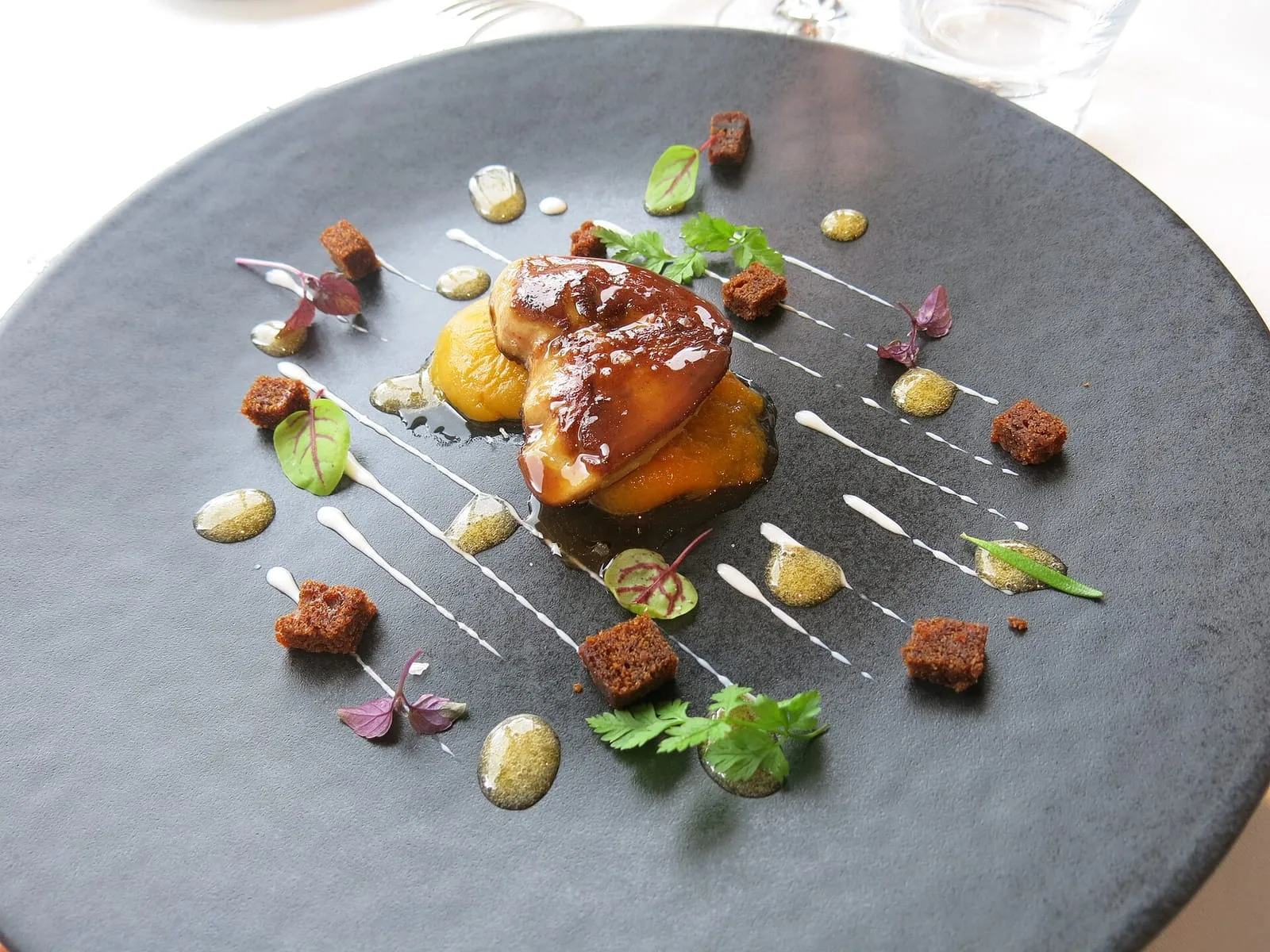
A pan-seared escalope is a different dish: hot, meltingly soft, with a caramelised crust and a light bitterness. The fat is thinner and easier to rinse, but the caramelisation demands freshness. A full dry white, an extra-brut Champagne or a young high-acid sweet wine all beat an old opulent Sauternes, which turns heavy against a hot plate.
Seared foie gras with fruit, apple, fig or mango, brings the two schools together: the sugar is already on the plate, so leave it out of the glass. That is where a demi-sec Vouvray shines.
Can you serve red wine with foie gras?
This is the family-dinner default and the biggest source of bad pairings. Fat and tannin do not clash the way people assume: the fat softens the tannin a little, but the tannin dries the liver and leaves a dusty finish. A young oaked Bordeaux on a terrine tastes like wet cardboard.
If you want red, take one with almost no tannin, fruity and served cool: Burgundy Pinot Noir, Fleurie, Chiroubles, or a ripe Loire Cabernet Franc. Same reasoning as in what wine goes with duck, except foie gras is fattier and less forgiving.
The genuinely good red answer is a fortified sweet red: Banyuls or Maury. Black fruit, cocoa, residual sugar and enough alcohol to carry the fat. It also sets up the roast bird that follows, covered in wine and Christmas capon.
What wines should you avoid with foie gras?
Four traps, all seen every December.
Tannic, oaky reds, young Bordeaux at the front. Mistake number one, and it is cultural more than culinary.
Sweet wines without acidity, industrial Muscat and cheap dessert wine. Sugar alone is not a pairing, it is paste.
Thin dry whites served too cold. A Sauvignon Blanc at 6 degrees does not cut anything, it just vanishes.
And the quantity trap: a full glass of sweet wine before the main course ends the meal early. Pour a third of a glass.
What serving temperature works best?
Take the terrine out of the fridge fifteen minutes ahead, because too cold it says nothing and the wine has nothing to answer. Serve sweet whites at 9 to 11 degrees, never ice-cold, or the acidity vanishes and only sugar is left. Dry whites 10 to 12, Champagne 8 to 10, light reds around 14.
In short
With a cold terrine and something sweet on the plate: sweet Jurancon, Loupiac or Sauternes. With pan-seared foie gras, or when it opens a long dinner: dry Jurancon, Alsace Riesling or extra-brut Champagne. In red: Banyuls or Maury, and nothing tannic.
The best thing you can do is open both, one sweet and one dry, and decide over the same plate. That side-by-side is worth more than any table, ours included. Everything else we have written sits on our wine pairing page.
Frequently asked questions
What is the best wine to serve with foie gras?
There are two right answers, not one. For a cold terrine served with fig jam, chutney or brioche, pour a sweet white with real acidity: Sauternes, sweet Jurancon or Coteaux du Layon. For pan-seared foie gras, or when foie gras opens a long dinner, pour a full-bodied dry white such as dry Jurancon or Alsace Riesling, or an extra-brut Champagne. Both are correct.
Does Champagne work with foie gras?
It works beautifully, and it is the smartest option when foie gras is the first course. Bubbles and acidity scrub the fat film off your palate instead of layering on top of it, so the rest of the meal still tastes of something. Choose a blanc de blancs extra-brut for pan-seared foie gras, and a richer vintage or demi-sec Champagne for a terrine. A brut Cremant does most of the same job for a third of the price.
Can you drink red wine with foie gras?
Only a narrow kind of red. Tannin dries out the liver and leaves a dusty, chalky finish, so young oaked Cabernet or Bordeaux is the classic mistake. If you want red, pick something with almost no tannin, served cool: Burgundy Pinot Noir, Fleurie, Chiroubles, or a ripe Loire Cabernet Franc. The genuinely great red answer is a fortified sweet red, Banyuls or Maury.
Does the wine change between terrine and pan-seared foie gras?
It changes a lot. A terrine is cold, dense and salty, it coats the palate, and it happily takes the sugar of a sweet wine, especially with chutney or fruit bread alongside. Pan-seared foie gras is hot, softer, with a caramelised crust and a faint bitterness. It wants more freshness: a full dry white, a low-dosage Champagne, or a young high-acid sweet wine rather than an old opulent Sauternes.
What is a good cheap wine for foie gras?
Sweet Jurancon from south west France is the best value on the shelf: Petit Manseng, candied citrus, bright acidity, usually 12 to 20 euros. Loupiac and Sainte-Croix-du-Mont sit across the Garonne from Sauternes, and Monbazillac makes the same style over in Dordogne, all for a fraction of the price. On the dry side, dry Jurancon or a demi-sec Vouvray hold up for about fifteen euros.