With raw oysters, pour a dry, unoaked, high-acid white: Muscadet Sèvre-et-Maine sur lie, Chablis or Picpoul de Pinet, at 8 to 20 euros. For fleshier flat oysters, step up to village Chablis or a low-dosage blanc de blancs Champagne. Serve at 9°C, and go easy on the vinegar mignonette.
An oyster arrives at the table already seasoned. Nobody salts it, nobody cooks it, and yet it brings salt, iodine, a light bitterness and a genuinely long finish. That is what makes the pairing both obvious and treacherous: any wine that is too ripe, too oaked or too sweet gets caught immediately.
Do cupped and flat oysters need different wine?
France produces roughly 80,000 tonnes of oysters a year and accounts for close to 90% of European output. Of that, about 98% are cupped oysters and 2% are flat oysters. These are not two sizes of the same animal, they are two different species, and they do not ask for the same glass.
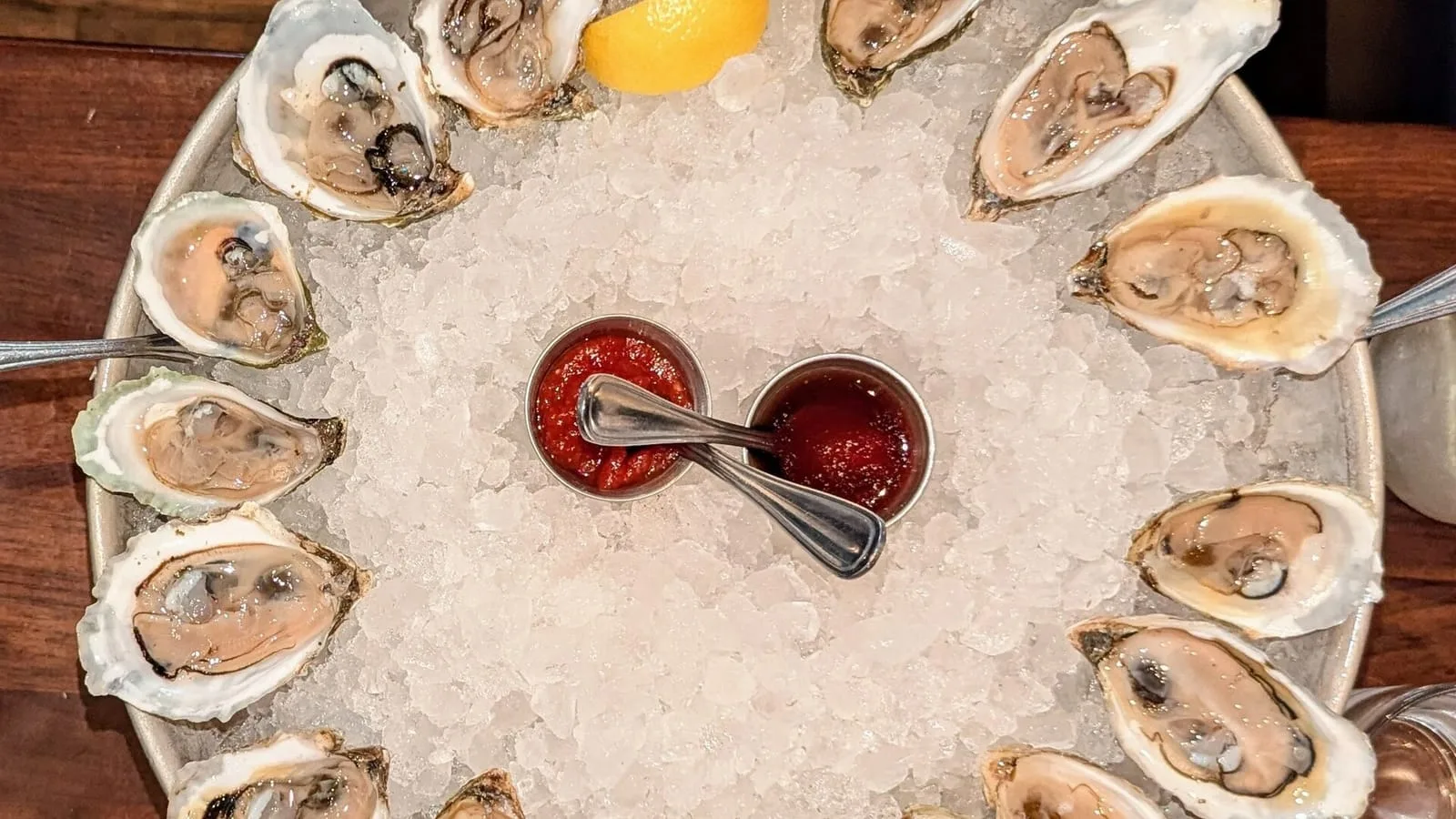
The cupped oyster has an elongated shell, crisp flesh and a flavour that leans towards cucumber, hazelnut or fresh butter. This is the everyday oyster, the one on the Christmas platter, and it is perfectly happy with a simple, sharp white.
The flat oyster is rounder, rarer and far more intense. A Belon, or a flat oyster from Cancale, carries a metallic bitterness and a persistence that can hold for thirty seconds. Entry-level Muscadet gets flattened by one. You need a wine with more tension and more body.
Grade matters too, and it runs backwards: the smaller the number, the heavier the oyster.
- Grade 5: 30 to 45g
- Grade 4: 46 to 65g
- Grade 3: 66 to 85g
- Grade 2: 86 to 110g
- Grade 1: 111 to 150g
- Grade 0: over 150g
Grade 3 is the platter standard and the baseline for every pairing below. Flat oysters use their own scale written in zeros, where more zeros means a bigger oyster.
One last variable: finishing. A fine de claire spends a few weeks in the clay basins of Marennes-Oléron, a spéciale de claire stays longer and comes out fleshier, sweeter and less saline. The fleshier the oyster, the more substance the wine can carry.
As for the old rule about months without an “r”, it was about summer spawning, not food safety. Between triploid oysters and modern refrigeration, you can eat them all year without worrying.
Why are Muscadet and Chablis the safe answers?
Because salt is in charge. An oyster deposits salt, iodine and umami on your palate, and salt does two measurable things to a wine: it erases part of the bitterness and it makes the wine taste fruitier, rounder, almost sweeter. A white that was already ripe turns heavy, and only real acidity resets the palate before the next oyster.
Muscadet Sèvre-et-Maine sur lie ticks every box. Melon de Bourgogne gives almost no dominant aroma, the lees ageing adds a slightly creamy texture and a faint prickle of carbon dioxide, and the finish is properly saline. It grows at the mouth of the Loire, forty minutes from the oyster beds of the Vendée coast. Budget 8 to 12 euros, or 15 to 20 for a cru communal such as Gorges or Clisson.
Chablis is the other reflex, for a geological reason that is almost too neat: the Kimmeridgian marl there is packed with fossil oyster shells. Chardonnay grown on it gives a straight, chalky wine with no vanilla at all when it is fermented in tank. Petit Chablis runs 12 to 16 euros, village Chablis 15 to 25. Avoid the new-oak cuvées, they are not built for this.
Three more dependable routes. Picpoul de Pinet, grown on the edge of the Thau lagoon among the oyster tables of Bouzigues, at 8 to 11 euros. Entre-deux-Mers or a dry white Graves, when you want Sauvignon Blanc with a bit more lift. And outside France, Albariño from Rías Baixas, Assyrtiko from Santorini or a dry Alsace Riesling, all working the same way: dry, taut, saline, never oaked. The same logic governs a whole seafood platter.
Is Champagne worth it with oysters?
Yes, but not any Champagne, and it is the dosage that decides. A standard brut can carry up to 12 grams of sugar per litre. On an oyster that residual sugar does not go unnoticed, because salt amplifies it and the mouthful ends on a syrupy note.
Aim for extra brut or brut nature, ideally a blanc de blancs, meaning 100% Chardonnay. You keep the acidity, the chalk and the bubbles, without the sugar. Those bubbles do real mechanical work: they lift the fat off the oyster and scrub the palate between tastes in a way no still wine quite matches. Budget 35 to 50 euros.
What to skip is the long-aged vintage Champagne, with its brioche, toasted hazelnut and oxidative notes. Those bottles are wonderful and they steamroll a raw oyster. Save them for cooked ones.
If the budget is tight, a brut Crémant de Loire, a Crémant de Bourgogne or a brut nature Cava at 10 to 16 euros does 80% of the job. On a shared platter, nobody will complain.
Lemon, mignonette or nothing: what changes for the wine?
Start by eating one naked. It is the only way to find out whether you have an oyster that is briny, sweet, nutty or frankly metallic, and therefore what to do next.
Lemon is the wine’s friend. Citric acid runs in the same direction as the acidity in the glass, it tightens the flesh, and it wakes up the softer texture of an over-fleshy spéciale.
Vinegar is another matter. Classic mignonette, shallot and red wine vinegar, is built on acetic acid, the one table acid you smell as much as taste. That volatile lift is the same note we call a fault in wine, and a heavy-handed mignonette puts it right under your nose as you drink. Two easy fixes: cut the vinegar back to a few drops, or replace the vinegar with the white you are serving, plus shallot and a lot of black pepper. Mignonette made with Muscadet is better than the original and it breaks nothing.
Rye bread and salted butter add fat and more salt, which raises the need for acidity and pushes you further towards Chablis or bubbles. Hot sauce and Tabasco simply take the wine out of the game.
Which wine goes with which oyster?
| Oyster or preparation | Wine to pour | Why it works | Indicative price |
|---|---|---|---|
| Grade 3 cupped, served plain | Muscadet Sèvre-et-Maine sur lie | Saline, neutral and sharp, it never covers the iodine | 8 to 12 euros |
| Grade 2 cupped or spéciale de claire | Village Chablis | More texture for flesh that is fatter and sweeter | 15 to 25 euros |
| Flat oyster (Belon, Cancale) | Extra brut blanc de blancs Champagne | Bubbles and chalk stand up to a metallic bitterness | 35 to 50 euros |
| Oysters with lemon | Picpoul de Pinet | Lemony acidity running in the same axis as the juice | 8 to 11 euros |
| Oysters with mignonette | Sancerre or Pouilly-Fumé | Sauvignon’s aromatic lift survives vinegar and shallot | 14 to 22 euros |
| Grilled, baked or poached oysters | Chablis premier cru or young Saint-Aubin | Heat and butter call for weight and a little richness | 25 to 45 euros |
| Oysters with hot sausage | Dry white Graves | Dry and faintly smoky, it bridges shellfish and pork | 12 to 20 euros |
| Large mixed shellfish platter | Well-chilled Manzanilla or Fino | Total dryness and flor salinity, an Andalusian classic | 12 to 18 euros |
What temperature, and how much per person?
Nine to eleven degrees for still whites, eight to ten for sparkling. Served at 5°C a Muscadet has no fruit and no salinity left, only acid, and that is the single most common mistake at an oyster lunch where every bottle sits in the same ice bucket all afternoon. Half an hour in the fridge is enough, or fifteen minutes in a bucket of ice and water. Never the freezer.
The glass matters as much. Use a normal white wine glass rather than a flute. A flute preserves the bubbles but traps the aromatics, and on a low-dosage Champagne that is exactly what you came for.
On quantity, six to nine grade 3 oysters each as a starter, a dozen if the platter is the meal. One 75cl bottle covers three people as a starter, two if you are settling in for the evening.
One detail people skip: shuck at the last minute and tip out the first liquor. The liquid that reforms ten minutes later is cleaner and less aggressive, and that is the one that should meet the wine.
What mistakes should you avoid with oysters?
Tannic red first. Iron reacts with the unsaturated fats in the shellfish and leaves a metallic bitterness, exactly the problem we describe with mussels.
Oaked Chardonnay second. Vanilla, butter and new wood over iodine give a fat, sweet mouthful that erases the oyster. Chablis works precisely because it has no oak.
Aromatic and off-dry whites are the third trap. Gewurztraminer, Muscat or demi-sec Vouvray turn clean salt into a fishy aftertaste.
Fourth, serving too cold, which we covered. Fifth, drowning the platter in vinegar.
The last one is about sequence: never serve oysters after a red wine course. Your palate holds on to the iron from the wine and a perfect oyster tastes metallic. Oysters open the meal, with scallops following on if you want to keep going. For everything else on your table, our pairings all live on the wine pairing hub.
Frequently asked questions
What is the best wine to drink with oysters?
Muscadet Sèvre-et-Maine sur lie, at 8 to 12 euros, is the most reliable bottle on the list: bone dry, sharp, saline and free of any dominant aroma that would cover the iodine. If your oysters are big and fleshy, move up to a village Chablis at 15 to 25 euros, which brings the same acidity with more texture and a chalky finish.
Does Champagne actually work with oysters?
Yes, provided you check the dosage. A standard brut can carry up to 12 grams of sugar per litre, and salt makes that residual sugar obvious straight away. Choose an extra brut or brut nature, ideally a blanc de blancs. The bubbles lift the fat and the acidity resets your palate between oysters. Budget 35 to 50 euros.
Can you ever drink red wine with oysters?
Almost never. Iron in red wine reacts with the unsaturated fats in shellfish and leaves a hard metallic bitterness, and the salt of the oyster, which rounds tannin off rather than hardening it, does nothing to fix that. The one tolerated exception is the southwest French ritual of oysters with hot sausage, where the red belongs to the sausage and not the oyster. Pour it afterwards, not alongside.
Should you use lemon or mignonette on oysters?
Eat the first one naked, because that is the only way to know what you actually have. After that, lemon is the wine's ally: citric acid runs in the same direction as the acidity in the glass. Vinegar mignonette is the problem: acetic acid is the one you smell as much as taste, and that volatile edge is the same note that marks a faulty wine. If you love it, make the mignonette with the wine instead of vinegar.
How many oysters and how much wine per person?
As a starter, six to nine grade 3 cupped oysters per person is plenty, and one 75cl bottle covers three people. If the platter is the whole meal, count a dozen oysters and half a bottle each. Shuck them at the last minute, tip out the first liquor, and pour into a normal white wine glass rather than a flute.