You have read the headline a hundred times by now. Young people are not drinking wine. Wine is in crisis. The category is dying, killed off by seltzer, sobriety, cannabis, GLP-1 drugs, and a generation that would rather be at the gym.
The numbers behind it are real, and they are not pretty. US wine sales dropped below 300 million cases last year for the first time in two decades. Measured by taxable removals, the volume entering the American market fell from a peak of 743 million gallons in 2020 to 554 million in 2025. That is a quarter of the market gone in five years, and four consecutive years of decline.
So the crisis is real. But a white paper published on 18 August argues that almost everybody has misdiagnosed what it actually is, and we think the argument is the most interesting thing written about wine this month.
The claim: this is a crisis of discovery
Jason Wilson and Caroline Lamb, writing at Everyday Drinking, put it simply. The industry does not have a demand problem. It has a discovery problem. People have not stopped being capable of loving wine. They have stopped being able to find the wine that would make them love it.
Their term for what is missing is a “wine of discovery”: in their words, “a compelling, affordable bottle that leads to a consumer’s better understanding of wine, and of their own tastes.” Something cheap enough to gamble on, and distinctive enough to actually taste of somewhere.
And then they say something that we have been circling around on this site for years, but they say it more bluntly than we ever have. The industry’s response to declining interest has been to apologise for wine. To simplify it, strip out the geography, drop the words, and sell people an inoffensive sweet red with a cartoon animal on the label as a “starter wine”. They call the starter-wine concept bogus, and one of the most cynical marketing tactics going, because it gives large wineries cover for knowingly making and selling bad wine.
Their line on it: “when the industry starts apologizing for wine’s depth, it strips away exactly what draws in real wine consumers.”
That is exactly right, and it is worth sitting with for a second. The theory behind a starter wine is that you begin with something simple and sugary and graduate later. In practice nobody graduates, because nothing about the experience suggested there was anywhere to graduate to. If your first bottle tastes like squash, wine has told you what it is, and you have no reason to spend a Saturday finding out otherwise.
The plumbing broke, and that is why
The paper’s real contribution is explaining why discovery stopped working, and it is not about consumer taste at all. It is about pipes.
According to their figures, the US had over 3,000 independent wine distributors in the 1990s. Today there are roughly 1,000. Eighty-one percent of wine sold in America now moves through the top ten distributors alone. E&J Gallo is the largest supplier in the country by a distance.
We will add one small correction here, in the spirit of checking things. The paper says Gallo controls “more than a third of all wine in the market”. The most recent supplier rankings put Gallo at 32.6% of US wine market share on around 90 million cases. So it is roughly a third rather than more than a third. The difference does not weaken their argument even slightly, and honestly the fact that we are quibbling over whether one company controls 32% or 34% of a national wine market is itself the entire point.
What consolidation did, they argue, is turn distributors from advocates into logistics companies. A distributor with 200 wines and a passionate sales rep could walk an interesting Muscadet into forty restaurants. A distributor with 12,000 SKUs and a sales target cannot, and will not. As the paper puts it, distributors “are no longer able to create demand for wines of discovery, and they haven’t been able to for a long time.”
So there are, right now, thousands of genuinely lovely bottles sitting in importer and distributor portfolios that nobody is pushing, competing on the shelf against industrial wine at exactly the same price, and losing, because the industrial wine has a marketing budget and they have nothing.
The wine did not disappear. The person who would have told you about it did.
Where we part ways: the price
Here is our one real disagreement, and it matters.
Wilson and Lamb put their wines of discovery at $21 to $29 retail. They have a reason: sales in that band are growing while the market shrinks, and yet it is still only about 7% of the market, so there is obvious room. Fine. As a commercial strategy for American importers, it is probably correct.
As a description of where good wine starts, we think it is too high, and we think saying it out loud does some quiet damage.
Because that $21 floor is not a fact about wine. It is a fact about the American market. It is what happens when you take a bottle, add a 15% tariff, run it through three mandatory legal tiers that each take a margin on the previous margin, and land it in a country where distribution is controlled by ten companies. The floor is an artifact of the plumbing the paper itself just spent five thousand words describing.
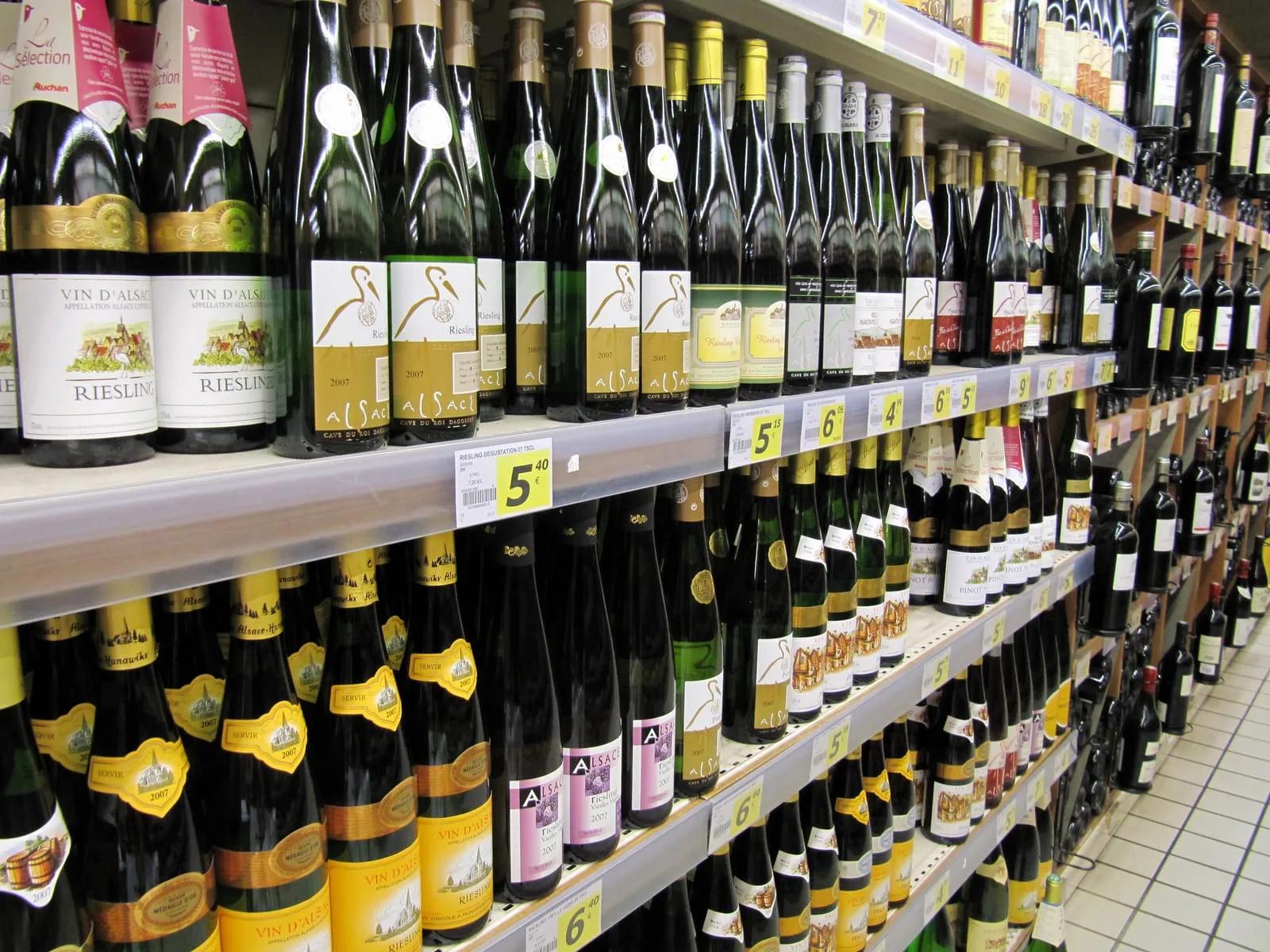
Walk into a decent shop in France, Spain, Portugal or Italy and the discovery band starts around €8 and is in full flow by €12. Not compromise wine. Actual wine, of somewhere, made by someone. A Loire Chenin, a cru Beaujolais, a Dão, a Sicilian Nerello, an Alsace Riesling like the ones on the shelf at the top of this article. Alsace in particular is almost a parody of an undervalued region: some of the most precise white wine in the world, priced like it is apologising.
So we would put it differently. The problem is not that cheap wine exists. The problem is that nobody tells you which cheap wine is real.
That is a discovery problem too. It is just a more generous one, because it does not begin by telling somebody on a tight budget that they need to spend more before they are allowed to have good taste.
The number that actually explains a cheap bottle
There is one place where the “spend a bit more” advice is genuinely, mathematically true rather than just snobbery in a nice jacket, and almost nobody explains it properly. So here it is, with the working shown.
In the UK, wine duty is charged on alcohol, not on price. From February 2026 the rate is £30.62 per litre of pure alcohol. A standard 75cl bottle at 12.5% ABV therefore carries £2.87 of duty, and it carries exactly the same £2.87 whether the bottle sells for £8 or £80. Add VAT at 20% on top of the whole retail price.
Run two bottles through that:
- An £8 bottle: £2.87 duty, £1.33 VAT. That is £4.20 of tax, leaving £3.80 to cover the glass, the cork, the label, the shipping, the importer’s margin, the retailer’s margin, and, somewhere at the end of that queue, the wine.
- A £20 bottle: £2.87 duty, £3.33 VAT. That is £6.20 of tax, leaving £13.80 for the same list.
You paid 2.5 times the price and got 3.6 times the money that is not tax. That is the whole mechanism. A flat per-alcohol duty is brutally regressive against cheap wine, which is why the jump from £8 to £15 transforms what is in the glass while the jump from £40 to £80 mostly buys scarcity and a reputation.
We are showing the arithmetic because a version of this circulates as a much punchier claim, the one about a £7 bottle containing “62p of actual wine”. That figure is stacked on a pile of unstated assumptions about margins and freight, and the versions going round appear to use pre-February duty rates. The direction is right. The decimal point is invented. We have written before about wine statistics that turn out to be somebody’s press release, and this is the same species.
Note also what this means outside the UK and the US. In much of Europe, still wine duty is zero or close to it. That is not a small detail. It is most of the reason a €9 bottle in Lisbon can be a genuinely good wine and a £9 bottle in London mostly cannot be. Same continent, same producers, completely different arithmetic.
“I think about this every time somebody tells me they do not really like wine. Almost always, when I ask what they have drunk, the answer is a list of wines I also would not like. They have not rejected wine. They have rejected the four bottles the system put in front of them. That is not a taste problem, it is an access problem, and it is fixable in about one evening.” — Antoine
What actually fixes it
The paper’s answers are aimed at the trade, and they are good ones: wineries have to position themselves instead of waiting for a distributor to do it, the industry should back the people who actually advocate for wine, and there is an enormous underserved market outside the coastal cities, where roughly 75% of Americans live. It also makes the nice observation that more than 20,000 Americans are currently enrolled in WSET courses, which is 20,000 potential evangelists that nobody has thought to mobilise.
But if you are reading this as a person who drinks wine rather than sells it, the fix is smaller and more immediate. Discovery is a human being telling you about a bottle. That is all it has ever been. So:
Find one merchant and become a regular. Not an app, not an algorithm, a person. Tell them honestly what you liked and what you did not, including the wines you found boring. A good independent will start pulling things off the shelf for you within three visits, and this is the single highest-return thing you can do for your drinking. It costs nothing.
Buy the unfashionable neighbour. Every famous appellation has one next door making similar wine at a third of the price, because it has the wrong name. Sancerre has Menetou-Salon and Quincy. Châteauneuf has Vacqueyras and Cairanne. Barolo has Langhe Nebbiolo. Chablis has Saint-Bris and Petit Chablis. This one trick is most of value wine.
Follow the importer, not the producer. On the back label of most imported bottles there is an importer’s name. If you loved a wine, that importer’s taste matched yours, and they have a whole book of other wines chosen by the same palate. This is the closest thing to a cheat code that exists in wine retail and hardly anyone uses it.
Buy the odd grape. Assyrtiko, Trousseau, Blaufränkisch, Xinomavro, Mencía, Cinsault. Unfamiliar names cannot charge a premium for their fame, so the price reflects the wine and only the wine. This is the cheapest quality in the entire market and it is sitting there in plain sight.
Give a bottle a fair hearing. Serve it at the right temperature, in a glass big enough to smell out of, ideally with food. Half the wines people write off were simply served badly. We put the full version of this in how to choose wine.
None of that requires spending $21, or £15, or €12. It requires one person telling you one true thing about one bottle, which is precisely the service that a thousand distributor consolidations quietly deleted.
That is what the white paper gets right, and it is why the piece deserves the attention it is getting. The wine is still there. It was always still there. We just dismantled the part of the machine whose job was to introduce you to it.
Sources: Jason Wilson and Caroline Lamb, Everyday Drinking, VinePair, HMRC alcohol duty rates, Silicon Valley Bank State of the US Wine Industry
Hero photo: wines from Alsace on a supermarket shelf, by francois from Strasbourg, CC BY 2.0, via Wikimedia Commons.