LVMH’s partner in Ningxia has put its 40% share of the Chandon China vineyard business up for sale, and the starting bid is one yuan. That is about 13 euro cents.
The headline writes itself, and most of the coverage we have seen ran it more or less as written: luxury giant’s China wine project, sold off for the price of a sweet. It is a good line. It is also not what is happening, and the gap between the two is a small lesson in how wine businesses are actually built.
What is actually for sale
The seller is Ningxia State Farm Group, a state-owned agricultural company. The listing went up on the Ningxia Technology Resources and Property Rights Exchange at the end of September, and the Chinese business press had it on 30 September, a week before the English-language trade caught up. Online bidding closes on 22 October.
What it is selling is 40% of Moët Hennessy Chandon (Ningxia) Vineyard Co., set up in October 2011. The other 60% belongs to Moët Hennessy.
The important word is vineyard. This company grows grapes on Huangyangtan Farm in Yongning County, south of Yinchuan, and sells them. It does not make the wine. Chinese reports say the winemaking, the selling and the visitor side of the estate sit in a separate company that Moët Hennessy owns outright. Nobody is selling Chandon China. A state farm group is selling its minority share of the business that farms the land.
Why one yuan buys you very little
The one yuan is a minimum bid, and it has to be read next to the balance sheet published with the listing:
- End of 2025: assets of RMB 19.73 million, liabilities of RMB 37.09 million, so shareholders’ equity of minus RMB 17.36 million.
- End of August 2026: assets of RMB 19.31 million, liabilities of RMB 36.58 million, equity of minus RMB 17.27 million.
The company owes about twice what it owns. A 40% stake in a business with negative equity is not worth much more than nothing, which is roughly what is being asked for it.
The conditions are where the real price sits. According to the Chinese reports of the listing, the buyer has to accept the company’s existing debts, including loans from related companies, show a reserve or a financing plan to repay them, and see them cleared by the end of 2026. Payment is in one go, no consortiums, and the bidder needs international management experience. Moët Hennessy, as the existing shareholder, has a right of first refusal, and the Chinese trade commentary we read expects it to end up taking the stake itself.
So the honest version of the headline is: a state partner wants out of a loss-making farming company, and the likeliest buyer is the partner it is leaving.
The number that does not add up
Here is where we went back and read the figures again.
The listing says the vineyard company booked revenue of RMB 3.60 million and a net profit of RMB 1.47 million in the first eight months of 2026. That reads like a turnaround.
But the equity line barely moved. It went from minus 17.36 million to minus 17.27 million, an improvement of about RMB 90,000. If the company really made RMB 1.47 million and kept it, equity should have improved by something close to that. It improved by roughly a sixteenth of it.
There are ordinary explanations. Money can leave a company through a payout or an intercompany charge, the profit figure may be calculated on a different basis from the balance sheet, or an adjustment we cannot see may have eaten most of it. We cannot tell which from what has been published, and we would not quote the profit as a recovery until someone can.
Where the money sits in a wine business
The most interesting thing in the Chinese coverage is not the price. It is the structure.
Commentators in the Chinese wine trade press point out that the set-up puts the low-margin work, growing grapes, in the company with a local partner, while the high-margin work, turning those grapes into bottles of sparkling wine that sell from around RMB 300, sits in the company Moët Hennessy owns alone. Whether or not that was the intention in 2011, the effect is plain: the farm carries the cost and the risk, and the brand keeps the margin.
That is not a Chinese quirk. It is how most of the wine world works. In Champagne, growers own the overwhelming majority of the vines and the big houses sell most of the bottles, and the argument over the price of a kilo of grapes has run for a century. In Bordeaux, the people who farm the land and the people who make money on the label are very often not the same people. Wherever you look, the grower is the one who absorbs a frost, a heatwave or a bad year, and the brand is the one that gets to set the price on the shelf.
The Ningxia listing is just that arrangement written down in a balance sheet, with the numbers attached.
Is Chandon China in trouble?
Nothing in the listing says so. The vineyard company is losing money; the winery company’s accounts are not part of this sale and have not been published.
And Chandon China is selling the one style of wine that is growing in China right now. China’s customs data for the first half of 2026, as reported by Vino Joy News, show sparkling as the only import category that rose in both volume and value: 4.4 million litres, up 16.3%, worth US$39.1 million, up 20.9%. Bottled wine, by contrast, fell 14.6% in volume and only held its value because the average bottle got dearer. A local traditional-method sparkling with a famous name on the label is well placed for that.
If you buy a bottle of Chandon from Ningxia next year, it will very likely be made from the same vines by the same team. What is changing is who owns a share of the dirt.
What we are watching
Whether anyone other than Moët Hennessy bids before 22 October, and whether LVMH uses its right of first refusal and ends up owning the whole operation, vines and winery together.
It is also worth watching what other state partners do. A lot of foreign wine projects in China were built as joint ventures with local state-owned groups, and a state group deciding a loss-making stake is no longer worth carrying is a quieter story than a winery closing, but it tells you more about where the money thinks Chinese wine is going. We looked at another way Chinese wine is trying to build its audience, with music rather than capital, in our piece on Canaan Winery and its jazz festival.
Sources: Vino Joy News on the stake sale, Sina Finance (Jiuyejia) on the listing terms, Eastmoney on the listing, Vino Joy News on China’s H1 2026 wine imports, LVMH on Chandon China
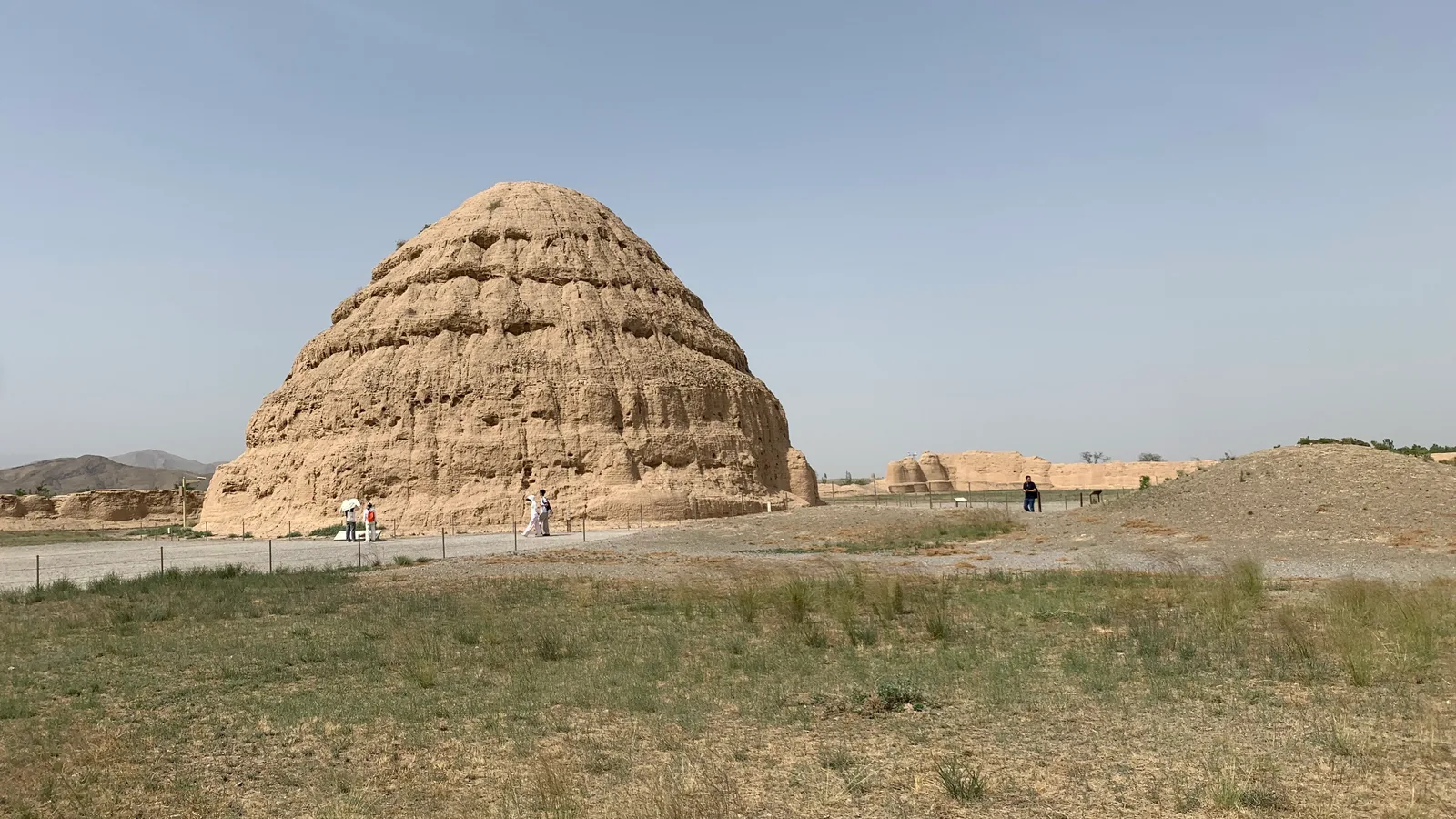
Hero photo: a Western Xia royal tomb on the plain below the Helan Mountains, Ningxia, CC0, via Wikimedia Commons.