Vino Joy News ran a piece at the start of the month about Canaan Winery, in Huailai county in Hebei, about eighty kilometres northwest of Beijing. The framing was how a Chinese winery goes global. The detail that stopped us was much smaller: the winery runs an annual music festival, and it treats that festival as part of the job rather than as marketing.
If that sounds like a gimmick, we would point you at Marciac.
What Canaan is
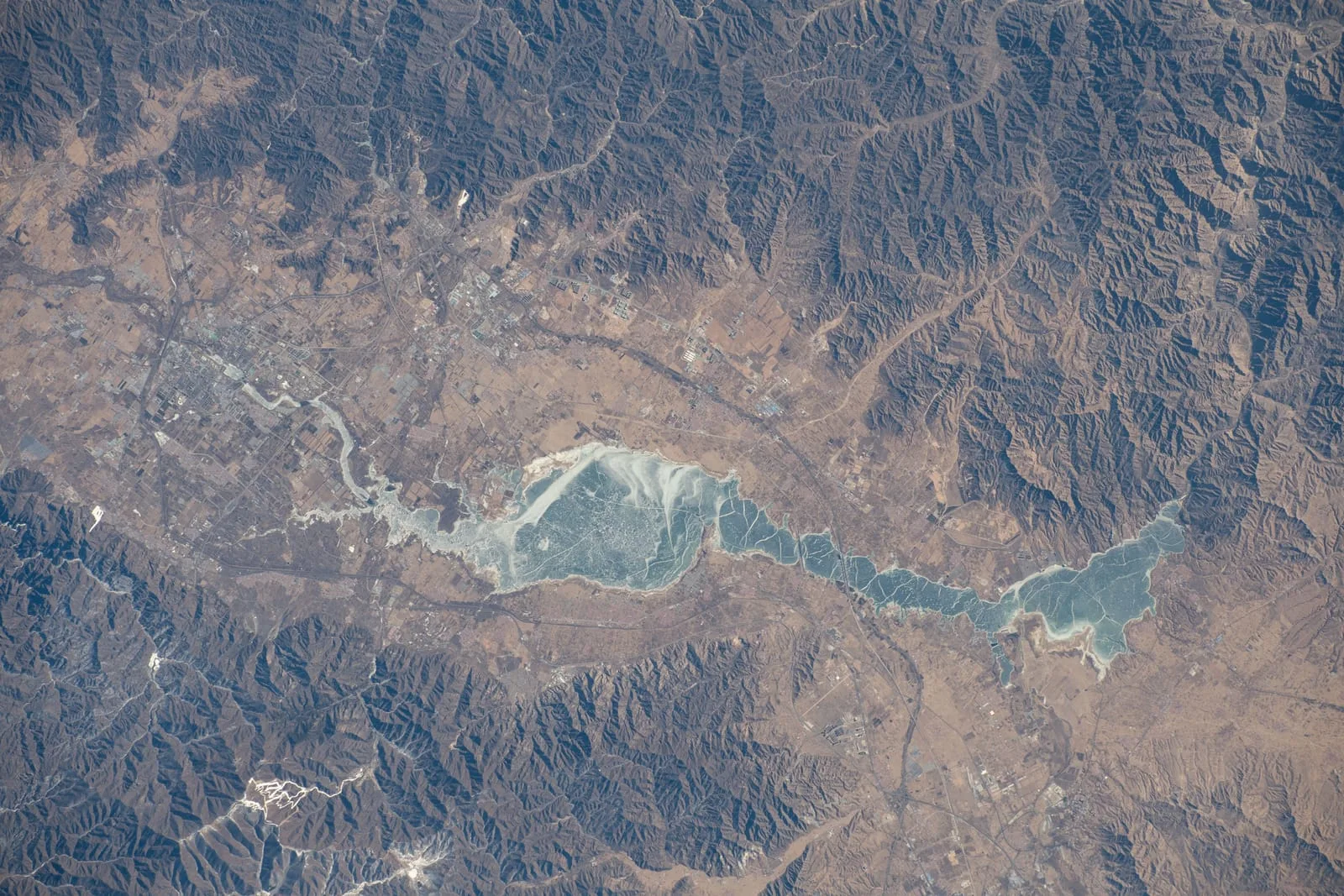
The project started in 2006 with a search rather than a vineyard. The team spent two years covering something like 17,000 kilometres across eleven provinces looking for a site, and settled on Huailai for a fairly specific set of reasons: a continental monsoon climate, a large day-to-night temperature swing, and the moderating effect of the Guanting Reservoir sitting right there in the basin.
That reservoir is the photograph at the top of this article, taken from the International Space Station. It is worth a look, because it explains the choice better than a paragraph does. The vineyard is not on a famous slope. It is in a mountain basin next to a large body of water that keeps the extremes off.
The first vines went in in 2009. The winery was finished in 2012. The plantings run from around 498 to 1,050 metres of altitude across three sites, in Riesling, Chardonnay, Tempranillo, Syrah and Merlot, which is not a list anyone would have predicted for northern China. In 2023 it became the first Chinese winery ever to make the World’s Best Vineyards list, at number 80, and in 2024 it was the only Chinese winery on it, at 77.
And in 2023 it launched a music festival.
Why the festival is not a side project
Here is the problem Canaan is actually solving, and it is not a wine problem.
China does not have an inherited wine culture. There is no equivalent of a French household where a bottle appears on the table on a Wednesday because that is simply what happens. Wine arrived in China as a business object: something you bought for a boss, a client or a banquet, in a red bottle, at a price chosen to be visible. That model has been collapsing for several years. The banquet trade has contracted hard, and what is growing instead is people buying wine for themselves, at home, in lighter styles.
Which is good news and a very difficult commercial problem at once. If wine is no longer a gift, it has to become a habit, and nobody has a habit they were sold. You cannot advertise your way into somebody’s Tuesday evening.
So you do the slow thing. You get people to come to the place. You put on something they would have wanted to attend anyway, and the wine is simply there, in their hand, while they are enjoying themselves. Canaan pairs that with wine education, including partnerships with WSET providers in Beijing. The festival is not there to sell the bottles in the room. It is there so that in ten years there is a room.
That is a twenty-year business plan being executed by a winery that has existed for twenty years.
Gascony got there first
Antoine’s first reaction to the story was that it sounded like Jazz in Marciac, and he is right, to a degree that is almost funny.
Marciac is a village in the Gers, in Gascony, about twelve hundred people. Its jazz festival is now one of the biggest in Europe and draws something in the region of 200,000 people over three weeks. And Plaimont, the Gascon co-operative behind Saint-Mont, Madiran and a large slice of Côtes de Gascogne, has been a partner since the festival’s beginning, roughly forty years ago.
Not a logo on a poster. Plaimont pours at the festival, runs tastings through it, and since 2012 has staged its own free concert at Château de Sabazan, in the middle of the Saint-Mont vineyard, so that the audience ends up standing in the appellation rather than reading about it. Marciac is effectively the southern gate of the Saint-Mont vineyard, and Plaimont has spent four decades making sure that people arriving for the music leave knowing what Saint-Mont is.
Consider what Saint-Mont had to work with. It is a tiny appellation in a corner of southwest France that most French people could not place on a map, growing grapes almost nobody outside the region has heard of, with no classification, no first growths and no Parker history. By every conventional measure it should be invisible. It is not, and one of the larger reasons is that it attached itself to a reason for people to come.
We talked to Olivier Bourdet-Pees, Plaimont’s director, on the podcast a while back, in episode 40. What comes through is that none of this is a marketing department’s idea. It is what a co-operative does when it decides the region matters more than any single label in it.
What the two have in common
Both are working the same problem from opposite ends of the world: a wine that nobody has a prior reason to care about, and no shortcut available.
Neither of them has a famous name to lean on. Neither can rely on a classification or a critic. Both concluded that the way to build demand is to build a reason to be there, and then let the wine happen in the middle of it. It is slow, it is expensive, and it is the only method we have ever seen actually work for a region starting from zero.
It is also, quietly, the anti-snobbery position. A festival does not ask you to know anything. Nobody at Marciac is being tested on Tannat, and nobody at Huailai is being asked to identify Riesling blind. You turn up for the music, somebody hands you a glass, and you find out that you like it. That is how almost every wine drinker we know actually started, and it is nothing like how the wine trade usually tries to recruit people.
The bit we will be watching
Canaan’s export ambition is the part that could go either way. Building a domestic habit and selling bottles abroad are different projects, and Chinese wine has generally been better received by judges than by importers.
But the domestic side is the one that matters more, and it is the one where the model is already proven, just not in China. If Chinese wine finds its audience, it will not be because it won a medal. It will be because a few thousand people spent a September weekend in a vineyard basin with a band on and a glass in their hand, and then bought a case on the way out.
Ask Gascony how that ends.
Sources: Vino Joy News on Canaan Winery, Vino Joy News on the World’s Best Vineyards listing, Plaimont on Jazz in Marciac, Aquitaine Online on forty years of Plaimont and jazz
Hero photo: the Guanting Reservoir, northwest of Beijing, photographed from the International Space Station on 15 February 2024. NASA Johnson Space Center, public domain, via Wikimedia Commons.