Australian white wine exports to mainland China jumped 143.6% by volume in the third quarter of 2026, standing out sharply in an otherwise tough quarter for Australian exporters. Globally, Australian wine shipments dropped in both volume and value between July and September, with steep declines in the United Kingdom and the United States. Mainland China went the other way, lifted largely by white wine moving off Australian docks at more than double last year’s pace.
The catch is sitting right beside that 143.6% headline. Value rose 51.9%, less than half the pace of volume, which pulls the average price per litre down roughly 38% from a year ago. Looking at both numbers side by side tells a far more grounded story than celebrating a single triple-digit percentage.
What the Q3 2026 export figures actually show
Data published by Wine Australia and reported by Vino Joy News on 13 November puts the third-quarter white wine surge into a wider export picture. While mainland China grew slightly overall, Australia’s next two biggest value markets pulled back sharply:
| Destination or segment (Q3 2026) | Volume | Volume YoY | Value | Value YoY |
|---|---|---|---|---|
| White wine to mainland China | 5.26M litres | +143.6% | A$11.87M | +51.9% |
| All wine to mainland China | 17.06M litres | +14.9% | A$166.33M | +1.9% |
| All wine to the United Kingdom | 44.50M litres | -8.7% | A$81.81M | -12.6% |
| All wine to the United States | 29.52M litres | -4.5% | A$63.70M | -12.5% |
| Global Australian wine exports | 148.25M litres | -4.7% | A$520.57M | -7.3% |
Sparkling shipments to mainland China also climbed from a small base, up 25.4% in value to A$1.95 million and 22.8% in volume to 171,818 litres. Red wine value, by contrast, slipped 0.5%. That means white and sparkling shipments supplied all of China’s modest third-quarter value growth for Australia.
The dock-price math nobody put in the headline
Divide A$11.87 million by 5.26 million litres and you get an average free-on-board (FOB) export value of A$2.26 per litre for Australian white wine bound for mainland China. In standard 750ml bottle terms, that is about A$1.69 before shipping, duties, importer margins and retail markup. Using the reported growth rates (1.519 divided by 2.436, minus one), the average export value per litre dropped roughly 38% compared with Q3 2025, when the unit average sat around A$3.62 per litre.
Contrast that with Australia’s overall China export basket in the same quarter: A$166.33 million across 17.06 million litres equals A$9.75 per litre (around A$7.31 per 750ml bottle FOB). Mainland China bought more than twice as much Australian wine by value as the UK while sitting only fourth in volume behind the UK, the US and Canada. Wines priced at A$10 or more per litre FOB generated A$137.82 million in mainland China alone, accounting for 59% of Australia’s worldwide earnings in that A$10+ bracket (A$233.50 million).
Does a 38% drop in the white-wine average mean a particular bottle suddenly became 38% cheaper? No. An average shifts whenever the mix shifts. South Australia led all regions into mainland China at A$106.55 million (up 32%), yet the second-largest slice at A$16.78 million was “No Label Claim” wine carrying no stated regional origin at all. Ship a few million extra litres of commercial or bulk white wine alongside smaller allocations of estate Chardonnay, and the per-litre average plunges even if top producers held their prices firm.
We saw a similar dynamic in our analysis of New Zealand’s export volume-value gap, where a +72% China volume jump hid a 28% drop in average FOB price per litre. Volume grabs headlines; price per litre tells you who is actually getting paid.
Burgundy alternatives, Hunter Valley Semillon and the 7.14% reality check
Why is Chinese interest in Australian white wine growing at all right now? Over the past two years, white wine has gained traction in China, especially among younger drinkers and women, creating space in a category previously led by New Zealand Sauvignon Blanc and German Riesling.
Shanghai Pran Wines CEO Hong Boyong told Vino Joy that customers have started asking specifically for Hunter Valley Semillon as well as premium Australian Chardonnay, including Burgundy lovers looking for compelling value outside increasingly expensive Côte de Beaune whites. Producers such as Margaret River’s Leeuwin Estate have also been actively pouring their whites at tastings in Shanghai.
Still, we need to keep the proportions honest:
- White wine accounted for just 7.14% of Australian export value to mainland China in Q3, against 91.62% for red wine.
- Worldwide, white wine makes up 27.74% of Australian export value, versus 70.38% for reds.
China remains overwhelmingly a red-wine market for Australian producers. A 7.14% share leaves genuine room to grow, provided buyers come back for second and third orders rather than treating white wine as a one-off container fill.
Keeping the 9-month, 12-month and regional Asia data separate
One trap in trade reporting is blending different time windows or lumping all of Asia together. Across the first nine months of 2026, Australian export value to mainland China was actually down 10.4% to A$758.59 million, even while volume rose 8.2% to 79.31 million litres. Seen in that context, Q3’s slight +1.9% value gain suggests importers may be working through earlier post-tariff stock and beginning to reorder.
Step back further to Wine Australia’s October market bulletin, which tracks the twelve months ending September 2026: total global Australian exports fell 7% in value to A$2.25 billion and 5% in volume to 590 million litres.
Even within Asia, where six of Australia’s top ten export markets by value sit, Q3 2026 went in completely different directions:
- Singapore fell 16.0% in value to A$20.62 million (volume down 12.0% to 1.32 million litres).
- Hong Kong, kept strictly separate from mainland China data, dropped 22.5% in value to A$15.00 million (volume down 19.7% to 1.38 million litres).
- Japan fell 16.8% in value to A$10.35 million (volume down 5.0% to 2.58 million litres).
- Thailand jumped 26.3% in value to A$14.67 million even as volume dropped 14.1% to 1.47 million litres, pointing to a sharp trade-up toward higher-priced bottles, nearly catching Hong Kong.
- Indonesia posted the fastest percentage rise in the top ten, climbing 59.0% in value to A$7.66 million on 44.0% higher volume (376,974 litres).
Calling Q3 an “Asia boom” or a “China white wine takeover” misses how uneven that map really is.
What to watch next, and what to pour in your glass
For anyone watching the trade, the real test comes over the next two quarters: do Chinese importers reorder once Q3 containers land in warehouses, and does retail sell-through hold up at full price once launch promotions fade? Shipments leaving Adelaide or Sydney only mark the first mile of a bottle’s journey.
For drinkers, export stats are simply a reminder to look beyond dusty stereotypes of 1990s over-oaked Australian whites. Modern cool-climate bottlings from Margaret River, Adelaide Hills or Tasmania offer tense, linear Chardonnay with bright acidity and restrained oak. Even more distinctive is Hunter Valley Semillon, bottled dry at 10.5% to 11.5% alcohol, bracingly citrusy in its youth and quietly honeyed with toast and beeswax character after a few years in bottle, often at half the price of a village white Burgundy. Tell your wine merchant whether you want electric freshness or fuller texture, and let your palate judge whether Australia belongs in your white-wine rotation.
Sources: Vino Joy News report on Q3 2026 Australian wine exports, Wine Australia Market Bulletin Issue 375
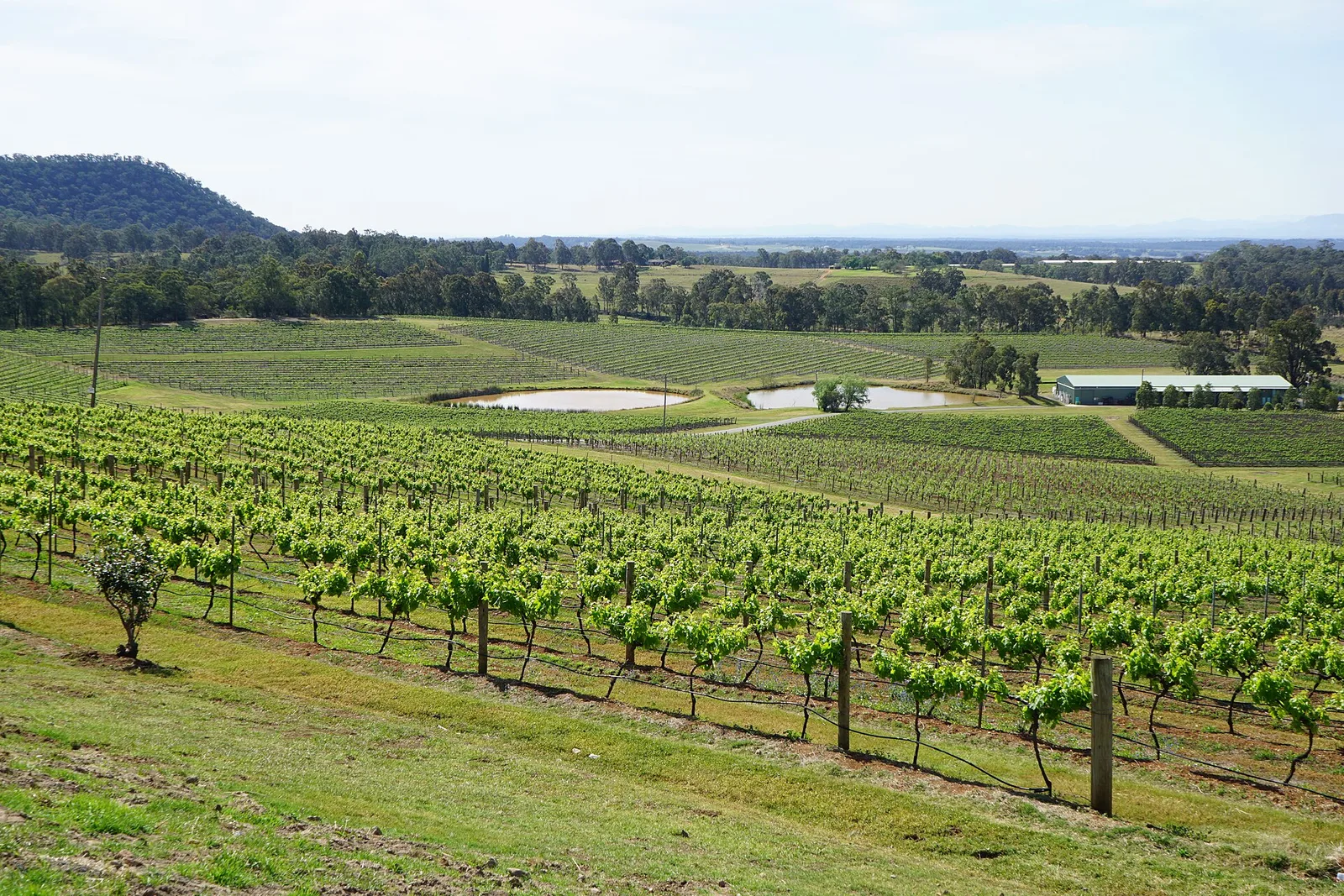
Hero photo: vineyards in the Hunter Valley, New South Wales, Australia, by thinkrorbot, public domain, via Wikimedia Commons.
Frequently asked questions
Do rising export shipments prove Chinese consumers are drinking more Australian white wine?
No. Export statistics track shipments leaving Australia, not retail sell-through or consumption. Importer restocking and inventory clearances can lift a single quarter even when retail sales move more slowly.
Why did Australian white wine export volume to China (+143.6%) grow faster than value (+51.9%)?
Average export value fell roughly 38% year-on-year to A$2.26 per litre FOB (about A$1.69 per 750ml bottle). That points to heavy shipments of entry-level or commercial white wine alongside smaller volumes of fine Chardonnay and Semillon.