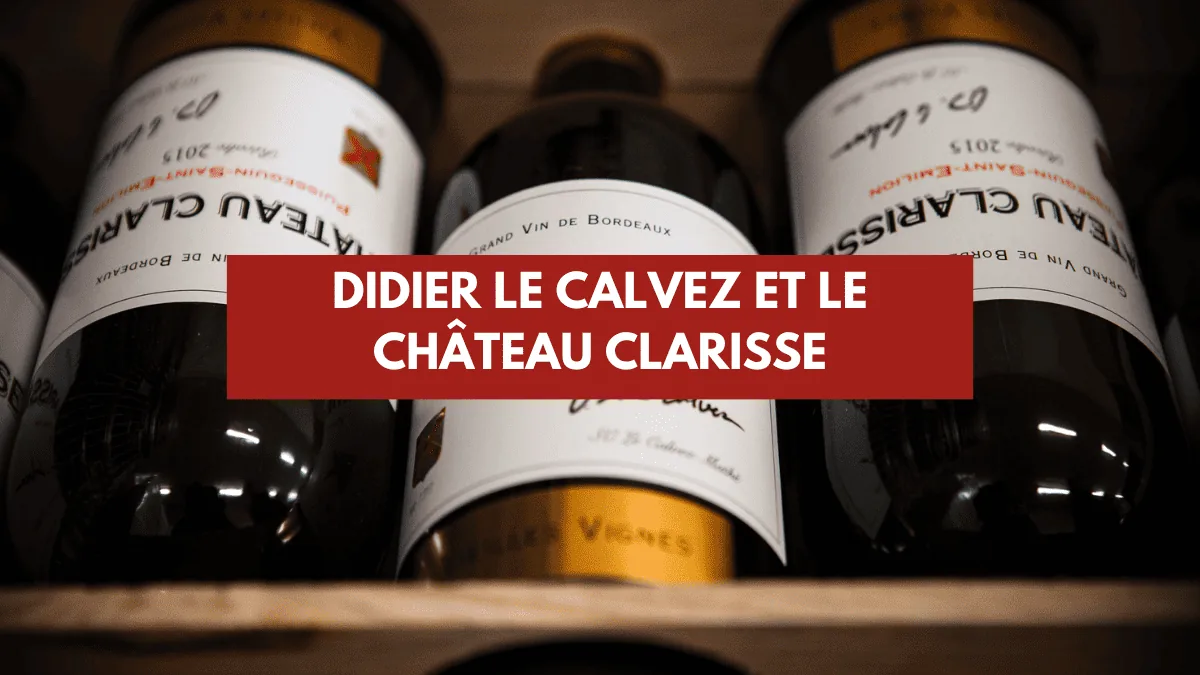
For this new episode of the Wine Makers Show, your wine podcast, I went to meet Didier Le Calvez. With a rich career in hospitality, Didier is launching into wine with this incredible adventure. He tells us about his journey and takes us into the heart of Château Clarisse. If your wine cellar doesn’t yet contain a few bottles, you know what’s left for you to do. I wish you a wonderful listen and an enjoyable read!
Before Château Clarisse: a career at the heart of hospitality
Antoine
Can you start by introducing yourself.
Didier Le Calvez
I’m Didier Le Calvez, owner of Château Clarisse. I have a hospitality background prior to this experience in the world of wine, with many other activities related to project management assistance, hotel marketing, the press. For five years now, I’ve been an autonomous entrepreneur with my wife and apart from that, there are 45 years of hospitality experience.
Antoine
We’re going to dive a bit into the past first to understand all this journey, but what struck me when we met or when Alexandre Lazareff introduced us, is that he introduced you as the person who created the George V. You don’t quite agree, but can we go back a bit to your career, really understand how you started and how all of that ultimately led you to wine?
Didier Le Calvez
Of course. In very simple terms, my family is from the Île-de-Ré. Me, I’m of Breton origin, Breton-Périgord, if I may say so. I chose hospitality as a profession. To keep it short, I went 25 years abroad. I spent about 10 years in Asia and 15 years in the United States. I had the chance to work in the Philippines, Korea, and Hong Kong, and each time very young, doing hotel openings. I participated in the opening of the Manila Hotel in 1977. Then I spent four years in Korea. I participated in the opening of the Shangri-La in Hong Kong in 1981. Following that, Westin Hotel, which was my employer at the time, gave me a very nice opportunity in Texas in 1982. I was promoted to assistant director of their hotel in Texas. I was 29 at the time. I was then promoted to director of food and beverage for the group based in Seattle. As an aside, I was in Seattle in a city no one knew, and I lived in Redmond. When I started in Seattle in 1985, in Seattle, people told me “There’s this little company where everyone has done very well, but it’s too late to invest because the good deals have been done.”
Of course, that was Microsoft. I then had the chance to go to New York. New York in ‘88, I was the last director of the Plaza. Mr. Trump was the owner, so I had the Plaza with its 800 keys. I think we had eight restaurants at the time. Then I went with Four Seasons to the Pierre. The Pierre was part of the Four Seasons group, and I stayed with Four Seasons for 18 years. Besides Four Seasons, I was repatriated for two and a half years to take over the Regent group in Asia with Four Seasons. I had very good results in Singapore, very good results again at the Pierre until ‘98. And it’s these results that allowed me to get the promotion to open the George V, which was a privilege I wasn’t claiming. Having spent 25 years abroad, you don’t feel totally at home in France, and you do have two cultures, an American culture which is very strong. So I had the chance to be able to reopen the George V with substantial carte blanche, because at the time, there was no other Four Seasons, except the one in Milan and London.
Given the good results I had achieved in Singapore and at the Pierre, I had the chance to open a hotel with carte blanche. I did about 10 years at the George V. Then the CEO asked me to prepare the opening of the Shangri-La and I went with Oetker to the Bristol for six years and I joined Mr. Reybier and the Réserve as CEO. The Bristol, I was the CEO of the group, so I helped the groups, which had only four hotels when I joined them, grow to a level of eight hotels around the world. And then especially, I had the chance to be able to work with Mr. Reybier as CEO of the Réserve. And in 2007, the conclusion, my wife and I, we have three young children, we have a lot of activities, we launched Château Clarisse in 2010, we have two small hotels on the Île-de-Ré. It wasn’t livable. So I had the chance to have two very nice offers to do a hotel I can’t mention in Paris, in central Paris, a very nice hotel in Rabat.
And so we decided to take the leap with my wife, but it’s a project that had been in our minds for ten years. I made the leap in 2017 to be full-time for Château Clarisse and other things.
An entrepreneur’s journey
Antoine
It’s a journey I obviously find incredible, but what I find most spectacular about it, is that you contributed to the opening of places where, from my point of view at least, because for many of them I wasn’t born, there was almost nothing on site or not much. When you talk about Hong Kong in the 80s, I don’t know what it looked like, but I had the chance to meet several people who did business in Asia at that time and they told me “But Hong Kong, in the 80s or 70s versus today, has absolutely nothing in common.” In fact, it’s a journey certainly within established hotel groups, but it’s especially an entrepreneurial journey that you’ve had.
Didier Le Calvez
Yes, when you bathe in it, you’re young, you find it natural. In Asia, you work on two-year renewable contracts, you’re young, you’re not married, so… And then it’s a very fast career evolution. The advantage of working for North American companies is that everything is based on merit. People don’t ask you questions about your family, this, that. I was given very strong opportunities, quite substantial, very young, and yes, you’re touching on a subject very close to my heart. I regret not having filmed more or not having filmed at all. Because I went for the first time to Shanghai in 1981. You can’t imagine what Shanghai was in ‘81, because Hong Kong is already a very developed city. You have two hotels, you have the Mandarin, you have the Peninsula, the Regent that’s opening, and the Shangri-La. You still have a core. Hong Kong has a core. But when you go to China, me I go to Shanghai, in Shanghai, you have no car. You have a curfew at night.
People stare at you because they haven’t seen a Caucasian person. Not always pleasantly, by the way. At the time. But it’s very funny. Everyone is in a Mao collar, you have bicycles. But that’s true for any life, I think. I think people would be very surprised to see how those countries were not so long ago.
The memories of a life around the world
Antoine
Yes, that’s clear. These are questions I ask myself a lot because I’m obviously much earlier in my career and in what I do. I’m trying to document a bit of what’s happening, take videos, publish them, do little interviews, etc., to show you a bit of what’s happening. It’s true I don’t see a finality right away. I think people don’t really care about what we do, where our offices are, what we’re doing.” But I tell myself maybe in 30 or 40.
Didier Le Calvez
My wife Olivia takes a lot of photos, she makes a lot of albums and it’s great. I think for the children… It’s top. But me, I regret… So I have small memories here and there, but I lived through the Manila Hotel. We’re doing the opening of the Manila Hotel. It’s the entire Philippine presidency that’s there. We have Imelda Marcos who’s at our place every day, the president who comes occasionally. I remember Kissinger’s visit. It’s the suite where you have General MacArthur who stayed. You don’t realize it when you’re living it. We live these moments and we don’t fully realize the chance we have. So now that I’m a bit older, I enjoy each moment in a much more intense way. My son asked me a question. Georges asked me a question the day before yesterday. I told him “Dad, are you intelligent or are you wise?” An interesting question. I tried to dodge it by saying that with age, there was a bit of wisdom.
I think you’re generations… Today, I was talking with one of my former colleagues who was asking me for some opinions on his personal career, and I think you’re generations who had a better balance between personal and professional life, it seems to me, from the outside. That, I think, is a good thing because we are generations, I don’t regret it at all, who worked a lot because we were raised that way. But I’m not sure I enjoyed my personal life as much as I could have.
Antoine
Yes, that’s clear. Especially around the world, there were surely beautiful things to do, whether hikes, visits.
Didier Le Calvez
That, I was pretty good at that. No, there, I’m good. I love history. In all the countries I’ve visited, I think I know Korean history as well as any Korean. I visited every possible and imaginable temple in Korea. In every city I go to, I’m passionate about history, archaeology. So no, I wasn’t purely in my office.
Didier Le Calvez’s interest in wine
Antoine
You have all this hospitality career. Wine, gastronomy, that’s necessarily something that occupies you, because in these hotels there are restaurants, prestigious restaurants of quality, in which every detail has its place. Did you already have an attentive eye on wine during this career or was it something you relegated, but that you entrusted to the sommelier team and that wasn’t really your priority?
Didier Le Calvez
First, sommelier teams didn’t exist in the 70s. It doesn’t exist. It’s basically the maître d’ who handles the wine. Sommeliers are non-existent. There’s a very strong attraction. First, there’s an attraction to the land. On my mother’s side, we’re Périgord, so we’re attached to a rural world, to truffle growing, to that kind of thing. My grandmother had a house in Cadaujac, in Bordeaux, and I remember going to her house when I was 9 or 10 years old. At the time, you weren’t in a monoculture situation. You had small farms with cows, with woods. It seems strange to say, but you have to understand the evolution of Bordeaux. Bordeaux, in the late 60s, mid-60s, you had small farms with mixed agriculture. They went to gather hay, this, that. There were a few rows of vine, there was a little vine. People generally make a small wine for themselves.
In this specific case, it was called the Boutique. And so there’s something that’s an awakening. I remember, at 9-10 years old, putting little cubes of sulfur in the barrels, all that. There was something that struck me. Then, my profession means you of course do studies on wine and that kind of thing. Me, I have a good appetite. Now, I pay more attention, but I’ve always been someone who likes to eat well. You know what they say about a Périgord man who has depression? No. It’s a Périgord man who has no cholesterol. But that’s not a good example to follow. And then I had in ‘80 and ‘82, I was promoted to the United States, and there, it’s the birth of the vineyard. Me, I knew Napa in ‘80, ‘82. And then we see people with extraordinary enthusiasm who launch into wine. Many, many are novices. You have certain people like the Winiarski family who have experience. Take Robert Mondavi, he doesn’t have real knowledge of wine, except that he’s Italian. And that fascinated me because I saw people who really had the American pioneer mentality, who had extraordinary energy, an extraordinary smile.
There, really, in ‘82-83, I had almost bought a bit of acres in Napa. I almost did and I didn’t do it. And there, it’s really that world that fascinated me. Me, every year, I did a tasting at Middlewood where we took… It was very American, it’s Robert Mondavi. We took about sixty vineyards. We chose wines that were going to be passed on to the entire Westin group, which at the time was robust, it’s 60 hotels. I might as well tell you that all the winemakers were knocking at our door. We tried to please everyone, so there were always a few here and there, but it’s really the birth of the Californian vineyard. Then, I lived in Seattle, so there were two vineyards in Seattle, that’s all there was. Pinot noir wasn’t yet in Oregon, it came after, but I really liked that pioneering side of the United States. When I’m in Texas, they were launching a bit of vineyard in Texas. Texas, you really have to understand, is seven times France. So you have zones, we imagine the very desert side of Texas and all.
There’s everything in Texas, there’s everything in Texas. There’s oil. But the wines, in my humble opinion, are not at the level of California wines or pinot noirs and all that. But all that to say “Me, I was fascinated by that world.” And then, I came back to the George V and I had the chance to bring in a very good florist directly from the United States. And I hired someone called Eric Beaumard, who came from La Poularde. And I found that not only was he a very good taster, but he had important human qualities. I entrusted him with the restaurant of the George V, just like with the chef of Taillevent with Philippe Le Gendre. Eric introduced me to Burgundy which I didn’t know. Burgundy totally seduced me.
Discovering Burgundy as a revelation
Antoine
Discovering Burgundy with Eric Beaumard, that can’t be sad.
Didier Le Calvez
Burgundy, me, totally seduced me. Then, in 2009 with Olivia, we decided to diversify our patrimony. The fact that I worked a lot abroad, that opens up networks. We have a particularity, we sell everything direct. And then, I started from a blank page, the same thing I did at the George V. That is to say the George V, before its closure, was no longer totally a palace. Thanks to Prince Al-Walid’s investments, thanks to Four Seasons’ work, I was able to put together a very strong team. There, we created a cellar, and with Eric, we had the chance to go to Burgundy several times. It confirmed my desire to come back, but it’s something that matured from ‘82 to 2009. It’s not something I discovered like that, but I remember going to see Robert Mondavi’s house in Napa, he’s on top of a hill like the Italians know how to do. You go up with cypresses, all that. It’s extraordinary. Then, I remember several very nice visits with Eric, of course, the Domaine de la Romanée Conti, Coche Dury.
It struck me when I was young. I always had a love of the land. As a child, I had a small garden like everyone had their small garden. Then there were the United States, the return to France. And then I told myself “It’s a diversification of patrimony.” Today, we’re distributed in 25 countries. It goes from Australia to Japan, Korea, Brazil, Mexico. We continue to grow regularly. Until now, we had a problem, knock on wood, it’s a production problem, that is to say we didn’t have enough quantity. Now, we’re starting to be good. So we started from five hectares. Today we have 18, 21 with the woods. But in fact, we restructured 60% of the vineyard and it’s a work over 20 years, I’d say. The chance of being a hotel director is that you cross paths with tons of people. I remember at the Bristol, I had the Wertheimer brothers who were our clients. From the moment you’re a winemaker, regardless of your degree of wealth, you have a common language. I remember hearing certain opinions I’d found wise.
Eric introduced me to many people, whether Pierre Lurton at Cheval Blanc. He introduced me to a lot of people. I feed a lot off these people. I feed a lot off people passionate about what they do, and that’s our guiding line with Château Clarisse.
Didier Le Calvez looks back on buying a property
Antoine
That’s exactly what I’m trying to do too with this podcast, feed off these journeys, off these opinions. We’re rather aligned. How does it work, exactly, buying a château?
Didier Le Calvez
Me, I did it in a prudent way. I took two years, I saw 40 different vineyards, and in fact, depending on my budget, I went for five hectares. If there’s a book I could write, it’s for any person who wants to invest in wine, I could give them advice. Not how to make wine, but the mistakes to avoid. And in fact, what’s very difficult in vines, unless you have very significant means, is to find a vineyard that’s well taken care of, that’s well maintained. Generally, what you buy, let’s be clear, is what isn’t always very well maintained. Me, I see, today, we really have a garden, but it took us 15 years. And we’ll get there, I’d say, to another stage in the next five years. Because there, we restructured 60% of the vineyard. So how do we find the wine? Me, I entrusted this mission a bit to Stéphane Derenoncourt. Today, you have to understand that you have core samples that INRA did, that give you a very clear vision of the soil under you.
So there, we have a limestone, we’re on a plateau. It’s a vineyard that, in Saint-Émilion, would be a premier grand cru. A premier grand cru. And that’s a bit of the reproach I have for the Bordeaux system. And we say that, it’s like people criticizing the Michelin. People can criticize the Michelin, the Michelin is still the best reference for us to have. But I find that vineyard rankings are rankings that were made in 1855 by merchants. But today, we can clearly see that we can produce great wines. There was Jean-Marc Quarin who was talking about the great wines of New Zealand with Pinot noir, four days ago. Me, I’ve seen pretty much all the great wine regions, or at least many in the world. In France, we are blessed by the gods to have terroirs that are exceptional for wine. And limiting ourselves to these rankings that were made over 100 years ago is terrible.
The soil of Pétrus is 13 and a half hectares. There’s 1 and a half hectares that are with Gazin, 12 hectares that are Pétrus. It’s a blue clay, it’s very clear, it’s very specific. But of course, there are nuances because that’s the beauty of the land. Why is this parcel good and that one bad? But we can have very beautiful terroirs in many regions of France. Why? You have very good wines coming out of the Loire. Of course, we don’t talk about Burgundy, but you can make very good wine in many regions of France. And we, we’re a stone’s throw, less than three minutes, four minutes from Saint-Émilion. We overlook, we’re at 100 meters. So the good fortune we have for our vineyard is to the right, we have the Rothschilds with Château des Laurets, and to the left, we have Beauséjour Bécot. Me, I tell myself, if these people are next door to us…
But no, you have exceptional terroirs. But no, a terroir is human. When you go to Burgundy where you’re in a winemaker’s world, you won’t cross paths with Coche Dury on his vineyard without his hoe. Bordeaux is a bit different. I don’t claim to be a winemaker, but I claim to be passionate about working the land. That’s a bit the difference between… That’s what showcases Burgundy and in Bordeaux, we can have exceptional wines if we work them very well. Let’s be judicious, let’s choose the right terroirs. That’s still the beauty of this profession where you have to know your parcels well, what rootstock you put, and then which grape variety you orient toward. The beauty of being on a satellite like Puisseguin is that you can be very innovative.
We have a small parcel of carménère. Carménère is a bit what gives that peppery taste sometimes. It’s a bit deceiving. If you have a peppery taste, your wine isn’t quite ripe. You have to be patient, you have to bring it to maturity. Cabernet francs are two weeks after Merlot. Carménère is two weeks after Cabernet franc. You have to accept, hang on, but when it comes out for you, you have nice red leaves, it’s a very nice product. There, we just planted Petit Verdot, we’d tried that. It gives us very, very nice results. And there, on the 18 hectares, we have two hectares planted with chardonnay. I was able to recover vines directly from the Domaine des Bises, in Burgundy, and we’re going to have our first chardonnay cuvée. We have a small preview of what it’ll give. Always the same, you have to rely on experts like Julien Viaud from Michel Rolland with us. We identified the parcels, we did the soil analyses, we do it, and then we find the right rootstock. You have to go in stages, that is to say you plant a little, you taste, you wait four, five years, and then you can go.
We can roll out the carpet, so we have two hectares of chardonnay that’s going to be in production from… that will start this year.
The vine’s rhythm at Château Clarisse
Antoine
Isn’t it something, this long time in the vine, isn’t it something that frustrates you a bit compared to what you were able to do before in hospitality?
Didier Le Calvez
There are still parallels. I’m a bit of a truffle grower. Truffle grower is very simple. You leave a piece of land fallow for five years, you plant, and possibly after seven years, you have a truffle. So you’re on a 12-year cycle. So if you want, that trains you.
If you do a hotel first, we, we’re opening two hotels this year, three. It’s four years of work upstream to design the rooms, that kind of thing. It’s the birth of a baby. Indeed, you see a result quite quickly. One year, two years after the opening, you see where you are. But having said that, you can manage the best hotel in the world if you’re lucky. Every year, there are areas of improvement. You’re never perfect. And that’s what I love in wine. There, you see, we replanted last year two and a half hectares with the right rootstocks, on the right parcels, with land that was left fallow for 3 to 5 years. I love this side of waiting, of training people, of patience. It’s not something that bothers me at all.
Antoine
When we met, it seems to me, if I’m not saying nonsense, that you have three cuvées?
Didier Le Calvez
No, that’s all from Château Clarisse.
With the Chardonnay. I took a Burgundy approach. First, to make a old vines cuvée, one because we have two parcels with vines that are 75 years old and the grape is exceptional. The problem with old vines is that you don’t know. There’s very good that’s been planted, there’s less good, there might be bad. We, in 15 years, we must have done about fifteen exchanges. We pulled out more than 60% of the vineyard and I kept only what was interesting. I had parcels with SO4. It’s a very productive rootstock that’s been removed. I have three wines, one that’s from old vines that’s going to make between 8,000 and 10,000 bottles, since we have about two hectares. At the beginning, I made only a single grape variety, only Merlot, and now I add Carménère at 4%, and we also add Cabernet franc at 30 or 40%. Then we have a Côtes de Castillon that we’re ramping up.
We have two hectares 20. I’m in the process of buying a hectare 20 right around me. It’s a soil, all the people will say that, but it’s really an exceptional soil. And there, we make a cuvée in single grape variety Merlot. Maybe for novices, Pétrus is 100% Merlot. So we make a wine and our three wines are very different. The Castillon is a single grape variety in merlot. The Old Vines is mainly grapes more than 75 years old. And then we have the Clarisse which is a wine with Petit Verdot, and then we go to a balance that’s more 50-50, 50 Cabernet franc, 50 Merlot, which is roughly the percentages of Cheval Blanc and Ausone. For me, the great wines of Saint-Émilion, besides Pavie and the others, but if you take those whose percentages I know, are Ausone and Cheval Blanc and we’re roughly 50-50. The advantage of Cabernet franc is that it’s a wine that comes to very good maturity at 12.5 degrees. Hence the reason to go with more Cabernet franc. And then, Cabernet franc brings structure.
If you will, we have three wines. Mr. Cazes is someone who inspired me a lot. And in fact, for each birth of the children, I drank a half bottle of Cazes, of Lynch-Bages. I love Lynch-Bages, I find it consistent, constant. We have a very good product in the bottle, and for me, I really like what Haut-Bailly does, I really like Lynch-Bages. Haut-Marbuzet too. Those are the four wines that inspired me on the Clarisse. For me, the whole idea is that Clarisse, there’s consistency from year to year. That’s what we’re looking for. If we think we don’t quite have the quality we’d like to have, we’ll sell a little bit of wine in bulk, but it’s very important. For example, in 2013, we had a wine that had millerandage that was a bit weaker. We strengthened it with a bit of 2014, which is what we have the right to do, up to 10% I think. But the whole idea for us is to have a product that’s very consistent with Château Clarisse.
Entrepreneurship as a family
Antoine
It’s a project you do with your wife, this château. Until this château, did you have professional projects in common?
Didier Le Calvez
With my wife, we do… Yes, always. Everything is in common, of course. The hotels on the Île-de-Ré, my wife is the owner. But no, we do everything together. We have four or five small companies, as I said, in press, marketing and all that. Besides, it’s Olivia’s office and mine. We share the same office. And no, we do everything in common.
Antoine
How does it work? How do you divide the tasks? How does it work to make a decision at Château Clarisse?
Didier Le Calvez
Clarisse, it’s more me than Olivia. It’s more me on other subjects, like project management assistance, that’s going to be more her. But we’ve been working together for 20 years, I think there’s a natural distribution of roles. We don’t need to script one or the other, knowing when we need the other’s opinion, what our respective degrees of competence are. And there’s a real complementarity between Olivia and me. It happens very naturally.
Antoine
We talked a bit about the children in the introduction, especially your daughter who made this painting, but do you feel a family attraction in everything you do?
Didier Le Calvez
We try not to lose sight of our family life. It’s not easy, but our children are in schools that require very good follow-up. Olivia is much more on this school side with the children, but of course, we try to take care of them a lot, especially in recent years. Georges, our eldest son, is starting to be very involved. He’s already done two seasons on the Île-de-Ré, at his request. He’s doing a third season, and the youngest is too young. But yes, of course, first, we have very nice professions. We have the chance to mix with super interesting decorators. There, we’re doing a very nice hotel on Place Vendôme. We’re doing a very nice training center on the Champ de Mars. So yes, we try to involve them. And then, in any case, it’s always… I don’t believe in people who force a profession on their children. But if naturally they want to go in this direction… The vineyard is fascinating because we’re in biodynamics, we have the chance to be surrounded by hedges and woods.
It’s a process that began 14 years ago. We cleaned the woods, we worked with INRA to replant different species. This year, we planted 200 trees. Last year, we planted 500. There’s the cherry tree of the youngest, the apple tree of the second. You understand? No, but you have to… I think the vineyard, for me… I have a lot of admiration for people who pass on the vineyard from generation to generation. The vineyard is a place of life and it’s a transmission. In the woods, this year, we replanted cedars. 12 years ago, we planted sequoias. I attach a lot of importance to children being privileged to have direct contact with nature. There, you see, for the Easter holidays, Georges is going to spend a week at the vineyard and he’ll be a little helper. He’ll help the staff do what’s there. But I think it’s a privilege for children to have this kind of contact.
Didier Le Calvez’s ambitions
Antoine
How do you see the future, exactly, for all of this? You have a portfolio of assets that respond a lot to each other. The hotels, the vineyard, the consulting activities at the same time. How do you see all of this growing and continuing to interact? Is it also a desire to continue to grow? If you tell me about hotel openings, new things, that’s the case.
Didier Le Calvez
The future in all this? Me, I think in life, you have to strike while the iron is hot. We’re moving away a bit from consulting because first, everyone is a consultant and it’s an overused term that means nothing. I prefer the term management. We work a lot through re-management and by doing market studies, contract proposals, hotel proposals on which we assume the profitability. Me, I’ve seen too many hotel groups that say everything and anything to investors. And then it translates into very unpleasant situations, that is to say if you’re going to invest 20, 50, 100, 300, 300 million euros in a project, you have a person who’s trying to make you sign this project who shows you fabulous returns. And then it doesn’t pan out. I always say as an anecdote, in 1997, when Prince Al-Walid presented the George V project to Four Seasons, it’s a 310 million project at the time. It seemed expensive to us, and we, Four Seasons, as a company, we told Prince Al-Walid not to make this investment because it would never be profitable.
It turned out he said “I’m an investor, I want to do it” and he was right. But the advantage of the position and ethics of Four Seasons, is that me, when I opened in 2000, I had three years’ lead on our projections. That removed all the pressure of opening a hotel because at the base, we had been very conservative. We made a big deal of the Ritz, the Plaza Athénée, all that, telling ourselves “It’s going to take us three, four years to be at their level.” We had underestimated our strength, and from the first year, we were roughly first on the market, except for the Ritz, at that time, in 2000. Me, I retained that a lot, and if you go on our re-management site, that’s part of our credo, that’s part of our culture. The other thing we put in our credo is a phrase from Mark Twain that says “Because they didn’t know it was impossible, they did it.” Me, I think that’s… Me, I know that the George V was an opportunity to… I’d given my teams as a goal to reach the five best hotels in the world.
We were ranked first hotels in the world for eight consecutive years, and that, that’s a chance to be able to manage such a machine. It’s a chance to manage such a machine.
Antoine
Yes, that’s clear. Me, I see a lot in the environment in which I evolve. I created a company in automotive, but as a result, I’m both surrounded by entrepreneurs and I bathe in this environment. It’s true that this is a question that’s really difficult: “How do we build our projections, what do we want to sell to investors?” Since both, we want to oversell a bit because…
Didier Le Calvez
That’s normal, it’s a legitimate game. It’s a legitimate game. I think you can but not too much. I won’t mention names, but me, I’ve seen people who openly cheated with investors. That, you mustn’t do. That, that’s not good. I had the chance, when I was director of the Pierre, to be in direct contact with Mr. Sharp, the founder of Four Seasons. Me, when I joined Four Seasons, we only had 15 hotels, so we knew each other a lot, all that. Then I had the chance, the Pierre, there were what we call “co-ops,” that is to say apartments in the hotel, to mix with a lot of people. Me, as always, we said, at the start of the meeting, I learn a lot from people I mix with. We always find people who have succeeded better than us, others who have succeeded less than us, but I like to draw lessons from the people we mix with. And there you go, that’s a bit the story of our entrepreneurial spirit. But I think good relationships are relationships based on ethics and sincerity. And all the projects we’re currently opening, we’re in line with our financial projections.
And that, for me, is the best of compliments you can give to an investor. So you ask me where we’re going. Me, I have a very young team around me, I have about twenty people. We’re quite solicited, so there’s a will to move forward. We have activities that are connected, but nevertheless diversified. Then there, we have a project in the United States. We have unique activities presenting themselves. Teams need to feed on interesting projects. You said it yourself, wine, thanks to Julien Viaud, we really made a restructuring map. Me, I know the parcels I’m going to pull out in four years, I still have one. I can’t pull it out as long as I don’t have new productions. You have to be patient. Then, when you plant a vine, in general, you have a good grape after seven or eight years. It’s a project where you can’t go faster than nature.
You can slightly improve your chai, you can greatly improve the human, that is to say the people who work for you who will make the difference on the grape, that is to say that you don’t have disease as much as possible. That, that’s an investment we can make that has a fairly immediate impact. But the question of plantings, of rootstocks, all that, you’re committing for the long term. You commit for the long term. What’s always interesting is when you’ve put your stone in the building and the building still stands, that people have a good memory of you and that what you did isn’t lost. Me, I spent ten years at the George V, ten wonderful years. I really loved the Pierre in New York. The Pierre is a hotel that’s very, very dear to me, totally different from the George V, but I really enjoyed working with Mr. Reybier, but there are also moments, you have to know how to turn the page. Me, after ten years at the George V, the hotel arrived at a level of perfection.
In any case, today, you have five hotel directors in Paris who worked at the George V. That means something. The Ritz, the Peninsula, the Bristol, the George V. The George V was a training ground for many talents. And there, if you want, the wine, we’re arriving at a moment where we’ve done all the steps. You just have to arm yourself with patience. But every time you change the structure of a parcel that maybe wasn’t very good and you do it with a very good rootstock, the right thing, intrinsically, you improve your wine. On the other hand, you have to be patient.
Antoine
It’s often said that you plant for your children, even your grandchildren.
Didier Le Calvez
Yes, there, I might not say… We say that, but I’m… Today, honestly, it’s true, if you’re on sandy soils, if you’re in the Saint-Émilion plain, that, I can conceive. But on the clay-limestone soils that we have, with limestone at the surface of the soil, in seven or eight years, you have something very, very beautiful.
If Didier Le Calvez had the opportunity to see himself younger
Antoine
That’s already seven or eight years, so it’s still quite substantial. If you had the opportunity to see yourself again at, exactly, 25, 26 years old, when you’re in Asia or in the United States, I don’t know where you specifically were. In Asia or maybe in Korea, by the way. If you had the opportunity to see yourself again at that moment and slip a little advice in your ear, what would you tell yourself?
Didier Le Calvez
I think when you’re young, you don’t realize the… Because life goes so fast, you don’t realize the chance that you have to live intensely. Me, I lived in moments… There are moments when I’m in Korea, it’s all the restructuring of Korea. Korea was devastated by the war, let’s not forget. And then you have a president called Park Chung-Hee, who’s from the agricultural world and who replanted everything. That is to say, what was striking in Korea is that hill after hill, everything was replanted and all that. Then I saw a coup d’état, two coups d’état. We talked about it a bit informally. We don’t take enough videos, things like that. Me, I remember, I was in Korea during the… There was the assassination of the president. Then there were revolts. That, you don’t film, it’s not very pretty. But there was a coup d’état where, it’s very simple, you have to understand the demilitarized zone between North Korea and South Korea.
I think it’s the 101st division, which is the elite unit of the Korean army, that moved during the entire night. You wake up in the morning, you have the army everywhere and the Americans hadn’t realized that the entire Korean army had moved. That, if you will, we’re talking about a coup d’état, there’s an anecdote that’s quite amusing. That is to say everyone wakes up, you have tanks everywhere and all, no one realized that in one night, they had moved. It’s small anecdotes like that that make… In Korea, I had the chance, we had a culinary festival of one week. For one week, I had at the hotel, Castel, Jacques Martin, Poilane, Mr. Bocuse and Pierre Cardin. For one week, I had them in a hotel where they had nothing else to do, except a meal for the president. For one week, we mingled with them, we played foosball together, things like that. I have one or two photos lying around, but those are quite exceptional moments. For me, it’s my first trip especially to Shanghai. It must be ‘82-83 and there, there’s not a single international hotel.
The only one we stay in is a small Sheraton. There’s nothing. There’s a small Swiss hotel because the Swiss are always everywhere, so they always have a small chalet. There’s not a single hotel and in fact, they do it the Chinese way, that is to say they took an entire university promotion and told them “You’re going to be hoteliers.” All that wave became hoteliers and there was only one hotel. Me, I remember, I prepared the opening of the Westin and at the time, there was the rose garden in the center of Shanghai. We had rented a restaurant and all that. I think it’s also true today. We don’t realize that what we see today won’t be the same in 40 or 50 years. Today, for people of my generation, when we look at films from the 70s, we plunge back into a certain era. If I have a small regret, yes, it’s maybe not having taken enough films. I think I did it well, but I think I could have done it better if I’d had this idea that all the people we meet, that we mix with, we didn’t spend enough time with those people.
Antoine
It’s super interesting this part on contemplating the world as it is at the moment we enjoy it. I was talking about it not so long ago with my girlfriend because we said in 1970, there were 36 million internet users in the world, while today, there are two billion. The question we asked ourselves, we asked two questions, is what is there today only 36 million users and there will be two billion in 30 years, even more? Even if we go a bit further back, I think in the middle of the 19th century, we had no idea that one day, it would be possible to do video calls. We say to ourselves: what don’t we have today that will be obvious tomorrow.
Didier Le Calvez
But there, the project we’re doing on Champ-de-Mars with holograms, and we’re going to be able to organize live conferences between this place and someone in the United States. It’s as if we were side by side, it’s mind-blowing. It’s mind-blowing. But in the same way, it’ll be outdated in ten years. Remember Steve Jobs when he presented… You’re not so old, do you remember the BlackBerry? Who uses it today? Yet, the BlackBerry was a revolution 15-20 years ago. No, I think we’re in a world… But me, I also come from a generation where we didn’t have a television at home.
But like our parents, we have our grandparents. Me, I remember, we had two television channels, I must have been 14 years old at the time, in black and white. And there’s a person in town who, one day, bought a color one. But so the evolution. So, at the Pierre, the height of the height was to have a fax in the rooms. There, you were… From a technological standpoint, you were exceptional. Today, finding faxes in rooms, there are no more. You don’t have a fax at all anymore. There it is, that’s it. No, but your question, it’s a good one. We don’t know what tomorrow will bring, from a technology standpoint, that kind of thing, but it’s the fascinating side. It’s maybe there where wine, there’s an immaterial side, because you’re tackling a basic product where there’s always to improve it, there are always axes through vinification and all, but still, the product is the grape that you harvest. We’re maybe in a constant value and it’s maybe this side I love. Me, I love planting trees and seeing them…
At the Pierre, we had a large sidewalk on 5th Avenue that was totally broken, so I had it redone. And then I asked the city for permission, so they gave us permission, and we planted two trees. And today, when I’m on 5th Avenue, I have two trees that I planted, so it’s amusing. You know, I love this side, me, timeless of planting trees and then telling yourself “I plant a lot of pine, of umbrella pines around the vineyard, we have a dozen. It’s very beautiful, but you have to wait 30 years. But if you don’t start, you’ll never have them. So it’s quite amusing. I really like the work of landscaper, of the English, to create something and then telling yourself “How will people see it in 15, 20, 30 years?” So that, that’s the work we did on Château Clarisse. We terraced everything around. It’s a large, very beautiful garden, but it’s in full birth, I’d say.
Conclusion of the interview
Antoine
There’s a proverb that says “The best time to plant a tree was 20 or 30 years ago, and the second best time is today.” Didier, thank you so much for the time you gave us. It was a pleasure. I have three questions left that are quite traditional in this podcast. The first is do you have a wine book to recommend?
Didier Le Calvez
The book by Olivier de Kersauson that I’m currently reading, Veritas Tantam. First, I know Mr. de Kersauson quite well. I’m very sensitive to his person. I’m very sensitive to what he projects, and me, I recommend it because it’s a book of common sense where he says things that, me, speak to me. He’s a very lettered gentleman and so it’s very, very, well, there’s a quote in Latin. I wrote it down, I suspected you would ask me this question. And the quote in French says “Truth has such power that it cannot be annihilated.” And the book is very easy to read. It’s very easy to read, but me, I find a lot of truth in it, I find a lot of common sense, a lot of common sense.
Antoine
Top. Thanks a lot. I’ll buy it and read it in the coming months. Do you have a recent tasting favorite?
Didier Le Calvez
Precisely, when we were together at the George V, I tasted the wines of Mr. Berrouet, which I found superb. Mr. Berrouet, you have to understand who he is. The Berrouet family, he’s a gentleman I’ve met once, so I’m not the lawyer of this family that I don’t know globally. But he was cellar master of Pétrus for years. They have two or three small vineyards. I think in Montagne and Néac, and the wine they make is of very great finesse, with a very good quality-to-price ratio. So I have no problem advocating for this wine.
Antoine
That works. Indeed, I share. It was a very nice tasting during this fair, this discovery. And finally, last question, who is the next person I should interview?
Didier Le Calvez
I’ll give you two people, I’ll make it very hard to access. One who’s a very great restaurateur and very great gastronome, is Jean-Louis Costes, because I love what he does. I love his passion for the restaurant profession. He’s a hard worker, he’s someone who’s in detail, who knows how to manage the restaurant, his type of restaurant like very few people do. He’s a great hotelier, even if he wants to say he isn’t one.
The other person, because I spoke with him… I called him from Morocco to ask him for advice that was supposed to last only three minutes. I had 30 minutes’ worth, it’s Alain Vauthier from Ausone. He’s inexhaustible on wine, he’s inexhaustible on his knowledge that he doesn’t hesitate to share. Very difficult to leave Saint-Émilion, you’d have to travel.
I hope you enjoyed this interview, if so, don’t forget to share it around you and to discover the wines of Château Clarisse. If you’d like to support me, discover the wine lists of The Wine Galaxy and these wine glasses which will be perfect for your tastings.