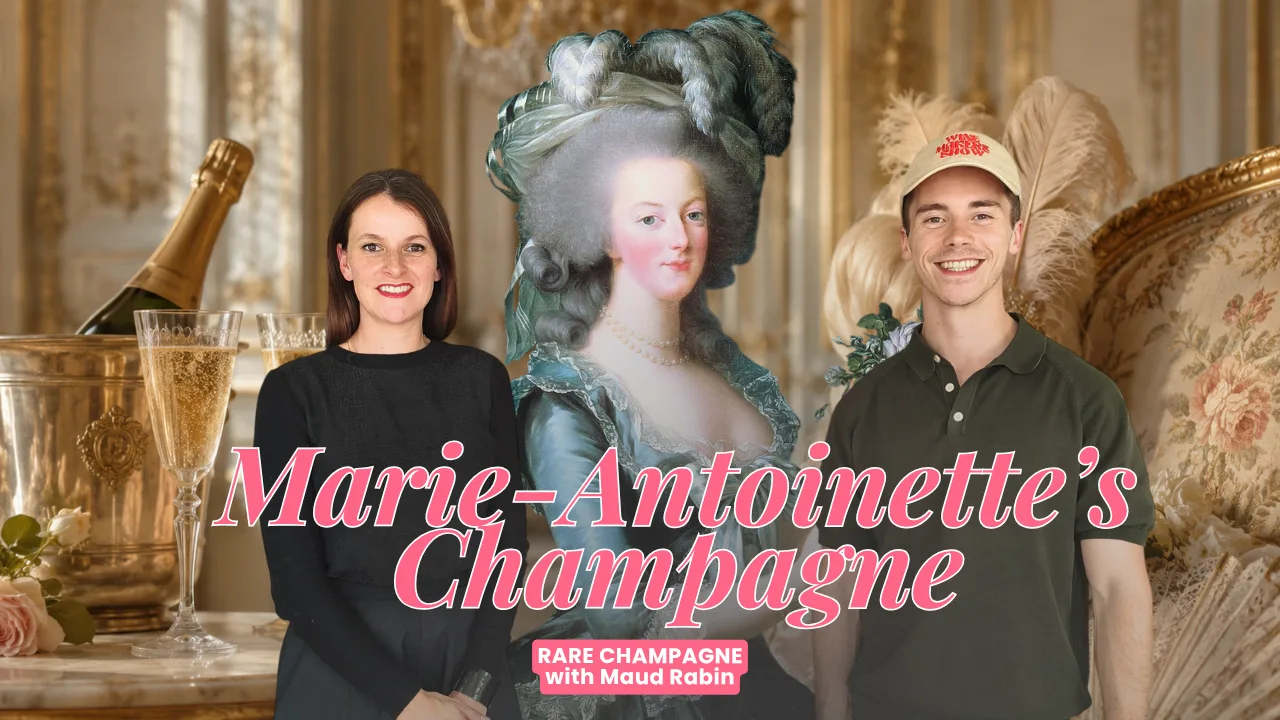
Pour a glass and hold onto your tiara: this episode drops us straight into the gilded world of Rare Champagne, the vintage-only prestige cuvée born at the court of Versailles.
We sit down with Maud Rabin, Managing Director of Rare Champagne, inside the house’s headquarters in Reims (in the Salon Marie-Antoinette itself) to unravel a story that runs from a queen’s love of pineapple in 1785 to a bottle dressed by Van Cleef & Arpels two centuries later.
Maud trades ten years in fashion for the world of Champagne, tracks down the very family who relaunched the brand, and reveals why Rare Champagne only exists in vintage years, why it took four decades to make just four rosés, and why the tiara on every bottle is glued by hand, one dot at a time, by a team of eight women in Reims.
Expect royal history, Chardonnay obsession, and a glass of Rare 1988 paired with Comte. Tune in!
Watch the full interview with Maud Rabin
Listen to the podcast with Maud Rabin
A recap of the conversation with Maud Rabin
From fashion runways to Rare Champagne
Maud Rabin did not start out in Champagne. She grew up around vineyards, but in the Loire Valley, in a family of wine merchants, with a grandfather who considered Champagne the most beautiful wine in the world and made sure every Christmas included a single drop of it for the kids. She spent ten years in the fashion industry before joining Remy Cointreau, where she worked on the image of the spirits division, mostly Cointreau. At the time, Remy Cointreau also owned the Champagne division, including Piper-Heidsieck and its prestige cuvée, Rare.
In 2011, Remy Cointreau sold the Champagne houses to Monsieur Descours. In 2015, he hired Damien Lafaurie, formerly the number two at Remy Cointreau, to run the company, and in 2017, Lafaurie called Maud with an offer: come meet the family and Régis Camus, the cellar master who built Rare Champagne’s style. She spent three hours with Camus, who told her that wherever you come from, what matters is understanding and respecting Mother Nature. She agreed, and in 2018 was hired to split Rare Champagne away from Piper-Heidsieck and build it as its own standalone house.
A puzzle solved in London
Before she could sell the story, Maud needed to understand it herself: why the name Rare, why the tiara, why Versailles. Her boss told her the founding family had cut ties with the house decades earlier and there was no chance of tracking them down. Three weeks later, at a masterclass in London, a guest approached her and introduced himself: Patrick d’Aulan, son of the Marquis d’Aulan, the man who had relaunched Rare Champagne in the 1980s. They spent three hours together, and Maud’s puzzle fell into place.
A cuvée worthy of a Queen
The house’s founder, Florens-Louis Heidsieck, had one ambition: to become the richest man in Europe. In the 18th century, bubbles were reserved for the royal court, so he set his sights on meeting the queen. Researching her tastes, he discovered Marie-Antoinette’s love of pineapple and tropical fruit, exotic imports that had only reached France in 1730 and were still a privilege of the king and queen alone. He built a blend rich in tropical notes to match and met the queen at Versailles on May 6, 1785. She loved it, ordering thousands of bottles. Word travelled fast: the royal courts of Spain, Austria and the Netherlands all began buying Piper-Heidsieck, some of which still carry a dedicated royal label to this day.
That same tropical signature, pineapple, vanilla, coconut, jasmine, still runs through every vintage of Rare Champagne, more or less cooked depending on the year.
From a sleeping beauty to a bottle by Van Cleef & Arpels
The next generation wanted a bottle worthy of the story and commissioned a decor from artist Pierre-Karl Fabergé. The drawing was beautiful, but impossible to produce: it called for a blue lapis lazuli finish that could not survive years of ageing on the bottle. The project slept for nearly two centuries, until the Marquis d’Aulan rediscovered Florens-Louis Heidsieck’s original notebook and decided to finally make the dream real, by creating the most expensive, most beautiful cuvée in the world.
He asked family friends at Van Cleef & Arpels to take Pierre-Karl Fabergé’s drawing as inspiration and dress the very first bottle of Rare Champagne, in gold, diamonds and lapis lazuli. The bottle was unveiled in 1985 at the Chateau de Versailles, in a celebration marking 200 years since that first royal meeting: 54 dishes, 1,700 guests, 10,000 roses, fireworks, and actress Carole Bouquet as hostess. Versailles later confirmed to Maud that Rare Champagne is the only brand in history to have been born there. The Marquis then toured the United States to introduce the cuvée, and it was Remy Cointreau’s American team who eventually flipped “Champagne Rare” into the easier “Rare Champagne.”
The tiara: hand-glued in Reims, 48 dots at a time
Around 2006, the house commissioned goldsmith Arthus-Bertrand to design the tiara that now crowns every bottle, an allegory of the triumph of the vine first briefed by the cellar master back in 1976, the year of Rare’s very first vintage. Today, a team of eight women in the Reims warehouse dresses each bottle entirely by hand, applying 48 dots of glue per tiara. It is a tribute to Queen Marie-Antoinette, and to the city of Reims itself, where 33 French kings were crowned.
Vintage only, Chardonnay-driven, and only four rosés ever
Rare Champagne releases a vintage only when the wine can deliver that exact tropical, floral and spicy-nut signature defined decades ago by longtime cellar master Régis Camus, built to age for 10, 15, even 20 years. Some years, it simply does not happen, and there is no vintage at all, though climate change means warmer, riper years are making that rarer. The blend leans 70% Chardonnay, 30% Pinot Noir, sourced from nine to eleven villages, mostly the same ones year after year, including Avize, Ay, Bouzy, Verzy and Verzenay.
Rosé is rarer still: only four Rare rosés have ever been made, in 2007, 2008, 2012 and 2014. Whether a fifth ever exists is entirely up to current cellar master Emilien Boutillat, who decides, sometimes at the very last minute, whether a wine truly earns the name.
That same discipline shapes release order. In 2023, Emilien launched the 2013 vintage before the 2012, judging the 2012 simply not ready yet. Tasted side by side, the difference is striking: the 2013 leans into apricot, cooked pineapple, brioche and honey, while the 2012 stays fresh, all lime, bergamot and citrus. No other Champagne house works quite this way.
Where to actually find Rare Champagne
Under strict allocation, Rare Champagne is sold city by city rather than country by country, with teams in London, Paris and across the US, from Miami to Las Vegas to California. The house looks for what Maud calls “rare birds”: wine stores, Michelin restaurants and hotels that genuinely embody the brand, and builds concepts around them, like the returning Marie-Antoinette afternoon tea at the Hotel de Crillon in Paris, where Rare is poured into a stemless glass modelled on one the queen herself used. Rare Champagne is also served at official dinners at the Élysée Palace, and, Maud says with a laugh, has occasionally turned up in far more surprising places entirely by chance.
Marie-Antoinette’s second life
The queen behind it all had a life more interesting than her legend suggests. She barely drank, just a sip of bubbles a day at most, avoided meat where she could, kept her own kitchen garden of strawberries and potatoes, and is credited with helping popularise both the potato and the croissant in France. It was Empress Eugenie, generations later, who first rehabilitated her image, a wave that has kept building ever since through biographies by Stefan Zweig and Antonia Fraser, the shōjo manga La Rose de Versailles (a childhood favourite of Maud’s, and still how much of Japan learns French history), and Sofia Coppola’s 2006 film. From September 2026 to January 2027, the Château de Versailles marks the film’s 20th anniversary with an exhibition at the Petit Trianon, the queen’s own private retreat.
If you want to go deeper on the grape behind that signature blend, our guide to Chardonnay covers what makes it Champagne’s backbone. For another take on how a Champagne house builds its own identity, our conversation with Guillaume Lete, cellar master at Champagne Barons de Rothschild, makes a great companion listen, and our piece on what actually makes Champagne, Champagne is the perfect primer before your next bottle.
Maud Rabin’s recommendations
Books:
- Marie-Antoinette, by Stefan Zweig
- La Rose de Versailles (Lady Oscar) - Tome 1, by Riyoko Ikeda, a manga that tells the story of French history through the eyes of Marie-Antoinette
- Vigneronne, by Laure Gasparotto
Learn more about Rare Champagne
From September 22, 2026 to January 24, 2027, the Chateau de Versailles celebrates 20 years of Sofia Coppola’s Marie-Antoinette with an exhibition at the Petit Trianon: more details here
Amazon links on this page are affiliate links. They cost you nothing extra, and they help me keep this going.