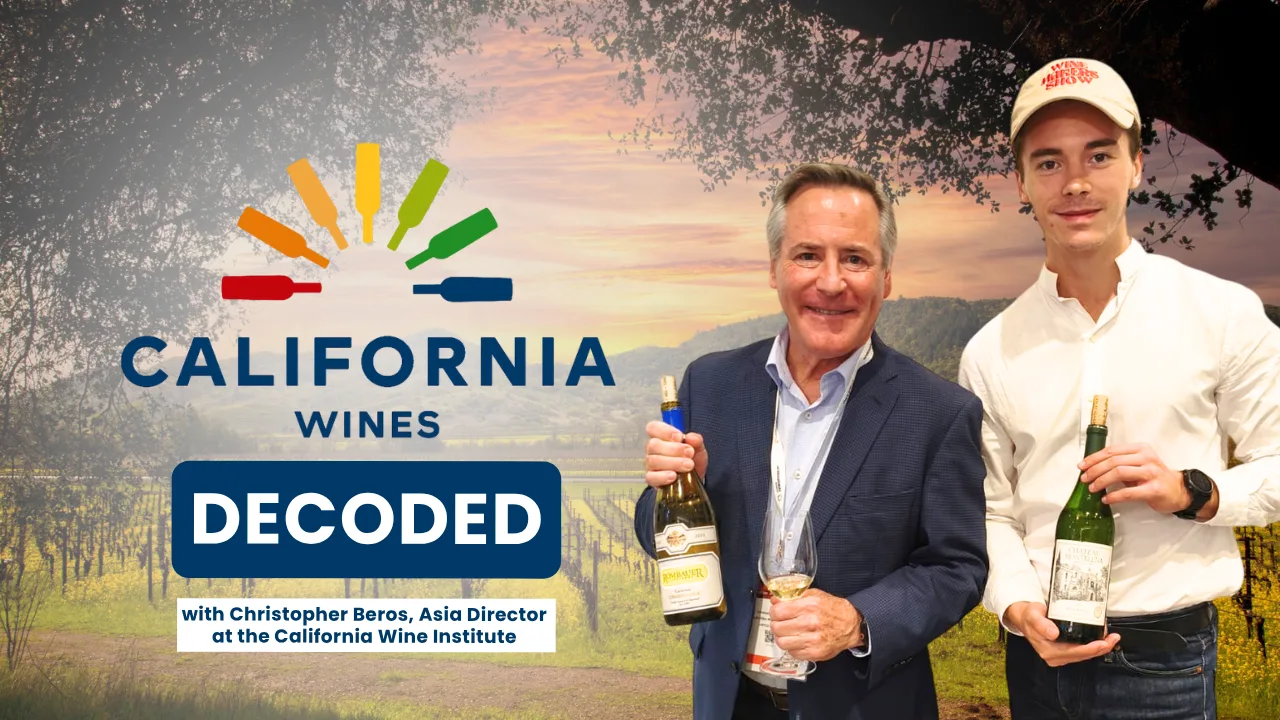
Forget everything you think you know about California wine. Pour yourself a glass, settle in, and let Christopher Beros, Asia Director of the California Wine Institute, take you from the fog-cooled vineyards of Napa and Sonoma all the way to the booming wine bars of Southeast Asia. Recorded live at Vinexpo Hong Kong, this conversation crackles with the energy of a region that refuses to sit still.
Christopher trades finance for wine, builds an import business in mainland China, then spends a decade championing California across Greater China and Southeast Asia. Along the way he unpacks the 154 AVAs that make up the most diverse wine state on earth, retells the Judgment of Paris with an insider’s eye, and explains why California’s “no rules” philosophy turns winemakers loose to experiment.
Then we open the bottles. Four Chardonnays, all from Carneros, all wildly different.
Tune in for a masterclass in why California is far more than big oaky whites, and why Asia’s most curious drinkers are falling for it.
Watch the full interview with Christopher Beros
Listen to the podcast with Christopher Beros
A recap of the conversation with Christopher Beros
From finance to importing California wine
Christopher Beros did not grow up dreaming of wine. He started in finance, covering food and beverage companies, and first set foot in China in 2006 to work on a transaction. The country captivated him, and rather than watch from a desk he started a company importing California wine into mainland China, running it until he sold the business in 2015.
That was the moment the California Wine Institute came knocking, asking him to represent the region across Asia. He admits he was not even sure he wanted the job, then gave it a try and never looked back. Since 2015 he has covered Greater China and Southeast Asia, living in Shanghai until COVID, and now based near San Francisco while travelling back and forth every month.
How China learned to drink the world
When Christopher first arrived, the Chinese market told a very narrow story. Between 2007 and 2010, about the only thing selling was red Bordeaux, a bottle with a château on the label, and little else. No Burgundy, no white wine, no American wine.
What happened next genuinely excites him: the Chinese consumer became far more sophisticated and open-minded. Because drinkers there built no fierce loyalty to any one region, they stayed curious, happy to try a California Zinfandel, a German Riesling or any number of whites. Every exporting region in the world, from Hungary to Georgia to Slovakia, courted China, so the market was exposed to an extraordinary range of wines. That same openness is now reshaping menus across Hong Kong, where you finally see Australians, Americans and far more variety than before.
What the California Wine Institute actually does
Founded in 1934, right after Prohibition ended, the Institute has two distinct halves. The domestic arm represents around a thousand wineries on US legal, public-policy and trade issues. The international arm, which Christopher leads in Asia, is a pure marketing organisation whose job is to promote California wine around the world, with counterparts in North Asia, Canada, Mexico, the UK and Europe.
A state of 154 AVAs
Ask Christopher about California’s regions and you had better clear your schedule. The state holds 154 AVAs (American Viticultural Areas), each a distinct growing region. The headline names are familiar, but the details surprise:
- Napa is the most famous yet accounts for only 4% of California wine, just 30 miles long and four miles wide, with around 600 wineries making world-class Cabernet Sauvignon.
- Sonoma is larger and more diverse, from the West Sonoma Coast to Alexander Valley, Dry Creek, Carneros and Russian River.
- Heading down the coast you reach the Santa Cruz Mountains (home to Ridge), then Monterey and the Santa Lucia Highlands for spectacular Pinot Noir, then Paso Robles, increasingly the home of brilliant Rhône-style wines at friendlier prices.
- Santa Barbara County holds a geographic quirk: a mountain range running west to east rather than north to south, letting Pacific fog pour straight in. The result is gorgeous Chardonnay and Pinot Noir, especially in the Santa Rita Hills.
The thread tying it together is the Pacific Ocean. That cold water sends fog in every night, lengthening the growing season, ripening grapes slowly and building complex structure. Layer in mountains and altitude, from the Mayacamas and Vaca ranges around Napa to vineyards barely two miles from the ocean, and you understand why so many grapes thrive across such varied terroir.
A history written by missionaries, Prohibition and Robert Mondavi
California’s wine story runs back to the Spanish missionaries of the 1700s, who carried “mission grapes” north as they built the missions that became San Francisco, San Jose and Santa Clara. The industry flourished into the late 1800s, then absorbed blow after blow: World War I, nearly fifteen years of Prohibition, and World War II.
The modern revival has a clear hero. In 1966 Robert Mondavi opened his Oakville winery, bringing sophisticated technique and, just as importantly, acting as an ambassador for the whole valley. His philosophy was generous and self-interested at once: “If Napa does well, I’ll do well.” He showed not only his own wines abroad but his neighbours’ too.
The Judgment of Paris, told from the inside
Ten years after Mondavi, the Judgment of Paris changed everything. Christopher is careful about what it did and did not do: it was never meant to be a contest. Organiser Steven Spurrier and his American partner Patricia Gallagher planned a friendly tasting for the 1976 US bicentennial, and only at the last minute did Spurrier decide to make it blind and slip in benchmark French wines judged by French wine royalty.
The result became newsworthy almost by accident, a story Christopher sums up with the word serendipity (which, we note with a smile, has no real French equivalent). Buried on page 56 of Time magazine, it was picked up by the wire services and republished everywhere. Overnight, the world learned that California could make world-class wine. A Chardonnay from Château Montelena topped the whites and a Stag’s Leap Wine Cellars red topped the reds, both retested and validated for decades after. The aftershock drew French investment to California, from Opus One in 1979 to a wave of Champagne houses in the early 1980s.
No rules, just conventions
Here is the difference that most surprises European drinkers. Where French and Italian appellations dictate grape varieties, blends, irrigation and ageing, California has almost none of those rules. A label must be accurate only on three things: the variety, the vintage and where the grapes are grown. Geography is policed strictly, say Napa Valley and the fruit must come from Napa Valley, say a single vineyard like To Kalon and it must come from that vineyard, but everything else is open.
That freedom sits at the heart of California’s identity. Christopher frames the brand around four pillars: innovation, boldness, inclusiveness and sustainability. It is no coincidence, he argues, that Hollywood and Silicon Valley share the same state. The same appetite for experimentation flows into the wines, which is exactly what so many visiting winemakers say they want to take home: the freedom to try things, to test, and to make wine people actually want to drink.
Four Chardonnays, all from Carneros
To prove the point, Christopher poured four Chardonnays for a 10am tasting, all from Carneros, the cool, bay-influenced region split between Napa and Sonoma. Same grape, same broad area, four distinct personalities:
- Château Montelena Chardonnay 2023 - a nod to the 1973 vintage that won in Paris. Bright, balanced, beautifully fresh acidity, never too oaky.
- Rombauer Chardonnay 2024 - one of America’s most beloved Chardonnays, bigger and more opulent, with savoury notes of fresh herbs, menthol and lavender.
- Hyde de Villaine (HdV) De La Guerra Chardonnay 2023 - a collaboration tied to Burgundy’s de Villaine family, sitting elegantly in between, with a lovely nose and silky texture.
- The Prisoner Wine Company The Prisoner Chardonnay 2021 - the richest and rounder of the set, with the most generous oak.
Four bottles, four moments to enjoy them, and a perfect illustration of California’s diversity. Next time, Christopher promises, he would love to show off Chardonnay and Pinot Noir from West Sonoma Coast, Russian River, Monterey and Santa Rita Hills, each one different again.
The Asian market, and what comes next
Christopher is happy when his wineries are happy, and at Vinexpo Hong Kong, with 30 California wineries plus nine from Oregon, they were. He calls it the best edition of the show since COVID and is delighted it landed in Hong Kong, a city he considers the ideal host for a major trade fair and a genuine gateway to the wider region.
Looking ahead, he sees real momentum in Southeast Asia. Thailand cut its wine taxes last year, Vietnam offers a young, aspirational, fast-growing population, and Indonesia keeps coming up in conversation. Hurdles remain, but he expects Southeast Asia to be one of the world’s growth stories over the next five to ten years. Closer to home, the Institute is rolling out Judgment of Paris tasting events, including one in Hong Kong featuring the original wines in current vintages alongside “modern California” surprises like a Napa Albariño.
If you want to taste this diversity for yourself, our guide to a recent California wine tasting in Hong Kong is a great place to start, and our deep dive on terroir explains exactly why that Pacific fog matters so much.
Christopher Beros’s recommendations
Books:
- The Wines of California, by Elaine Chukan Brown
- The Wine Bible, by Karen MacNeil
Learn more about California Wines
More details about the California Wine Month in Hong Kong & Macau
The wineries we tasted:

From the shop
Wear the grape that won in Paris
Four Carneros Chardonnays, four personalities, one grape that put California on the map. Our Chardonnay cap is a quiet nod to the variety that topped the Judgment of Paris, made in soft washed cotton in a dozen vintage colours.
Browse the cap →Amazon links on this page are affiliate links. They cost you nothing extra, and they help me keep this going.