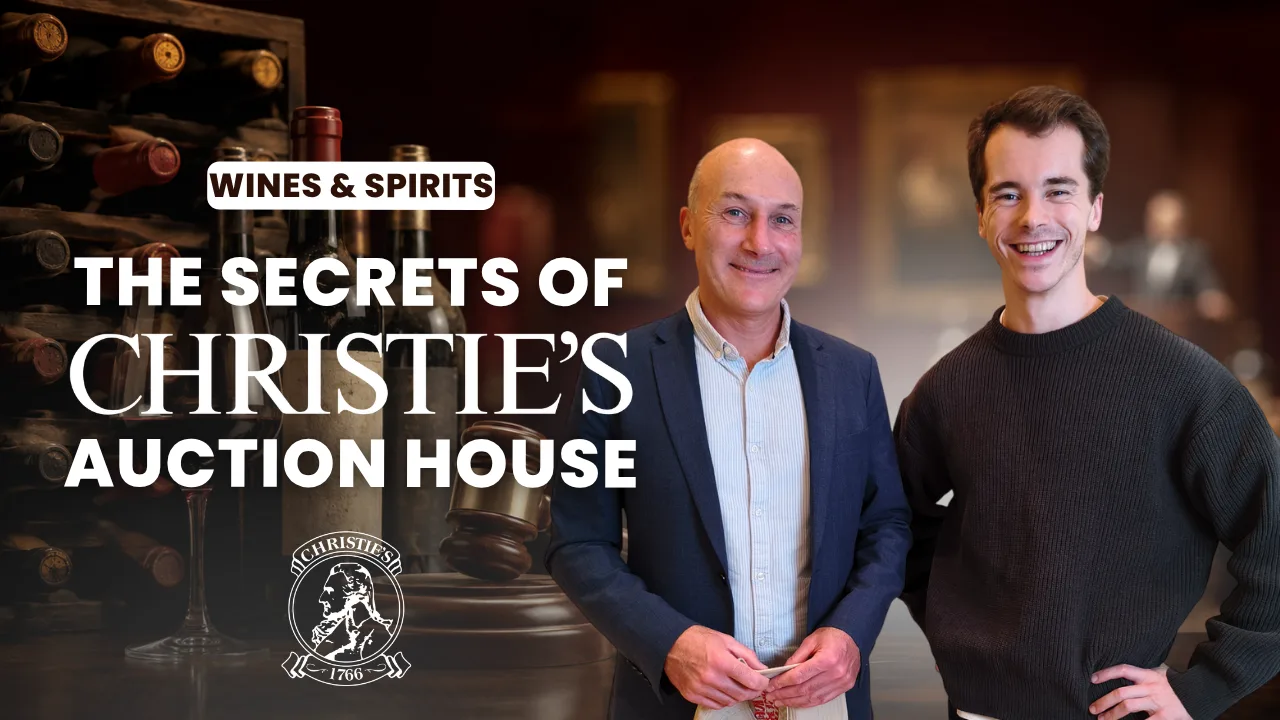
Ever wondered what it actually takes to sell a single bottle for over a million pounds? This episode takes us inside Christie’s, the auction house that has been selling wine since 1766, with someone who stands at the rostrum himself.
We sit down with Tim Triptree MW, International Director of Wine & Spirits at Christie’s, in Macau, where he’s judging the Wynn Signature Chinese Wine Awards, to trace his path from investment banking to the world’s oldest auction house, and to unpack exactly how a bottle goes from a private cellar to a world record hammer price.
Tim walks us through his unlikely route into wine, what it takes to pass the notoriously brutal Master of Wine exam, how Christie’s verifies that a bottle is genuinely what it claims to be, and why Chinese wines might be the next big thing to hit the secondary market.
Expect a 1.2-million-pound bottle of whisky, a champagne dosage deep-dive, and a very honest take on why Bordeaux still dominates the room. Tune in!
Watch the full interview with Tim Triptree
Listen to the podcast with Tim Triptree
A recap of the conversation with Tim Triptree
From investment banking to Christie’s rostrum
Tim Triptree did not grow up around wine. He’s from Wiltshire, in the English countryside, and studied psychology at university before starting a career in investment banking, working in equity research in London. He enjoyed it, but wasn’t passionate about it, so he took a career break to learn Spanish in Mendoza, Argentina, the province that produces 80% of the country’s wine.
Surrounded by vineyards and immersed in the local wine trade, Tim started a sommelier course on the spot, then went looking for further education back in the UK. He enrolled in an MBA in Wine Business Management at the Royal Agricultural University in Cirencester, an 18-month course that gave his banking-heavy CV the credibility it needed. From there, he worked at UK retailer Majestic Wine before landing a job as a junior specialist at Christie’s in 2005. Twenty years later, he’s the house’s International Director of Wine & Spirits.
Learning the ropes, then finding the wines
As a junior specialist, Tim’s job wasn’t sourcing consignments, it was processing them: inspecting labels, capsules and ullage levels, checking that a wine’s colour hadn’t turned, and making sure nothing out-of-condition ever reached an auction catalogue. He credits mentors like Christopher Munro, David Elswood and Master of Wine Michael Broadbent for shaping his early career. Broadbent, in particular, once signed a book for Tim with a note saying he had “full confidence” he’d become a Master of Wine one day, a line Tim held onto through years of studying.
Today, as International Director, his role is finding the wines in the first place: convincing collectors across Christie’s markets (London, Hong Kong, New York and Los Angeles) to consign their bottles, running inspections and condition reports, pricing rare and hard-to-value mature vintages, and standing at the rostrum as an auctioneer himself.
Passing the Master of Wine, a decade in the making
Tim started studying for the Master of Wine in 2010, after completing the WSET Diploma. He passed the theory exam on his first attempt, but the blind tasting component, the part most candidates struggle with, took years longer. A move to Hong Kong in 2013 for a new Christie’s role put his studies on hold entirely for two years, since preparing for the MW demands every weekend and most of a social life. He rejoined the programme, passed the tasting in 2016, and spent two more years on a research paper about Champagne, which won the Noval Award for best research paper. He was awarded the Master of Wine title in 2018, a milestone that helped pave the way to his current role.
His thesis looked at the use of reserve wines in non-vintage Brut Champagne over a 20-year period (1995-2015), finding that producers had significantly increased their reliance on reserve wines to build complexity and richness, a shift linked to falling dosage levels. As reserve wine use rose, less sugar was needed to mask a raw, acidic base vintage.
Sourcing consignments: a global, competitive hunt
Getting wines to auction is, in Tim’s words, a competitive business. Christie’s has sold wine at auction since founder James Christie’s very first sale in 1766, and that 260-year brand recognition brings plenty of inbound interest. But Tim is also proactive, travelling to meet major collectors (a recent Macau trip continues on to Hong Kong, Bangkok and Tokyo) and monitoring who has been buying heavily from Christie’s in past years. As he puts it half-jokingly, “death, divorce and duties” are often what bring wine to market, alongside collectors simply deciding they own more than they’ll ever drink and want to make room for younger vintages.
The rise of Chinese collectors, and Chinese wine
Tim traces the real inflection point for wine interest in Asia to 2008, when Hong Kong dropped its wine import duty to zero. That single policy change triggered a lasting boom, not just in China but across Southeast Asia, and made Hong Kong a natural hub for wine storage and consumption.
Chinese wines themselves haven’t yet reached the secondary market, but Tim sees real potential building. As a senior judge at the Wynn Signature Chinese Wine Awards for three years running, he’s watched quality rise sharply, with more medals awarded each year, all tasted completely blind. Beyond the awards themselves, producers get direct feedback from judges, creating a virtuous cycle: recognition for the best wines, and concrete notes for everyone else to improve on.
Twenty years of shifting tastes: Bordeaux, Burgundy and beyond
Since Tim joined in 2005, Bordeaux’s dominance of the secondary market has given way to real diversification. Burgundy, both red and white, has boomed since around 2012. Super Tuscans are now a permanent fixture, Spanish icons like Vega Sicilia and Pingus show up regularly, and wines from Chile (Viñedo Chadwick) and Australia have started appearing too. Still, France remains the backbone of what Christie’s sells, and Tim doesn’t expect that to change soon, even as newer regions close the gap over the next decade or two.
Geography matters less than people might assume: what sells well in London tends to sell well in Hong Kong, since serious collectors buy across both sales. The one real exception is Vintage Port, which performs better in London thanks to a longer-standing British drinking tradition.
Authentication: provenance first, always
Selling a fake bottle is the auction house’s worst nightmare, so provenance is the non-negotiable first filter. If a vendor can’t document where a bottle has come from (ideally with the original invoice), Christie’s simply won’t accept it for sale. Beyond paperwork, Tim and his colleagues physically visit storage conditions in situ, from professional warehouses to extraordinary private cellars, some guarded like a Bond villain’s lair, complete with retina scanners and hidden doors.
A world record, one gavel strike at a time
Tim’s standout auction memory is selling a bottle of Macallan 1926 whisky for £1.2 million in 2018, smashing the previous world record and drawing a round of applause in the room when the hammer came down. He was involved end to end, from securing the consignment to finding the eventual buyer.
On critic scores’ influence over auction prices, Tim thinks it’s real but fading: a decade or two ago, a single Robert Parker 100-point score could send prices soaring; today buyers still take confidence from high scores, but the effect is more muted.
If you want to go deeper on where China’s wine scene is heading, our conversation with Fongyee Walker MW, mainland China’s first resident Master of Wine, is a natural companion listen, and our piece on Winnie Chen managing 17,000 wine references in Macau covers the region’s wine boom from the sommelier side. If auctions and collecting have piqued your curiosity, our guide to investing in wine is a good next stop.
Tim Triptree’s recommendations
A book: Vintage Wine, by Michael Broadbent
Learn more about the Wynn Signature Chinese Wine Awards and Christie’s
Amazon links on this page are affiliate links. They cost you nothing extra, and they help me keep this going.