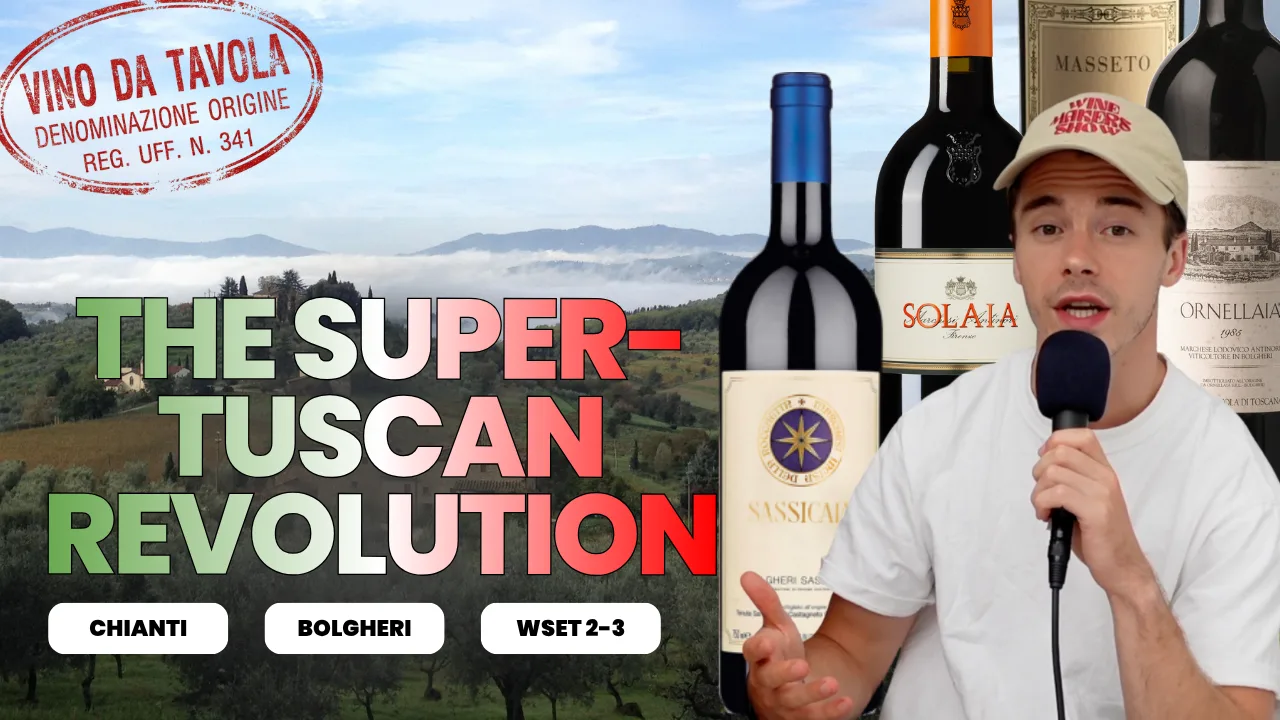
In 1978, in a London hotel ballroom, a panel of the world’s most respected wine experts sat down to a blind tasting. Thirty-three wines, including some of the greatest Bordeaux on earth. First Growths. Legends. When the bottles were finally unwrapped, the wine that had beaten them all was Italian. And back home, it was legally classified as table wine, the lowest grade the country produced. The same official status as a two-euro carton from a petrol station.
That wine was Sassicaia, and this is the story of the Super Tuscans: the rebel bottles that broke Italian wine law on purpose, made a swampy stretch of the Tuscan coast world-famous, and forced Italy to rewrite its own rule book. It has a marquis with a stable of racehorses, a stubborn Florentine family, a winemaker obsessed with Bordeaux, and one of the great acts of vindication in wine.
Watch the story
The rule book that made the rebellion necessary
To understand the rebellion, you have to understand what these producers were rebelling against. In the 1960s, Italy built its first formal wine quality system, DOC (Denominazione di Origine Controllata), copied from the French model. Every region got a rule book, and Chianti, the most famous Tuscan red, got a particularly bad one.
Under the original Chianti rules, to legally call your wine “Chianti” you had to do three things. First, use mostly Sangiovese, the local red grape. Fair enough. Second, you were not allowed to make a 100% Sangiovese wine: you had to blend in other varieties. And third, the one that drove serious growers mad, you had to include a mandatory percentage of white grapes in your red wine.
White grapes, in a red wine. The reason was political. Tuscany had a lot of farmers growing not-very-good white grapes, and the law was written to guarantee them a buyer. So every bottle of Chianti was, by law, slightly watered down by grapes that had no business being there. By the 1970s the reputation of Chianti had collapsed into a punchline: a thin, cheap red in a straw basket on every red-checked tablecloth.
A handful of ambitious producers looked at this rule book and made a quiet, dangerous decision. They were going to ignore it, and make the best wine they possibly could, even if that meant their bottles would be branded the lowest grade Italy could give: Vino da Tavola, table wine. The first to pull the trigger was a marquis. With racehorses.
The marquis with racehorses and a Bordeaux obsession
His name was Mario Incisa della Rocchetta, an Italian aristocrat with two great passions: racehorses and Bordeaux. The horses made him famous. His stallion Ribot is still considered one of the greatest racehorses in history, unbeaten across two seasons. To most people, Mario was a horse man, not a wine man, and that matters in a moment.
His estate, Tenuta San Guido, sat in a tiny coastal village called Bolgheri, in the southern reaches of Tuscany. In the 1940s, Bolgheri was nowhere: swampy, coastal, dismissed by the Tuscan wine establishment. But Mario had a fixation. He was convinced that the gravelly, stony soils of Bolgheri resembled the great gravel beds of Bordeaux, the ones behind the Médoc and Graves.
So in the mid-1940s, just after the war, he did something nobody in Tuscany was doing. He planted Cabernet Sauvignon and Cabernet Franc, French grapes, on a stony patch of his land. He named the vineyard Sassicaia, which means, more or less, “the place of many stones”. And then, for almost twenty years, he made the wine only for his own family, quietly, at the estate. Nobody outside really tasted it. Nobody outside really cared. He was, after all, the racehorse guy.
In the late 1960s his nephew, a young Florentine named Piero Antinori, finally tasted it and was stunned. He told his uncle the wine was extraordinary and had to be released. So in 1968 Mario bottled his first commercial vintage of Sassicaia, and it reached the market in 1971. Because it was made from non-Italian grapes in a place with no appellation, the label read Vino da Tavola. The most aristocratic wine in Tuscany, made by a marquis in a Bordeaux style on his ancestral estate, was legally the same category as the cheapest plonk in Italy.
That was the first shot of the rebellion. The second came almost immediately.
Tignanello: the rebellion reaches Chianti
Piero Antinori went home with a problem. The Antinori family had been making wine in Florence since the 13th century, twenty-six generations, with vineyards in the absolute heart of Chianti Classico. Piero was tired of watching the Chianti name get embarrassed by bad rules and bad wine, so he decided to do something quietly outrageous.
In 1971, on the family’s Tignanello estate in the middle of Chianti Classico, Piero and his Bordeaux-obsessed winemaker Giacomo Tachis made a red that broke essentially every local rule at once. They built it from roughly 80% Sangiovese with Cabernet Sauvignon and Cabernet Franc, and Cabernet was illegal in Chianti. They refused to add any white grapes. And they aged it in small 225-litre French oak barrels, exactly like Bordeaux, when Tuscan tradition called for huge old neutral casks.
The wine was magnificent. It was also, legally, table wine. Then Antinori did one more revolutionary thing. Rather than fight the classification, he simply gave the wine a name that could stand on its own: no “Chianti”, no official designation, just the name of the vineyard, Tignanello. A brand in place of a bureaucratic stamp. The wine would have to sell on quality and reputation alone, with no appellation to hide behind.
It worked. Tignanello became one of the most talked-about wines in Italy almost overnight. Now there were two of them, Sassicaia on the coast and Tignanello in Chianti, both officially “table wine”, both quietly humiliating properly classified wines that cost twice as much.
The blind tasting that changed everything
London, 1978. Decanter organised a blind tasting of Cabernet-based wines from around the world. Thirty-three bottles, including top Bordeaux and First Growths, next to ambitious Cabernets from California, Australia and anywhere serious wine was being made. Slipped in almost as a curiosity was the 1972 Sassicaia, the “table wine” from Bolgheri.
When the results were revealed, Sassicaia had won. It had beaten the most prestigious wines in the world, from a place nobody had heard of, made by the racehorse marquis, and labelled at home as supermarket plonk. The story was perfect, a Cinderella from the Tuscan coast out-drinking the great names of Bordeaux, and the wine press could not get enough of it.
A few years later the American critic Robert Parker got hold of Sassicaia. In 1988 he tasted the 1985 vintage and gave it 100 points, the first perfect score he had ever awarded an Italian wine. That was the moment Italy’s “table wine” rebellion broke through to the global market for good.
Where the name “Super Tuscan” comes from
You may have noticed we have not actually said the words “Super Tuscan” yet. That is because, for the first decade of the rebellion, the term did not exist. It was coined by English-speaking wine writers in the 1980s, scrambling for a way to describe spectacular wines that fit no official Italian category. Several people have been credited, the critic Luigi Veronelli, the journalist Burton Anderson, the Master of Wine David Gleave, and honestly nobody is entirely sure.
What everyone agrees on is that it was a happy marketing accident. It stuck because the alternative, calling these wines “table wine”, was absurd, and the classification that would eventually replace it did not exist yet. So “Super Tuscan” is not a legal category and never has been. It is a nickname that means, more or less: a high-quality Tuscan red that does not fit the official rule book. That is it.
Bolgheri becomes Italy’s Bordeaux
With Sassicaia proving that Bolgheri could grow world-class Bordeaux grapes, the gold rush began. In 1981, Piero’s younger brother Lodovico Antinori planted vines right next to Tenuta San Guido and called the estate Ornellaia. Its first commercial vintage, 1985, was a Bordeaux blend of Cabernet Sauvignon, Merlot, Cabernet Franc and Petit Verdot, made in Italy.
Inside Ornellaia sat a small plot of strange blue clay, completely different from the surrounding gravel. Lodovico planted it with Merlot, inspired by the great wines of Pomerol, and by the late 1980s that single plot had become its own wine: Masseto. Today Masseto is one of the most expensive Merlots on the planet, routinely selling for more than a thousand euros a bottle.
Back inland near Florence, Piero did it again with Solaia, first released for the 1978 vintage. Solaia was essentially a reverse Tignanello: Cabernet Sauvignon as the star, with Sangiovese in support, made in the heart of Chianti Classico. The 1997 Solaia would later be named Wine of the Year by Wine Spectator, the first Italian wine ever given that honour.
So in barely a decade, this rebellion had produced five of the most coveted wines in Italy: Sassicaia, Tignanello, Solaia, Ornellaia and Masseto. On paper, all of them table wine. In practice, all of them selling at prices that embarrassed the classified wines around them. By the mid-1980s dozens, then hundreds, of other producers were piling in, and the swampy Bolgheri coast was being called, seriously now, “the Italian Bordeaux”.
Italy admits defeat: IGT and a DOC just for Sassicaia
Eventually the establishment had to deal with the embarrassment. In 1992, Italy created an entirely new classification specifically to give the Super Tuscans somewhere respectable to live: IGT (Indicazione Geografica Tipica), sitting between Vino da Tavola at the bottom and DOC and DOCG at the top. From then on the Super Tuscans were no longer table wine. They were IGT Toscana.
Then in 1994 the Bolgheri DOC was rewritten to actually allow the Cabernet, Merlot and other Bordeaux varieties the rebels had been planting all along. The Chianti rules were quietly fixed too: the mandatory white grapes were phased out, and 100% Sangiovese Chianti, effectively banned since 1970, was finally permitted in 1996. Every single thing the rebels had fought for was, in the end, written into Italian law.
And then in 2013, Italy did something it had never done for any wine before: it created an entire appellation for a single estate, Bolgheri Sassicaia DOC. One wine, its own protected category, the only one of its kind in Italian wine law. A bottle that had spent its first quarter-century classified as bottom-rung now had a legal identity nobody else on earth is allowed to use. The marquis died in 1983 and never saw it. But he had won, completely.
What a Super Tuscan actually tastes like
Because there are no rules, there is no single Super Tuscan flavour, but there is a family resemblance. Most lean on Bordeaux grapes, so expect ripe, dark fruit, firm but polished tannins, and the cedar, tobacco and sweet spice that come from ageing in French oak. Next to a traditional Chianti they usually feel richer, rounder and more international, and the best are built to age for a decade or more. The Sangiovese-led ones, like Tignanello, keep a brighter, more savoury Tuscan edge; the Bolgheri reds lean closer to a warm-climate Bordeaux. The one constant is ambition.
How to read a Super Tuscan label
Here is the quick version that gets you through almost any bottle. Our full guide to reading a wine label goes deeper, but three habits cover the Super Tuscans.
Look for a made-up name. Super Tuscans almost never lead with an appellation. The big name on the label is a proprietary one: Sassicaia, Tignanello, Ornellaia, Solaia, Masseto, Guado al Tasso, Le Pergole Torte. A single distinctive proper name rather than a place is the first clue.
Check the classification in the small print. Look for IGT Toscana (or “Toscana IGT”), the modern Super Tuscan home, or Bolgheri DOC for the coastal Bordeaux-style wines, or, in exactly one case, Bolgheri Sassicaia DOC.
Research the producer. Because the category has no rules, reputation is everything. A great IGT Toscana from a serious estate is one of the world’s finest wines; a cynical one riding the marketing wave is overpriced juice. Names worth learning: Antinori, Tenuta San Guido, Ornellaia, Frescobaldi, Tua Rita, Le Macchiole and Montevertine.
Is the term still relevant?
One honest question to finish on. Is “Super Tuscan” still a useful term? There is a real case that it is not. The original rebellion is over, the rule book was rewritten thirty years ago, Sassicaia has its own DOC, and many of the legendary names now sit comfortably inside official appellations. Some sommeliers refuse the term altogether and just say “Toscana IGT”, or call the wine by name.
But the story behind the name is still doing real work. When you order a Super Tuscan, you are not only ordering a bottle, you are ordering a piece of wine history: a reminder that the rules of wine are written by people, that people can be wrong, and that sometimes the best answer to a bad rule is to quietly ignore it and make something so good that the rule book has to come to you.
Drink one, and you are not just tasting Cabernet and Sangiovese. You are tasting fifty years of an argument that Italy finally lost.
Frequently asked questions
What is a Super Tuscan wine?
A Super Tuscan is a high-quality red from Tuscany that sits outside the traditional Italian appellation rules. Most are built on Bordeaux grapes like Cabernet Sauvignon and Merlot, or on a Sangiovese and Cabernet blend. The name is a nickname, not a legal category, and the wines are usually labelled IGT Toscana.
Why were Super Tuscans classified as table wine?
Because their makers deliberately ignored the local DOC rules: they used grapes like Cabernet Sauvignon that were not permitted, and refused the white grapes the old Chianti law forced into red wine. That left them in the lowest legal grade, Vino da Tavola, even though they were some of Italy's best wines. Italy created the IGT category in 1992 to fix the absurdity.
What are the five most famous Super Tuscans?
Sassicaia, Tignanello, Solaia, Ornellaia and Masseto. Sassicaia started it all on the Bolgheri coast, Tignanello and Solaia came from the Antinori family in the heart of Chianti, and Ornellaia and Masseto are the Bordeaux-style stars of Bolgheri.
What is the difference between Chianti and a Super Tuscan?
Chianti is a legally defined appellation built around the Sangiovese grape. A Super Tuscan is a red that breaks or ignores those rules, often by adding Bordeaux grapes or by making a wine the old Chianti law forbade. Put simply, Chianti follows the rule book, and the Super Tuscans were made to beat it.
Are Super Tuscans worth the price?
The best ones, from serious estates, are among the world's great wines and can age for decades. But because the category has no rules, quality varies a lot, and some bottles trade on the name more than the wine in the glass. With Super Tuscans, the producer's reputation matters more than the label.
What grapes are used in Super Tuscans?
Most use Bordeaux varieties: Cabernet Sauvignon, Merlot, Cabernet Franc and Petit Verdot, either on their own or blended with Sangiovese, Tuscany's native red. There is no fixed recipe, which is exactly why the style is so varied from one estate to the next.