A mini wine cellar is between roughly six and twenty bottles, small enough to sit on a worktop or in the gap at the end of a run of units.
You are not buying capacity. You are buying the fact that it fits. Once you accept that, the decision becomes simple, because there is really only one question that matters.
The only question that matters
Does the room get warm?
Not “is it cool now”. Does it hit 28 or 30 °C in August, or when the oven has been on for two hours.
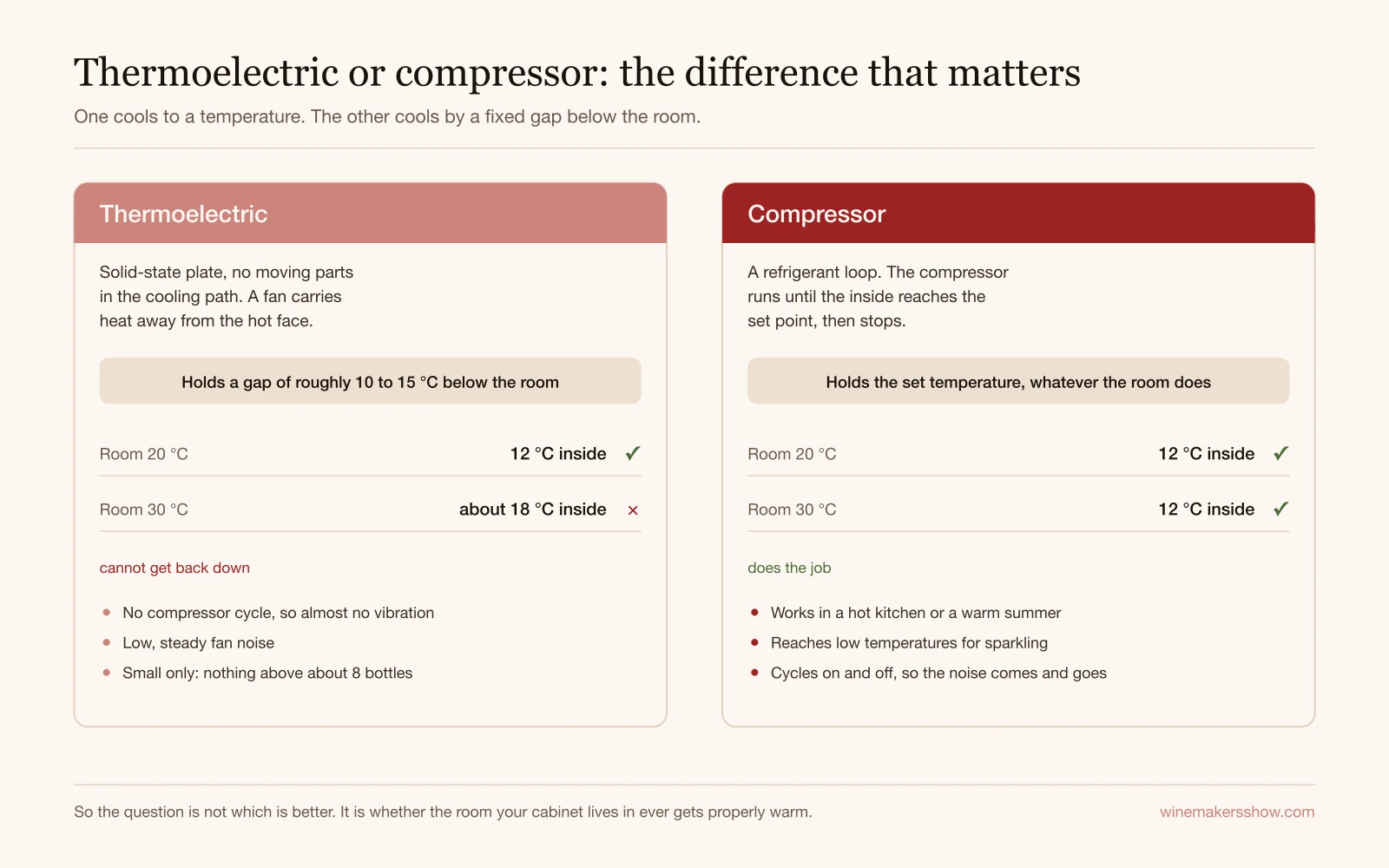
If no, a thermoelectric unit is the better buy. No compressor means no compressor cycle, so effectively no vibration and no hum starting up at two in the morning. In a bedroom, a study or a quiet corner of a flat, that is a real advantage.
If yes, you need a compressor, without exception. A thermoelectric cabinet does not cool to a temperature, it maintains a gap of roughly 10 to 15 degrees below the surrounding air. In a 30 °C kitchen it will sit somewhere near 18 °C and have no way to come down. It is not faulty. It is doing exactly what it was built to do, in a room it was not built for.
The full explanation is in thermoelectric or compressor.
The price per bottle nobody mentions
Divide price by capacity across the market and small cabinets look expensive, because they are.
- 6 to 8 bottles: roughly 20 to 23 dollars per bottle of storage
- 18 to 37 bottles, freestanding: roughly 7 to 10 dollars
So a mini cabinet costs about three times as much per bottle as the sweet spot of the market. That is not a rip-off, it is what a small machine costs to build, and if there is exactly one place in your flat a cabinet can go, you are buying the footprint and the price is fair.
But it is worth knowing, because a lot of people buy a six-bottle unit, fill it in a month, and buy a second one. Two six-bottle units cost more than one twenty-five bottle cabinet and take up more room. If you have the space, size up once.
What to check before buying
Bottle shapes. Every cabinet’s stated capacity assumes Bordeaux bottles nested perfectly. Burgundy bottles are about 84 mm across against 76, Champagne about 90. In a three-shelf cabinet, losing one bottle per shelf is a third of your capacity, so this bites much harder at the small end than it does on a fifty-bottle unit.
Internal height. Champagne bottles are taller as well as wider, and on several small cabinets the top shelf does not clear them.
Whether the control is digital or mechanical. A lot of cheap countertop units have a dial rather than a display, so you set roughly where you want it and never find out what the cabinet is actually holding. Given that stability is the thing that matters, that is a genuine limitation.
Freestanding, always. Small cabinets look like they belong tucked into a gap, and a gap with no airflow is exactly where they should not go. Almost none of them is built-in rated. See where to put a wine cellar.
What a mini cellar is genuinely good at
Holding a handful of bottles at drinking temperature, in a room where a compressor would annoy you, in a space where nothing bigger fits.
That is a real job and nothing else does it. Just do not expect it to be a storage solution: six bottles is six bottles, and if you are ageing wine for a decade this is not the machine.
The full criteria are in our wine cellar buying guide, and the current models are compared here.
Frequently asked questions
Which mini wine cellar is best for a flat?
It depends on one thing: how warm the room gets. In a bedroom, study or cool corner that stays under about 25 degrees, thermoelectric is quieter and vibration-free. In a kitchen or anywhere that heats up in summer, you need a compressor, because thermoelectric cools by a fixed gap below the room and cannot fight the heat.
Are mini wine cellars worth it?
Yes, if you are buying the footprint rather than the capacity. Storage in a 6 to 8 bottle unit costs roughly 20 to 23 dollars a bottle against 7 to 10 in a 25 to 37 bottle cabinet. That is a fair price for a machine that fits where nothing else will, but poor value if you actually have room for something larger.
How many bottles fit in a mini wine cellar?
Fewer than the label says, as with every size. Manufacturers count standard Bordeaux bottles nested perfectly, and Burgundy and Champagne bottles are wider. In a small cabinet this bites harder, because losing one bottle per shelf out of three is a much bigger proportion than in a fifty-bottle unit.