Everyone gets this number wrong in the same direction.
The cabinet arrives, it swallows the bottles you already own, you feel good about it for about four months, and then it is full and you are stacking bottles on top of the shelves at an angle. There are two reasons this happens, and they compound.
Reason one: the stated capacity is a laboratory number
Manufacturers do not lie about capacity. They just measure it in a way that has nothing to do with your kitchen.
The number on the box is how many standard 75cl Bordeaux bottles fit, laid flat, nested neck-to-base, on every single shelf including the ones you were planning to use for standing bottles up. Nothing else is in the cabinet. Nothing is half-drunk. Nothing is a magnum.
Your collection is not that. And the reason it matters is width:
| Bottle | Approximate diameter |
|---|---|
| Bordeaux 75cl | 76 mm |
| Burgundy 75cl | 84 mm |
| Champagne 75cl | 90 mm |
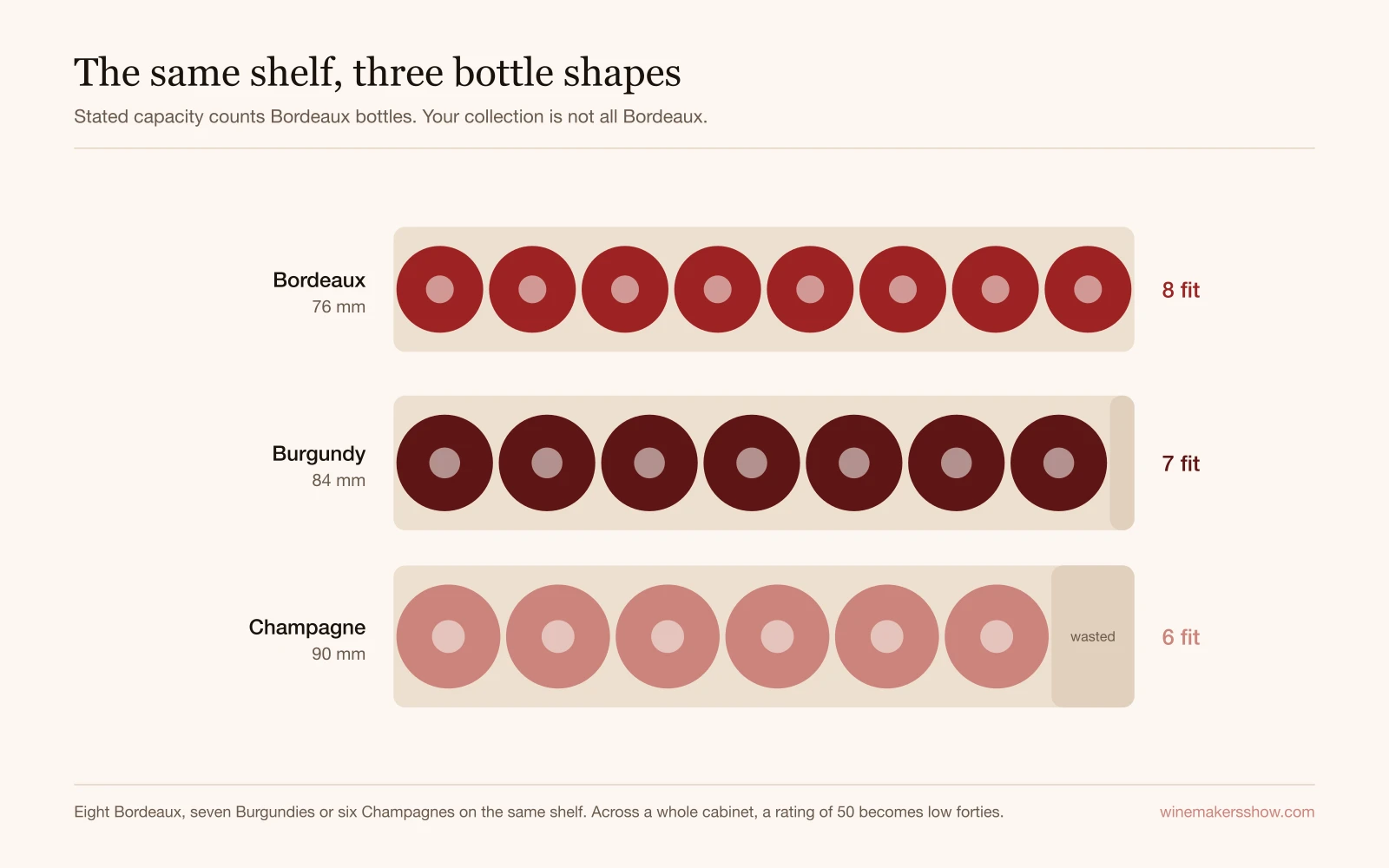
Those look like small differences. Follow them through one shelf. If a shelf takes eight Bordeaux bottles across, the same shelf takes seven Burgundies, or six Champagnes. That is 12 percent gone, then 25 percent gone, and it happens on every shelf that holds them.
A cabinet rated for 50 bottles, holding a normal mixed collection with some Burgundy and a few bottles of fizz, realistically lives in the low forties. Nothing has gone wrong. You just bought the laboratory number.
Champagne bottles bring a second problem: they are taller as well as fatter, and on some cabinets the shelf spacing at the top does not clear them. Check internal height, not just the count.
Reason two: collections grow faster than people plan for
The honest arithmetic is not “how many bottles do I own”. It is:
Bottles you own now, plus bottles you will buy this year, minus bottles you will drink this year.
For most people that second number is bigger than they expect, because a cellar changes buying behaviour. Once you have somewhere to put wine, you start buying wine that needs putting somewhere. You buy the case instead of the bottle. You accept the offer on six. This is not a failure of discipline, it is the entire point of owning a cellar, but it means the cabinet you size for today is the wrong cabinet.
There is also a quieter cost to running full. A full cabinet has no slack, so the bottle you open on a Tuesday is whatever is reachable rather than whatever is ready. People with cabinets that are permanently at capacity drink their wine younger than they meant to.
The market sells smaller than you think
Worth knowing what everyone else is actually buying, because it is a useful sanity check in both directions.
Looking at the Amazon US best sellers for wine cellars on 9 September 2026, the top thirty ran from 6 bottles to 61, and the bulk of them clustered between 18 and 34. The single best seller held 25.
Two things follow from that. First, if you are agonising over 40 versus 50, you are already buying more thoughtfully than most of the market. Second, those small cabinets sell in volume because they suit flats and kitchens, which is a real constraint and not a mistake. Small is fine. Small and full in six months is the problem.
How to size it properly
Count what you have. Actually count it, including the bottles in the cupboard and the ones lying in a box in the garage.
Add a year of buying. Be honest. If you buy a case at a time, that is twelve bottles in one afternoon.
Subtract a year of drinking. Bottles you will genuinely open, not bottles you intend to.
Then buy the next size up. Not because retailers want you to, but because the capacity figure is optimistic and because the alternative is buying a second cabinet in two years, which costs more, uses more electricity, and takes up more floor.
If the answer comes out under about a dozen bottles and the room is quiet, look at the mini cellar options. If it comes out at 40 or more, you are into cabinets that need proper placement, which is covered in where to put a wine cellar.
One thing worth spending on instead of capacity
If the choice is between a bigger cabinet and a steadier one, take the steadier one.
Capacity is the specification everyone compares because it is the easy one. Stability is the specification that decides whether the wine is any good when you open it, and a cabinet holding a rock-solid 14 degrees keeps wine better than a larger one swinging between 10 and 18. You can always buy a second cabinet. You cannot un-cook a case that spent three summers oscillating.
The reasoning behind that, and what the temperature and humidity numbers actually need to be, is in the wine cellar buying guide. If you want models at each size, the current shortlist is here.
Frequently asked questions
How many bottles will a 50-bottle wine cellar actually hold?
Fewer than fifty, unless everything you own is Bordeaux-shaped. Manufacturers count standard 75cl Bordeaux bottles laid flat and nested on every shelf. A Bordeaux bottle is about 76mm across, a Burgundy closer to 84mm and a Champagne bottle around 90mm, so each wider bottle costs you space on the shelf. A mixed collection in a cabinet rated for 50 will realistically sit in the low forties.
What size wine cellar should I buy?
Work out how many bottles you own now, add what you buy in a year, and buy the next size up from that number. Capacity claims are optimistic, collections grow faster than people expect, and a full cabinet forces you to drink bottles before they are ready. Buying one size up costs less than buying a second cabinet later.
Do Champagne and Burgundy bottles fit in a normal wine cooler?
They fit, but fewer of them fit, and on some cabinets the top shelf is too shallow for a tall Champagne bottle. If you buy a lot of sparkling or Burgundy, check the shelf spacing and the internal depth rather than the headline bottle count, and look for a cabinet with at least one removable shelf.