No Bordeaux. No Burgundy. Not a single bottle from outside China. Hoi King Heen, the Cantonese dining room at the InterContinental Grand Stanford in Tsim Sha Tsui East, has rebuilt its wine list around wine grown in six Chinese regions: Ningxia, Xinjiang, Yunnan, Shandong, Shanxi and Hebei. According to Vino Joy News, it is the first Cantonese restaurant in a Hong Kong hotel to go all the way.
That “in a hotel” matters, because it is not the first Cantonese restaurant in the city to bet its list on Chinese wine. As far as we know, that title goes to Ho Lee Fook.
Ho Lee Fook did it in 2022
When we sat down with Jean-Baptiste Copot, director of wine at Black Sheep Restaurants, he told us the story from the inside. Ho Lee Fook, the group’s Cantonese restaurant, used to pour an eclectic list of young winemakers from Australia, Sicily, California and Chile. It worked. But a partner’s feedback stuck: the list had no point of view.
So around the end of 2022, the team committed to Chinese wine only. It started narrow, with Ningxia, Shandong and Yunnan, and grew with every reprint. Today it is almost entirely Chinese and runs to roughly 45 to 50 wineries from most of the country’s wine regions. Jean-Baptiste’s rule is the one we would want any sommelier to follow: a wine never gets on the list because of where it comes from, only because it is genuinely good.
He was also honest about the hard part. China’s fine-wine culture is only about fifteen years old, and quality still swings a long way, from bottles you could mistake for an ordinary Bordeaux to a handful with real personality of their own. That is exactly why a list like this needs someone who has tasted widely, rather than a buyer filling a “Chinese wine” box.
Why a hotel doing it is still news
A stand-alone restaurant in Central can take a risk on its regulars. A five-star hotel dining room is a different animal. Its guests include travellers, business dinners and people who walk in expecting a familiar French label, and its lists tend to be the most conservative in town.
Lars Ruecker, the hotel’s director of food and beverage, told Vino Joy that plenty of guests arrive asking for French or Italian wine and leave surprised, as much by the differences between Chinese regions as by the quality. He does not frame it as a bold move. The point, as he puts it, is a wine list connected to the restaurant’s Cantonese identity. As Vino Joy notes, most lists give Chinese producers a token bottle or two at best.
We have heard the same thing from Cyrus Ho at Island Shangri-La: plenty of guests are sceptical of Chinese wine, and the only thing that reliably changes their mind is tasting it, ideally blind.
What is on the list
Vino Joy names several producers we know well:
- Changyu’s Chateau Longyu, one of the big Ningxia estates.
- Xige Estate, also from Ningxia, which we covered this month as it raised money to plant in Tibet, Yunnan and Sichuan.
- Tiansai Vineyards, from the Yanqi Basin in Xinjiang, at the foot of the Tianshan mountains.
- Penfolds CWT 521, the first China-sourced wine in the Penfolds Collection: cabernet sauvignon from high-altitude villages around Shangri-La in Yunnan, plus marselan from Ningxia.
- Puchang, from Turpan in Xinjiang. Its Beichun 2018 was our Sunday’s Delight this week, and a Puchang red sits on the Ho Lee Fook list too.
- Clos des Cîmes, from Yunnan.
- Devo, a small Ningxia producer in the foothills of the Helan mountains that specialises in traditional-method sparkling wine.
The list is sorted by style rather than by producer or grape, running from crisp and light whites through to richer, more textured ones. We think that is the smartest decision in the whole project. Most guests could not place Shanxi or Hebei on a map, and they do not need to. They need to know whether the wine will be fresh or rich, and whether it will work with the fish on the table.
Why the whites are the story
Ruecker says white wine draws particular interest from guests, while red remains the more familiar choice. That matches what we keep seeing: China’s white-wine moment is real, and it is changing what the country imports too.
It also makes sense at a Cantonese table. So much of the cooking is about delicacy: steamed fish, seafood, clean broths, a lot of texture and not much heat. Then there are the sweet glazes and the deep savoury notes of oyster sauce or dried scallop. Sweetness and umami in food make wine taste drier and more bitter, which is why fresh, fruit-forward wines with little tannin tend to survive a dim sum table far better than a big, structured red. Nobody needs a 14.5% Cabernet with a steamed garoupa.
The honest caveats
This is not a fairy tale, and the hotel does not pretend it is. Ruecker points to limited awareness among drinkers, and to supply and pricing that can be inconsistent, especially from the smaller wineries. Hong Kong drinkers are well informed and many will compare every bottle with Bordeaux, Burgundy, Italy or Australia, so Chinese wine has to compete on consistency and value, not novelty. The one encouraging note in the report: Chinese wines are becoming more competitive on price.
The report does not give prices for bottles, glasses or the tasting flights. That is the number we would most like to see, because it decides whether this stays a curiosity for hotel guests or becomes a habit for locals.
What we take from it
Two Cantonese restaurants, one stand-alone and one inside a five-star hotel, have now built their lists entirely, or almost entirely, from Chinese wine, and both landed on the same logic: Chinese food, Chinese wine, chosen on merit. Jean-Baptiste got there almost four years ago. The fact that a hotel group has followed tells you the idea has moved from brave to commercially sensible.
If you are in Hong Kong, the experiment is easy to run yourself. Order dim sum, ask for the freshest Chinese white on the list, and judge it on what is in the glass. That is the whole point.
Sources: Vino Joy News on Hoi King Heen, Treasury Wine Estates on Penfolds CWT 521, Decanter on Devo
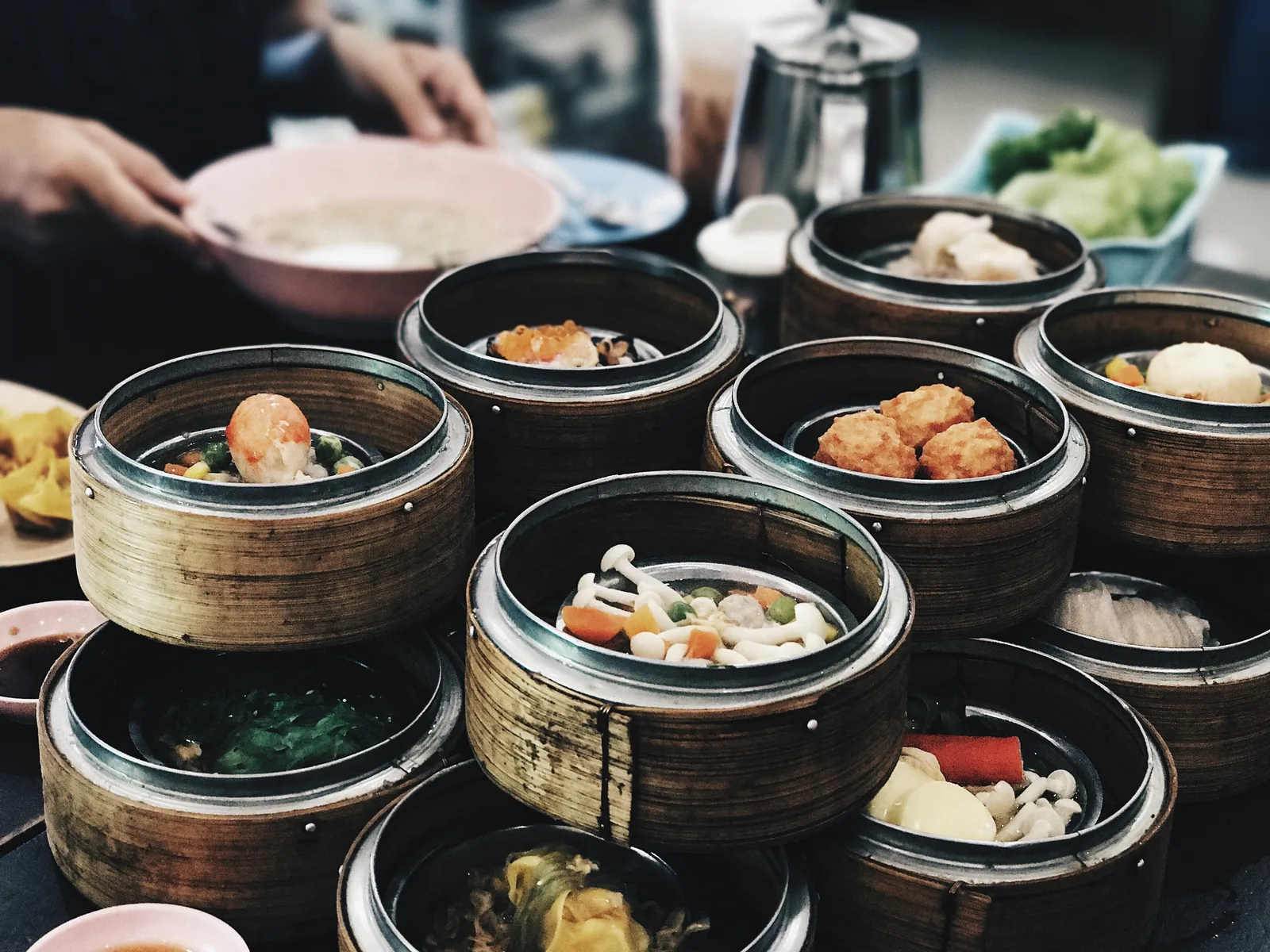
Hero photo: breakfast dim sum in Hong Kong, by afterdog, CC0, via Wikimedia Commons.