Every week we open something on a Sunday and write down what it did. We call it Sunday’s Delight, and this is the third one.
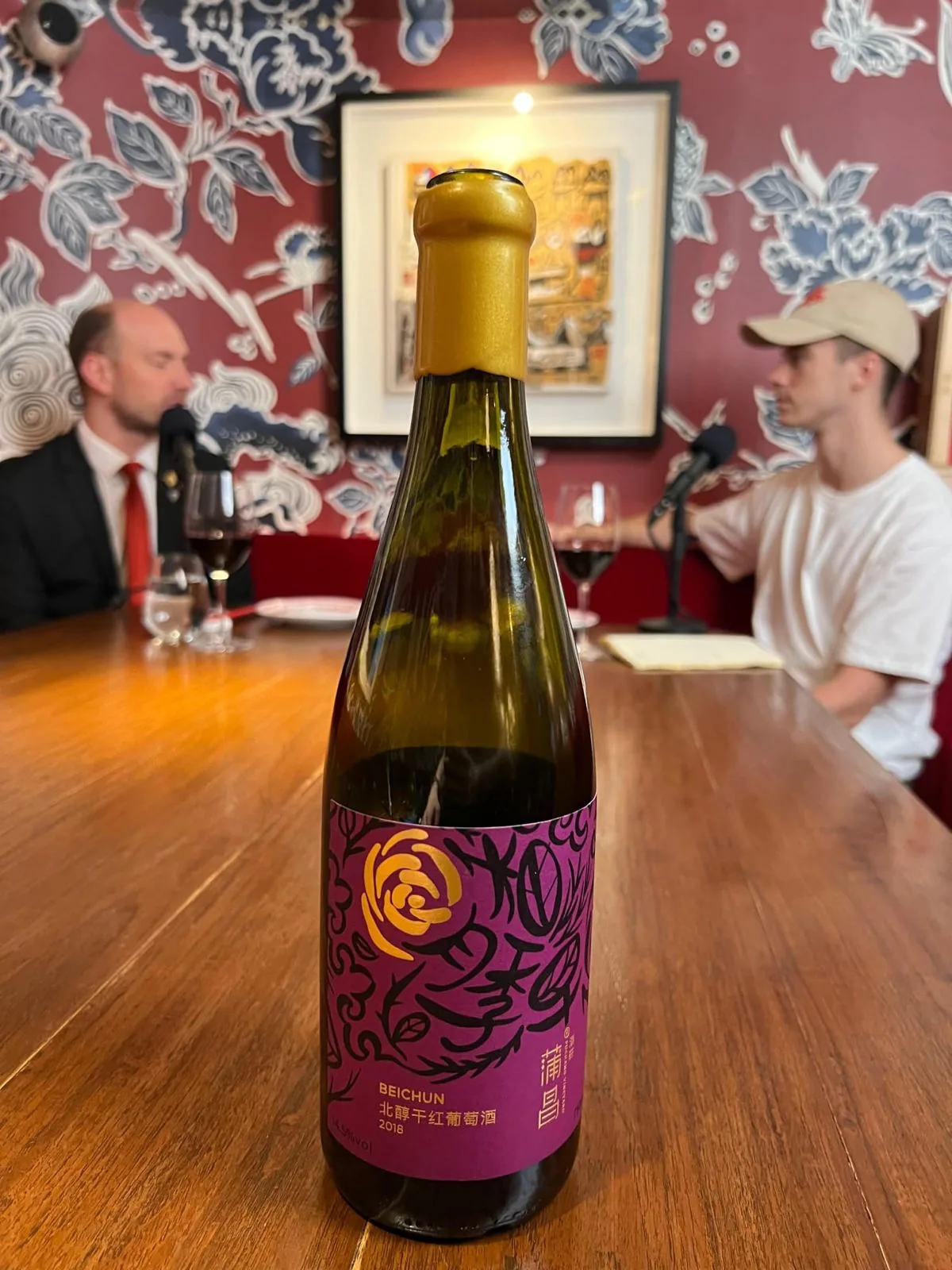
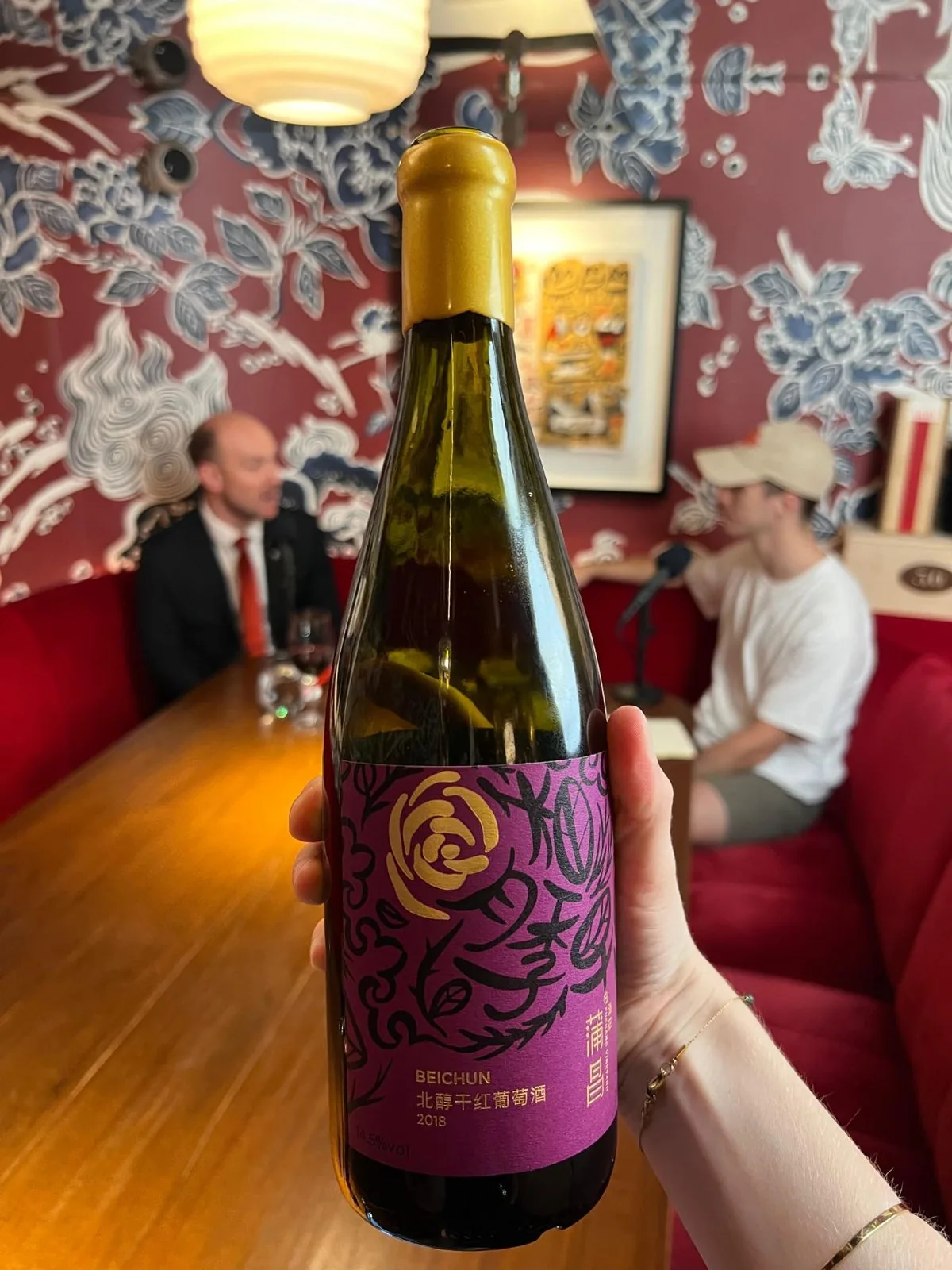
The first two were French. This one comes from Xinjiang, in China’s far west, made from a grape almost nobody outside China has heard of, and it is exactly why I keep digging into Chinese wine. This bottle stood on the table through a podcast recording, between the microphones and the glasses, which is where the photos come from.
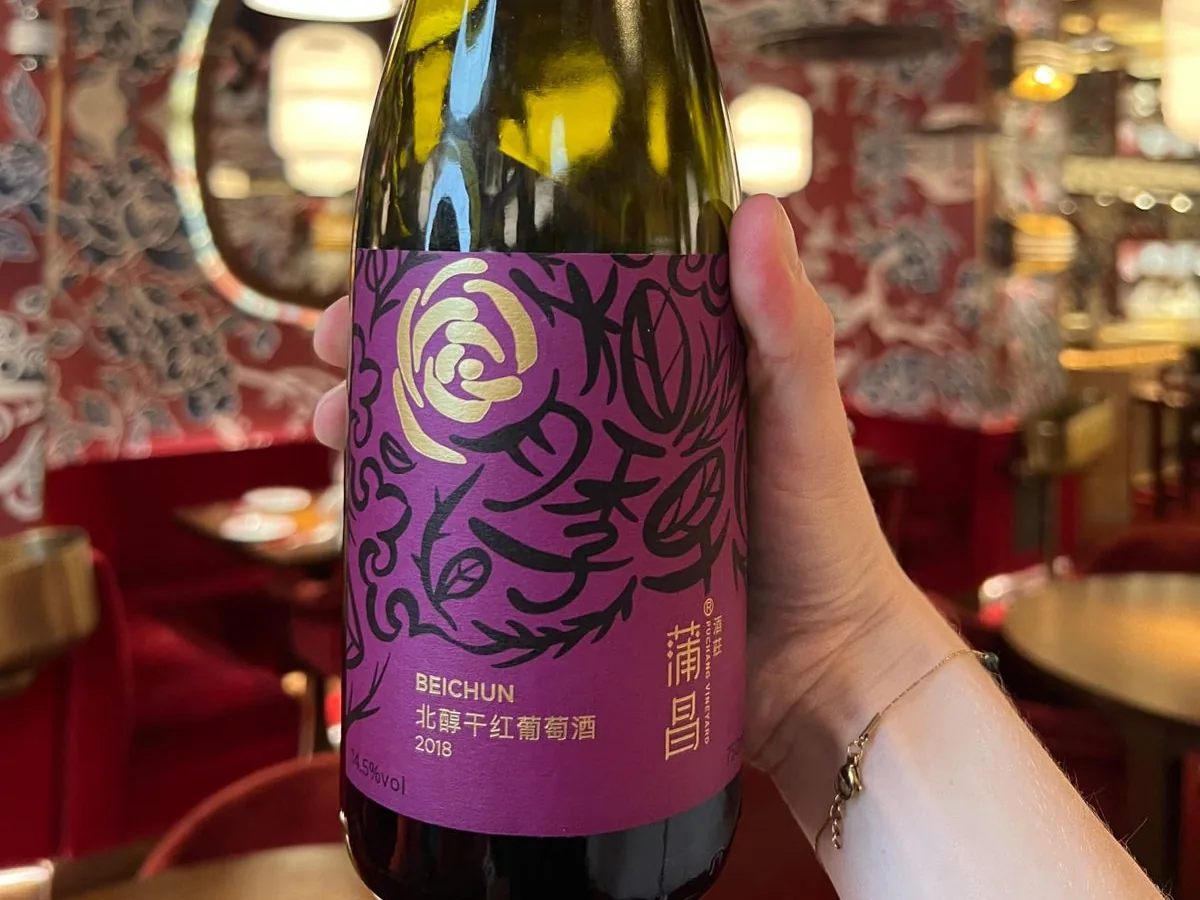
Beichun 2018 is a 100% Beichun red from Puchang Vineyard (蒲昌酒庄), an organic estate in the Turpan region of eastern Xinjiang, planted on gobi, the stony gravel desert at the foot of the Tian Shan mountains. It is deep ruby and full-bodied but elegant, with dark and bright cherry, cocoa, liquorice and a hint of violet. A 14.5% red that never feels heavy.
What is in the glass
The colour is a deep, luminous ruby: dark, but with light still coming through it.
The nose is cherry, two kinds of it: a dark, ripe one and a brighter red one beside it. Then come cocoa and liquorice, with violet underneath.
On the palate it is full-bodied, as you would expect at 14.5%, yet it never turns heavy. That is what I mean by elegant: a wine with body that knows what to do with it.
What it is not is a baked, jammy desert red, which you might fear from a vineyard where summers reach 46°C.
Ian D’Agata, who tasted it in 2023, likens it to a well-balanced Amarone-style wine. In September 2026, Caroline X.H. Lin of Palate Journal found it lighter in colour than the estate’s Saperavi, with lively acidity and softer tannin. Put the two together and you land close to my own two words for it: full-bodied, and elegant.
Beichun: bred in Beijing, not Xinjiang
You will often read that Beichun (北醇) is a Xinjiang grape, grown only there. It is not. It was bred in 1954 at the Beijing Botanical Garden, part of the Chinese Academy of Sciences’ Institute of Botany, by crossing Muscat Hamburg with Vitis amurensis.
Muscat Hamburg sounds German but was bred in England in the mid-19th century. DNA shows its parents are Schiava Grossa (Trollinger) and Muscat of Alexandria, and the “Hamburg” comes from “Black Hamburg”, an old English name for Schiava Grossa. It is mainly a table grape, once a favourite of Victorian hothouses, and in Chinese it is 玫瑰香, “rose fragrance”, which makes the gold rose on the label rather apt.
The other parent is the wild Amur grape, 山葡萄 or “mountain grape”, native to north-east China, the Russian Far East and Korea, and one of the most frost-resistant grapes there is.
Why that pairing? Across northern China, roughly wherever winter drops below -17°C, European vines have to be covered with soil every winter and dug out again in spring. Lionel Le Gal put it plainly in our episode with him: burying vines drives costs up. In Xinjiang the job is reported to cost over ¥15,000 a hectare a year. Beichun was bred to skip all that: thanks to its wild parent, it gets through the winter in the open.
High-yielding, high in sugar and happy with humidity, it also took to China’s rainy south. By the 1970s it covered more than 100,000 mu, around 6,700 hectares, in nearly every region of China except Tibet and Taiwan, and it helped fix the country’s shortage of wine grapes. What you rarely see is Beichun taken this seriously: on its own, from old vines, with a year in barrel.
Turpan: a furnace in summer, a freezer in winter
The Turpan Depression drops to Ayding Lake, 154 metres below sea level, the lowest point in China. The town of Turpan gets about 16 mm of rain a year against roughly 3,000 mm of potential evaporation. In July 2023, Sanbao in the Turpan area hit 52.2°C, the highest temperature ever recorded in China. Then winter flips it: January averages about -7°C in Turpan, and the estate talks about -20°C.
Puchang’s vines are not at the bottom of the basin but on the slopes above it, with the Beichun at around 600 to 650 metres. The soil is gobi: in Chinese, 戈壁 means stony desert, not the Gobi Desert of Mongolia. Here that means alluvium, gravel, sand and silt, with a little clay.
Water comes from Tian Shan snowmelt, carried by the karez (坎儿井), centuries-old underground tunnels that cut evaporation, then along stone-lined channels into the vineyard. With barely any rain, almost every drop the vines drink is snowmelt the grower chooses to give them, and the dry air leaves little room for the diseases that plague wetter vineyards. That is what makes organic farming so much easier to keep up here than somewhere rainy.
As for winter, a Decanter China promotional feature says the estate’s vines are buried one by one each December and dug out again in spring. The Beichun looks like the exception it was bred to be: Ian D’Agata notes that in the cold spring of 2016 the estate’s other varieties came out of the ground ten days late, while the Beichun budded and flowered almost on time.
Turpan is no newcomer. It is one of China’s oldest grape-growing oases, on the Silk Road: a vine stem from the Yanghai tombs, about 2,300 years old, is the earliest physical evidence of Vitis vinifera cultivation in China. Today the region produces more than 90% of China’s raisins.
Puchang: from state winery to organic estate
The name is recent, the vineyard much less so: it was first planted in 1975 by the state-run Turpan Municipal Winery. In 2008, by most accounts, Hong Kong entrepreneur K.K. Cheung (张建强) bought it and renamed it Puchang. He started by planting more than a hundred varieties to see which suited the site; the first Beichun was the 2013 vintage.
The estate covers about 67 hectares, all certified organic by Ecocert since 2013 (it says it uses no chemical pesticides or herbicides), and Italian winemaker Loris Tartaglia has worked there since the same year. Its calling cards are two Georgian grapes, Saperavi and Rkatsiteli: the Rkatsiteli 2017 won one of China’s seven Golds at the 2019 Decanter World Wine Awards.
Beichun is about a quarter of the vineyard, on vines more than 25 years old, which makes them older than the Puchang name itself: they were planted in the state-winery days. The 2015 took Silver at the 2018 Decanter World Wine Awards, and there was no 2017 at all: the team judged the fruit not good enough. Skipping a vintage costs real money, and doing it for a grape most drinkers have never heard of is taking that grape seriously.
The 2018 was fermented with native yeasts in stainless steel, then spent about a year in 500- and 225-litre barrels already used twice, and around eighteen months in bottle before release. Old barrels leave little oak flavour behind, so the fruit does the talking.
What to eat with it
This wine has ripe cherry fruit, a full body and 14.5% alcohol, so it wants fat, protein and salt. Start with the food of its own region, then follow the grape back to Beijing:
| Dish | Why it works |
|---|---|
| Cumin lamb skewers, well salted, chilli on the side | Fat and protein soften tannin, salt rounds the wine out, and the cumin picks up the liquorice |
| Polo, the Uyghur pilaf of lamb, carrots and rice cooked in the lamb fat | The lamb and the rich rice take the tannin, and the acidity cleans your palate between mouthfuls |
| Lamb shoulder roasted with cumin and garlic | The home-kitchen version of the skewers: same fat, same salt, same spice echo |
| Big plate chicken (da pan ji), ordered mild | Chicken, potatoes and wide noodles in a rich braise suit the fruit, as long as the chilli is turned down |
| Peking duck, with only a smear of sauce | A homecoming for a grape bred in Beijing. Duck fat and crisp skin suit the cherry, but the glaze and the hoisin bring sugar and umami, which make a red taste harder; if the sauce flows, our duck pairing guide reaches for an off-dry Alsace white |
One rule worth remembering: alcohol turns up the burn of chilli, and this wine has 14.5% of it. A full-strength big plate chicken or skewers caked in chilli flakes will taste a lot hotter. And the usual rule holds: sweetness and umami in food make wine taste drier, more bitter and more astringent than it is, so take care with hoisin and with sticky soy-braised pork belly.
How to serve it
Our red wine serving temperature guide puts reds concentrated in alcohol at 15°C and supple reds at 15 to 16°C, so aim for 15 to 16°C (about 59 to 61°F). Warmer, and the 14.5% takes over. Cooler, and the tannin firms up.
As for air, our guide to aerating wine recommends a carafe mainly for young wines whose tannin is still hard, and opening older bottles ahead of time instead. This 2018 sits in between, eight years on from the vintage: open it an hour before, or give it half an hour in a carafe if you are short of time. No rush either: Ian D’Agata gives it a drinking window running to 2034.
Would we buy it again
Yes, and not as a curiosity. It is a big wine that stays elegant, and it puts the whole improbable story in one glass: a grape bred in Beijing to survive the winter unburied, ripened in the corner of China that holds the national heat record.
The only catch is finding it. In China, the wine site Wine-World gives a domestic reference price of ¥375 (roughly US$55). An Australian merchant listed it at A$69 before selling out, and it turns up in Singapore merchants’ catalogues. In Hong Kong, Puchang has been sold through Watson’s Wine, and a Puchang red sits on the almost entirely Chinese wine list at Ho Lee Fook, as Jean-Baptiste Copot told us in our episode with him.
If you want to place this wine on the map of Chinese wine, from its grapes and regions to the producers worth knowing, that is what our Chinese wine course on the Academy covers.
You can find the estate and its range at puchangwine.com.
Bred for Beijing’s winters. Ripened in Turpan’s summers.
Frequently asked questions
What is Beichun?
A red Chinese grape, bred in 1954 at the Beijing Botanical Garden, part of the Chinese Academy of Sciences' Institute of Botany, by crossing Muscat Hamburg with Vitis amurensis, the wild Amur grape. It was bred to get through northern Chinese winters without being buried, and it was planted in almost every region of China, not just Xinjiang.
Where is Puchang Vineyard?
In the Turpan region of eastern Xinjiang, between the Turpan Depression and the Tian Shan mountains, about 150 km south-east of Urumqi. The vineyard, first planted in 1975, sits on gobi, a stony gravel desert, on the slopes above the depression, and every plot is certified organic by Ecocert.
What does Puchang Beichun 2018 taste like?
Deep, luminous ruby, full-bodied but elegant, with dark and bright red cherry, cocoa, liquorice and violet undertones. A 14.5% red that never turns heavy.
What food goes with Puchang Beichun 2018?
Xinjiang cooking is the natural match: cumin lamb skewers, polo (the Uyghur lamb and carrot pilaf), or a cumin-rubbed lamb shoulder at home. Fat and protein soften tannin, and salt rounds the wine out. Go easy on chilli, which 14.5% alcohol amplifies, and on sweet sauces such as hoisin.
Where can I buy Puchang Beichun 2018, and how much does it cost?
In China, the wine site Wine-World gives a reference price of ¥375 (roughly US$55). Elsewhere it goes through importers: an Australian merchant listed it at A$69, it turns up in Singapore merchants' catalogues, and in Hong Kong Puchang has been sold through Watson's Wine and appears on restaurant lists such as Ho Lee Fook's.