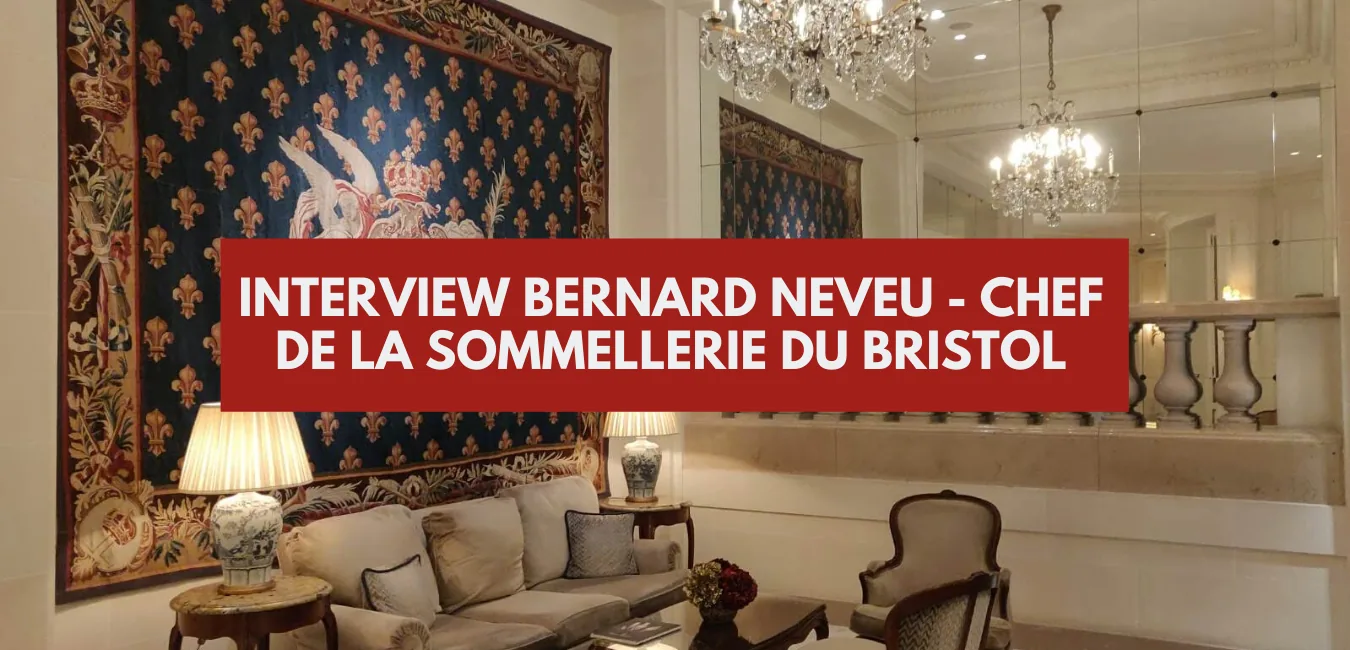
To kick off the year right, we’re sitting down with Bernard Neveu, head of the sommelier team at Le Bristol in Paris. Wine Makers Show pushes open the doors of the Bristol’s cellar. We thank him, of course, along with the Bristol team, for their openness, and we hope you’ll enjoy this episode as much as we enjoyed recording it.
Can you start by introducing yourself?
I’m Bernard Neveu, head of the sommelier team at Le Bristol Paris. Le Bristol Paris is a historic palace on the Parisian scene. I’m 38, we’re a team of 12 sommeliers and 2 cellar masters. Among the sommeliers, there are also two apprentices. The restaurant L’Épicure is the flagship of the hotel. It’s a three-Michelin-star restaurant (for 10 years), with chef Frechon at the helm for 20 years. We have another restaurant in the hotel: Le 114 Faubourg, with one Michelin star. This restaurant also has its own sommelier team: 3 sommeliers and an apprentice.
How did your passion for wine come about?
It came late. My dad was in the restaurant world: he was a chef. I knew I wouldn’t do that job. I love eating and tasting, but I’m not a good director for food. Still, I knew this world that’s always a bit on the boil. The contact with guests, playing the messenger role: I’ve always loved that, and I figured it out pretty young. So I followed a service training and was lucky to meet some great teachers. They were able to educate my taste, since I didn’t come from a wine-drinking family. I figured out pretty late that wine was made from grapes, and so I dove into books. Every three months I’d reread the same wine books because I was soaking them in. I realised the complexity around all of it.
What I find incredible is that you have to start over for every vintage. With each vintage, you almost wipe the slate clean. There are things that don’t change, methods, but there’s always something new. Climate variability brings huge complexity. That journey with my teachers was the spark. Today I’m still in a restaurant dining room, recommending beautiful bottles to our guests.
Let’s go back to your training
I oriented myself around 17 or 18 and I really fell head over heels. I dove into books, walked through wine merchants, learned to read a label and really soaked it all in. I did a sommellerie specialisation. I finished that training in 2003, knowing perfectly well I wasn’t a sommelier yet but everything was beginning. I had no safety net. I had to advise the guest without a parachute, and that’s where you have to double down on the work. The first motivation is to satisfy the guest. Of course, I want to explain and let people discover, but satisfying the guest is the most important thing.
How did leaving school go?
I left with a sommellerie specialisation, so that’s exactly what I wanted to do. I joined a junior sommelier role straight away. I wanted wine to be my job.
The first service: it has to be prepared. You need to have worked the wine list and the food menu. You can’t not know the lists if you want to advise the guest well. The first night, you fumble a bit, you haven’t necessarily tasted everything. Then you gently impose your mark and your style. When you’re a sommelier, you have to know the cellar, the wines and make all of it your own. There’s only one truth: it’s in the glass. You can only talk about a wine after you’ve uncorked the bottle and tasted it.
I remember as an apprentice, I’d done the Olympiad of Trades. At the national finals, there were three bottles of wine from the same vintage: a Bourgogne village rouge, a Vosne Romanée and an Échézeaux. Same owner and same vintage. I had to discuss them, and that put me in difficulty because even though I knew what they were, I hadn’t tasted them.
How did you arrive at Le Bristol?
Le Bristol is part of the Oetker Collection: a collection of hotels in France with a few abroad. I knew the structure well because I’d worked at Château Saint Marin et Spa. I was called to become head sommelier at the three-star restaurant. I obviously knew the hotel aimed to be number 1. We all want to be the best, otherwise we don’t do this job. So I told myself it was a wonderful opportunity. I went through the various recruitment stages and started in February 2015.
You arrived at the restaurant five years ago, and now you handle the whole hotel
That change happened pretty fast because my predecessor went on sick leave. You have to know how to swim, because we’re in deep water here. If I hadn’t had the path I had before, I wouldn’t have made it. I haven’t only done three-star restaurants, I’ve done many different structures. So I was a Swiss Army knife. That’s what’s important in a restaurant like this one.
Are the first days here similar to the first days you described earlier?
Yes, that’s it but in triple-XL version. Everything goes much faster. The colleagues are very precise and very strong. You have to be a good swimmer. It’s a very, very beautiful structure. It’s a magnificent restaurant where everything moves fast. It’s like a Formula 1 circuit where we’re full at lunch and dinner, 7 days a week, all year round. We’re flat out all year. So you need to be on the right train straight away. Obviously, if you miss the first train, the second isn’t as fast and you’ll have to work twice as hard.
Let’s talk numbers, how many covers is that?
We’re at almost 100,000 bottles in the cellar, which is starting to be quite something. We have 40,000 bottles in storage outside Paris with a service provider. We do all our allocation and vintage tracking and build the cellar with my colleagues. We have total freedom from the restaurant management and from our parent company. 60,000 bottles are in the Bristol cellars. That lets us have a selection of around 2,500 references on the wine list, available to guests. That’s a fair bit of reading.
It’s important to have choice across all regions. There are strong regions: Champagne, Burgundy, Bordeaux, the Rhône Valley. We’ve beefed up other regions: Alsace, which makes great whites, the Jura, Savoie, where we’ve expanded the list, and foreign wines, which are growing a lot on the list. We’ve increased the share of foreign wines by 50%. It’s important to give choice to guests. And for us it’s important to have the best wine list: that’s why we get up in the morning.
This list won the Wine Spectator Grand Award in 2016. It’s a great honour because few restaurants in France have it. It’s a real follow-up by the American magazine that awards this prize. It isn’t easy to get. Someone from the magazine asked to see our cellar and the bottles after receiving our list. We send our wine list in advance and that person asked to see certain bottles. Every year, around the same time, we send the wine list.
You’ve evolved the cellar; have you noticed an evolution in the consumer profile?
There’s one huge thing: grower champagnes. We have 400 references on our champagne list. We have the great classics of course, but also many grower champagnes. If I only proposed conventional champagnes, we’d be behind. Champagne is exploding in terms of growers. There are lots of families who used to sell their grapes to big houses but the current generation is taking back leases or fully reclaiming their vines and deciding to make champagne. It’s a bit like Burgundy in the 1970s and 1980s. It lets us introduce these champagnes to guests.
We hear a lot about organic and natural wines, do you see that?
I have nothing against natural wine, or against wine made the conventional way. What matters most to me is guest satisfaction. For that, I want clean, well-made wines. That’s the most important. There are many winemakers who follow all the organic specifications but don’t have the label. The most famous estate in the world in this respect is Romanée-Conti. As long as the wine holds, I have no problem. If the wine spins out, I’m putting my employer at risk, I give a bad image of sommellerie, and the guest suffers.
You have a team of 14 and you’ve often mentioned apprentices in this interview. Is that important to you?
Yes, very important. I take many on. I try to take Brevet Professionnel students. I find it’s an excellent training where students go out into vineyards. Le Bristol is a wonderful learning place where staying two years as an apprentice is an incredible development. It takes two years for apprentices to come out of Le Bristol very strong. It’s very important that this transmission happens.
Do you keep bringing in new references?
Yes, it’s almost a pathology. The only thing we have to do is have the best cellar and the best wine list. Not necessarily at any price, but there are always new estates we bring in. We solicit winemakers, taste collegially. In the end I’m responsible for the choice, and if I’m convinced we go for it with great pleasure. We travel a lot to vineyards, about once a month. We follow estates we know well and we always try to discover and stay current.
What’s left for you to do with all this?
Keep going. I still have time and I’m in good shape. What’s fantastic is that a sommelier can’t be seasonal. They need to stay at least 2 or 3 years to analyse the life curve of a bottle. A bottle evolves and won’t be the same depending on when you taste it. Following the evolution of bottles is very enriching. I have two deputies and there’s a large part of the wines we bought when we arrived that we’re starting to put on the list.
Do you have a story about a service?
I have so many that I can’t pick one. There’s always something. We always have surprises. Sometimes, opening a bottle, you’d swear the level is very low or the cork is in bad shape. In the end the wine is fantastic. The moral is that the truth is in the glass.
We created a small caveau adjoining the great Bristol cellar. It’s a space we wanted to be very intimate, to allow for tasting a glass of wine.
What’s your daily routine?
I get in around 10:00, 10:30. I drop by the restaurant to see the opening sommelier and check that everything went well and that the right references are in place. I pick up my mail and open it. I spend an hour on the computer to follow orders, allocations, logistics. I also see the day’s delivery. Then comes lunch service. After that, we follow the list: new arrivals and recent departures. All of this is very collective, I really wanted to open things up. When I arrived, I inherited an office with a computer. Now we have the same office but with three workstations. I opened things up to make it more collaborative. All sommeliers have access to the cellar: it’s not mine, it’s the Bristol’s. It’s extremely important to have this collaborative side: they’re not just bottle openers.
Do you have a wine book to recommend?
It came out not too long ago, an excellent book by Philippe Bourguignon: sommelier à mots choisis. It’s an excellent book, very well written, full of beautiful anecdotes. I really enjoy reading it and it’s one of the lovely sommelier books.
What’s your latest favourite wine?
I knew the estate by reputation but I’d hardly tasted it. It was last night: one of my former apprentices is in London. He came back to France for the holidays. He stopped by here. So we went to a well-known restaurant near the Champs Elysées. We had a bottle of Jérôme Bressy: Domaine Gourt de Mautens blanc. I’d tasted the red a few months ago and found it fantastic. This one is among my latest favourites.
If you had a person to recommend for this podcast?
A former sommelier: Jean-Luc Lavatine. He’s a former sommelier who reconverted as a sales rep at a major Bordeaux wine distribution company. For the past year, that company has bought a Loire wine distribution company. He’s one of those people with a real sensibility, a sommelier past, and who knows what he’s talking about.
Amazon links on this page are affiliate links. They cost you nothing extra, and they help me keep this going.