For this 15th episode, Wine Makers Show pushes open the doors of Le Meurice, the legendary Parisian palace. We’re meeting Gabriel Veissaire, the hotel’s head sommelier, who looks back at his career and tells us how he put together the Meurice sommelier team with a single goal in mind: serving the guest. Enjoy the listen.
Gabriel, can you start by introducing yourself?
I’m Gabriel Veissaire. I’m a sommelier and I grew up in Auvergne. At 17, I chose to attend the Chamalières hotel school. I started with a year in the kitchen and quickly realised it was a very tough job. I felt more at home in service than in the kitchen, so I followed up with a sommellerie specialisation. I then went to Tours to study with an excellent teacher: Christian Pechoutre, MOF in 2000, one of the first Meilleurs Ouvriers de France in sommellerie. I had the chance to travel through many vineyards, visiting 200 estates in two years. It was sharp, hands-on training.
I wanted to be a chef. I’d always grown up with the smells and tastes of my mum’s and grandmother’s kitchens. That hunger to taste was there from the start. I was thrilled to get into hotel school. But I quickly realised it would be tricky because I wasn’t organised in the kitchen. I had a teacher who’d come check on us before service to verify how the chicken was cooking. I’d tell him everything was fine. He’d ask where the jus was, and I’d answer “oh, there was a jus to make?” I kept skipping the basic methodical steps. At the same time, we were doing dining-room service. My teachers quickly figured out I was more comfortable on the floor.
The taste for wine came from the very mystical side of the cellar. During family celebrations, my dad liked to take my brother and me down to the cellar to pick a bottle. I was always curious about that mysterious side of the cellar: dark, with bottles lying down and dusty. There were always lots of questions when we walked in. That curiosity and the desire to discover pushed my passion for wine. Food and wine pairings were also incredible to me: I loved how the right wine could elevate a dish. Wine is the dish’s partner, made to highlight the product.
Note: on this topic, you can find an interview with Fabrizio Bucella about his book on food and wine pairings.
We’re interrupting your reading for a moment, but it’s for your own good. To never miss an episode of our podcast, you can leave us your email address. As a bonus, we’ll send you a tasting sheet you can fill out so you never forget those precious moments.
At what age did you start tasting wine?
Very early. Around 13 or 14, I’d go down to the cellar with him and smell the corks. My father would let me taste, without swallowing of course. Around 14 or 15, I started enjoying food properly, and that’s when my taste sensations started developing.
Can you tell us more about your sommelier training?
My specialisation took a year. I chose to do an apprenticeship after that. The mix between theory, discovering estates and a few weeks in a working environment was really interesting.
What would you have done if you hadn’t become a sommelier?
I think I’d have kept pushing in the kitchen. I’d have wanted to keep going until I made it. I have to do a food job: I have to taste. I ask myself this question every day. I always tell myself I’d have come back to the pleasure of tasting.
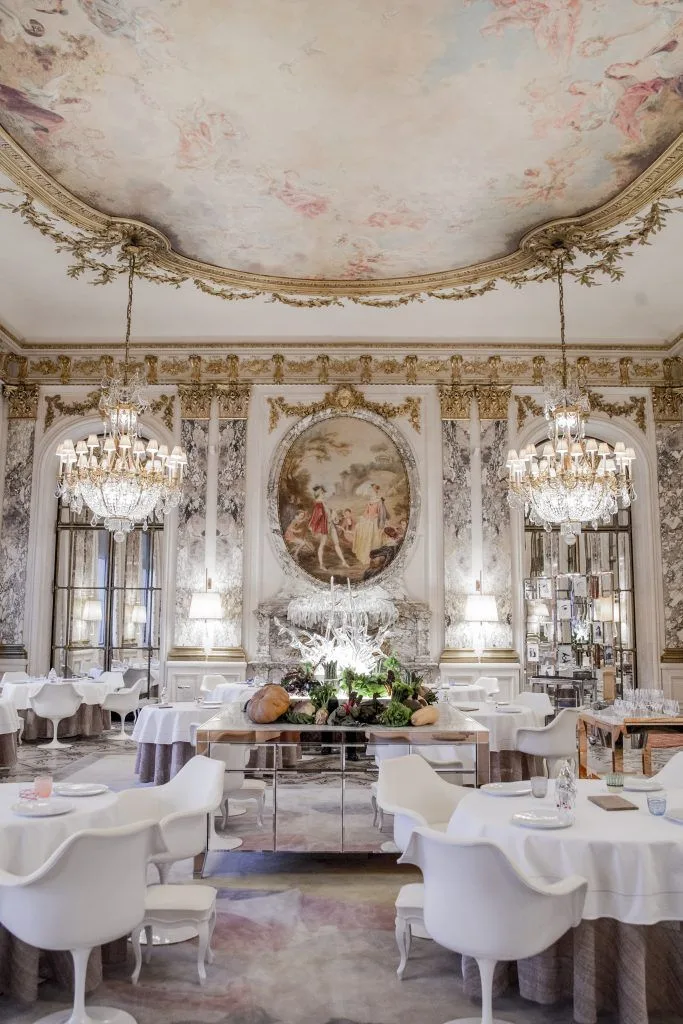 Le Meurice Alain Ducasse (c) Pierre Monetta
After school, you started working?
I had the chance to take a head sommelier role at a one-Michelin-star restaurant in Clermont Ferrand. The restaurant was promoted to two stars two years in a row. That was my first job with real responsibilities, lasting two and a half years. I was 22. I always had my purchases approved. They trusted me because they knew the school I came from, and I wanted to share my passion with the customer.
After more than two years there, I wanted a change of scene. So I wrote handwritten letters to every three-star restaurant in France. I got several rejections. Le Louis XV in Monaco called me back and said “can you be there Wednesday at 11?”. Of course I went. They offered me a job which I took right before the Grand Prix. I went back to being a commis sommelier. It was a huge change. The clientele was completely different. The politics of a palace hotel were different too. I had to keep up with Noel Bajor, who I’ll always count among the people who shaped me.
What did you take away from that period?
Noël Bajor had a beautiful technique for managing people. He understood me very quickly and saw where he could take me. From him I took professional bearing, respect, an incredible way of carrying yourself, and the understanding that we’re at the customer’s service. I also took a method and powerful technical skill. He knew how to manage according to each person. There were three of us and he’d take the best of each and push it as far as possible. Today I have six different people on my team: each brings something so the team can move forward with passion. I leave no one behind.
What did you do after Monaco?
Right after, I took over the cellar of a restaurant in Auvergne with Xavier Beaudimient. I had carte blanche on the wine list since he’d just opened. Soon after, the head sommelier at Guy Savoy called me and I joined the restaurant for nearly 10 years. Time flew by with a great chef who was very approachable. It was wonderful, and I almost had a tear in my eye when I left. The teams stay almost unchanged. You feel good there.
I then wanted to leave the team to keep growing and fly on my own. I told myself I was still young and could see further. I saw a listing for Le Meurice. The adventure begins.
I got married in 2019, my little girl was born in 2019, and I changed jobs in 2019: it’s a triple.
How did the first days at Le Meurice go?
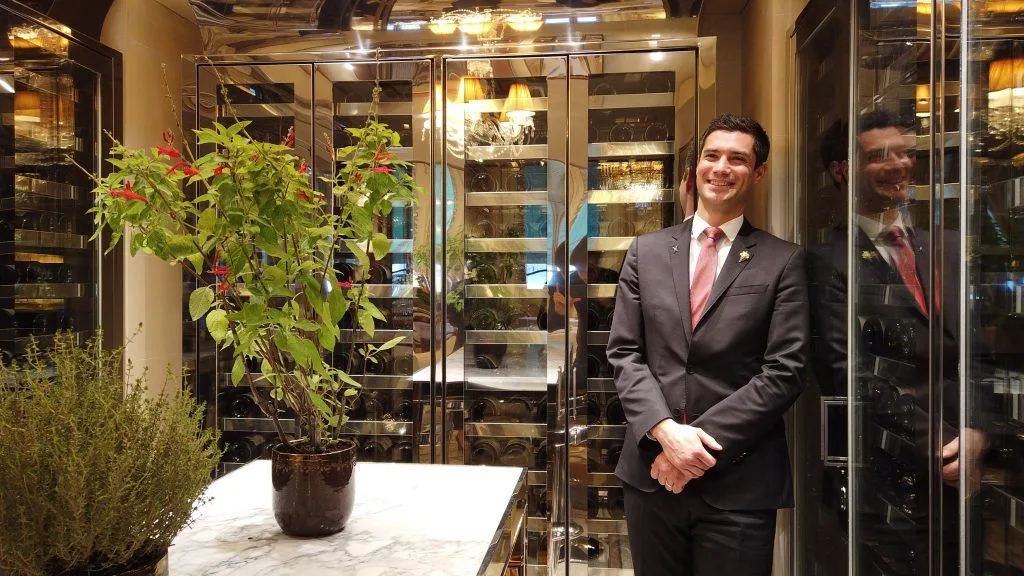
I was very, very well welcomed by all of the Meurice staff. I love atmospheres where you feel good, and that’s the case at Le Meurice. I’m in the oldest Parisian palace. When I was younger and drove past Rue de Rivoli with my parents, I’d tell myself I’d love to step inside. Today the dream has come true.
You also got to know the cellar
Of course. The cellar is where I feel at home. I went to see all the references, learned how the cellar was organised. I recognised many labels I already knew very well. I thought about how we’d organise things. When I arrived, the two sommeliers were leaving. For two months I had to soak in the work to be done across all of Le Meurice’s outlets, on my own. I always tell myself: who can do more can do less. I built up my team, which is now a wonderful team.
How is your team set up?
There are six of us, including two apprentices. I bet a lot on apprentices. The future is in apprenticeships and hotel schools. I have one apprentice who’s signed up for the best-apprentice-of-France competition, and we’re training her for it. These schools have a strong impact on the future of the trade. The future is them. We need that freshness and renewal.
Do you have a few numbers on the Meurice cellar?
The central cellar has roughly 15,000 to 16,000 bottles. The cellar is organised like a classic cellar with different regions and sub-regions. 95% are French wines. The restaurant has a capacity of 35 to 40 regions. We pay close attention to the cellar’s value. In the end, we also have to sell the wine. We have to share a message and please the guest, but we also have to manage the cellar.
How does a wine get listed at Le Meurice?
Ah. You have to make beautiful wines. This morning, for instance, I was tasting. I really enjoy this wine and to me it deserves a spot on the palace’s list. We taste a lot and stay alert to discover wines that could join our list. I have a friend, for example, Laetitia Pietri at Collioure who makes white wines of incredible purity and freshness. Everywhere I’ve worked, her wines have joined the list because they have the balance and the purity to be on a list.
What’s the consumption profile of Meurice guests?
We have an international clientele. They tend to gravitate towards reassuring regions: Burgundy in white and Bordeaux in red. We also have a clientele that is very open and wants to be guided. For example, today we have a table of eight and all the wines are being tasted blind. We go to small, lesser-known regions and seek out lesser-known winemakers. The wines are great.
What’s your relationship with the winemakers?
I travel with my team at least once a month. I call winemakers every year to ask how the growing cycle went, how the harvest went. I check on the vintage and visit as much as possible. We need that to see the vines, smell the soil, soak in the ecosystem. Going to see a winemaker is the most beautiful gift you can give them.
I try to rotate, and we often travel as a team. To be a sommelier, you have to be curious.
What’s a typical day for the head sommelier of Le Meurice?
I get in around 9:30. I deal with my emails. My team arrives a bit later. I might have a tasting at 11, or the banqueting service might need food and wine pairings. I deal with everything as best I can and try to be efficient with all the tasks we have to get through. Then we run the lunch service. I often receive winemakers at 4 pm or future candidates. Then evening briefing and service. I make the most of my little girl now, but she always gets a kiss from dad when I get home. Every day is different. That’s what’s so powerful in this job.
Do you have a story to tell about one of your services?
I’ve got a good one from Guy Savoy’s restaurant. We’d had a visit from Brad Pitt and Angelina Jolie. They’re real wine lovers and had ordered the wines in advance. Every wine was served in magnum and they all had to be served at the same time. Brad Pitt mixed up all the glasses, there were about eight of them. Looking at me, he asked where the Châteauneuf du Pape was. I pointed to the right one because I recognised the colour. He tapped me on the shoulder and said “you’re a good one”. It was a really nice moment.
Sometimes guests ask us for specific wines. When we don’t have it, I always find an alternative. You always have to find solutions and never say no. There are also simple things. Some guests ask for wines we may not have. But the next time they come back to Le Meurice, the bottle they’d asked for is waiting in their room. That leaves a mark.
What have you learned after a year at Le Meurice?
I’ve learned to be even more flexible. I’m starting to get used to the regular guests. I’ve developed my creativity and my team spirit. I keep passion at the heart of the work, of course.
What would you tell a young sommelier?
I’d tell them to be curious, to ask questions. The apprentice, for example, is not there to do an employee’s work. I always tell them to observe and ask questions. Personal study is very important. I push my teams to invest in theory. I sometimes ask sommeliers to put together reports on regions and then present them to the rest of the team. It’s great because it spreads knowledge and improves public speaking within the team. Steve Jobs said: “The best things that happen in business are not the result of one person’s work. They’re the work of an entire team.”
Have you changed anything on the Meurice list since you arrived?
I didn’t want to revolutionise everything. I wanted to bring a bit of freshness. At lunch, we offer a food and wine pairing menu at very attractive prices. I have to find the gem from a winemaker that will really marry the dish we’re offering. We rely a lot on seasonality, so it has to evolve constantly.
We have a large international clientele. When they come to Le Meurice, they want to drink very good French wine.
Do you have a wine book to recommend?
Right now, I’m reading Le vin by Antoine Pétrus. He’s a sommelier with great talent and humility. He has huge potential and tremendous craft. I love how he talks about wines, and we share the same approach to wine. It’s the book on my bedside table.
Buy Le Vin by Antoine Pétrus
Do you have a favourite tasting?
It’s the one I haven’t done yet. I always hope to have one. Wine came to me. I’d say a Jurançon from Yvonne Hegoburu. I find real emotion in her wines. She makes a 1996 cuvée called “pour René” in tribute to her husband. There aren’t many bottles left.
Who should I interview next?
I’d say Sylvain Nicolas: my former head sommelier at Guy Savoy. He’d be delighted to welcome you.