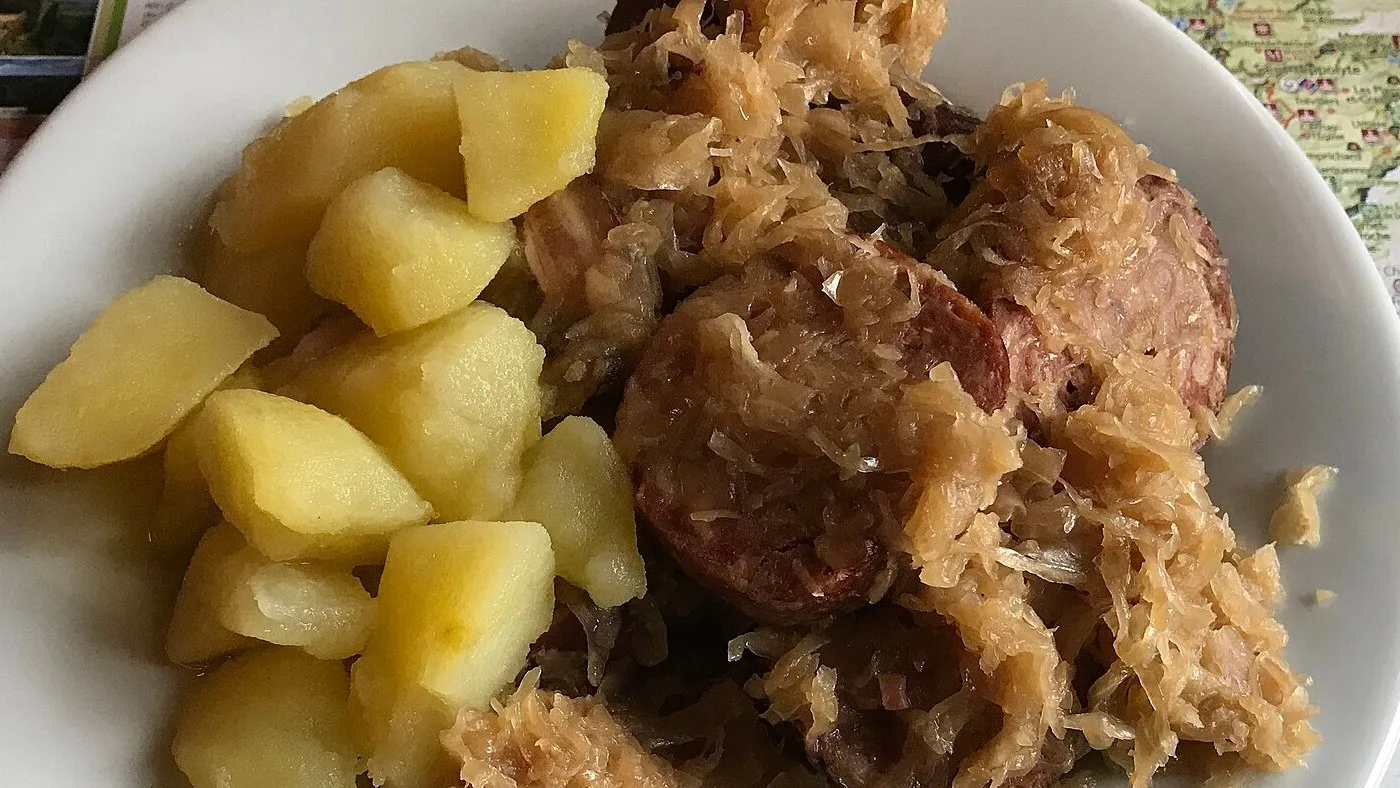
Sauerkraut with sausages and pork calls for a dry Alsace riesling. Its sharp acidity is one of the few things that can stand up to fermented cabbage, and it cuts through the fat of the sausages and the smoked pork. Sylvaner and pinot blanc work too, more simply. Skip tannic reds.
A note on names before we go further. This dish is Alsatian and German territory: in France it is choucroute garnie, in Germany Sauerkraut mit Würstchen or the full Schlachtplatte. Same cabbage, same pork, same wine problem. And it is a real problem, because sauerkraut is one of the most hostile things you can put on a plate next to a bottle.
Why does sauerkraut fight most wines?
The sausage is not the issue. Neither is the smoked pork or the potatoes. It is the cabbage.
Sauerkraut is lacto-fermented: shredded, salted, packed down, and left for several weeks while bacteria turn its sugars into lactic acid. What comes out of the barrel is sour, salty and faintly sharp. Most recipes then add another layer in the pot, with white wine, juniper berries and sometimes a splash of vinegar.
Put a wine that lacks acidity next to that and it reads as soft, flat, almost sweet. This is not a question of taste, it is a contest: whichever of the two is more acidic wins. Same thing happens with a sharp vinaigrette, which flattens any round white sitting beside it.
Meanwhile the garnish pulls the other way. Frankfurters, knacks, smoked belly, shoulder, ham hock: all fatty, all salty, all asking for a wine that rinses the palate between mouthfuls. We went through that side of the equation in more detail in our guide to wine with pork.
So you need two things that sound contradictory: enough acidity not to be crushed by the cabbage, and enough tension to cut the fat. Alsace whites do both, which is no accident. They grew up with the dish.
What white wine goes with sauerkraut and sausages?
Dry Alsace riesling is the answer. It is among the highest-acid whites in France, it sees no oak, and it keeps a lemony bitterness that answers the cabbage rather than running from it. With three or four years in bottle it picks up a warm-stone note and a little weight, which helps again on the smoked pork.
One trap: not every Alsace riesling is dry. Plenty of growers leave a few grams of residual sugar, and on sauerkraut that sugar makes an awkward half-sweet, half-salty pairing that wears thin by the second glass. Look for “sec” or “trocken” on the label, or ask. If you want the region as a whole, we wrote a full guide to the wines of Alsace.
| Appellation | Why it works | Price band |
|---|---|---|
| Alsace riesling, dry | Straight acidity, no oak, lemony bite. The benchmark | 10 to 16 € |
| Sylvaner (Alsace) | Quiet, saline and sharp, built for cabbage. Best value on the list | 7 to 11 € |
| Pinot blanc or auxerrois (Alsace) | Rounder and softer, keeps a table that dislikes acidity happy | 8 to 13 € |
| Crémant d’Alsace brut | Bubbles and freshness, scrubs sausage fat better than anything | 10 to 16 € |
| Edelzwicker or Gentil | The everyday Alsace blend, simple and thirst-quenching | 6 to 10 € |
| Alsace grand cru riesling (Schlossberg, Rangen) | More substance and salt, for a rich or seafood version | 22 to 45 € |
| German riesling trocken (Pfalz, Mosel) | Same grape, lower alcohol, even sharper | 12 to 20 € |
| Dry muscat d’Alsace | Fresh-grape nose, bone-dry finish. Surprising on the knacks | 12 to 18 € |
| Alsace pinot noir, served cool | The only credible red: low tannin, real fruit, real acidity | 14 to 24 € |
Sylvaner or pinot blanc: which one for a big table?
This is the real decision of the meal, and it depends on your sauerkraut.
Sylvaner is the historic grape for the dish. Long dismissed as filler, it is back in the hands of serious growers: little aroma, plenty of salinity, honest acidity, a faintly bitter finish. It is the technical choice. If your sauerkraut is very sour, heavy on juniper, cooked the old way, buy sylvaner and stop worrying.
Pinot blanc, usually blended with auxerrois, is rounder, softer, less tense. It does not fight the cabbage, it goes along with it. That is the social choice: at a table of ten where half the guests find riesling too sharp, it keeps everyone happy without breaking the pairing. If the dish is rich, generous on pork belly and potatoes, it does the job well.
If you would rather not choose, open a Crémant d’Alsace. Bubbles do the same work as acidity, with one mechanical bonus: they lift fat off the palate. On a dish that takes two hours to eat, sparkling is the wine that tires you least.
Is beer better than wine with sauerkraut?
Beer works, and we are not going to pretend otherwise. In Alsace and across the Rhine, half the tables drink a cold pilsner with this, and the match is good: hop bitterness answers the salt, carbonation cleans the fat, coldness resets the appetite.
The honest objection is volume. Sauerkraut with sausages is already a filling plate, and half a litre of beer adds bulk to a meal that needs none. White wine leaves more room and can be sipped over two hours without saturating anyone. If you want both, the local formula solves it: beer as an aperitif, riesling at the table.
Can you drink red wine with sauerkraut?
This is the mistake people make, and it starts from a reasonable instinct: there is meat on the plate, so out comes a red. The trouble is that young Bordeaux, Cahors or a big Côtes-du-Rhône meet the worst possible combination here, acidity plus salt plus fat. The tannins harden, the wine turns dry and metallic, and the food suddenly tastes twice as heavy as it is.
If you want red anyway, you need one with no aggressive tannin, decent acidity and plenty of fruit, served cool at about 14 degrees Celsius: Alsace pinot noir first, then poulsard or trousseau from the Jura, or a fine Beaujolais such as Chiroubles. Stay young and drinkable. It is the same logic as the other fatty winter dishes, which we worked through for raclette.
What about a seafood sauerkraut?
The seafood version swaps the charcuterie for smoked haddock, salmon, pollock and sometimes scallops, often with a butter sauce. The cabbage is still sour, but the dish loses its smoky salt and gains finesse.
Trade up on the riesling here: a grand cru, or an old-vine bottling with a few years on it. The salinity links to the fish, the acidity still holds the cabbage, and the length carries the sauce. A blanc de blancs Crémant d’Alsace also performs very well at half the price. What fails: heavily oaked whites, whose buttery edge collides with the beurre blanc, and off-dry wines, late-harvest gewurztraminer above all, which make the whole thing cloying by the third forkful.
How should you serve the wine?
Serve the white between 9 and 11 degrees Celsius, no colder. Ice cold, riesling loses its aromatics and keeps only its acidity, which is exactly what you do not need on a dish this sharp. Take the bottle out of the fridge ten minutes before sitting down.
On quantity, sauerkraut is eaten slowly. Plan one bottle per three guests across the whole meal, and keep one more in reserve, because the salt makes everyone thirsty. Put as many water jugs on the table as bottles, so nobody empties the wine for the wrong reason.
Last piece of advice: stay on one wine from start to finish. Sauerkraut has no crescendo, it is a long, steady plate, and switching bottles halfway breaks the rhythm more than it adds. For everything else on the table, our food and wine pairing guide collects the rest of the answers.
Frequently asked questions
What white wine goes best with sauerkraut and sausages?
A dry Alsace riesling, roughly 10 to 16 euros, is the safest and best answer. Its sharp acidity stands up to the fermented cabbage instead of being flattened by it, and its tension cuts the fat of the sausages and smoked pork. Sylvaner is a cheaper, more saline alternative, and pinot blanc suits a table that finds riesling too sharp. Check the label says dry.
Can you drink red wine with sauerkraut?
Only a light, low-tannin red served cool, around 14 degrees Celsius. Alsace pinot noir is the obvious pick, followed by poulsard or trousseau from the Jura, or a fine Beaujolais such as Chiroubles. Tannic reds like young Bordeaux, Cahors or a big Côtes-du-Rhône turn dry and metallic against the acidity and salt of fermented cabbage. That reaction is chemical, not a matter of taste.
Is beer better than wine with sauerkraut?
Both work, and in Alsace and southern Germany plenty of people drink beer with this dish. A cold pilsner brings bitterness and carbonation, which scrub the fat as well as a sharp white does. The drawback is volume: sauerkraut with sausages is already filling, and half a litre of beer weighs the meal down. The local solution is beer as an aperitif, riesling at the table.
What wine goes with a seafood sauerkraut?
Stay with riesling but trade up: an Alsace grand cru, or an old-vine bottling with three or four years of age. Its salinity meets the smoked haddock and salmon, and its acidity still handles the cabbage. A blanc de blancs Crémant d'Alsace also works beautifully for half the money. Avoid oaked whites, whose buttery edge collides with the sauce, and anything off-dry.
How much wine do you need for eight people?
Plan one bottle for every three guests across the whole meal, so three bottles for eight people, and keep a fourth in reserve. The salt from the cabbage and the charcuterie makes everyone thirsty. Serve the white between 9 and 11 degrees Celsius, never ice cold, and stay on the same wine from start to finish. Put as many water jugs on the table as bottles.