A framed 1929 Pommard poster hanging inside a recreated Orient Express dining carriage in Shanghai would feel like pure nostalgia if the winemaker standing beside it had not lived through one of Burgundy’s wildest modern detours to get there.
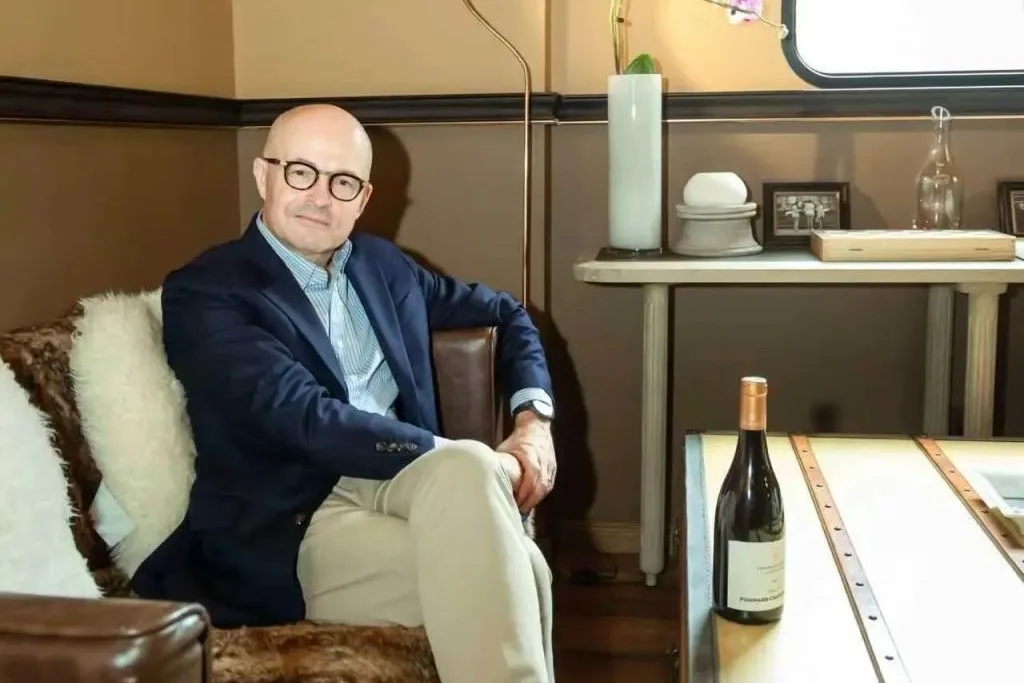
This November, Laurent Delaunay, fifth-generation owner of Maison Edouard Delaunay, stopped in Shanghai to mark a permanent heritage partnership with Le Bec Bund, the multi-storey French restaurant opened in May 2026 by former two-Michelin-star Lyon chef Nicolas Le Bec and his wife Liu Yu. Announced on 22 November by Olivier Hui-Bon-Hoa, Asia Regional Director for Badet Clément and Delaunay Vins & Domaines, the collaboration brings two original interwar Delaunay travel posters into the restaurant’s top-floor private dining rooms and makes Le Bec Bund the only table in China pouring the house’s 2021 Pommard Premier Cru Les Chaponnières.
Because we have sat down twice with Laurent over the years, first in Burgundy and later over a blind Pinot Noir tasting in Hong Kong, the details in Olivier’s post jumped out immediately. Behind a charming hospitality story sits a thread that connects the 1920s sleeping cars, a painful family sale in 1993, a cellar tasting of 1929 bottles, and Burgundy’s very real 2026 fight to keep its place on restaurant wine lists.
When Burgundy travelled by sleeping car and ocean liner
Founded in 1893 by Laurent’s great-grandfather Edouard Delaunay, the house spent its early decades building quiet credibility in the Côte d’Or before Edouard’s sons Jean and Marcel took the name global after the First World War. From the early 1920s through the late 1970s, the fastest way for an international traveller to meet Edouard Delaunay Burgundy was in transit.
As Olivier Hui-Bon-Hoa noted, the house supplied the wine lists of the Compagnie Internationale des Wagons-Lits and the Orient Express, transatlantic crossings with the French Line (Compagnie Générale Transatlantique) and Britain’s Cunard, and later Air France right into the Concorde era.
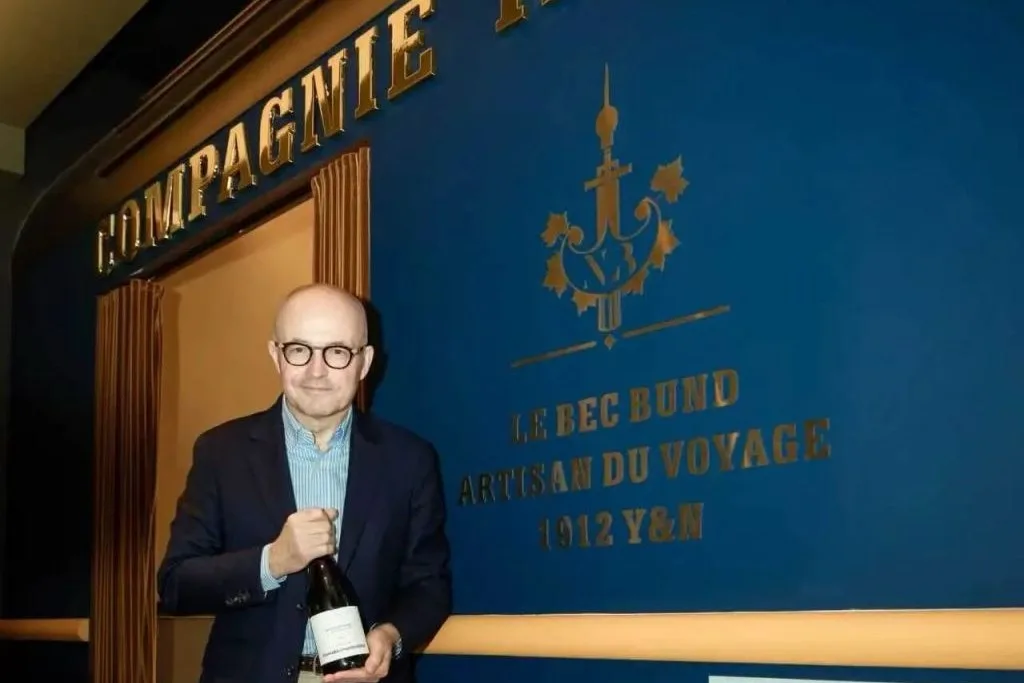
Laurent Delaunay outside the recreated Wagons-Lits dining carriage on the top floor of Le Bec Bund in Shanghai.
Le Bec Bund occupies a restored five-storey neoclassical building inside The Bund City Hall Plaza in Huangpu District, expanding on more than a decade of Nicolas Le Bec’s Bistro 321 Le Bec on Xinhua Road. Up on the top floor, the restaurant built a series of private dining rooms styled after classic Orient Express carriages, complete with royal-blue panelling, brass luggage racks, steamer-trunk tables and numbered cabins such as Cabine Club 10.
In that setting, two original vintage Edouard Delaunay advertising posters now hang permanently on the walls. Both carry the period slogan “Voyagez en bonne compagnie” (“Travel in good company”): one depicts a three-funnel ocean liner alongside a waiter’s tray bearing a bottle of 1929 Chambolle-Musigny, and the other frames a blue Voiture Bar N° 2976 railcar next to a bottle of 1929 Pommard.
A 1929 poster, a 24-year detour and a time capsule
During his stop in Shanghai on 4 November 2026, Laurent took a silver marker to the glass over the railcar poster and wrote: “Le vin est un voyage ! Laurent pour Le Bec Bund. 4/11/26.” (“Wine is a journey!”)
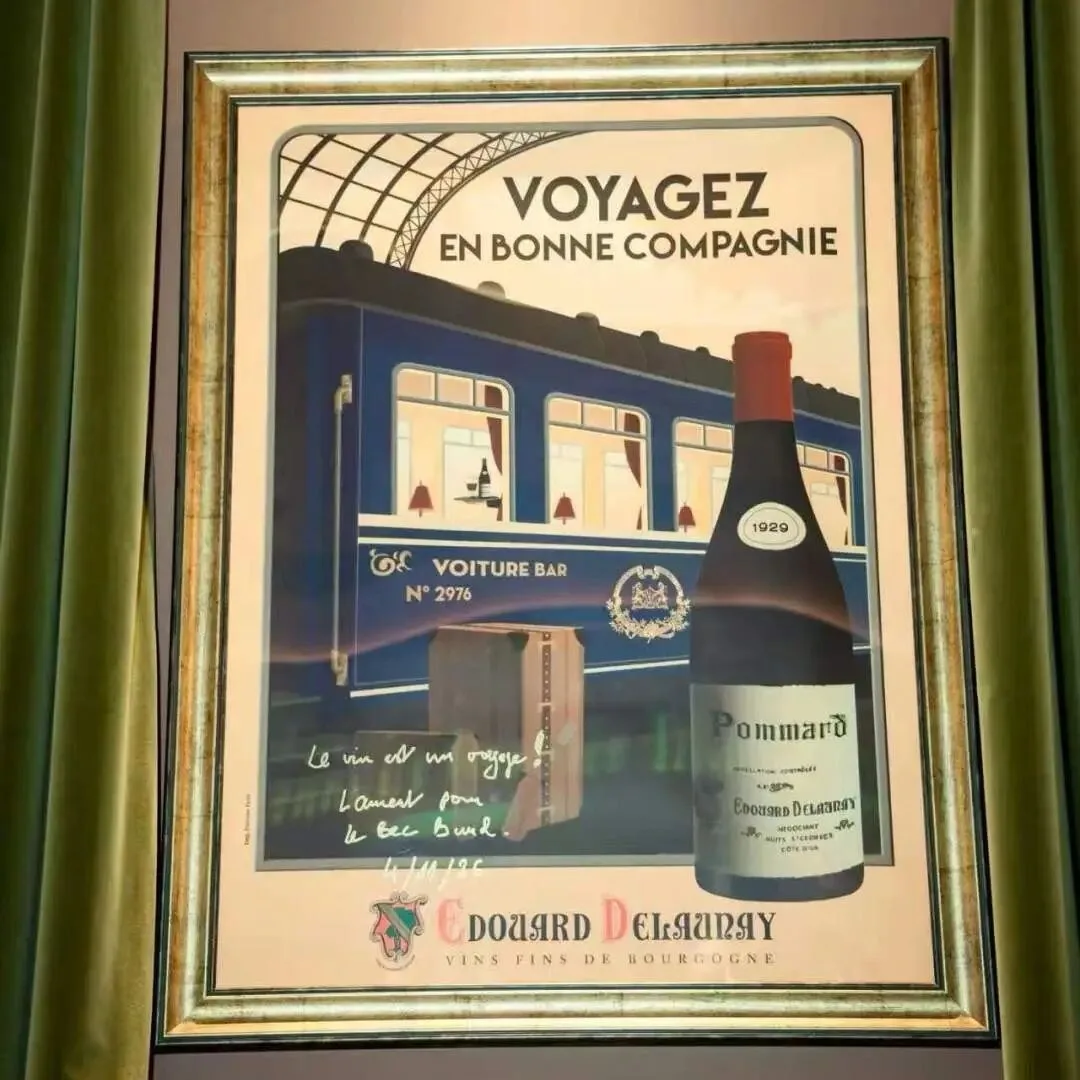
The 1929 Pommard rail poster hanging at Le Bec Bund, signed by Laurent Delaunay during his November visit.
Anyone who has listened to our Episode 60 interview with Laurent Delaunay knows how far that phrase stretches. When Laurent joined his father in late 1989 after viticulture studies in Beaune and Dijon, a year in Napa Valley and a business degree from ESSEC, he expected a smooth handover. Instead, his father developed Alzheimer’s disease just as the early-1990s downturn hit Burgundy. Before turning 25, Laurent spent two to three years trying to keep the five-generation business afloat before the family was forced to sell in early 1993.
In 1995, Laurent and his wife Catherine, also an oenologist, started over in the Languedoc with no vineyards, no winery and no money, building the Les Jamelles brand and Badet Clément from rented cellar space. They returned to Burgundy in 2003 through a small domaine-wine distribution company that eventually connected them with roughly 180 family estates, before a chance coffee in 2016 led Laurent to buy back Maison Edouard Delaunay in 2017, 24 years after letting it go.
Even the 1929 vintage printed on the neck label of that Orient Express poster echoes what Laurent told us when we asked for his favourite tasting memory in Episode 60. While relaunching the house with Burgundian terroir scholar Jacky Rigaux, Laurent opened around twenty untouched bottles kept in the family cellar by his father, grandfather and great-grandfather, going all the way back to 1929. He called an old bottle a “time capsule” that lets you “travel through time” alongside the people who made it. Seeing his signature on a 1929 Pommard poster in Shanghai feels like a neat public postscript to that cellar tasting.
Why 2021 Pommard Premier Cru Les Chaponnières is no random bottle
To seal the partnership, Laurent presented Chef Nicolas Le Bec with a signed bottle of Edouard Delaunay Pommard Premier Cru Les Chaponnières 2021, placing the cuvée exclusively on Le Bec Bund’s wine list in China.
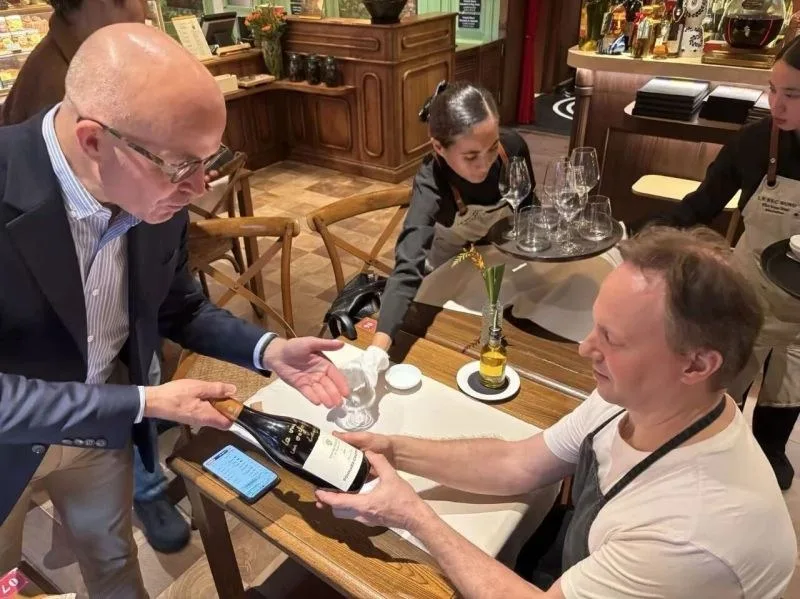
Laurent Delaunay handing over the signed bottle of 2021 Pommard Premier Cru Les Chaponnières to Chef Nicolas Le Bec.
The choice lands on three different levels at once:
- Railroad history: Pommard was one of the flagship Burgundy appellations poured on the Orient Express during the interwar decades, when robust Côte de Beaune reds travelled well and anchored French gastronomic lists abroad. Readers curious about how Pommard’s iron-rich clays behave in the glass can also hear our conversation with Paul Zinetti at Clos des Épeneaux.
- The return to farming vines: As Laurent explained in Episode 60, the revived Edouard Delaunay began in 2017 purely as a micro-négoce, buying grapes from trusted growers without owning vineyards of its own. 2019 changed that: the house took on its very first 2.5 hectares of vines to farm in Pommard, split between Pommard Village and two Premier Crus, Les Pézerolles and Les Chaponnières (tucked just beneath Les Rugiens). Gifting Les Chaponnières in Shanghai puts the exact vineyard that marked the family’s return to the soil on Chef Le Bec’s tables.
- The 2021 lesson on placements: Notice the year on the label. 2021 was the severe frost vintage that shrank Burgundy’s crop and triggered steep price rises. In September 2026, speaking as co-president of the BIVB, Laurent Delaunay asked Burgundy growers to hold prices steady after another 30% crop drop, warning openly that 2021 taught the region a hard truth: once a restaurant drops your wine from its list, it rarely hands that spot back. Setting aside scarce 2021 Premier Cru bottles specifically for a flagship restaurant cellar in Shanghai is that philosophy put into practice.
Demand for the village has hardly cooled either. Just days after Laurent’s Shanghai visit, four of five Pommard cuvées set new records at the 2026 Hospices de Beaune auction, even as white Burgundy averages fell by more than 30%.
What this says about Burgundy in Asia right now
When I filmed our Behind the Label blind tasting with Laurent Delaunay in Hong Kong, where he tasted his own Nuits-Saint-Georges Le Village Vieilles Vignes 2022 alongside Pinot Noirs from China and Italy, he explained why Asia sits near the centre of Edouard Delaunay’s strategy. He visits the region several times a year, entered select cuvées into Bonhams auctions in Hong Kong to establish collector benchmarks for a house reborn in 2017, and spoke with pride about his daughter Jeanne representing the sixth generation after training in Burgundy, California and Australia.
That strategy looks very different from the headline numbers on Chinese e-commerce. As we saw in our breakdown of JD.com’s Singles’ Day 2026 wine rankings, mass-market platforms are dominated by Penfolds, domestic giants and casual 500ml sweet fizz, while the old banquet gifting trade has faded. Fine Burgundy does not win in that environment through discount coupons. It wins in rooms built around craft, food and a story worth pouring at the table.
Nearly a century after Voiture Bar N° 2976 carried Côte de Beaune reds across Europe, Maison Edouard Delaunay has found another dining room worthy of the poster. If you want to place Pommard alongside its neighbouring Côte de Beaune and Côte de Nuits villages before your next glass, start with our ultimate guide to Burgundy wines.
Sources: Olivier Hui-Bon-Hoa (Delaunay Vins & Domaines) on the Le Bec Bund collaboration, Maison Edouard Delaunay
Photos: Olivier Hui-Bon-Hoa / Delaunay Vins & Domaines, at Le Bec Bund in Shanghai.
Frequently asked questions
What was Maison Edouard Delaunay's historical tie to the Orient Express?
Founded in Burgundy in 1893, Maison Edouard Delaunay expanded internationally from the 1920s under the founder's sons Jean and Marcel. Between the early 1920s and the late 1970s, its wines were poured aboard the Orient Express and Wagons-Lits trains as well as French Line, Cunard and Air France routes.
Why did Laurent Delaunay choose 2021 Pommard Premier Cru Les Chaponnières for Le Bec Bund?
Pommard was one of the Burgundy appellations served aboard the Orient Express during the interwar decades. It is also deeply personal: when Laurent revived Maison Edouard Delaunay, Les Chaponnières was part of the first 2.5 hectares of Pommard vines the house took on to farm in 2019.
Where can you see the original Edouard Delaunay Orient Express posters in Shanghai?
Two original vintage Edouard Delaunay advertising posters now hang permanently in the top-floor Orient Express private dining rooms at Le Bec Bund, Chef Nicolas Le Bec and Liu Yu's restaurant in Shanghai's Bund City Hall Plaza, which is also the only restaurant in China listing the 2021 Pommard Premier Cru Les Chaponnières.