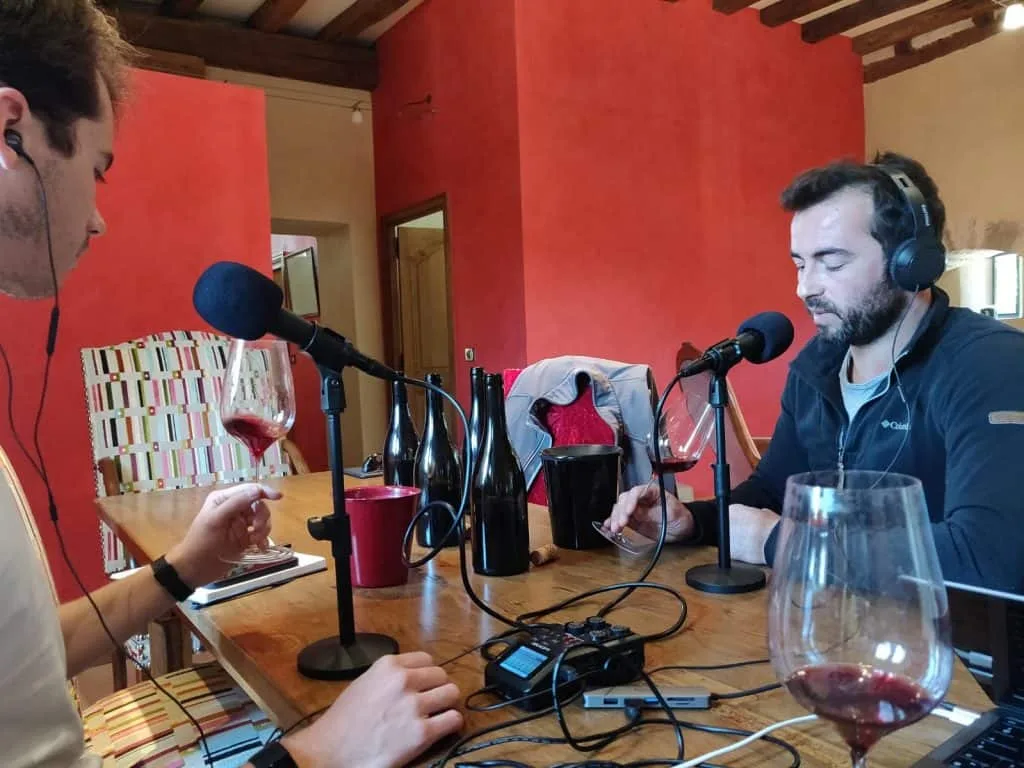
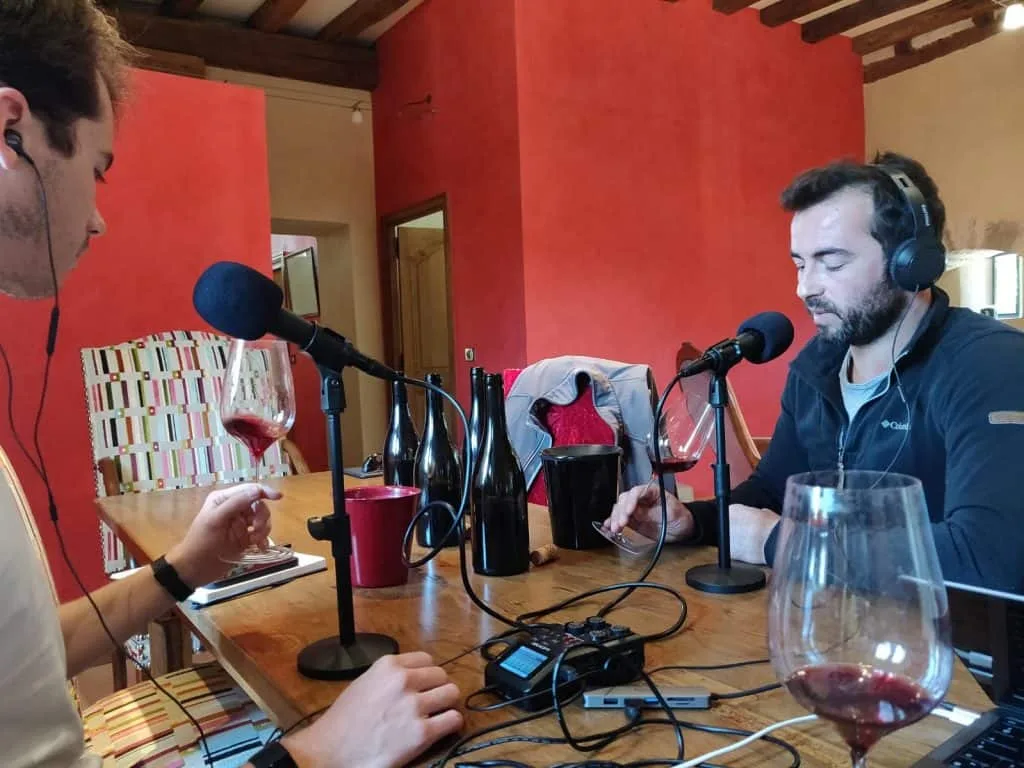
For the 56th episode of the Wine Makers Show, your wine podcast, we headed out to meet Paul Zinetti at the Clos des Épeneaux: a real gem of just a few hectares we were lucky enough to discover. This was the very first interview of our Burgundy trip and it felt great. We hope you’ll enjoy this first ASMR tasting edition too.
Antoine: Hi Paul. Paul: Hi. Antoine: Thank you so much for having me here today. Paul: You’re welcome. Antoine: I’m thrilled. We just arrived. We just tasted a few centiliters of your aligoté, which we’ll probably talk about a bit later. Paul: 2019 vintage. Antoine: It’s really lovely and it’s the perfect way to fully arrive in Burgundy.
Obviously we’ll talk about lots of things, but first, can you start by introducing yourself?
Paul: Yes, I’m Paul Zinetti, 39 years old, turning 40 tomorrow, that’s a milestone. Burgundian by birth, born in Beaune. I joined the Domaine in 2010 and took over the reins in 2014, my first vintage being 2014.
What happened between when you were born and 2010? You’re 40 now.
Paul: A lot of things. I was born in 81. I started my professional career in the late 90s, let’s say. I went to school of course, I went to the Beaune wine school, that was the foundation. The start of my wine career. I wasn’t very studious. I preferred the option of professional experience, across various regions and various Domaines. I quickly left the classic curriculum to work, in Burgundy when I was younger, and in the south in the 2000s, from 2000 to 2001, 2005, 2006, in Languedoc-Roussillon, with Bruno Lafon at Domaine Magellan. That’s where I learned the ropes, then I went back to school, did a professional training, and after that I came back to Burgundy and did a BTS at Davayé-Mâcon. A one-year BTS in viticulture and oenology. After that, I had various experiences with different Burgundian colleagues, in the Mâconnais and Côte d’Or, Mâcon and the Côtes de Beaune. And here I am, I arrived here in 2010.
What made you want to get into wine in the first place? Why did you join that wine school at the very start?
Paul: Because here, apart from vines… Antoine: I mean, you could have done it elsewhere. Paul: I think I was also conditioned. I come from a Burgundian family, anchored in the Burgundian wine landscape. But I don’t have family in wine strictly speaking. I had great-grandparents who were in it back then. They were négociants, a négoce that no longer exists today. My parents know many prestigious winemakers, including Dominique Lafon who was an old friend of my parents. I started little by little, working seasons in the vines. At some point, you have to choose a school path and I specialized in this. It could have been something else, but given that we’re still in the wine world, in central Burgundy, I preferred, well my parents preferred that I do this.
And what made you stay?
Paul: I didn’t fall in love with wine and the vine right away. It took me a few years and at some point, it became obvious to me. Through working, I learned a lot of things on the ground, as I was saying. So I told myself, what do you want to do? Either go back to school, but as I said, that wasn’t really my thing.
I preferred to perfect myself in this. And then, over time, I came to love nature. Actually, I’ve loved nature since I was little. My parents were in the equestrian world. We used to have riding centers. I’ve always been immersed in nature, in the plant and animal world. And there you go, I loved it. In the south I really enjoyed it and I wanted to continue in this without regret. Today, I’m well rooted.
Can we come back to those “field” experiences you mentioned in several places? Can you go back over them a bit, and what did you learn at the different places?
Paul: Actually, I often compare. I tend to compare the wine world to the world of cooking. Making wine is for me like making a dish. You make beautiful dishes with beautiful ingredients, beautiful vegetables and all that. And so you make beautiful wines, great wines with beautiful grapes. We’re not magicians. I’m not a magician. There you go. I think that part, all those experiences I had through different winemakers, different vinifiers, was for me a kind of journey trying to get as much hands-on experience as possible. That way, afterwards, I could put it all together. For me, school wasn’t necessarily very obvious. I preferred to learn this way. And it works today. I tell myself it’s my taste that makes the wines, and it’s chemistry, sure, but I rely on this. Acquiring experience. And learning what Olivier Martin does in the Mâconnais, Nicolas Potel here, Dominique Lafon in Meursault, Bruno Lafon in Languedoc. The advantage of Languedoc is that I worked with thirteen different grape varieties at the time. That’s a pretty nice way to start. Antoine: It’s a bit more diverse than coming back to pinot noir. Paul: Pinot noir, chardonnay and aligoté, it’s not the same, but I think it’s all that which made me end up here today.
How did you come to the Clos des Épeneaux? How did it happen?
Paul: Before me, there was Benjamin Leroux, who was the régisseur of the Domaine from 99 to 2013. Benjamin Leroux needed an assistant at the Domaine in 2010. I knew him a bit before. I knew he was looking for someone, so I put myself forward for that position. And then, we talked about it a bit and there was maybe an opportunity for me to take over the Domaine after a few years. Benjamin had told me he might leave at some point. I positioned myself for that. There was a bit of stress at the beginning, then I told myself: “If it happens, it happens, if not, it won’t be a big deal.” And then at some point the position opened up. I wasn’t the only one, there were other people. The Comte Armand, who was in place before, his son took over management since 2016. It’s Olivier Armand now, but the Comte Armand is still alive. He gave me the chance to become régisseur. He’s a beautiful and great person. I think feelings spoke and when I said I loved the Domaine and the Clos des Épeneaux, the clos as such, as a parcel. I wasn’t lying, that was really it. That’s why I arrived here as régisseur in 2014.
We’ll come back to your relationship with the Comte Armand a bit later, but how did this arrival go? As régisseur, you change roles a bit. How did it go for you at that moment?
Paul: It was like I was being watched closely. In 2014, Paul Zinetti taking over the Domaine des Épeneaux wasn’t necessarily obvious to everyone, nor for me. Surprisingly, I didn’t have stress at the beginning. I had more stress a few years later. I took it as a challenge. Things came together little by little, naturally. The team, I already knew them. That’s also simpler. The Domaine, I knew it and I’d been there three or four years. I make my wines with my taste and with my sensitivity, my technique, my vinification process. I did what I knew how to do, simply put. I didn’t try to copy and paste. I did this naturally. It went very well. We had a complicated vintage in 2014. It was the first vintage for me as régisseur, a hail vintage, so very small quantities. We lost more than 80% of the harvest in 20 minutes. So, lots of sorting to do, lots of dryness, but a complicated vintage in the end. We worked enormously in the cellar, sorting, doing, as I said, trying to get the best grapes into the vats. After that, the vinifications happened naturally. The wait afterwards on the wines was there, then it worked. The 2014s pleased and continue to please. Little by little, you find your bearings. I had more stress later, oddly enough, two or three years later. The first vintages can work and you can tell yourself it’s luck. But you have to last over time. That’s the most complicated thing in the trade. Today, I won’t say everything is fine, because there are always moments of self-questioning, especially with the complicated years we’ve had. But I know what I want to do. I know that the wines I make today are pleasing, with my personality, my tastes and my sensitivity.
How did you get past that moment when you said: “I don’t know if I’m going to make it, I’m starting to feel some pressure”? What happened for you?
Paul: How I did it, that’s a good question. I didn’t go see a psychiatrist, that wasn’t the moment. You surround yourself afterwards. You need to be surrounded by people in the profession, people like I said, and godfathers in quotes. I can talk about Dominique Lafon, who I know, who has known me since I was a baby. He came at the start to taste my wines, Benjamin Leroux was there too. But letting me do what I wanted. I think if you’re alone in those moments, it’s complicated. You have to be surrounded, family, friends, the profession, colleagues. Then talk about it, get help when things aren’t going well. I never had to get help. In January, we have what we call Burgundy Week in London. For a week, we let importers and importers’ clients taste our wines. These wines are en primeur. It’s a bit like the Bordeaux primeurs, so wines drawn from the barrel. There, you bare yourself in front of everyone and I was pleasantly surprised by the feedback from the end client and from fellow winemakers. It allows you to gain confidence. We know that what we’re doing today in vinification and aging pleases, and so we continue. Each year is different, there are complicated years. And then there’s the Armand family, you mustn’t forget. I was talking about the Comte Armand, I always get a bit emotional when I talk about him because he’s a great person. He gave me the chance to become régisseur of a prestigious Côte d’Or Domaine. Small in size, 9 hectares, but that’s also what I wanted, a family Domaine. It’s everything. The Armand family, my family, friends, that’s what allowed me to move forward serenely.
How would you characterize this relationship with the Comte Armand to come back to it? You knew him from when you arrived at the Domaine. How did it go?
Paul: It happened naturally. I didn’t force my character traits. I was myself. I spoke from the heart when I spoke to him about taking over the Domaine. I don’t know if I can use this term, but he’s a bit like a second father. He supported me, he allowed me to be where I am today and he trusted me. And the whole family goes in the same direction as him. Today, it’s Olivier, his son, who has taken over the management. They’re people who have another job. They’re in Brussels or Paris. It’s a big family. They’re not often here, but they leave the keys to the Domaine to someone like me. And they’re beautiful people, simply put. You can’t be bad with these people. It’s quite delightful to work for people like that.
Today, what’s your relationship with them? Do they come to the Domaine from time to time?
Paul: Very good. They come for the harvest. On the Clos des Épeneaux, we can talk more about it later, but it’s a large parcel of 5 hectares. We do blends but I’m the one who does them with Boris, my assistant in the cellar. They come, yes, three, four, five, six times a year. I don’t know, it depends. And then I see them in Paris sometimes. They’re very healthy, very frank relationships. There’s a business to run, there’s a Domaine to run. It’s also a beautiful relationship.
So let’s dive into the Clos. We’ve touched on it here and there, but can you tell us a bit more?
Paul: Shouldn’t we taste a red? Antoine: Yes, let’s taste, indeed. Wait, I’ll finish my white.
Can you maybe describe the white for us?
Paul: So now we’re tasting a Bourgogne aligoté 2019. Bottled five months ago. Aligoté, Burgundian grape variety, an old Burgundian variety used for a very long time, and it’s still the case for crémants and the famous kir. Kir is an aperitif made with aligoté and crème de cassis. But today, we manage to make aligotés that are a bit more qualitative and even gastronomic, let’s say.
So this is a blend of three parcels in Pommard, Volnay and Meursault. Very young vines in Pommard, Volnay, vines between 8 and 13 years old, and old aligotés and dorés in Meursault, vines that are over 90 years old. Aging in 600-liter barrels, 50% in 600-liter barrels and 50% in stainless steel tank. It needs to keep its tension, I like aligotés that have a bit of tension like a muscadet. It needs to be a bit tonic. But the barrel will bring a bit of roundness and gourmandise. It’s a lovely aligoté. Don’t forget that aligoté is a grape variety that produces a lot, that is generous.
So you have to be careful with the quantity and volume of wine and especially the waiting time. It needs to be ripe, otherwise you get very acidic aligotés and that’s not what we want.
For 10 or 15 years, there’s a new generation of winemakers producing very beautiful aligotés. So there you go, it’s a small wine, but I like it.
Antoine: I excessively agree, I really found it very good, very nice.
Paul: And so I was suggesting, we can perhaps taste a 2019 Volnay Village. It was bottled a bit later, in June, July. It’s a blend of two Volnays: Volnay Grand Champ and Volnay Famine in 2019.
In 2019, it was quite hot in Burgundy, we’re not like in 2020, but not far. What’s interesting about this vintage is that we have nice balances, we have ripeness, fairly ripe skins, which generates fairly supple tannins. And behind that we have acidities that are also there. The Pinot, I like Pinot when it pinotes as we say in Burgundy. There I find it pinotes and you have the balance behind, the acidity that comes to balance the mouth a bit.
If you make Pinots without acidity, they’ll be soft Pinots. Acidity is really something I look for in wines, in any case that balance. Like in a dish, in fact. If there’s no acidity in a dish, it’s not interesting.
These are still babies, 2019. As I said, it was bottled not long ago but we can still wait some time. In any case the Volnay, two or three more years would be good but it tastes well today, I find.
Antoine: It already tastes very, very good.
Paul: All the better.
Antoine: And we find the acidity you spoke of, the balance there can be in it, it’s very nice.
Paul: 2020 will be a vintage that will be a bit similar, with differences of course. But we have these clear-cut acidities and beautiful ripenesses. In 2020 we harvested at the end of August. It was a heatwave vintage. We’re on two beautiful vintages, small in volume, but great in potential. And the aging potential, we have it, no worries there.
Antoine: So we have a few silences which are due to tasting but it’s normal, it’s an atmosphere being created. I hope it makes you want to, the people listening.
Paul: I don’t know if it sounds good.
Antoine: Yes I think so. I hope you’re not listening to this podcast too early on the commute, that it’ll make you want to skip work today and go taste instead. No, it’s sublime.
Paul: It’s pretty, it’s round, it’s silky, there are silky tannins. And as I was talking about skins earlier, we can talk about that a bit, if you allow me. I was talking earlier about skin ripeness and prime quality, intrinsic quality of the product, of the grape, to make great wines. I attach great importance to ripeness, even risking over-ripeness sometimes. So you have to be careful because 2020 was a somewhat extreme vintage. We went a bit far, but it’s very good. Skin quality means ripe skins.
A simple example is for choosing the harvest date, which is a fairly complicated, difficult choice. It’s a bit, you feel like you’re playing poker when you choose the harvest date. A few days can really change a lot. There’s still an important organoleptic aspect. We take samples in the vines. We do them two weeks before. We do three or four during this two-week period. Of course we analyze the juices to see acidities, the potential degree, the sugar, all that, the pH and everything.
But what we do here is we come and taste the skins and seeds, we see how they look. If the seeds are brown. If we can chew, chop the skins. There, we’ll have a trend for the vintage. It gives a trend to see how we’ll be able to extract afterwards. That’s why the idea of waiting a bit longer and having ripe skins, we’ll have an easier tannic potential, supple tannins, simply put.
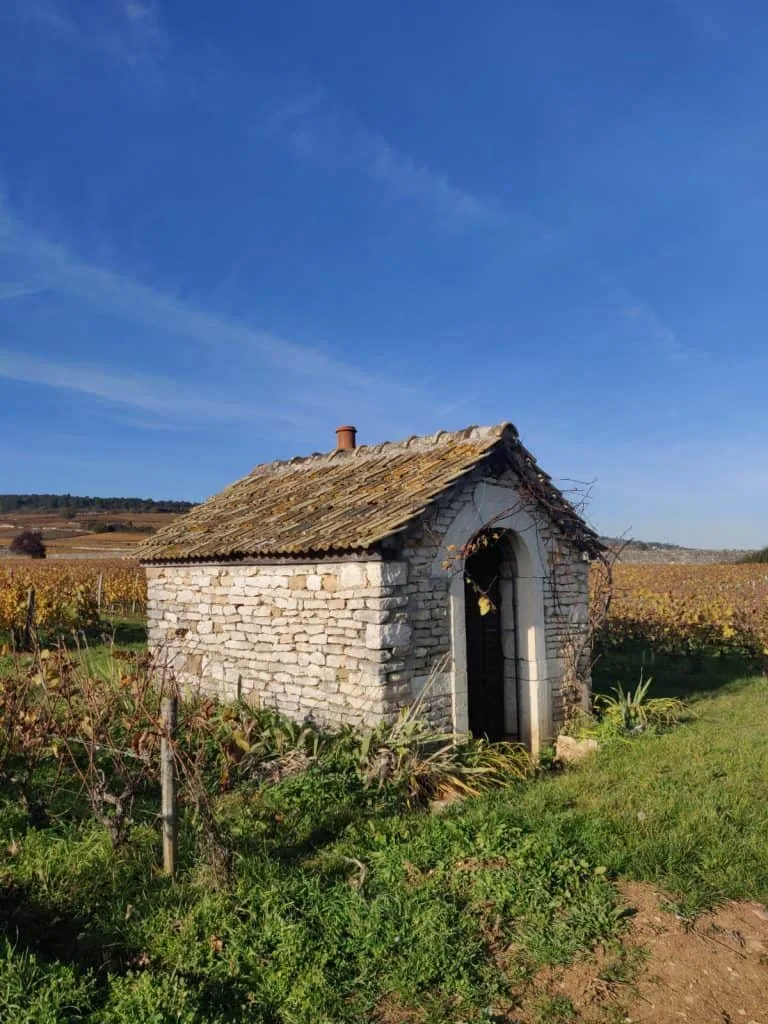
What you’re saying is super interesting. I think, for the people listening, it’s about how to visualize or test if a grape is properly ripe. You said there are two big elements. The first is the seed, make sure it’s nicely brown.
Paul: Yes, the color of the seed.
The second is the skin, being able to eat it, to chew it.
Paul: To chew it yes, and the pulp too. That is to say that when you take a grape that isn’t ripe, the pulp will stay attached to the seeds. So that’s a sign that ripeness isn’t there. We see it on table grapes, we don’t expect the same thing on a table grape, but the pulp must come away from the seed, and at that moment we’ll tell ourselves it’ll be good. So there are these three parameters that are important. Sometimes, we don’t have much choice, like in 2021, which was a complicated vintage from A to Z with frost, with weather that wasn’t there and all that. There, we didn’t have many solutions. We had to harvest at some point because we didn’t have a rot problem, but we could have encountered one. In 2019 and 2020, we didn’t have that problem. We had very beautiful summers, even too beautiful, too hot, with very little water also, which explains these small yields. But there you go. It’s important to taste the grapes and I think to get an idea of the vintage already and the grape’s potential. And to know what we’ll do in extraction, in vinification. We go through pigeages and all that. In 2019, we didn’t pigé much, I’m not a big fan of pigeage. If I pigé, so pigeage, we do it either with a pigeou, so with a broomstick and a kind of round funnel about twenty centimeters in diameter. Otherwise, we do this a lot, we get into the vat with the body, with the legs, and then we push the grapes down into the juice. We call this pigeage. There are two schools. There are those who do it at the start of fermentation, even cold. That’s rather my case. We’ll extract fairly supple, fairly silky tannins. At the end of fermentation, we’ll be at slightly higher temperatures around 28 or 30 degrees. And there, if you pigé too much, you’ll extract slightly dry, slightly firm tannins. You have to be careful at that period.
Pigeage is when you have the grape juice, so to speak, and there are all the skins and seeds I think that rise to the top.
Paul: All the grape rises through the pushing phenomenon of carbon dioxide and we push down this cap. Antoine: A bit like a tea bag, when at the bottom of the mug, it infuses. Paul: Exactly. We also crush the skins. But it’s true that’s exactly it. We often talk about infusion in vinifications.
So, to come back to the Clos des Épeneaux, you told us 9 hectares?
Paul: For the Domaine. Antoine: For the Domaine, yes. Paul: For the Domaine, the Clos des Épeneaux, the Monopole is 5 hectares 23. That’s the Pommard premier cru vineyard, Clos des Épeneaux Monopole. And then, we have a Domaine of 9 hectares. We’re in Pommard appellations, of course, on the Clos des Épeneaux. Then we’re in Volnay Village and Volnay premier cru. So Volnay Village, we have it in the glass. Volnay premier cru, the Fremiets. A small parcel of 45 ares. Then, we’re in Auxey-Duresses, so Auxey-Duresses Blanc. In the commune we can make white, we did some a few years ago but we’ve stopped now and so we make an Auxey-Duresses Village and an Auxey-Duresses premier cru, aligoté and chardonnay. Antoine: Aligoté and chardonnay. Paul: There are five reds and two whites.
Where can we find them?
Paul: At all good record shops. No, we have distributors, wine shops. We have a problem today, which is that the demand for wine is very high. We do 80 to 85% export, so it’s quite substantial but we can’t be present everywhere, we don’t have huge volumes. And we make around 45,000 bottles per year in total. So you find them, yes, at wine shops, at Lavinia in Paris, in restaurants, in beautiful establishments, we try. Antoine: We did an episode of this podcast with Édouard Margain from Lavinia. We did an episode together, it’s good you mention Lavinia, if you haven’t listened to it yet… Paul: Go ahead, yes. Antoine: Speaking of distribution, you told us a bit earlier about Burgundy Week in London, which is an event I have to admit I don’t know since I’m still a young Burgundy novice. In this podcast, we’ve done a lot of Bordeaux because we have family nearby. So it’s pretty easy to have a base. We don’t have family in Burgundy, so it’s been a bit harder. Paul: And then, we’re closed off too. Antoine: And yes, it’s a bit harder. Paul: Really? Antoine: No, I don’t know, I’m joking. Paul: Are we talking about Bordeaux too?
I didn’t know this Burgundy Week at all. Of course, I know the primeurs. I can’t say like the back of my hand because that’s far from true yet, but in any case, I know them much more. But can you tell us a bit more about this Burgundy Week?
Paul: All the importers, well many importers in England, which is a big historical market, the English have been wine buyers for a very long time, agreed to organize this for a week. It often falls in the first or second week of January. It’s a week of tastings. We send our wines en primeur, either drawn from the barrel, in tank or bottled. But generally, it’s on the current vintage, so wines that are still being aged. We send the wines there and we present the wines. For example, I have six different importers in England. I have five tastings from Monday to Friday in different places. And there are many Burgundian winemakers who go. We all meet there, we work a lot. But we also enjoy the moment because they’re moments where we meet as winemakers. Burgundy seems small, but there are plenty of people we only see at these moments because we can’t be everywhere. Antoine: It’s not very big but Burgundy is very stretched out. Paul: Yes, it’s quite stretched out. Dijon, then it’s mainly the Côte de Nuits, Côte de Beaune, Côte Chalonnaise, that’s where it stops. A bit of Beaujolais too, but very little. We don’t have time to see each other outside of these moments. We meet there for a week, we taste our wines. In any case, generally, these are wines that are already confirmed, because we work by allocations. We allocate the wines generally before this week to English importers. They have a volume, let’s say, to offer their clients. The end client, whether pro or private, tastes our wines, and after that they make purchases. Antoine: They confirm? Paul: They confirm. Antoine: For you, it must be great too to see these clients, the people who drink the wine. Paul: I think it’s very important. We missed a year, we tend to say two years. I’m a bit lost with the lockdown etc. Antoine: We all are. I can’t keep track. Paul: I feel like it was 10 years ago. We had a year and a half that was complicated. In any case, we couldn’t move much anymore. I think the end client needs to see us. The buyer, in any case, the one who consumes our wines. We also need to have feedback on this. The people, we see them again every year. They’ve been buying our wines for a very long time. I think today, we don’t have a problem selling our Burgundian wines. You shouldn’t forget the client and you shouldn’t snob all that, simply put. Antoine: You have to listen to them, talk with them. Paul: Yes, exchange. They’ll ask you questions about this or that bottle they’ve opened, I don’t know, a vintage 10 years ago, 15 years ago. They’ll tell us: “What do you think?” And it does us good to see people who love our wines. We tend to be locked up in our cellars and our vines, in Burgundy. Winter is sometimes long in Burgundy, so we have to move. Business and people need to see us. I think it’s important. The importer too, they’re the one who buys our wines, they see we’re moving too. It’s not just an exchange of emails. Generally, they come to taste the wines here too, the buyers and importers. But you have to move. You may need to rethink travel because there are many trips that aren’t necessarily always useful. And then today, the carbon footprint and all that. We’ll talk again later about organic, but organic for me is on the vines, but it’s a whole, it’s the management of all that, packaging, transport… You have to think about all that. Today, we have technical means that allow us to do Zoom, things like that. I’m not a fan of Zoom, but it’s perhaps something that can sometimes replace travel. Sending the wines, why not, and then being there behind it. Antoine: It can avoid certain unnecessary round trips. Going to London for a week, I think if you do a week, with five appointments, seeing people… Paul: That’s very important. Antoine: If you do the round trip in a day. Paul: We go by train. Antoine: For one tasting, clearly that doesn’t serve much purpose. Paul: But going for two days to Singapore, I think that’s not necessary. Antoine: Yes, that’s clear. Paul: Even if it’s nice.
You said a word earlier that’s interesting, for people discovering Burgundy or wanting to go a bit further. It’s the word “allocation”. It’s something relatively unique to Burgundy, since there are precisely small volumes, it’s something a bit less present in other regions. Can you explain a bit what it is and how it works?
Paul: The allocation system is that we allocate wines that aren’t yet bottled, not yet on the circuit or the market. In November, I’ll send allocations, so proposals to our English and American importers first, because they’re the ones who want the prices first, well, the availabilities and prices. So the allocation includes the volumes of wine, the volumes of bottles and the prices too. We can change the price or not, it depends. We work a lot like this with our importers and even with our private clients, our restaurateurs, agents. We sell our wines by allocation.
In fact, you send a file that says this year, we have X bottles at this price?
Paul: Yes, I decide on the number of bottles we’ll offer to such and such. And generally, it’s pro rata. During years we make less than twenty percent, it’ll be pro rata. You have to respect the client even if there are very good clients who take more. That’s how it is, everyone is treated the same way. And it’s true that it’s specific to Burgundy. Not all Domaines work this way, it’s a chance to be able to do it. And yes, it’s expected. After that there’s the work of selling and proposing. The importers do work nonetheless. Antoine: They’re not just an intermediary. Paul: They’re not just an intermediary. The importer still has a lot of meaning today in the wine world. We often talk about intermediaries and people who say: “There are too many intermediaries.” In some markets, there may be a bit too many, but on the whole, they have their importance. Today Burgundy wines sell very well, we can talk about prices, Burgundian wines are very expensive. If tomorrow, we have more trouble selling them, we’ll be glad to have these people behind us.
I think it can also depend a lot on the size of your structure actually.
Paul: Of course. Antoine: Indeed, if you have a big maison in the broad sense and with many people, it’s potentially easy to say I’ll be my own importer in the United States or in England and I’ll manage because in fact you can. Paul: You can.
But actually your importer in the U.S.A. or U.K., they have you as a client and probably 30 others. So the costs they charge you are a thirtieth of what you would have had to pay if you’d done it alone.
Paul: Absolutely. No, that’s it. Antoine: It depends. Paul: It’s important.
We have topics to discuss, you brought us two other bottles. Do you want us to taste them now? Or do we wait a bit?
Paul: Let’s do it. There it’s a Pommard premier cru Clos des Épeneaux 2019. So same, bottled end of June, beginning of July. It’s really a baby. From the Clos des Épeneaux parcel, the Monopole we mentioned earlier. A 5 hectare 23 parcel, so a very large monopole on the Côte. We’re among the largest monopoles in premiers crus, grands crus. Antoine: It’s a baby, but it’s already very beautiful nonetheless. Paul: Yes, but I’m a fan of 2019, of the vintage in general for Burgundy. It produced very beautiful reds and very beautiful whites too. We have this balance and an appetizing, mouth-watering side that’s interesting. We have spices coming through nicely, a beautiful length, a touch of tannins that’s quite silky, I find. I often say it’s very easy to make monsters on the Clos des Épeneaux, on Pommard in any case. On this parcel, we’re on a parcel where there’s a lot of clay in certain corners. You have to be careful, work fairly gently. Vinification, extraction, try to be careful too because you can quickly tip over to tannin hardness and all that and make Pommards, as many people might think, fairly hard, fairly rustic Pommards. Whereas today, there’s a new generation in Pommard for some years, it’s not new. But you can make very fine Pommards and it’s a beautiful example I find with an aging capacity and a potential that are there. Today making great aging wines is important. You shouldn’t change course either. We also have a different way of drinking wines now. Wines are kept a bit less, people have more trouble keeping them. Prices aren’t the same either. 20 years ago having bought Burgundy wines was easier. Today, it’s a bit more complicated. Antoine: Unfortunately. I was still a bit young 20 years ago. Paul: I think me too so I don’t have many in my cellar. So making wines that can have this potential, this capacity to open in five or seven years, and same, that we can on the other hand take very far. I’m a bit appalled today to see on social networks, on Instagram and all that, people who, I might seem like an old crank, but who show themselves with vintages of grands crus or very beautiful wine Domaines, not just Burgundian, it’s a whole, very young. Opening 2018s today on grands crus is a bit of a shame. But that’s how it is, it’s not the end of the world. I think you can miss out on lots of things and especially on Pinots and on great terroirs like that. Antoine: That’s clear, unless they have 12 in the cellar. Paul: After if they open one a year to see. That’s what I often say to clients, if you have lots, you open one from time to time and then you see. After, there are people who like very young wines. I respect it, but I think there’s still a minimum wait without tipping over to old wines, to tertiary aromas. But it’s like for, we have trouble waiting today. That makes me sound like an old crank.
No, but I quite agree. There’s a cellar at our place. What bothers me is that there are more and more wines inside that I really want to wait for. And so I tell myself I won’t touch this part. And this part where I can’t touch, has become three quarters in fact. So I can’t touch anything anymore.
Paul: You have to have a cellar with rotation, some quaffers, not every day. But that’s how it is, it’s an evolution. It’s something to take into consideration. We have this luck and bad luck with this climate change we see every day. And then we have the luck of having riper and healthier grapes than before. We also have a technique that’s better than before. A technique also to reduce doses in the vines, doses of sulfur, copper and all that. It’s going in the right direction. I find we make wines qualitatively that are top. We have no more bad vintages, very few in any case. Before, 30 or 40 years ago, you could miss out on a vintage because you didn’t have the techniques or technical means we have today. Warming is a bad thing, but it’s a good thing for pinot. And for the overall quality of the wine.
Do you want to address the topic of organic? Can you explain your approach a bit?
Paul: Yes, we can talk about it. Organic is a global approach. As I was saying earlier, after, everyone has their way of seeing organic. It needs to be resolved in its globality, that’s how I conceive it. The vine remains the most important. That’s where we’ll spend the most time. It’s our bread and butter. But after I was talking earlier about transport, trying to reason everything, dry materials, cardboard, travel. We encompass all that. We’ve been Ecocert certified for some years now, for more than ten years. We have specifications, we have an annual audit performed by the Ecocert organization. So we’re in it, no problem. But we move forward, we don’t stay on organic telling ourselves we have it and we’re satisfied. No, we try, we try to go a bit further and for example, on the Clos des Épeneaux, which is this flagship parcel of the Domaine and which is more than 5 hectares with the contours we have much more than that, but it’s enclosed by walls, that’s important too. These are walls that are quite high. We really have this vine enclosed by the walls, the old walls dating from the 18th century. And in this vine, I replanted fruit trees a year ago. We planted about fifteen trees in one part. We have bees, we make honey. I’ll give you a small jar of clos honey. Antoine: With great pleasure, I love honey. Paul: 2021 vintage, by the way. We’ve put back honey-bearing hedges, we’re going to try to recreate a biodiversity that’s there but isn’t necessarily very present. Then, a few years ago we put back bat houses. After that we realized that bats don’t need us to nest in the walls and all that. I had looked at one point at putting up nest boxes for birds too, we use sexual confusion. I think today, we have the technical and also financial means once again to go in this direction and to go a bit further. And that, I really enjoy, continuing to extend this organic and biodynamic part that was instituted by Pascal Marchand and by Benjamin Leroux, let’s say from the mid-1980s until now.
In the 80s, starting to work like this must have been…
Paul: They were precursors, Pascal Marchand was a precursor. There was a whole generation of winemakers at that time who were avant-garde. It existed already well before. We were coming out of the 70s, which were years where products were used that weren’t necessarily very clean. And so, there are new generations. We talked earlier about Dominique Lafon, he’s part of it. All these people, they were great for that.
Do you feel a difference by carrying out these actions?
Paul: At the level of the vine and the living, you mean? Antoine: Yes. Paul: Yes, we see a difference. We see the soils first. The soil is the vine’s support. It’s what’s most important. The bulk of the work is at the soil level. After, if we have soils that respond well and that are well-structured, with composts, beautiful balances, we’ll find these balances behind in the grapes and in the wines. So the foundation is there. Earlier I was talking about reasoning, tractor passage and all that. That’s also, soil compaction and all that. So organic allows us to have much more living soils, biodynamic too. And behind it, we have concrete results. We’ve created a small reflection group with other winemakers, it’s David Duband who created this small reflection group on agroforestry with beautiful Domaines from the Côte, Côte de Nuits, Côte de Beaune and a bit of Côte Chalonnaise. It’s to go in this direction, agroforestry. It would mean reinstalling trees on the contours, in the vines. It’s not obvious here because, as you could see, the spacings are quite small. We’re at one meter by one meter, at 10,000, 12,000 plants per hectare so we can’t do what we want. But we do it for beauty. I think anything beautiful is better, and we do it because it’s important. We can be considered polluters sometimes, but we try. There’s an increase in people who are organic here, there are more and more of us nonetheless.
Yes, well, this is a bit of a cliché what I’m going to say, but I think in the long term, it can only work.
Paul: But I think we won’t have a choice. Antoine: Nothing bad can happen to you by adding a tree. Paul: No, on that, it’s clear. But you see, a vintage like 2021 which was a crappy vintage, I’m talking about the season, I’m not talking about the wine and the final quality, but complicated with the frost in April. Then, we had a lot of rain, fairly heavy accumulations. We dropped on two, three diseases. We had quite a bit of mildew and oidium too. It’s complicated to do organic in those years. I think we shouldn’t give up. After there’s also an economic aspect. We don’t all have the same problems. Each one does what they can on their Domaine, but the trend is still to go in this direction and I think it’s important. And we won’t have a choice later perhaps.
Shall we talk about the last one?
Paul: Yes. We’re going to continue on the Clos des Épeneaux. It’s a 2017 now. Clos des Épeneaux 2017, which I’ll serve right away. Antoine: I hope this tasting format pleases our listeners, it’s the second time I’m doing it like this. Paul: It’s nice, isn’t it? It allows us to talk about concrete things. And then we drink wine, that’s good. Antoine: That’s not bad. So, I reassure the people listening to us, I don’t know if you can hear it, but we spit absolutely everything. Paul: Of course, definitely. No, but for sure, you have to consume in moderation. Should you say that or not? Antoine: I don’t know. In any case, people who do an hour of wine podcast, normally consume in moderation. Paul: We won’t leave tipsy. So, 2017, vintage after the 2016 frost, very impacted by the 2016 frost. The years after frost are generally considered fairly productive years. Generally in frost years, there’s no fruit. There’s no grape, no cherries, no almonds, there’s nothing. The years after, nature takes back its rights. A fairly generous year, but with yields around 30, 35 hectoliters per hectare, which remains fairly well managed, it’s not crazy yields either. We’re talking about this fairly classic vintage in Burgundy, in the good sense of the term. It makes fairly balanced, fairly fine wines. The finesse of pinot, we have it well. Less exuberant than some vintages, perhaps like 2019 which are a bit more, a bit hotter and a bit beefier, with a bit more wine volume. 2017 is more precise, finer, and it’s a wine that was bottled in 2019. It has 2 years in bottle. It’s starting to be a bit more settled. These are wines that aren’t filtered, I don’t filter the reds. I work on the principle that if we do fairly long agings, we don’t need to filter. I like wines that are quite limpid and bright, that’s the case here. We’re talking about turbidity that’s quite low. Filtration isn’t necessary. There are years when we can do it, but we’ll see. Each vintage is different and we adapt techniques to each vintage. I really like what we do. He’s talking about his wines, of course he likes them. I always have a small reservation about this because I don’t like to put myself forward either. But I like it. It’s a vintage I had trouble making people taste during the whole aging time. It’s a slightly closed, slightly hard vintage and now I find it tastes well.
What’s impressive is that there are two years between these two different vintages. The energy, even the touch, etc., have nothing to do with each other. They’re two different vintages. There are plenty of conditions that mean that on personality as such I find it plays a lot.
Paul: It’s surprising and I think it’s important to play this vintage effect. We have vintages that are better than others, that’s how it is. But to smooth out quality, that’s not a Burgundian thing. We really try to make fine wines. 2021 will be different again, 2020 is different. The client is rather happy with that. For the technical part, we destem everything, no whole bunches. The final blend has 30 to 35% new barrels, that’s all. Aging of 18 to 20 months, it’s classic, on lees, no racking in between. And there you go. Antoine: Then off to the bottle! Paul: And then, we put it in there and we wait. I’m putting away the corks. Antoine: Incredible. First, thank you for this tasting. Paul: You’re welcome.
I hope people have enjoyed it. I hope it’s also given you the desire to discover the Clos des Épeneaux at all good wine shops and good restaurants. It was super interesting. Of course, you can come see us here.
Paul: Yes, of course, you can contact me on the site and the email address. I don’t have a reception cellar, but I can do tastings, no problem. I have time. I have trouble saying no, that’s a bit my flaw. So yes, come, I’ll have trouble saying no. So I’ll say yes. Antoine: But not all at the same time and not two weeks before the harvest. Paul: No, there are some key dates. The harvest, forget it. Summer, it’s a bit hot. July is okay, but before, it’s a bit more complicated. Antoine: Yes, that’s clear. Even for me. I can’t do podcasts at that time so I have to have stock otherwise it doesn’t work. But there I’m okay, I’m quite serene. Thanks for all that. I have three questions that are quite traditional. Before doing them I think we’ve done a nice tour. Paul: I think yes, we’ve swept through everything, the history.
I have three questions that are quite traditional. The first is, do you have a book on wine to recommend?
Paul: So, I tried to think during this little hour. A book that comes to mind is a book by an Englishman, Jasper Morris, who’s quite well known in the wine world and worked for a very long time for Berry Brothers, an importer, Master of Wine and all that. It’s called Inside Burgundy. Jasper is a Burgundy lover who’s been living in Burgundy now for a very long time. There’s a great lady of Burgundy who passed away not long ago called Becky Wasserman who did a lot for Burgundy, in the United States and elsewhere, and Jasper is part of that caliber. Inside Burgundy summarizes Burgundy quite well and lots of anecdotes about wine of course, about Domaines, about terroirs. And all that. So, it’s a big book, but interesting.
Antoine: Got it, I’ll add it to my reading list and I’ll add Jasper to my list of potential guests. Paul: He should be invited one day, he’s an erudite, very interesting and very nice. Antoine: Understood.
The second question is, do you have a recent favorite tasting?
Paul: Very good question. I haven’t done many recently. I was a bit focused here, but the last one I did was at Lafon, Domaine des Comtes Lafon. It was last May, I think. I might not be very original, but well. The Domaine des Comtes Lafon remains a sure value of Meursault, a great flagship Domaine and great whites, great reds. Antoine: Very good, that’s noted and totally accepted as a tasting. Paul: It’ll go Comte Armand, Comte Lafon, we stay with the comtes. It’s part of my flagship Domaines. After there are others, there are many other Domaines.
Last question, who’s the next person I should interview on this podcast?
Paul: We’re going to go with the new generation. So I’d say we’ll go with a German winemaker called Catharina Sadde, who set up a small Domaine, Domaine Les Horées, which is now in Beaune. She bought a cuvée in Beaune. She makes wines all in finesse, and she’s someone I really appreciate, she has a beautiful personality too. A future or already great lady of Burgundy, Domaine Les Horées, Catharina Sadde. Antoine: Okay. Count on us to contact her and to come back to Burgundy to do this interview, that would be great. Thank you very much. Paul: You’re welcome, it was great. Antoine: It was a pleasure. I hope you also enjoyed being at this mic. Paul: It’s good, it went fast. Antoine: It went very fast, it always goes very fast. I hope it also went fast for you listeners and that you want to go further. If so, don’t hesitate to, we’ll open an ASMR channel together to give you these tasting sounds in another podcast. We’ll do ASMR wine tasting. Subscribe to the Wine Makers Show newsletter, the links are in the description and I’ll send you this new podcast. Thanks again for everything. Paul: You’re welcome, it was nice. Antoine: See you soon!
Amazon links on this page are affiliate links. They cost you nothing extra, and they help me keep this going.