In eleven days, at midnight on Thursday 19 November, Beaujolais nouveau 2026 goes on sale. It is the one wine most people know that turns up on a date, like a birthday, and people have been mocking it and buying it for decades in about equal measure.
This year’s has had a rough ride to the bottle. Here is what we actually know about it, and what nobody knows yet.
A hard year in the vines
The official start of the harvest, the ban des vendanges, was set for 13 August, against 19 August in 2025 and 6 September in 2024. Before that came hail in mid-July, reported to have hit about 5,000 hectares, or some 40% of the vineyard, and then heatwaves and drought on top.
Growers told Bourgogne Aujourd’hui in late August what that meant in the vines. In Brouilly and Lantignié they expected around 20 hectolitres per hectare, and in Chénas just over 25. One grower further south, in Châtillon d’Azergues, was much happier with 35 to 40. Every story was different, depending on where the storm passed and how little rain fell.
How small is it? Careful with the numbers
You will see several figures going round for this harvest, and they do not measure the same thing.
- Down 22% is the French agriculture ministry’s October estimate, but it covers Burgundy and Beaujolais together, all wines. It is not a Beaujolais number, and as we explained the earlier “down 33%” for the same basin has been superseded.
- 320,000 to 330,000 hectolitres, about 10% less than 2025, is the expected Beaujolais figure quoted by Vinabox, crediting Vitisphere. That looks mild next to what growers were describing in August, and it is still an estimate.
- More than 60% down comes from one estate, Domaine Bel Avenir, on its UK retailer’s page. It may well be true for them, and it tells you nothing about the region.
We could not find an official regional total from Inter Beaujolais. So: a short crop, certainly, but anyone quoting you one precise figure for the whole of Beaujolais is ahead of the data.
Not quite the usual style, perhaps
Nouveau is usually sold as light, juicy and easy. The early signs suggest a riper version this year. Georges Duboeuf’s bottle is listed at 13.5% and talks about cherries and griottes in eau-de-vie. The Bel Avenir bottle is 13%, and the winemaker expects something darker and more concentrated, with blackberry and blackcurrant.
Those descriptions come from people selling the wine, and we have not tasted a drop. Nobody outside the trade should have before the 19th, so treat all of it as a forecast, ours included.
What will it cost?
We found no like-for-like price comparison with last year, so we cannot honestly tell you the short crop has pushed prices up. Here are the markers we can point to.
| Bottle | Price |
|---|---|
| French supermarket, 2025 vintage (Vinabox’s own purchases) | about €3.75 to €5.50 |
| French wine shop or grower, 2025 vintage | about €8 to €15 |
| Georges Duboeuf 2026, its own online shop | €9.95 |
| Domaine Bel Avenir 2026, UK retailer | £14.50 |
| Georges Duboeuf 2026, US | about $18 |
One figure is worth keeping in mind at the bottom of that table. The French site Actu Alt Plus works out that at a 2025 bulk price of €280 per hectolitre, the wine in a bottle was worth about €2.10. Add the glass, the cork, transport, margins and tax, and you can see why a very cheap bottle has very little room in it for the grower. We found no 2026 bulk price yet.
A smaller party than it used to be
Short crop or not, this is a tradition living on a smaller scale. In 2025, about 104,000 hectolitres of Nouveau were sold, or 13.8 million bottles, which was still 21% of all the Beaujolais sold. France drank about two thirds of it. Exports came to 36,500 hectolitres, led by Japan with 1.8 million bottles.
Compare that with the past and you can see the change. Inter Beaujolais figures compiled by the Dutch wine writer Reinier Broeks put Nouveau exports at 74,000 hectolitres in 2019 and about 191,000 in 2002. So exports have halved in six years, and fallen by more than 80% since 2002.
That is rather sad, and a bit unfair. Beaujolais has spent years telling us it is far more than this one wine, and it is right. But a wine that gets people to open a bottle with friends on a random Thursday in November is not something the wine world has in surplus.
How we would play it
Do it, and do not overthink it. A few simple rules:
- Spend a little more than the minimum. Going from the cheapest bottle to around €10 or so is where you start to find a named grower and more care. Beaujolais-Villages is a good word to look for.
- Serve it cool. About 13 to 14°C, in line with our serving temperature guide for low-tannin reds. Thirty to forty minutes in the fridge is about right.
- Keep the food simple. Charcuterie, roast chicken, cheese and good bread. We have more pairing ideas here, and the full story of the tradition here.
- Do not cellar it. With a few exceptions it is made for this winter, not for your grandchildren.
If you love it, tell your friends. If you do not, try a Morgon or a Fleurie from the same hills next. It is the same grape, and that is how plenty of people find out what Beaujolais can really do.
Sources: Vinabox, Vinabox on the October Agreste figures, Actu Alt Plus, Bourgogne Aujourd’hui, LyonMag, Reinier Broeks, The Wine Shift, Market Watch, Georges Duboeuf, Wickham Wine
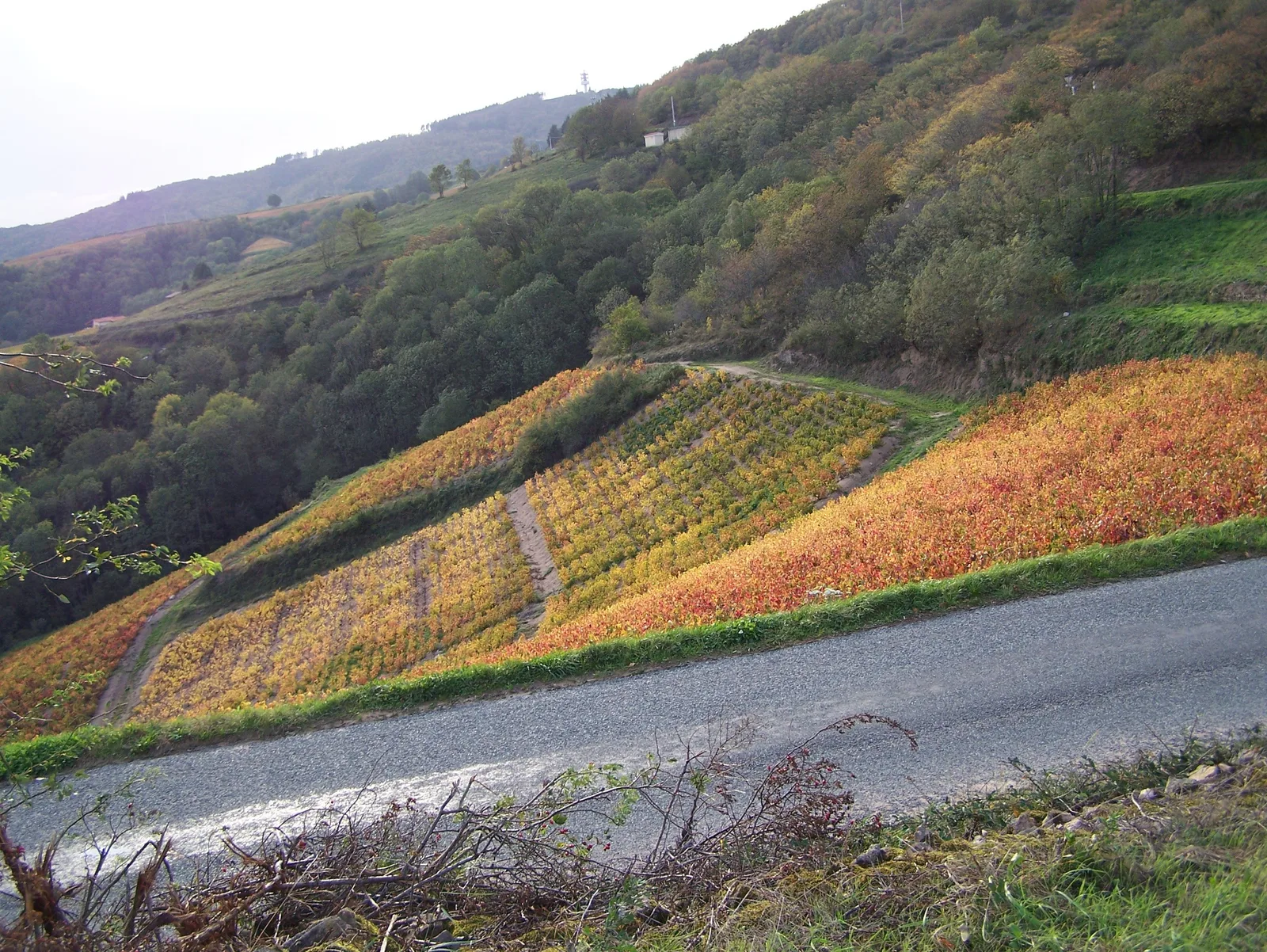
Hero photo: vines in autumn above Avenas, in Beaujolais, by Alainauzas, public domain, via Wikimedia Commons.