Marvin Shanken died on 29 October, aged 83. If you have ever bought a bottle because of the number on a shelf tag, his life touched yours, whether you knew his name or not.
We do not give wine scores on this site, and we will come to that. But a man who loved wine this much, and who got this many people to care about it, deserves better than a cheap shot. So let’s start with what he did.
A bottle of Pétrus and a loan from his sister
Shanken was a young Wall Street banker when a deal sent him to California in 1970 to look at vineyard financing, and he was struck by how little anyone had published about the wine business. Then, at a restaurant, a client told him to order whatever he liked. He picked a 1961 Pétrus. He later said bells went off.
He borrowed $5,000 from his sister Elaine to buy a small trade newsletter called Impact, with a subscriber list that came in a box of index cards. He later said he spent the first three months convinced he had made the biggest mistake of his life.
In 1979 he bought a struggling San Diego tabloid that was on its way to closing. It was called The Wine Spectator, and about 5,000 copies were going out. By his own account, he mostly did not want to see it die.
From tabloid to institution
Today Wine Spectator’s circulation is above 385,000, according to the magazine. He moved it to San Francisco, took over as editor himself in 1983, turned it into a glossy in 1987, and built things around it that still shape the wine world: the restaurant wine list awards, now held by more than 4,000 restaurants, and the Wine Experience.
He once said he was in the education business rather than publishing, and for several decades of American drinkers that was simply true. Before magazines like his, a curious person in Ohio had very little to go on. The Wine Experience also funds a scholarship foundation that has raised more than $40 million, according to the magazine’s obituary.
Plenty of what we do on this site, explaining wine to people who were not born into it, walks a path that he helped to clear.
Then came 1985
That year Wine Spectator adopted the 100-point scale. The magazine did not invent the idea: Robert Parker had been using it in The Wine Advocate since the late 1970s. But the reason Shanken’s magazine gave says everything. It wanted a format that American consumers would instantly understand. Everyone remembers school marks. A 92 needs no translation.
It worked, and that is the problem. Two of the biggest voices in American wine were now speaking in the same simple language, and retailers, importers and producers learned it fast.
Over the years a number on a shelf tag became a shortcut, and shortcuts change behaviour:
- It sounds more precise than it is. A score is one taster’s or one panel’s judgement on one day, however careful and blind the tasting. The gap between 89 and 91 can feel like a verdict, and it can move a lot of bottles.
- It flattens style. A number can tell you somebody liked a wine. It cannot tell you whether it is the kind of wine you like. A lean mountain red and a big ripe one can end up with the same score.
- It rewards what it measures. In his column on Shanken for Wine-Searcher, W. Blake Gray argues that telling people how wines should taste was bad for wine, while still crediting the ambition behind it. We lean the same way, with the same respect.
And the habit is alive and well. Within days of Shanken’s obituaries, James Suckling named Beaucastel’s 2024 flagship red the best wine in the world, on 99 points out of 100. It may be a very fine wine. But “best in the world” is quite a claim for a number to carry.
What we would actually do with a score
Scores are not evil, and pretending you never glance at one is its own kind of snobbery. Use them as one clue among several, if they help you when you are lost in an aisle.
But then read the note, ask the person in the shop, look at who made the wine, and trust your own mouth. That last part is the thing no scale can do for you. The best way to honour someone who fell for wine over a single bottle is to go and find your own.
Our thoughts are with his wife Hazel, his daughters and his family.
Sources: Wine Spectator obituary, Whisky Advocate obituary, W. Blake Gray for Wine-Searcher, Wine Industry Advisor on Beaucastel
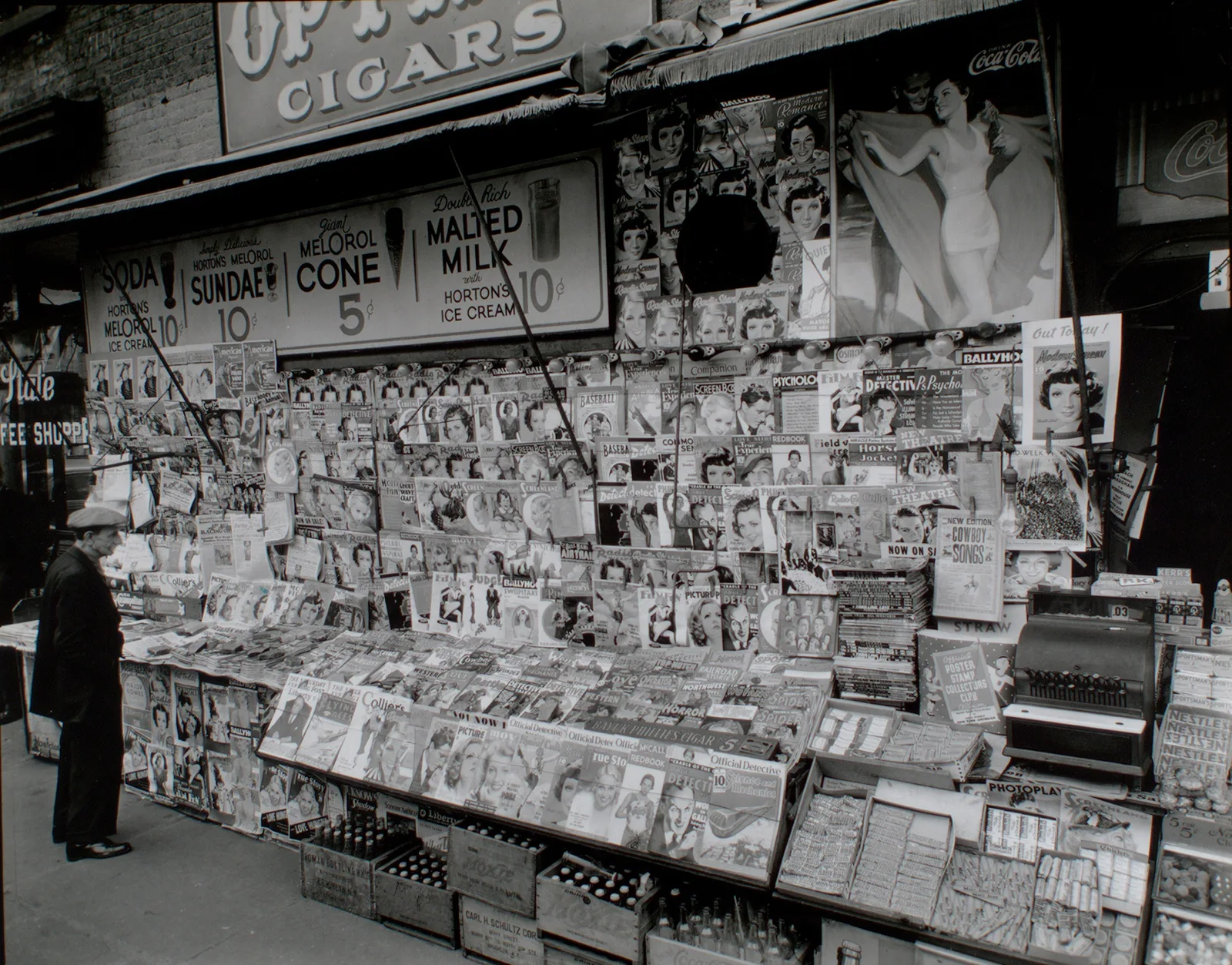
Hero photo: newsstand at 32nd Street and Third Avenue, Manhattan, by Berenice Abbott, 1930s, public domain, via Wikimedia Commons.