With black Périgord truffle, pour a mature red with tertiary notes: ten-year-old Burgundy, aged Châteauneuf-du-Pape, evolved Barolo, Rioja Gran Reserva. With white Alba truffle, go lighter, a fine Nebbiolo or a rich slightly oxidative white. A young tannic red flattens truffle aroma in a single sip, whatever it cost.
That is the whole article in three sentences, and almost nobody says it plainly. Truffle is not an ingredient, it is a perfume. It does not fill the plate, it moves through it. So the wine’s job is not to stand up to it. The wine’s job is to leave room and answer back in the same family: forest floor, humus, dried mushroom, leather.
What wine goes with black Périgord truffle?
Black truffle is the winter one, roughly December to March. Its perfume is deep rather than loud: cocoa, damp earth, undergrowth, a faintly animal base note. It survives gentle cooking, it loves fat, and it needs a wine that has already begun its second life.
The textbook answer is red Burgundy with ten to fifteen years in bottle. A Nuits-Saint-Georges or a Chambolle-Musigny at that age develops exactly the forest-floor notes truffle is looking for, with tannin that has resolved. Our guide to Burgundy wines breaks down the drinking windows.
Burgundy has no monopoly, though, and it has become expensive. An eight to twelve year old Châteauneuf-du-Pape brings garrigue, leather and sweet spice, and aged Grenache is more generous than Pinot Noir on a truffle that has been cooked rather than shaved. In Piedmont, a Barolo with ten years or more gives tar, dried rose and sour cherry: that region grows the truffle and the grape together, which is no coincidence.
The best value on this page comes from Spain. Rioja Gran Reserva reaches the shelf already evolved, with leather and dried fruit, often between 30 and 50 euros, where an equivalent Burgundy asks three times that. When truffle meets foie gras the logic shifts again, which is the argument we make in our piece on wine and foie gras.
What wine goes with white Alba truffle?
White truffle is a different animal. Harvested October to December in Piedmont, it is never cooked, and it is shaved raw over a hot dish at the last possible second. Its perfume is far more volatile and far more insistent: garlic, aged cheese, honey, an almost gassy top note.
The instinct is to open the biggest bottle in the cellar. That is the mistake. Here the wine has to be even more self-effacing than on black truffle, because the aroma already saturates the room.
In Piedmont they pour Nebbiolo, but fine Nebbiolo: Barbaresco, Langhe Nebbiolo, or a Barolo from a supple vintage. Plenty of tannin, little colour, little heavy fruit, so there is air around the truffle.
The other direction, more surprising and often better, is white. An oxidative Jura Chardonnay, an eight-year-old Meursault, an aged white Rioja or a Savagnin all give walnut and ripe apple notes that meet white truffle halfway.
Why does a young tannic red flatten truffle?
Two mechanisms, which stack.
The first is physical. Tannins bind to salivary proteins and dry the palate. Truffle, though, is perceived retronasally, through the back of the nose at the end of the mouthful, and a dried-out palate cuts that pathway off. That is a different problem from red wine with shellfish, where the metallic finish comes from iron in the wine oxidising the delicate seafood fats, not from tannin, as we unpack in our article on tannins in wine.
The second is aromatic. A young wine talks about fresh fruit: blackcurrant, blackberry, plum. Truffle talks about undergrowth and dried mushroom, the vocabulary of tertiary aromas, which only appear after years in bottle. A wine with nothing but primary fruit has nothing to say back. It is not a clash, it is an impossible conversation.
Hence the only real buying rule: hunt for age before appellation. And if you are pulling out something genuinely old, our guide to opening an old wine will save you from a crumbling cork.
| Dish or situation | Wine to choose | Why it works | Indicative price |
|---|---|---|---|
| Black truffle, braise or roast poultry | Red Burgundy, 10 to 15 years | Resolved tannin, forest floor that mirrors the truffle | 45 to 90 € |
| Black truffle, sensible budget | Rioja Gran Reserva | Sold already evolved, leather and dried fruit | 30 to 50 € |
| White truffle shaved raw | Barbaresco or Langhe Nebbiolo | Little heavy fruit, it lets the perfume through | 25 to 60 € |
| White truffle, white wine route | Oxidative Jura Chardonnay | Walnut and ripe apple, the exact range of magnatum | 20 to 35 € |
| Truffled eggs, scrambled eggs or truffle risotto | Aged white Rioja or mature Saint-Aubin | Weight for the egg and the rice, nutty age for the truffle | 25 to 60 € |
| Truffle pasta with butter and Parmesan | Supple Barolo or mature village Burgundy | Body for the butter, no spike of tannin | 30 to 60 € |
| Truffle oil, truffle fries, a few shavings | Chianti Classico or Rioja Reserva | Honest, lightly aged, nothing to lose | 12 to 20 € |
What wine goes with truffle pasta or truffle risotto?
These are the two truffle dishes people actually cook, and the two hardest to get right.
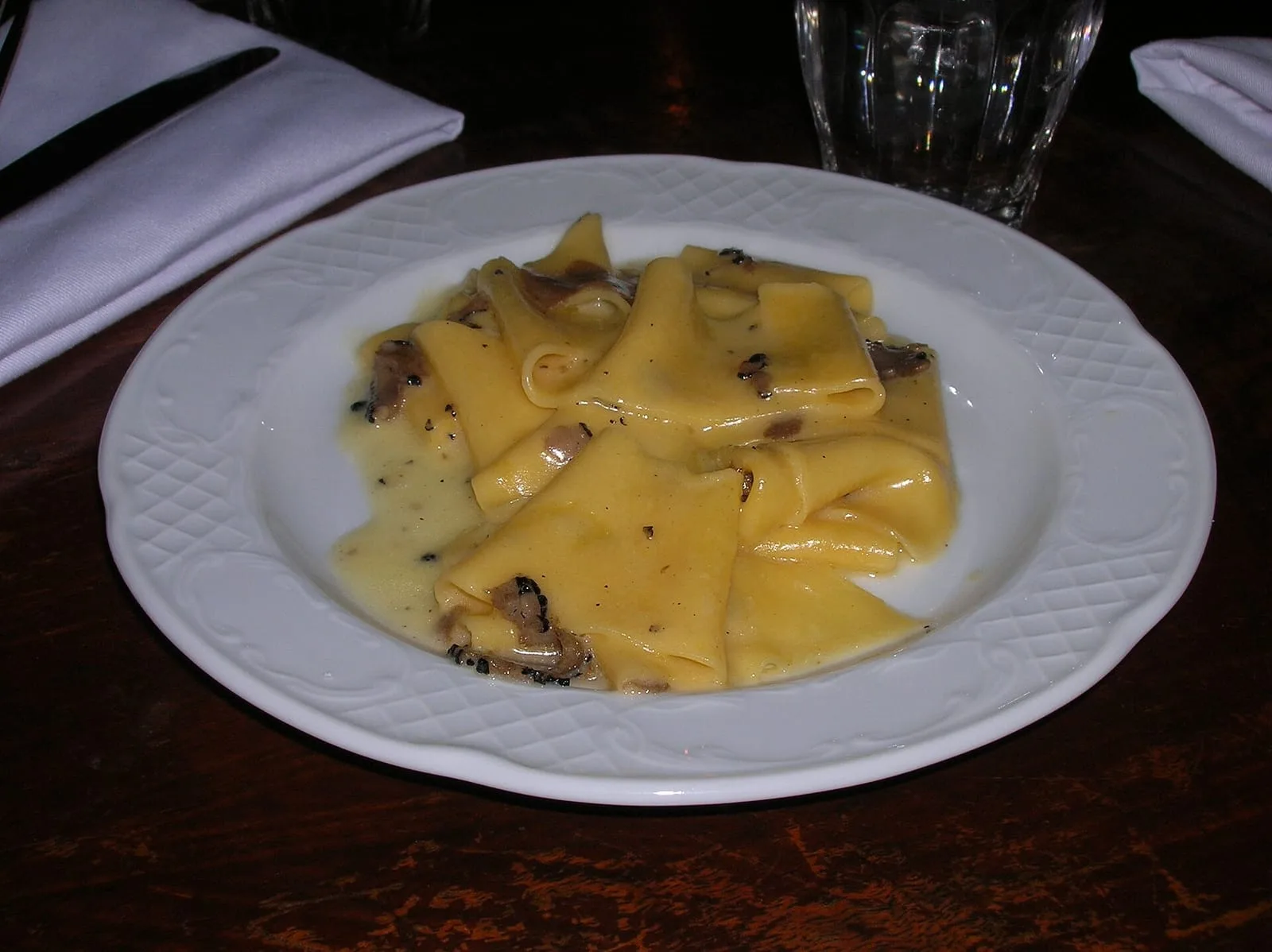
Truffle tagliatelle with butter and Parmesan is about fat and salt, not about meat. A mature village red Burgundy is the reference and a supple Barolo runs it close: both have substance for the butter and enough restraint to leave the perfume alone.
Risotto pushes further towards creaminess, so a rich white often beats a red. Jura Chardonnay is my first pick, a mature Saint-Aubin the comfortable version. Heavy Parmesan actually helps, because salt makes an aged white taste rounder.
Truffled eggs deserve a note of their own, because egg is genuinely difficult for wine: its texture coats the palate and its sulphur compounds harden tannin. A rich, slightly oxidative white is the reliable answer.
Serving temperature matters: mature reds at 15 to 16 °C, no warmer, or the alcohol covers the truffle. Rich whites, 12 to 13 °C.
What wine goes with truffle oil, truffle fries or a few shavings?
Time to be honest, because this is where most of us actually are.
Commercial truffle oil contains almost no truffle. It is flavoured with a synthetic compound that reproduces one facet of the perfume: powerful, persistent, one-dimensional, without the nuance that makes the pairing interesting. Opening a fifteen-year-old Burgundy over truffle fries wastes the bottle.
Buy a simple red with a few years on it instead, 12 to 20 euros: Chianti Classico, Rioja Reserva, a five-year-old Côtes du Rhône Villages. Enough earth and leather to bridge the gap.
Same logic for three shavings of real truffle over pasta, the realistic dose for most of us. Step up one level, not three: a Langhe Nebbiolo is plenty. Save the serious bottle for the day you grate fifteen grams.
How much should a truffle dinner really cost?
Fresh black truffle trades, depending on season, from several hundred to over a thousand euros a kilo, but fifteen to twenty grams feeds four people. White truffle routinely costs a multiple of that.
The wine does not have to follow that scale, and this is the point I repeat most often. On truffled eggs, a 35 euro Rioja Gran Reserva beats a young 200 euro grand cru nine times out of ten. The deciding variable is the age of the bottle, not the price on the label.
Which wines should you avoid with truffle?
Mistake number one is the young, powerful, tannic red opened because it is a special dinner. A three-year-old Médoc, a Madiran, a young Argentine Malbec: their tannin and dark fruit simply erase the truffle.
Mistake number two is the young, loudly aromatic white. Exuberant Sauvignon Blanc, young Riesling, Muscat or Gewurztraminer head off in a floral, tropical direction that has nothing to do with forest floor. They do not fight the truffle, they ignore it.
Three faster traps: young, heavily oaked Chardonnay, whose new-barrel vanilla jars against humus; wine served too warm, which lets alcohol mask fine aromatics; and raw garlic, which ruins the pairing before the wine gets a chance.
Where should you start if you are not sure?
Two questions settle it before you pull a cork. Is your truffle black or white? And does your bottle have at least eight years on it?
Black truffle plus a wine of eight years or more, and you cannot really go wrong: Burgundy, Rhône, Rioja, Piedmont. White truffle, drop a level and take the white-wine route seriously. And if the truffle came out of an oil bottle, keep your money for next season.
For more dishes in the same register, our food and wine pairing guide collects foie gras, cheese boards and the rest of the winter table.
Frequently asked questions
What is the best wine with black Périgord truffle?
A red that has already started to age, with tertiary notes of forest floor and leather. A ten to fifteen year old red Burgundy is the benchmark, but an eight-year-old Châteauneuf-du-Pape, a mature Barolo or a Rioja Gran Reserva does the same job for a lot less money. The variable that decides the pairing is bottle age, not the prestige of the label.
What wine goes with white Alba truffle?
Stay restrained, because white truffle aroma is far more explosive and far more fragile than black. In Piedmont they pour Barbaresco or a light Langhe Nebbiolo, and that remains the safest red choice. For whites, an oxidative Jura Chardonnay, an aged white Rioja or a long-aged vintage Champagne all work beautifully. Avoid anything young, peppery or loudly fruity.
What wine goes with truffle pasta?
Buttery truffle tagliatelle wants weight without aggression. A mature village red Burgundy or a supple Barolo is the classic answer, served around 15 °C. If the dish leans on cream and Parmesan rather than butter, a rich white with a little age suits it better: Jura Chardonnay, mature Meursault, or an aged white Rioja if you can find one.
Can you drink white wine with truffle?
Yes, and it is often the better choice when truffle sits on eggs, risotto or pasta. What you need is a rich white with some age and ideally a faintly oxidative edge: Jura Chardonnay, mature Meursault, aged white Rioja, Savagnin. A young, crisp, aromatic white misses the point entirely, because it has no earthy vocabulary to share.
What cheap wine works with truffle oil?
Do not sacrifice an old bottle. Commercial truffle oil is almost always flavoured with a synthetic compound rather than real truffle: powerful, persistent, and missing every nuance that makes the pairing interesting. A simple red with a few years on it is plenty, in the 12 to 20 euro band. Chianti Classico, Rioja Reserva, or a four-year-old Côtes du Rhône Villages.