On 10 October, Christie’s sold the wine cellar of Henry Tang, the former Chief Secretary of Hong Kong and one of Asia’s best-known collectors, in a single-owner sale at its Asia Pacific headquarters in The Henderson. Bidding ran for thirteen hours. Every one of the roughly 860 lots found a buyer, and the total came to HK$50,212,875, or about US$6.4 million.
Big numbers are fun. They are even more fun once you cut them into pieces you can picture. So let’s do that.
The top lot, by the glass
The star was a magnum of Domaine de la Romanée-Conti’s Romanée-Conti 1971, which sold for HK$875,000 (US$111,500). Christie’s says that is more than 219% above its low estimate.
A magnum holds two standard bottles, so that is HK$437,500 per bottle. A 75 cl bottle pours about six glasses, which puts every glass of that wine at roughly HK$72,900, or about US$9,300. A careful pour, please.
The second-highest price went to an imperial of La Tâche 1996, from the same domaine, at HK$687,500 (US$87,607). An imperial holds six litres, the equivalent of eight bottles (our bottle-size guide has the whole family). That works out at about HK$86,000 a bottle, roughly a fifth of what the Romanée-Conti cost per bottle. Different vineyard, different vintage, different format, so it is not a clean comparison. But it is a nice reminder that even at this altitude, “cheap” is relative.
Spread across the whole sale, the average lot went for about HK$58,000, roughly US$7,400. Many lots held several bottles, so the average bottle cost less than that.
The “estimate” figure depends on who is counting
Here is the part most headlines skip. Vino Joy News reported the result as about 67% above an original estimate of HK$30 million, and noted itself that this is not a like-for-like comparison. Decanter’s preview put the pre-sale estimate at more than HK$26 million. And Christie’s own release says the hammer total came in “151% above the low estimate”.
That last one does not add up as written. Take a low estimate of HK$26 million or more: 151% above it would be a hammer total of around HK$65 million, which is more than the whole HK$50.2 million result, buyer’s premium included. The figures only work if Christie’s means the hammer reached about 151% of the low estimate, in other words roughly 50% above it. To see why the numbers drift so much, it helps to know what is being counted:
- The hammer price is the winning bid when the gavel falls.
- The buyer’s premium is a percentage the auction house adds on top, set in each sale’s conditions. The HK$50.2 million total includes it.
- Estimates are set before the sale, exclude the premium, and come as a low and a high figure.
So if you compare a premium-inclusive total with a premium-free estimate, you flatter the result, and if you compare against the low estimate rather than the high one, you flatter it again. The cleanest statement is the one Christie’s makes about the lots themselves: 80% sold above their high estimates. That is a strong sale, without any arithmetic needed.
Thirteen years later, the same money
This is not Henry Tang’s first time. In March 2013, Christie’s sold The Henry Tang Collection in Hong Kong: a two-day, single-owner sale, all Burgundy. It was also 100% sold, for about HK$48.05 million.
So, thirteen years apart, two Tang sales landed within about 5% of each other in nominal terms. They are not the same wines, so this says nothing precise about how prices moved. But the Hong Kong dollar is pegged to the US dollar, and a dollar in 2026 buys a lot less than it did in 2013. For all the excitement, this sale was not a sign that fine wine is back to its old highs, and Vino Joy is right to warn that one strong auction does not make a market recovery.
About those Gen Z collectors
Christie’s says almost half of the buyers were millennials or Gen Z, and that close to 70% of that group were new buyers. Two small things worth knowing before that line becomes “young people are buying DRC”. First, the oldest millennials turn 45 this year, so “millennial” now covers plenty of people in their forties. Second, the release does not say what “new” means: new to Christie’s, new to its wine sales, or new to auctions altogether.
None of that makes the figure false. It just means it tells you less than it seems to.
What this means for your glass
Honestly, nothing, and that is fine. Nobody needs a US$9,300 glass of wine to understand Burgundy. When the sale was announced, Henry Tang said that after more than fifty years of collecting, wine had always been about sharing.
What you can do is taste the same corner of the world for the price of dinner. Romanée-Conti and La Tâche sit in Vosne-Romanée, in the Côte de Nuits. A good Bourgogne Hautes-Côtes de Nuits, grown in the hills just behind, often costs 20 to 35 euros, and a Côte de Nuits-Villages from a serious grower is usually not much more. It will not be a 1971 grand cru. It will tell you what pinot noir from that slope tastes like, which is the whole point. Our guide to Burgundy wines walks you through the hierarchy.
Hong Kong’s auction season is far from done, by the way. On 21 November, Bonhams sells twenty lots from the cellar of Liber Pater, including a 27-litre bottle estimated at up to HK$9 million. We will be getting the calculator out again.
Sources: Christie’s results release, via Artdaily, Vino Joy News on the sale, Decanter preview of the sale, Decanter China on the 2013 sale
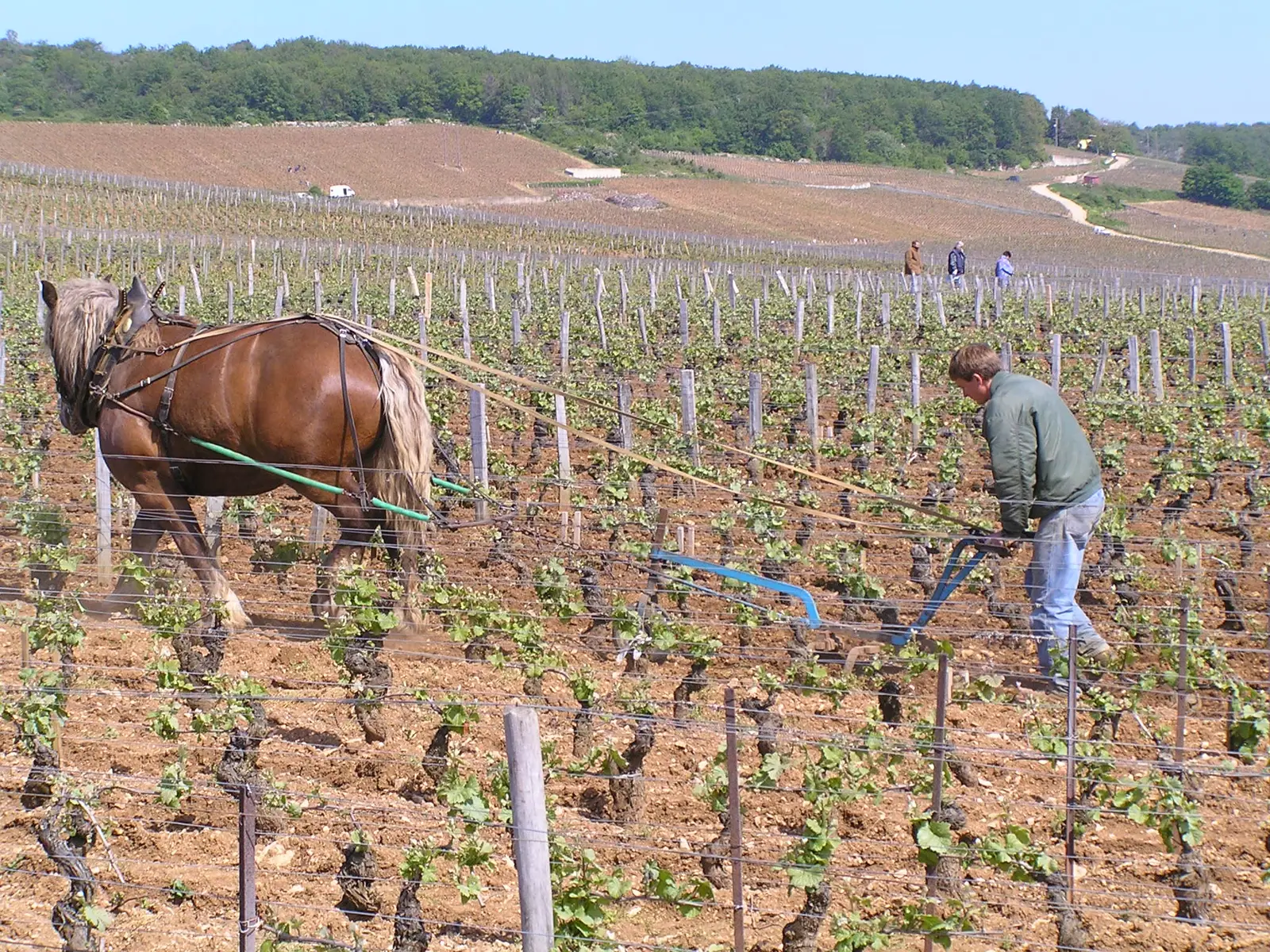
Hero photo: ploughing by horse at Domaine de la Romanée-Conti, Vosne-Romanée, May 2005, by Gavin Sherry, public domain, via Wikimedia Commons.