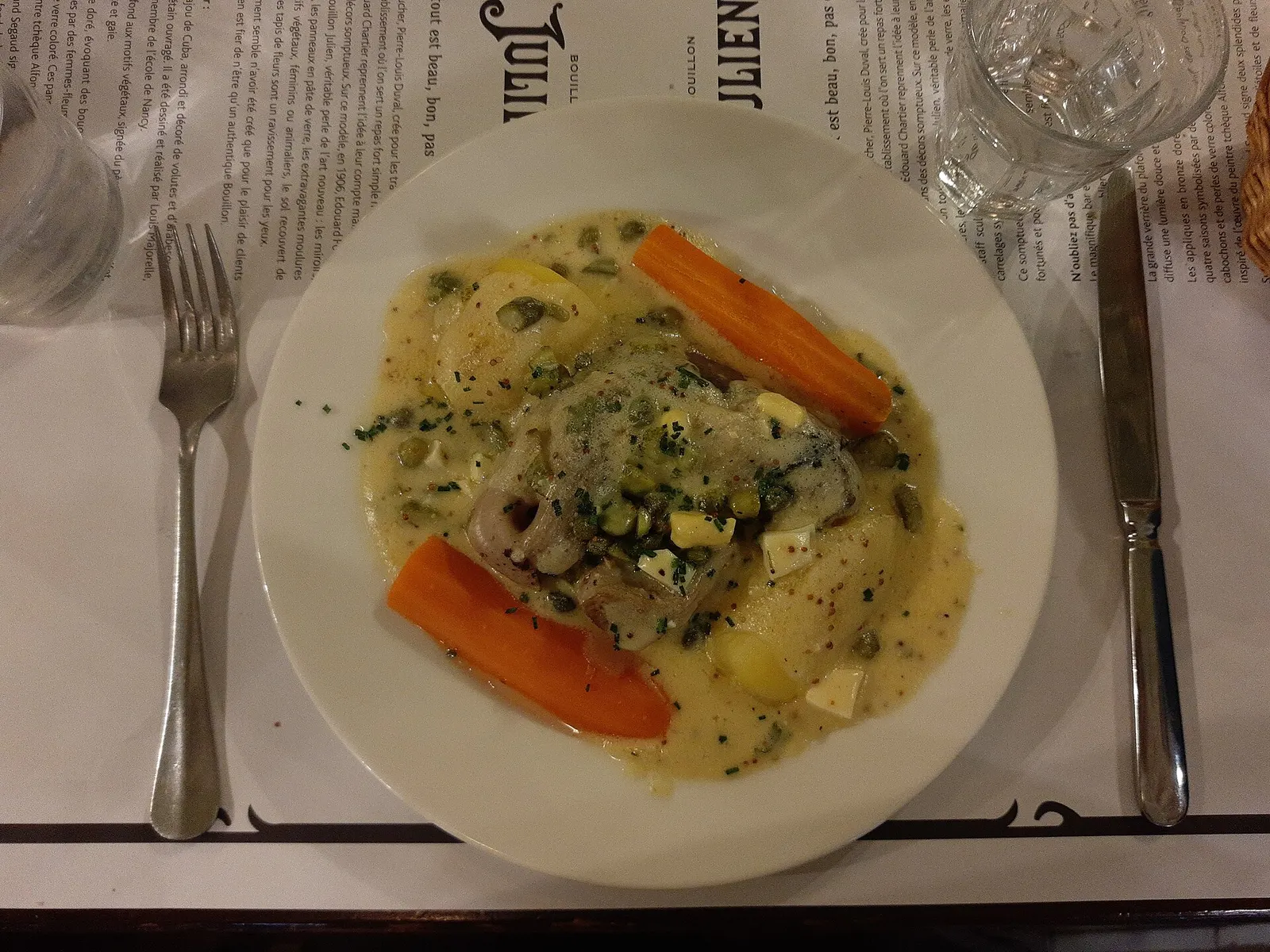
With a creamy white stew, chicken fricassee, veal blanquette or pork in a cream sauce, serve a dry white with body and real acidity: Chablis, Meursault, dry Vouvray, Alsace Riesling or white Pessac-Léognan. The cream and the pale meat need freshness to stop the dish turning cloying. Skip red unless its tannins are fully resolved.
Why does a creamy white stew need white wine?
Call it fricassee, blanquette, a creamy chicken casserole or pork in cream sauce, the pairing problem is identical, because the cooking method is identical. The meat is poached or gently simmered rather than browned, so there is no roasted, caramelised layer of flavour. The sauce is finished with butter, cream, sometimes an egg yolk. And the aromatics, carrot, onion, leek, bay, bring a soft vegetal sweetness.
That combination sets three traps for a wine at once. The cream coats the palate and kills any wine that is soft or purely fruity. The pale meat is delicate to the point of neutrality, so a powerful wine simply erases it. And the absence of browning means there is no toasty, savoury anchor for oak or tannin to grip.
What you need is a wine that scrubs the palate clean without shouting over the food. That is exactly what a dry white with genuine acidity does: the acidity cuts through the fat, the weight of the wine stands up to the sauce, and the aromas stay discreet enough to let the meat exist. There is a happy side effect too: a dry white that is not too high in alcohol keeps the calories in your glass modest next to an already generous plate.
The logic holds for every white sauce dish, and it is the same reflex we apply throughout our food and wine pairing guide: pair with the sauce first, the meat second.
What white wine goes with fricassee, blanquette and creamy casseroles?
Here are the appellations we actually recommend, what each one brings, and a rough shop price.
| Appellation | Why it works | Indicative price |
|---|---|---|
| Chablis | Taut acidity and a saline edge that slice straight through cream | €18 to 25 |
| Saint-Véran or Pouilly-Fuissé | Ripe, rounded Chardonnay, the best value in Burgundy | €15 to 30 |
| Meursault or white Saint-Aubin | Buttery, hazelnut rich: a mirror image of the sauce | €40 to 70 |
| Dry Alsace Riesling | Citrus and precision, resets the palate between mouthfuls | €12 to 20 |
| Dry Alsace Pinot Gris | Broad texture and a smoky note, excellent when mushrooms are involved | €14 to 22 |
| Dry Vouvray or dry Montlouis | Chenin Blanc: tension and roundness for very little money | €12 to 18 |
| White Pessac-Léognan | Sémillon and Sauvignon, rich and bright at once, seriously classy | €25 to 45 |
| White Saint-Joseph or white Crozes-Hermitage | Marsanne and Roussanne, weight without biting acidity | €18 to 30 |
| Côtes du Jura Chardonnay | Nutty character that answers mushrooms, a specialist’s match | €15 to 25 |
If you only want to remember one bottle, buy a dry Vouvray at around €15. It is the best pleasure to price ratio on the list, and Chenin Blanc has exactly the double personality, fresh and enveloping, that a cream sauce demands.
One word on Chardonnay: avoid the heavily oaked versions. A wine marked by vanilla and new barrels smothers the meat and picks a fight with the cream. Look for something raised mostly in tank or in older barrels.
Can you drink red wine with a creamy stew?
Let us be blunt: in nine cases out of ten, red is a mistake. Not for the reason repeated everywhere, though. Milk protein binds the tannins in red wine and makes them feel rounder, which is precisely why cheese and steak flatter a tannic red. Cream is not the enemy here. The problem is proportion: poached pale meat is fragile, there is no roasted edge to meet the wine halfway, and a red with any real structure simply paints over the dish.
The exception exists, though, and it is narrow. A red works with a white stew if it ticks all three of these boxes:
- Tannins melted by age. Count on ten years minimum, fifteen for a serious cellaring wine. That is how long it takes for tannin to soften and stop gripping.
- A light grape. Pinot Noir, Cabernet Franc, a proper terroir Gamay. Not muscular Syrah, not young Cabernet Sauvignon.
- Little or no new oak. Oak adds a bitterness that the sauce amplifies.
In practice: a ten to fifteen year old Volnay or Givry, a well aged Loire Chinon, a grower’s red Burgundy forgotten at the back of the rack. Serve it cool, around 15°C, never at room temperature. If your only red is a three year old Saint-Émilion, save it for the cheese.
You will often read that Saumur-Champigny goes well here. It is a Cabernet Franc, usually young and leafy, and that green firmness rides straight over the pale meat. A white Saumur, on the other hand, is a very good idea.
What wine goes with a mushroom version?
This is where the pairing genuinely shifts. Morels, ceps or even ordinary button mushrooms bring a woodland, nutty, brothy depth that calls for a more complex wine.
The best answer is a white from the Jura: a Côtes du Jura Chardonnay aged under a veil of yeast, or a Savagnin if you enjoy wines that taste like nothing else. The walnut character of the wine and the mushroom speak to each other directly. A Château-Chalon does the same thing more spectacularly, but budget €45 and remember it comes in a 62cl bottle.
It is also the one case where we would spontaneously suggest a red, as long as it is mature: Volnay, Givry, or a fifteen year old Pomerol if the cellar allows.
What wine goes with a lemony or lighter version?
Plenty of cooks finish the sauce with lemon juice, and some skip the cream entirely, thickening with stock and egg yolk instead. Both versions change what the wine has to do.
Lemon works the other way round from what you would expect: acidity in the food softens the wine rather than sharpening it. A crisp white tastes rounder next to a lemony sauce, and it is the soft, low acid white that falls flat. Aim for a dry white with texture that keeps its edge: Pouilly-Fuissé, Savennières, dry Montlouis, or a dry Alsace Pinot Gris. Sancerre and Pouilly-Fumé, recommended by reflex far too often, are not mistakes, but their lemony Sauvignon echoes the sauce instead of answering it.
A cream free version is lighter, so lighten the wine too. Chablis, Roussette de Savoie or a dry Riesling are plenty, and a Meursault will feel overbearing. With a genuinely lean sauce, a light fresh red such as a Fleurie served at 14°C becomes playable even without great age.
What about pork or chicken in a cream and mustard sauce?
Mustard is the variable that changes everything. It adds heat and a sharp bite that a delicate white cannot absorb, so step up in intensity: a dry Alsace Pinot Gris, a white Saint-Joseph, or a barrel fermented Chenin from Savennières. Our full guide to wine with pork covers the creamed and mustardy cuts in more detail.
If the stew is built on chicken thighs with bacon and mushrooms, closer to a fricassee than a blanquette, the plate gains smoke and salt. That is the moment a white with a little oak, a Rully or a Mâcon-Villages, earns its place, and the moment a light red starts to make sense. Our guide to wine with chicken breaks the pairing down by cooking method.
Which mistakes ruin the pairing?
- Serving the white too cold. At 6°C the wine is mute and the sauce tastes heavy. Aim for 10 to 12°C, so take the bottle out of the fridge a quarter of an hour before serving.
- Choosing an over oaked white. New barrel vanilla plus cream gives a pasty, cloying whole.
- Reaching for something off-dry. The carrot and onion already sweeten the dish.
- Opening a young red because it is meat. Pale meat in a white sauce is not a red meat dish, it is a sauce dish.
Count on roughly one bottle for three people at the table, since a rich plate slows everyone down and a second glass of the right white is usually enough.
One last piece of advice: taste your sauce before you choose. If it is sharply lemony, go for weight. If it is heavily creamed, go for acidity. That is the whole logic of food and wine pairing, and it fits in a single sentence.
About to serve a creamy stew and open a good bottle? Take the chance to note what you smell in the glass. It is the best way to make progress, and to find the right wine again next time.
Frequently asked questions
What white wine goes with a creamy chicken stew?
A dry white that has both body and acidity. The safe bets are Chablis, Saint-Véran, dry Vouvray, dry Alsace Riesling and white Pessac-Léognan. If the budget stretches, a Meursault or a white Saint-Aubin is even more precise, because the richness of the wine mirrors the richness of the sauce without ever letting it collapse into heaviness.
Can you drink red wine with a creamy white stew?
Usually no, though not because of the milk: the proteins in cream actually soften tannin rather than harden it. Red fails here because it overwhelms a delicate poached meat cooked without any browning. There is one real exception: a red old enough for its tannins to have melted, light in body and low in oak. A ten to fifteen year old Volnay or Chinon works beautifully. A young, structured red never does.
What wine goes with chicken or veal in a mushroom cream sauce?
Mushrooms change the equation, because they add woodland and nutty notes to the plate. The best match is an oxidative white: a Côtes du Jura Chardonnay or a Savagnin, whose walnut character answers the mushroom directly. This is also the one version where a red genuinely works, provided it is mature, light and served cool at around 15°C.
Should the wine be dry or off-dry with a cream sauce?
Dry, unless the dish itself brings real sweetness, such as caramelised apples, and even then keep to a very light off-dry Chenin Blanc. A classic creamy stew is already rich, and its carrots and onions add only a gentle sweetness, not enough to call for an off-dry wine, which would stack sugar on sugar and make the meal heavy by the second glass.
Which white wine should I cook the sauce with?
A dry, neutral, inexpensive white: Aligoté, Muscadet or a simple country Chardonnay. Avoid oaked wine, because the oak concentrates as the sauce reduces and turns bitter, and never recycle a corked bottle into the pan. Ideally cook with a wine from the same family as the one you plan to serve, without opening the good bottle twice.