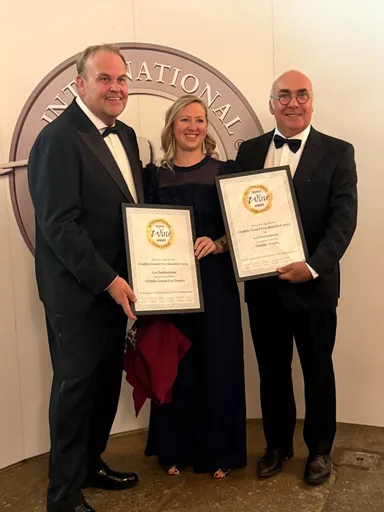
Some news from Chablis that made us smile this week. Estelle Roy, the chief winemaker of La Chablisienne, has been named White Winemaker of the Year 2026 by the International Wine Challenge, the big London competition that tastes wines from all over the world every year. She was one of three international finalists, and the jury picked her.
If the name of the house rings a bell, it should. We spent an afternoon at La Chablisienne for episode 63 of the podcast, with general manager Damien Leclerc, at the foot of the grands crus between the Serein river and the slopes. More on that below.
A second title in three years
This is not Estelle Roy’s first time on that stage. She already took the same trophy in 2024, so this 2026 title makes it two in three years, which is a remarkable run in a category where she is up against winemakers from every wine-producing country on the planet.
Her path at La Chablisienne explains a lot. She arrived in 2019 and worked alongside Vincent Bartement, the house’s long-time chief winemaker, before succeeding him in 2023. Bartement himself won this exact IWC title several times during his tenure, something Damien Leclerc told us about with obvious pride in our interview, calling the awards evening “a bit like the Césars of wine”. So the trophy has now gone to two successive winemakers of the same house. That is no coincidence, and it says something about how the place works.
The Blanchot 2023 took a Trophy too
The individual award was not the only good news for the house at this year’s competition. Its Chablis Grand Cru Blanchot 2023 won both a gold medal and a Trophy, the IWC’s distinction for the best wine of its category.
Blanchot is one of the seven grand cru climats of Chablis, all gathered on a single slope above the village. For a cooperative to place a grand cru at the very top of an international blind tasting, ahead of famous estates, is exactly the kind of result that keeps quietly correcting the old cliché that co-ops only make simple wine.
Why a cooperative keeps winning this
La Chablisienne was created in 1923 and today brings together around 250 winegrowers, representing a large share of the Chablis vineyard. The range runs from Petit Chablis all the way to the grands crus, which means the winemaking team works with an enormous palette of parcels, soils and expositions every single vintage.
When we visited, Damien Leclerc was clear about the house’s obsession: precision, and that famous mineral tension that makes Chablis taste like nowhere else. He also made a point we have never forgotten, that the real technical feat is not the thirty thousand bottles of grand cru, it is keeping the same level of demand on two million bottles of Petit Chablis. A title like Estelle Roy’s rewards her talent and her vision of winemaking, but through her it also rewards the growers, the cellar teams and a collective model built over a century.
And for us drinkers, this is the practical takeaway: Chablis remains one of the best places in the wine world for what Leclerc calls accessible luxury. A very good Petit Chablis costs around ten euros, and even the grands crus stay within reach for a special evening. When the person signing those wines has just been named the best white winemaker in the world for the second time, that is very good value indeed.
We visited La Chablisienne on the podcast
If this news makes you curious about the house, we recorded a full episode there. Damien Leclerc walked us through the crazy history of the co-op, founded in 1923 and led by women for its first years, the 2008 crisis, climate change in the vineyard, and how to explore the four levels of Chablis appellations without getting lost. It is one of our favourite Burgundy episodes.
Read or listen to it here: #63 - Damien Leclerc - La Chablisienne.
Listen to the podcast with Damien Leclerc
Congratulations to Estelle Roy and to the whole team at La Chablisienne. Twice in three years is not luck, it is a house style. We will be opening a Chablis this weekend to celebrate, and we suggest you do the same.