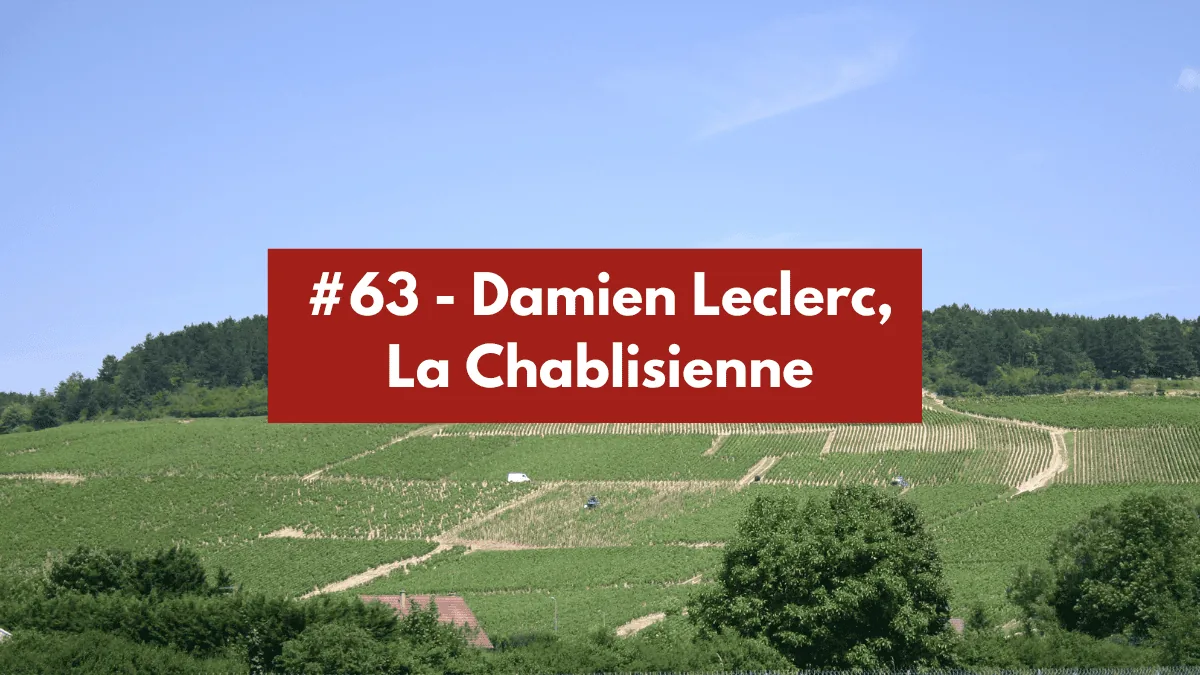
For this new episode of the Wine Makers Show, I got to discover Chablis with Damien Leclerc, the general manager of La Chablisienne. Chablis is an appellation in the north of Bourgogne, hugely famous for its white wines. Plenty here to enjoy and to add new bottles to your wine cellar.
Antoine: Thanks so much for hosting us today. We’re at La Chablisienne. It’s the first time I’ve come to Chablis, so I’m really happy to be here. We’re in a place that’s a bit special, and I’ll admit I didn’t catch the name.
Damien: It’s Le Moulin des Croix. We’re actually at the foot of the grands crus of Chablis and this magnificent building belongs to the Domaine de Château Grenouille. It’s an extraordinary spot between the Serein river and the grands crus.
Antoine: It’s beautiful. So, we learned the list of grands crus of Chablis before coming, so you won’t be able to trick us on that. We’ll obviously talk a lot about Chablis but before that, can you introduce yourself?
Damien: Sure, with pleasure. Damien Leclerc, I’m 48. I’m originally from this beautiful Yonne region. I grew up not far from here. Then, a bit like the journeymen, I traveled all around France during my studies.
I’ve had the pleasure of running La Chablisienne for nearly fourteen years. That’s a lot, and at the same time it’s gone by very quickly because it’s a fairly extraordinary company, a cooperative, as you know. The richness and complexity are obviously there. In any case it’s a pleasure and a source of pride to be at the head of this magnificent flagship for fourteen years.
You mentioned your studies. Did you always know you wanted to work in wine, or not at all?
Damien: No, absolutely not. It really came about by chance. On the other hand, working in jobs or sectors connected to nature or wide-open spaces, yes. For a while, I would have liked to find activities tied to the sea, which is a passion of mine. But no, it wasn’t planned at all.
I had a fairly classic schooling, then I went off to study in Bordeaux, well, Annecy, Bordeaux, Nantes. So a BTS, then engineering school and a third cycle.
I actually started in trading agricultural raw materials. I had just finished something that was mandatory at the time, my national service, which I did on a magnificent ship in the French Navy. It was a very nice experience.
When I came down from that magnificent ship I really wanted to stay near the water. So I started in Montoir-de-Bretagne, in Loire Atlantique. Since it was going pretty well, my boss quickly sent me to the head office in Paris. There I told myself, this isn’t possible, when you’re passionate about nature and wide-open spaces, it was too hard for me. A bit by chance actually, I came back to Bourgogne and I started in wines and spirits, with the Boisset group in Nuits-Saint-Georges.
Wine wasn’t a field you knew especially well. Did you already have an appetite for the product, or was it really by chance that you ended up there?
Damien: It was part of the sectors I always looked at because when you’re born in a wine-growing region, you’re inevitably a little bit of an observer. I had a chance to do some harvests, I had a few winegrower friends. My uncle was the mayor of Chablis for a few years. None of that was unfamiliar to me. But no, I didn’t necessarily have a very fixed or preconceived idea. That said, I’m delighted to have been working for over twenty years in this beautiful sector.
So tell us, you arrive in Nuits-Saint-Georges. What happens for you? Is it a kind of rediscovery? What kind of work were you doing back then?
Damien: Actually, I started not in the world of wine but in the world of spirits, and more specifically liqueurs, because the Boisset group at the time had bought a very nice company called L’Héritier-Guyot in Dijon, the specialist in crème de cassis. Behind that company, they had developed a portfolio of spirits.
My first job was working more on commercial functions related to those activities, with a lot of autonomy already on a fairly broad scope. And then there were great encounters, since Mr. Boisset is quite an extraordinary character who has undertaken a lot, who has developed his businesses very well.
It’s true that we’re in Chablis, not very far from Auxerre. In Auxerre we often talk about Guy Roux’s training center for AJ Auxerre, in the great era of the football club. I have to say that when you have the chance to work very young with, I’d say, exceptional bosses, it lets you learn faster and progress, to have ideas. It’s true that I had this opportunity and it was a treat to work for five years in that beautiful company.
I think one of the things that plays a huge role is the type of boss you manage to have in your first professional years.
Damien: Yes. It clearly influences you a lot. When I started in trading agricultural raw materials I also met two charismatic bosses.
The first was an absolutely extraordinary trader who taught me a lot of fundamental things in commodity trading, especially about commitment to your word, because we work in very small sectors with few players and that counts enormously.
And then Jean Myotte, who was the general manager of INVIVO, a great man, charismatic, brilliant and very pleasant. And it’s true that life is made of encounters and these encounters nourish you, make you want to go further, give you ideas. Often these great bosses are also demanding, charismatic leaders, so it forces you to evolve, to move forward and to project yourself with good reflexes and good habits.
Antoine: I think that if I had to give my younger self some advice it would be: “Choose a job more for the people you’ll be working with than for the sector or the type of things you’ll be asked to do.”
Because in any case, when you’re a junior in a company, whether you’re doing Excel or PowerPoint or whatever, it’s the same. What counts is the level of learning you can have with the people around you. The message is sent if my little brother is listening right now, that one’s a gift.
So, you do those five years in Nuits-Saint-Georges and then you join La Chablisienne?
Damien: No. Before that I also had another experience, still in Côte d’Or, near Chagny, Chassagne-Montrachet, with the Picard Vins et Spiritueux group, where I held my first general manager position for a little under four years, in another family business.
What interested me in that job was, I’d say, this evolution toward general manager functions, I was thirty, I wasn’t very old. I was running the parent company in Chagny, the Compagnie Vinicole de Bourgogne. About a hundred people.
It’s true that when you have the chance to meet great bosses, you naturally want to start things, you want to move forward and then you also want, or maybe not, but I wanted to go further.
So that was the first opportunity, and also the discovery of how complex this job is, because being a boss is a lot of things at once, it makes people dream, sometimes they hate you. In any case these are functions that leave nobody indifferent. You imagine a lot, and then when you’re confronted with reality you discover, you learn, but in any case it was also a beautiful experience.
There were also great encounters there, Michel Picard too, a great charismatic boss who started from nothing, who developed his business in a different style than Mr. Boisset but in any case someone interesting. And then consultants, particularly a guy called Michel Godard who had moved up a lot within the Heineken group, who came from large groups and also brought me a lot of methods.
Life is made of these good moments and sometimes also moments of doubt, of hard moments. What you also discover is that the flip side of power is often loneliness. You don’t necessarily imagine that at the start.
When you climb the ladder little by little, if you want to keep, I’d say, real objectivity, of course you have to work with the teams, but you also need to keep a little distance to maintain that freshness and that mindset to make the right decisions when needed.
I think it’s also healthy for your team you know, to have a bit of distance sometimes, because your team doesn’t act the same way if the boss is around. How long did you stay?
Damien: A little under four years and at that point Alain Cornélissens, who ran La Chablisienne for many years, was about to take a long vacation, he was preparing for retirement.
I was approached by a firm that had been mandated to find his successor. It happened pretty quickly and I arrived at La Chablisienne on July 1st, 2008 for what was meant to be a six-month overlap with Alain who was finishing, I’d say, his time at La Chablisienne. He stayed about fifteen years as GM. And then months of handover, learning, discoveries. I took the reins fully on November 15th, 2008 I believe. Knowing that, I don’t know if you remember, in 2008 we had a couple of small economic events. So yes I arrived here on July 1st, 2008.
I was thirty-five, and I arrived with the global economic crisis. I have to say it was a fairly difficult time because La Chablisienne, an agricultural cooperative society, eighty employees, two hundred and fifty winemakers. But what you have to keep in mind is that, behind La Chablisienne, directly and indirectly, it’s about a thousand families that live thanks to, with, in La Chablisienne. In terms of pressure to succeed, that’s not insignificant.
And I have to say that 2008-2009 context was very tough. All the more so because at the time we were very dependent on the British market. We were doing about forty percent of our turnover in the UK. The UK was one of the countries that took the biggest hit from the 2008 financial crisis. It also lets you gauge in a crisis situation the reflexes, the habits and what you’d been able to learn before, in terms of experience.
I have to say that having gone through some tough schools, with these charismatic leaders, was ultimately a great chance. Because I think it also let me make the decisions that needed to be made in that very tough context. We went through six consecutive months with turnover down forty percent, which is not insignificant.
Antoine: I remember the 2008 crisis but I was still young. How old was I in 2008? Twelve or thirteen. I remember that crisis and I remember it was something serious but I didn’t feel its effects personally at all. It’s true that, when I talk to professionals who were active at that time, they all say it was, my view was of a banking and financial crisis that was a bit distant and that mainly hit lower-quality assets, which trickled down to everything else.
But in fact, it was incredible tension on capital, on cash flow and therefore on all turnover. It’s much more impressive than the picture I had after talking to professionals. It really marked the minds of people who were active. Whereas for me it was just a crisis I’d seen in books or on TV, not in real life.
Damien: Very concretely, we lived through it very fast and very violently because our British importer’s bank was an Icelandic bank called Landsbanki. Landsbanki was the first bank to go bankrupt at the time of the financial crisis. I can assure you that we very quickly understood what that could mean in terms of consequences.
What difference did you see between when you arrived at the Picard family and when you arrived here at La Chablisienne? On one hand we have a large family group and on the other a cooperative. Were there things that struck you when you arrived, or notable differences between the two?
Damien: Actually, I was rather surprised by the fact that there weren’t that many differences. I clearly expected more differences, telling myself, “It’s a cooperative, with a cooperative way of operating.”
And then in fact, in terms of how La Chablisienne operates internally, not at all. That can be explained quite simply by the history of this very particular company, because La Chablisienne was created on May 1st, 1923. You have to know that at the time in Chablis, there were two cooperatives.
It’s worthy of a Pagnol film or book, since obviously the La Chablisienne we know was created on the initiative of a priest, the abbé Balitrand.
And then there was the Cave Coopérative de Chablis, which had been created by a political leader who today might be qualified as far-left.
What you have to keep in mind is that between 1923 and 1947, I really feel that the primary mission of La Chablisienne and the Cave Coopérative de Chablis was to win the ideological battle. Finally, in 1947, we come out of the Second World War, the two cooperatives are so weakened that the Crédit Agricole calls time on the dance, forces them to merge. We then become La Chablisienne Cave Coopérative de Chablis and incidentally Union des Viticulteurs de Chablis.
And so it’s set in stone that from 1947 we do only one thing: business. We no longer talk about politics, we no longer talk about religion, we no longer talk about unionism. So, very early on, we are under cooperative status, but it’s first and foremost a company with a corporate way of running.
There was another factor. In 1947 the first general manager was hired, which is quite rare in the cooperative world. It’s actually quite funny because he’s a former army officer. I think his primary mission was to bring back some order and discipline in this conflict situation.
Then, the other element, business culture, and on the other hand we operate over the long term because, you see, I’m only the fourth general manager and we’re in 2022. Since 1947, that means each one stayed fifteen, twenty years to bring their stone to the building.
So in the end, not that many differences. Yes, there’s a board of directors with the winemakers. But what do we do in this board? We talk about projects, we report on our commercial and economic activity, and the idea is for it to work. The winemakers are not philanthropists. Very clearly they bring their production to La Chablisienne but in return they expect an optimal level of valuation. There’s clearly a level of demand and a particular culture.
Each general manager who came through here stayed, you said, between fifteen and twenty years. Is that something you were aware of fourteen years ago, that you might also stay fifteen or twenty years?
Damien: First of all, that’s something I was asked. So, if you come to La Chablisienne, you’re not coming for three years. You commit long-term, because in our trade we work on long cycles, we only vinify once a year. If you really want to make an impact, if you want to influence, if you want to evolve things, you have to stay at least ten years.
That was the demand from the chairman who hired me in 2008. I think he was entirely right. And then time goes by very fast, when there are projects, when the missions are rich.
For me what’s essential is to take pleasure in what I do, to keep learning. As long as I’m enjoying it, I’m getting what I need.
Of course, I arrived here, I was thirty-five. I don’t know if I’ll stay here until the end of my career, probably not. Because at some point you also need fresh blood, because sometimes you also need fresh ideas.
In any case, for now I’d say I keep enjoying what I do, and unfortunately we’re going through period after period of crisis, and in those crisis periods you need stability. We’re very close to our winemakers and given the responsibility, we can’t just do anything either.
Can you tell us: what is La Chablisienne?
Damien: La Chablisienne today is a beautiful wine house. Under cooperative status, but I insist on this, it’s really a beautiful wine house with beautiful brands. Today we have two brands sold. One in the traditional sector, La Chablisienne. And the other in mass retail, Union des Viticulteurs de Chablis.
Ultimately, under this banner, today we bring together two hundred and fifty winemakers, one hundred and thirty for whom it’s their exclusive activity. We vinify between one thousand one hundred and one thousand two hundred hectares of vines each year and we produce on average eight million bottles. This production is sold entirely in bottles.
In 2021, we generated revenue of fifty-one million euros, of which sixty percent internationally, in eighty-seven countries. That’s also a particular point.
What you have to keep in mind is that this story is special in the sense that, in 1923 when La Chablisienne was created, contrary to many other cooperative structures, it wasn’t created to produce together but to do business together. The DNA, the starting point is above all a sales mission. By the way you’ll see, behind you there’s a beautiful poster from 1926. It’s a Lutetia poster. What’s quite surprising is that it’s really old but stays very modern today. That’s the starting point. And the story is a bit particular, because why La Chablisienne? Well, let’s not forget that in 1923 we’re very shortly after the end of the First World War.
We’re very shortly after the end of the Spanish flu, since we’re coming out of a pandemic. For half a generation, in Chablis as everywhere in France, it was the women who carried the farms because unfortunately many men did not return from the First World War battles, others came back wounded. And history is starting to talk a bit more about people who came back traumatized in very degraded psychological states. There’s half a generation where it’s the women. And this Chablisienne is special because starting with a commercial promise and created by women in 1923, that’s quite surprising.
And since then, I’d say we’ve kept that form of impertinence. Ultimately, we’re rarely where we’re expected. Sometimes we can disturb people too but it’s not too serious, it’s part of the company’s DNA.
It’s a bit like our wines. What we look for is that beautiful mineral tension, that liveliness. And ultimately, that liveliness is what characterizes us most today at every level and from every point of view.
Antoine: Super interesting. You must have incredible archives here on what happened in the company’s history. It’s true that this poster behind us is very beautiful.
For the people listening, we’ll surely include a photo in the article or on Instagram or somewhere else so you can see it. It’s very nice. And this emblem you’ve kept, you must have adapted it on lots of media, lots of different versions, with artists, or others.
Damien: It hasn’t evolved much. It evolves regularly with artists. Recently, for a few years now, we’ve been working with a fairly well-known calligrapher named Nicolas Ouchenir who has been a great help on the evolution of the figure.
The idea is to keep this image and this dynamism. Knowing that when you take the 1926 poster or today’s La Chablisienne poster, the symbolism is the symbolism of victory.
It’s quite logical and understandable when you look at this history. And I remain convinced that to move forward in good conditions you have to look at where you come from. We also had the good idea of having two history students work on the archives.
One of them did his thesis on the 1923 to 1947 period and a second on 1947 to today. Based on their work we’re working on writing a small book that will retrace our history. The idea is also to find anecdotes, particular moments, moments of doubt, moments of joy to celebrate our hundred years next year.
It’s coming up fast and we’re working on this project.
Have you learned things that are funny that you can share?
Damien: Anecdotes, there are bound to be some. Among the older ones what struck me was the recurrence of climatic challenges in the 1950s to 1970s. Today, we complain because with warming it’s hard but we realize that for about twenty years it was very tough.
Behind all that another key element was put in place, which is prudence in management because when you’re regularly subjected to these crisis periods, well, to get through, you need this wisdom and this prudence. And that’s part of the company’s DNA.
And then, more recently, I have two memories in mind. The first is, I think, in 2014 when the Revue des Vins de France gave us the prize of Cooperative Cellar of the year. For rugby players that was a Brennus shield, a French champion title. It’s pretty fun to share, and a real source of pride.
And more recently, with Vincent Bartement as part of a British competition called the IWC, International Wine Challenge, we won three or four times the title of best white wine vinifiers, in the world I’d say, since we’re up against the New World countries.
Now that’s fun because for a very long time we were told that we’d become “has-beens” in France and that only the New World counted, only the New World worked. Winning that trophy three or four times was something amazing for us. Quite simply because behind Vincent of course are all the teams, the winemakers and the technical teams. That evening is a bit like the Césars of wine. There’s also a lovely staging. It was really a great moment of emotion.
In what you say there’s that part you just mentioned about the prize with New World wines, earlier you also told us about international sales, I get the sense that openness to the world plays an important role for you?
Damien: It’s absolutely essential. And then, it’s also an enormous richness because when you work with eighty-seven countries, you have to imagine all the encounters behind all that, the exchanges, the visitors who come to discover what you do. The pleasure of traveling, of discovering other countries, other cultures, other consumption patterns, other production regions. There aren’t many jobs in which we have this chance. And it’s true that’s something I love.
I’m very unhappy because for the last two years, we replaced a lot of trips with video calls, we hardly traveled at all. We didn’t host many people. This openness to the world is something absolutely exceptional in terms of richness, pleasures, sharing and high points.
You used to travel a lot before?
Damien: Yes, before it was almost once a month. There I have to say that since November 2019, it stopped. Maybe things will pick up again. It’s also possible that at some point, given how air traffic has evolved, we maybe had a tendency to hop on planes a bit too quickly and easily with a carbon footprint that wasn’t great.
I think tomorrow won’t be quite like yesterday, that said, business remains above all about human relationships, encounters, and sharing. And even more so in our trade and with our products.
That’s clear. You have to make people discover, make them taste. Have you had any memorable tasting experiences abroad?
Damien: Yes, there’s a fair I love. It’s the Salon des Vins de Montréal, which takes place every two years in Montréal. It’s quite funny because there’s one day for professionals and then four days open to the general public.
I have to say it’s a really extraordinary country and it’s true that with Quebec we have, I’d say, privileged relations. They’re our cousins from across the Atlantic. It’s always a great moment of joy, exchange, sharing. That’s planned for this year. I sincerely hope to find again the pleasure of this fair, of this tasting.
I also have a memorable memory with our importer in the United States who’s based in San Francisco and who, like me, is passionate about the sea. He has a magnificent sailboat and we had the opportunity to do a tasting in San Francisco Bay while sailing. I have to say that was also a great moment of joy. These are privileged moments. You have to like to move around, that’s clear, sharp and precise. There you say next week I’m in San Francisco, then I’m off to Montreal or I’m going to Japan. When you love it, it’s just incredible. And it’s true that on the other hand, when you’re in Japan, the codes, the way of tasting are very different but it’s also fascinating in the end.
Antoine: It’s part of the trade you mentioned earlier, but if you like to travel and meet people, it’s part of the things that are possible. It’s really cool.
What was La Chablisienne like when you arrived fourteen years ago and what path have you traveled overall? What were your first missions when you arrived and in what direction did you want to take the boat?
Damien: The first mission was, I’d say, to adapt the sails of this magnificent boat to the storm because very clearly, in 2008-2009 we had to get through the crisis. That allowed us to rethink our organizations and how we operate. There was no social damage, clearly. We didn’t go that far, and thank goodness.
But it allowed me to overhaul the internal organization, the way of operating. To put in more cross-functional work. And then little by little to evolve this company, I’d say, more toward what we call today the liberated company with a lot of autonomy.
That is, I’m not at all in the culture of the weekly executive committee where everyone presents their projects, takes stock of their issues. Sincerely, I think that’s totally outdated today. Of course you have to get together to share because it lets everyone understand and it gives meaning. And when the project is shared, it’s much simpler for everyone. That, you have to do two or three times a year. But after that, you also have to leave autonomy, freedom for people to express themselves, to give the best of themselves.
Of course, there are times when we see each other but I’m rather in the other direction now. People come to me to take stock. It’s not me who summons them every week. When they have a topic well, we take stock, we discuss, we decide, we tackle, we move forward. And that’s a good thing. Then, I think we’ve made a lot of qualitative progress. It’s also true that at that time, a new oenologist arrived with the arrival of Vincent Bartement, who’s still here.
I’d say we already had, in my opinion, a very good qualitative level. On a scale of a hundred, I would have said eighty. But we also know that beyond eighty, when you want to progress, you’ll gain between one and two points each year, knowing that we only vinify once a year. So we worked on different topics. We worked a lot on dissolved oxygen. We overhauled a number of processes to gain in precision and with this culture of precision.
Objectively, I think we clearly crossed important qualitative thresholds, so today we have nothing to be ashamed of. There are today in Chablis very large domaines known and recognized. I think we’ve reached a fully comparable level but with one particularity. Today a beautiful domaine in Chablis will produce one hundred, one hundred and fifty thousand bottles each year. For us, it’s eight million bottles.
But on the other hand, from the Bourgogne Chardonnay to Château Grenouille, I think everyone enjoys our products, whether the entry-level or the top of the range. It’s harder because with the volume effect you need to keep this same level of demand. That’s the whole challenge, but I think we’ve succeeded with that one. That was the first stage, the know-how.
And then the second stage was to work on making it known. Communication, marketing and all the associated elements that allowed us to work on developing the awareness of La Chablisienne. That too happened over time, with great encounters.
We’re lucky to have a very nice team that supports us on communication with Marie-Catherine and her team. That’s really a great chance.
She’s someone extraordinary in the sense that, since she does her job very well, ultimately she’s the one who chooses who she works with. It’s great because she makes you progress. Frankly if at some point it doesn’t fit or if she’s had enough she can also tell you, “Well no, I’ve had it and I’m not working with you anymore.” So with this freedom of tone, it’s something very pleasant for us.
We also worked with friends from Champagne on stepping up the marketing with Nicolas Ouchenir, who I mentioned earlier, on the calligraphy side. We also met people who are independents. At one point we had an integrated structure. Today, we have one person in marketing. But the idea is rather to work with externals who also have the richness of seeing many things.
And I think today the recipe is working pretty well. I wouldn’t say it’s three stars, I don’t know what rating we could give ourselves in the Michelin Guide. But in any case we have nice ingredients, we have nice players, we have nice skills. I’d say all of that combined makes me think that La Chablisienne today has become a beautiful brand and a beautiful wine house. Now we mustn’t fall asleep.
Is that something you fear?
Damien: We always have it in mind. But it’s not the culture of the house. I think it’s anchored. In fact it’s also another essential element, which is that our trade isn’t a serious trade. Sometimes in wine, or in spirits, I find it can go off the rails.
We’re there ultimately to allow many people all around the world to share moments of pleasure. So it’s anything but serious, and that’s important. With us we don’t have a star oenologist, we don’t have star sales reps. We have people who are super pro, who are super committed. But humility is really part of the house’s DNA. It’s really essential.
Do you think it’s something that’s been a bit lost in wine, or at least in some domaines or some regions?
Damien: It’s possible, I’m not here to argue or do anything in relation to that. But I think we shouldn’t forget that this product is not an essential product, far from it. It’s clearly something we can do without. We can see in those slightly difficult moments, with the contraction of the economy due to the crisis, that unfortunately it’s possible.
Then again, it’s not the case for everyone because fortunately there are also wonderful counter-examples with very great winemakers who are absolutely brilliant in their humility. What’s always struck me with the very great is simplicity. I think that’s really essential.
Antoine: I think that’s also where you recognize those who are truly excellent from the others. I think you can’t want to do something important without being humble or modest. That doesn’t mean not having a great vision or not wanting to do something great, but it just means being nice, welcoming people properly, chatting easily. I find it’s the bare minimum, especially if you want to accomplish something cool afterwards.
You spoke earlier about climate change. Is it something you’ve felt very concretely in the vineyard?
Damien: Yes. Unfortunately for some years now. Since 2016, we’ve been confronted with the consequences of this climate change.
For us the first impact is obviously the consequences of these winters that are less and less winters since many people enjoy the mildness of the winters we’ve just lived through. But the problem in our trade is that ultimately the dormancy period of the vine shrinks since with the accumulation of these high temperatures, it tends to start up earlier.
So when it starts up again around the twentieth or twenty-fifth of March, we then find ourselves over fairly long periods, April, May, where it’s potentially very sensitive to spring frost.
And in 2016 as in 2021, we were very harshly hit by frosts called black frosts. Cold coming down from the North Pole and bringing very cold temperatures at a time when ultimately the buds have opened, the leaves have started to deploy, they’re two or three centimeters long and they’re very sensitive to cold. The consequences are catastrophic in terms of production.
In addition, in 2020 it was drought. In 2019, it was also drought. Unfortunately we’ve entered a recurring cycle of climatic challenges that disturb us and that worry us greatly.
Do you have actions to try to counter that or to adapt? Some heat if it’s cold, try to warm things up when it’s cold.
Damien: Yes. Today there are several possibilities. In the grands crus of course we’ll position candles in the vines. There were very nice images circulating last year in April. That allows us to protect them. Only the grands crus, in a vineyard of fifty-five hundred hectares represent one hundred and two hectares. We can’t necessarily protect the whole vineyard.
There are also now heating wires, wind turbines. We adapt the pruning techniques because we know that when you prune fairly late it can slow the bud break and the restart of the vine a bit. Yes, we try to combine several factors but nature is going to remain the strongest, unfortunately.
There’s an IPCC report that just came out that’s absolutely alarming. I think we haven’t all yet realized what’s happening. It will be high time to mobilize on this topic because otherwise the consequences risk being catastrophic.
Behind this catastrophic side, I remain positive because with the pandemic we just lived through, we still saw, well, we found solutions quickly. Because rolling out these vaccines in such a short time is extraordinary. That means that when we want to mobilize on essential topics, we can find solutions.
What we can perhaps reproach is that there’s a magnificent lab that made a fortune during this pandemic crisis whereas in the end basing everything on commerce in those situations can be a bit shocking.
I can’t wait to hear about the creation of the new Lépine competition for all the technical projects that will allow us, well, to counter climate change. It’s true that today we talk a lot about hybrid vehicles and electric vehicles. We also know that there are hydrogen engines, and that this hydrogen can be coupled with sustainable development. I find there aren’t enough projects, not enough calls for projects, not enough ambition. Today we’ll favor the existing economic sectors and that’s at the expense of these projects and this revival. I think we’ll have to be ambitious much more quickly and on this our politicians have an absolutely decisive role.
There’s also a fellow I know well and like a lot named Jean-Louis Étienne, who I run into from time to time. And so, he’s setting up a project called Polar Pod. He’s going to recreate a kind of floating station that will rotate around the South Pole precisely to study this area of the world which is an area where we capture a lot of CO2.
We’re also lucky to have absolutely incredible personalities who are able to carry projects of this nature. I think we really need to mobilize, to capitalize, to find financing and calls for projects in every direction.
Yes it’s catastrophic, yes it’s very tough but we have to move. Honestly when you see what we were capable of during the Covid crisis, if we really want to, I think we can move very fast and find solutions, but we have to move.
It’s a topic I carry every day with my company. We’re in electric mobility and clearly we’re trying to push as far as possible and to go fast. That’s clearly our challenge. Could La Chablisienne make wine outside of Chablis?
Damien: No, it couldn’t because since it carries the name of the appellation in its name, if it made wine outside Chablis it couldn’t be called La Chablisienne. That limits things a bit. Then our know-how could be transposable in other vineyards but with other signatures, yes, that’s possible.
Is that something you’re looking at?
Damien: We did look, before the Covid crisis, yes, we had started to look a bit toward New Zealand.
Oh yes? So not at all next to Chablis.
Damien: Not at all next to Chablis but what’s interesting with the southern hemisphere is that we’re on a reverse calendar. So right now, they’re doing the harvests and that could also let our teams not vinify once a year, but twice a year.
You see, for example, an oenologist, often when starting a career, will be number two or number three in a company and then as number one will do twenty or twenty-five harvests. And with a project of this nature, that could allow not twenty or twenty-five, but fifty. So it can be interesting.
And what can be interesting with this country and this project is that it’s also a large pool of quality dry white wine production with the sauvignon grape variety in particular in the Marlborough region on the south island. There are quite a few things that could match up and resemble each other.
Antoine: So it didn’t happen, Covid arrived.
Damien: Yes, it froze projects and ambitions. There we were saying, that’s it, we’re getting out of Covid, all good we can start up again, and boom badaboom it seems we again have an angry person who decided otherwise for Europe and for quite a few countries.
Today what’s the ambition you carry, the mission you’ve set yourselves? If you had to set off again for fourteen years right now, what would the next steps be?
Damien: The idea is to continue this work on stepping up the range, to continue this work on the brand, to continue this work on diversification.
You see, for example, there’s a country, a small country still, called the United States, in which unfortunately we’re not very present. So there we have, I think, found the solution to make progress. But there’s still much for us to do. Lots to do in terms of development, diversification.
We’re also working on other projects, typically the La Chablisienne brand will stay in the traditional sector in France and export, but for mass retail, today we have the Union des Viticulteurs de Chablis brand.
Chablis is at the heart of a department called the Yonne and for a few days now we’ve been the happy owners of a brand called Icona, which gave its name to this department. The idea is to develop a new range that should let us position our wines in other sectors, in other channels, also with a very premium positioning.
On the upstream side of course we started a few years ago, but the idea is to strengthen the entire policy linked to sustainable development, it’s absolutely essential and I think from this point of view we still have many projects to initiate to get through this slightly difficult climatic period and adapt to these changes to still be here tomorrow and the day after.
In the end, we reinvent ourselves a lot. What’s a bit regrettable is that we’ve had a bit of a sense for a few years of a never-ending day where crises follow one another on different themes and we don’t get out of it.
Economically, we got through these periods well but it’s true that we’d like to find some serenity to settle a bit more and validate that the projects in terms of development projection are the right ones.
You spoke a bit about it on the upstream side, the supplies, the winemakers, how do you manage that today? Do you often go around the different properties? What kind of relationship do you have?
Damien: We have an internal team today at La Chablisienne, made up of three people who are there to accompany them daily.
One person who will accompany them more from an administrative point of view because, as you know, wine production in France is something very simple with planting rights, with many declarations, lots of administrative work. It’s true that, sincerely, the administrative complexity is very present in our activities. So having someone dedicated who’ll provide advice and support, I think that’s something that’s appreciated.
In parallel, we also have two viticultural technicians who are there to support our winemakers throughout the year simply on technical advice. I think that’s good. By the way it’s quite interesting because since then the regulations have evolved because often phytosanitary product sellers were both advisors and sellers and for two years now the regulation has evolved. It requires splitting advisory activities from sales activities.
On that, we were rather avant-garde and we’ve actually tried to develop an advisory activity for winemakers more broadly, not just for ours, to bring added value since we’re also lucky to have two very competent people who know their trade well and who are very proactive on new techniques, new ideas.
Today, we also talk about artificial intelligence in viticulture more and more, for soil work, for pruning. Very clearly I think these are also sources of improvement with limited carbon footprints. From this point of view you have to be on the lookout, listen, meet partners, see startups and we’re lucky to have employees who are well connected on these topics and who let us move forward, that’s really essential.
Beyond all that we also have a general policy with our board of directors, our chairman. Our chairman is in organic conversion, that’s a signal given to everyone.
In parallel we went with the Terra Vitis reference framework which seemed to us much more precise than the notions of high environmental value of viticulture. The idea is progressively for all winemakers to be Terra Vitis certified and therefore La Chablisienne in its entirety.
Do you see a horizon for that?
Damien: It’s quick because we’re already well underway. I think within a maximum of five years, it’ll be done. We’re doing pretty well.
Then, in sustainable development, for ten years we’ve worked a lot on our energy consumption indicators in the cellar, whether it’s electricity or water. We’ve also made nice progress. But we’re not just there to respond to reference frameworks, we really have this culture of continuous improvement. It’s important.
And we do it, we never do it as a reaction to something asked of us by a client or by a trend. We try rather to project ourselves and stay avant-garde.
In fact the first sustainable development reference framework that was put in place at La Chablisienne was in 1990 with Agri Confiance. So you see, that’s starting to date a bit. And at the time nobody was asking us anything.
By the way this Agri Confiance project, at the time was carried by a young guy who was in charge of the quality group and who became chairman of La Chablisienne and stayed for nearly twenty years. We’re also lucky to have men of conviction who’ve made us progress from this point of view.
If you had to advise a wine lover who wanted to discover Chablis, what would you tell them? How would you guide them in this discovery?
Damien: What’s interesting in Chablis is that there are four levels of appellations. I sincerely think that what’s quite extraordinary is that whatever the level of appellation, you can take pleasure but for different consumption moments.
You’ll have the petit Chablis which are on the plateau zone. We’re everywhere on clay-limestone soils, but in terms of limestone, we have two main types: we have Portlandian on the plateaus with the petit Chablis, and then on the valleys and hillsides Kimmeridgian, so Chablis, Chablis premier cru and Chablis grand cru.
What you have to keep in mind is that really, with Chablis, what stands out is what we call mineral emotion, minerality. We have wines that are very tense, very elegant and that are aroma enhancers.
When you discover a glass of petit Chablis, of Chablis, premier cru or grand cru, these are wines full of energy that will wake you up, that will make you want to discover more. It’s not saturating.
Then, sincerely, whether with us or elsewhere, I take enormous pleasure in opening a bottle of petit Chablis just like that, with some oysters. I’m delighted to drink a bottle of Château Grenouilles with a magnificent fish. But ultimately, whatever the appellation level, and therefore whatever the price positioning, you can take a lot of pleasure. What’s interesting in Chablis is that we’re also in what I call “accessible luxury.” You’ll find a petit Chablis around ten euros and a grand cru around fifty or sixty euros. Ultimately, that’s still affordable. Let’s say you have an evening with two or three people, objectively buying a grand cru bottle is possible. It’s still affordable.
Which it isn’t in other cellars.
Damien: Exactly. I think really everyone can have fun at all levels. For us, it’s essential. Often we talk about grands crus, extraordinary domaines, iconic cuvées but what you have to do when you enter a wine house is taste the entry-level. If on the entry-level the quality is there, on the rest it’ll necessarily flow.
It’s still more complicated to produce two million bottles of petit Chablis than thirty thousand bottles of Grenouilles grand cru. If you’ve succeeded in this technical feat on the petit Chablis, then on the rest we can easily imagine that it’s mastered and that the moments of pleasure will be there.
Listen, that’s surely part of the rest of the day, going off on this discovery. We’ll do it of course with pleasure. Damien, we’ve taken a nice tour together, of all this, of your journey and also of what you do here with all your teams. Thank you very much for all this.
Do you have a wine book to recommend?
Damien: Well, no.
Antoine: Or just any book?
Damien: On the other hand, I invite you to read the latest book by Jean-Louis Étienne to talk about his project because this notion of sustainable development is absolutely essential. This man is someone extraordinary, of great simplicity, much generosity, much kindness. At the same time when you see all the expeditions he’s been able to put together it’s quite incredible.
I invite you to read this book, to buy it, to support his project because this climate change is a scourge that will impact us all. We really need to mobilize.
This project is an important project because it’ll let us discover a bit more precisely this far southern zone, around the South Pole, and potentially find ideas to fight this climate change. It came out a few weeks ago. You’ll find it pretty easily.
OK, the message has been sent and obviously you’ll have the reference in the podcast notes, in the article, if you want to find it, get it.
Do you have a recent favorite tasting?
Damien: Well, the recent favorite tasting I did? Yes, I had the chance to do a very nice Puligny-Montrachet tasting at Olivier Leflaive’s. I have to say frankly I was blown away by the quality of the wines. What I also liked was the finesse of the oak because sometimes in some sectors it’s a bit excessive. I have to say frankly they do remarkable work.
There was a Meursault and Pulignys that were really very fine and there was a lot of indulgence. It was this week, it was Tuesday evening. It’s all fresh but frankly, a lovely moment.
Great. Who is the next person I should interview?
Damien: The next person you should interview in the wine world? That’s a bit of a tough one. Maybe in Champagne, with our friends at Nicolas Feuillatte.
There’s a general manager who’s also quite active, named Christophe Juarez. Plus they’ve got a number of projects, they’ve developed well. He also has a nice background. It can be a nice meeting in my opinion.
Antoine: Listen, Champagne we’ve been a little bit. We did Pierre-Manuel Tattinger, that was one of the first I interviewed in this podcast. I ran into him on a train and he said yes. I was very lucky. And he was a character, we laughed, we ate a pizza after.
Who else have I interviewed? I interviewed Frédéric Zeimett of Leclerc Brillant. I think that’s all for now. So that’s part of the places I’d like to go a bit more too because in fact we all know champagne as something iconic but in fact things are happening.
I did EPC too, which is a new ultra-interesting champagne brand.
So I was saying, I’d like to go much more on the spot because lots of things are happening and we know champagne as a generic product but in fact the underlying, those are pretty incredible stories, people trying to move things in a region where it’s not always easy either. Count on me, I’ll contact Christophe on your behalf at Nicolas Feuillatte and I’m sure he’ll receive me very well.
Damien, thank you very much for the time you’ve granted us. It’s already been a little hour. It went fast.
For the people listening, if you’re still here it’s that you clearly liked this episode. Share it around you, talk about it to at least two friends, of course give it a five-star rating.
I’ll talk to you very soon. Damien, see you soon.
Damien: See you soon, thank you very much. It actually went very fast, it was a good moment for me too. Thank you very much.