With scallops, pour a crisp unoaked white when they are raw or barely seared (Chablis, Muscadet sur lie, blanc de blancs Champagne), and a rounder, richer white as soon as butter, cream or bacon enters the pan (Meursault, white Pessac-Léognan, dry Riesling). The cooking method decides the pairing, not the shellfish.
That is the part most pairing guides skip. You read everywhere that scallops mean white Burgundy, as if a lime-dressed crudo and a scallop seared in brown butter on parsnip puree were the same dish. The flesh does not change: sweet, faintly briny, delicate. What changes is how much fat, acidity and body you need in the glass.
What wine goes with raw scallops?
As crudo, carpaccio, tartare or ceviche, the scallop is at its most fragile: sweet flesh, a light saline edge, a squeeze of lime, good olive oil, a pinch of flaky salt. Anything oaky, high in alcohol or loudly aromatic buries it in one sip.
The safest reflex is a dry white with no barrel ageing at all. A village Chablis, all chalk and lemon, is almost purpose-built for this. A Muscadet Sèvre et Maine sur lie gives you the same straightness for a third of the price, and its saline edge does exactly what it does with oysters. Alto Adige Pinot Bianco and a good Aligoté are the clever options if you want to step off the beaten path.
Champagne is the other great answer, provided you go extra-brut or brut nature and blanc de blancs. The higher dosage of a standard brut leaves a sugary trace that weighs down flesh that is already sweet. Serve at around 10 °C: colder than that, the wine shuts down and the scallop tastes flat.
If the tartare heads toward yuzu, soy or ginger, a dry Riesling from Alsace or the Mosel handles it better than any Chardonnay.
What wine goes with seared scallops?
This is the version most people actually cook, and the one that changes everything. Two minutes in foaming butter gives you a caramelised crust and a toasted hazelnut note. The dish gains fat and sweetness, so the wine has to gain body.
Oaked Chardonnay becomes the right reflex again, but not just any oaked Chardonnay: you want discreet wood, not a plank. A Saint-Aubin premier cru is one of the best value bottles in the Côte de Beaune. A village Meursault, with its dried-fruit weight, is the comfort choice. Village Chassagne-Montrachet sits between the two. Further south, Pouilly-Fuissé and Saint-Véran give you 80 % of the pleasure for half the money.
Outside Burgundy, a topped-up Jura Chardonnay, meaning one aged without the yeast veil, is the underrated pick: same profile, more tension, often under 20 €. And if you serve the scallops on a parsnip or squash puree, a Savennières or a dry Jurançon brings the waxy weight you need without adding oak.
What wine goes with scallops in a cream or garlic butter sauce?
Cream, shallot, a white wine reduction, sometimes a splash of vermouth: the dish turns rich, and a lean white simply vanishes into it. You need fat to stand up to the sauce and acidity to reset the palate between bites.
White Pessac-Léognan is my first choice. Sémillon gives the roundness, Sauvignon keeps the bite, the barrel ageing bridges to the cream. Meursault and Corton-Charlemagne play the same tune, bigger and pricier. It is the same logic as lobster thermidor: the more cream on the plate, the more fat you want in the glass.
A garlic butter sauce is slightly easier, because there is less dairy and more punch. A Chablis premier cru or a ripe Vouvray sec handles it beautifully. If the sauce carries curry, saffron or vanilla, change direction entirely and reach for white Châteauneuf-du-Pape or a young Condrieu.
What wine goes with bacon-wrapped scallops?
A scallop wrapped in smoked bacon, or sitting on a coin of chorizo, is not really a seafood dish any more. Smoke, salt and pork fat take the lead, and the wine has to deal with those before it deals with the shellfish.
Two directions work. The first stays white: a dry Alsace Riesling, whose citrus slices through the smoke, or a dry Jurançon, whose tension and pineapple edge absorb the paprika in chorizo.
The second direction is a light red, and this is the one preparation on the list where red becomes a real option rather than a gamble. More on that just after the table.
| Preparation | Wine to pour | Why it works | Price band |
|---|---|---|---|
| Crudo, carpaccio, ceviche | Village Chablis | Chalk and lemon, zero oak, the flesh stays in front | 15 to 25 € |
| Raw, on a budget | Muscadet Sèvre et Maine sur lie | Saline and straight, the best value bottle in the list | 8 to 15 € |
| Passed as canapés | Extra-brut blanc de blancs Champagne | Bubbles scrub the butter, low dosage respects the sweetness | 35 to 60 € |
| Seared in butter | Meursault or Saint-Aubin 1er cru | Chardonnay fat answers the brown butter | 30 to 60 € |
| Seared, on a budget | Saint-Véran or Pouilly-Fuissé | Same profile, lighter oak, half the price | 12 to 20 € |
| Cream sauce | White Pessac-Léognan | Round Sémillon plus Sauvignon acidity, the sauce cannot flatten it | 25 to 45 € |
| Wrapped in bacon or on chorizo | Dry Alsace Riesling or dry Jurançon | Citrus cuts the smoke and the salt | 15 to 25 € |
| Risotto or saffron sauce | White Châteauneuf-du-Pape | Roundness and spice notes, it holds the creamy rice | 30 to 50 € |
| With a citrus dressing | Sancerre or Pouilly-Fumé | Restrained Sauvignon lifts without covering | 15 to 25 € |
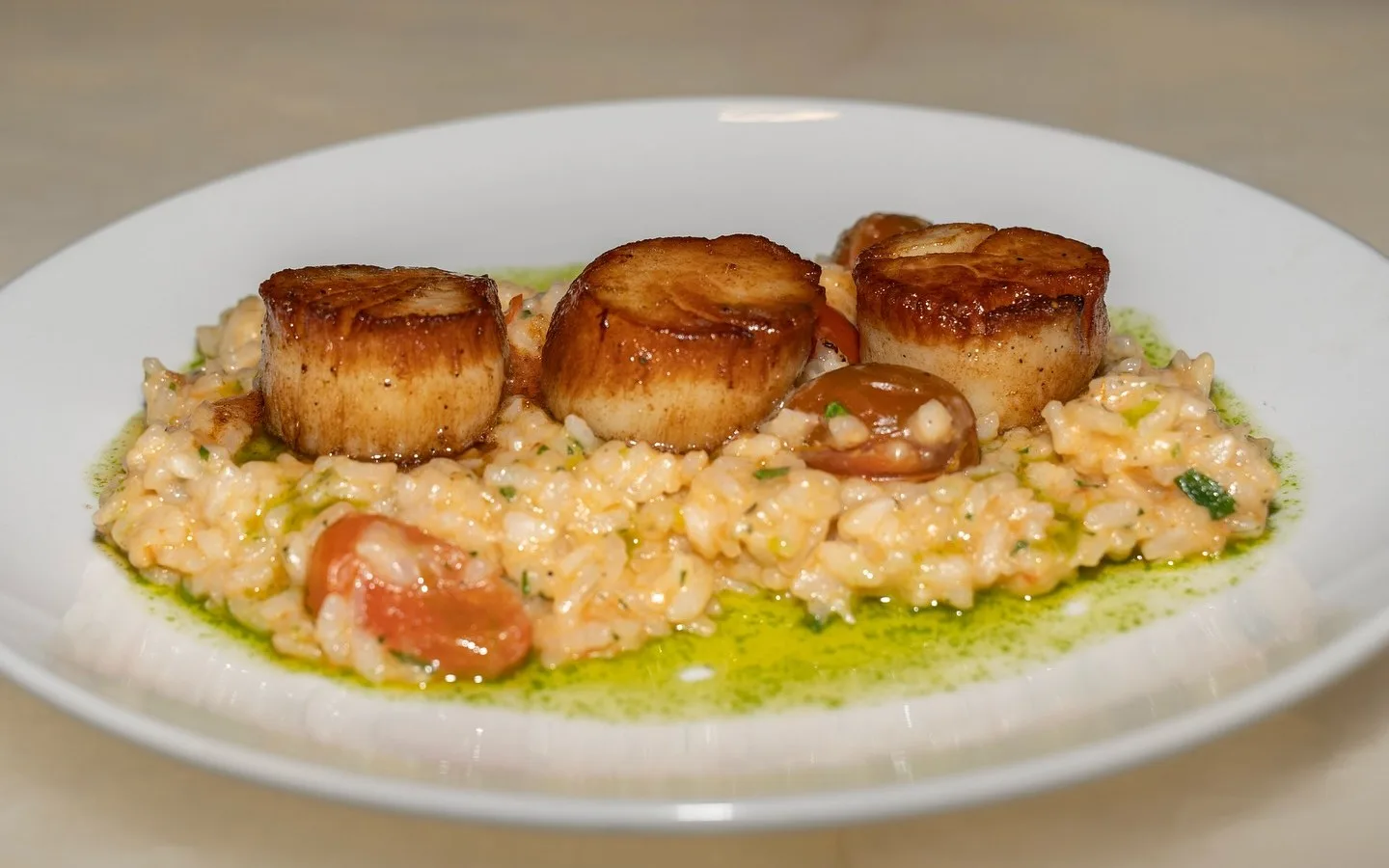
What wine goes with scallop risotto or scallop pasta?
Risotto, saffron, mounted butter, parmesan: the plate is creamy, salty, with a soft bitterness from the rice and the stock. A very lean white suddenly reads as hard and angular.
White Châteauneuf-du-Pape, built on Roussanne and Grenache Blanc, is the widest and most comfortable match. White Crozes-Hermitage and Saint-Péray do the same job for less. On a heavily saffroned version, a Jura Savagnin or an aged white Rioja make the insider pairing: the walnut and curry note in the wine lands right on top of the saffron.
For a scallop pasta with lemon and chilli rather than cream, drop back to something brighter: Vermentino, Greco di Tufo or a good Sancerre.
Can you drink red wine with scallops?
Nine times out of ten, no. Iron, far more abundant in red wine than in white, oxidises the fats in the flesh, and the finish turns frankly metallic. Tannin piles bitterness on top of that. That is not snobbery, it is chemistry.
The tenth case exists, and it needs two conditions at once. First a recipe that bridges the gap: smoked bacon, chorizo, black pudding, a reduced meat jus. Second a red with almost no tannin, served cool at around 14 °C. Jura Poulsard or Trousseau, Alsace Pinot Noir, red Sancerre, a light Fleurie or Chiroubles. A ten-year-old red Burgundy with resolved tannin works too. A young Bordeaux, a Madiran or a Cahors, never.
Which wines should you avoid with scallops?
Mistake number one is the heavily oaked Chardonnay poured on reflex because “this is a special dish”. On a plain seared scallop, the vanilla and toast of the barrel cover everything, and all that is left in the glass is wood. Save the oak for preparations that genuinely carry butter or cream.
Mistake number two is loud Sauvignon Blanc, Marlborough style. Its blackcurrant bud and tropical fruit steamroll flesh whose whole charm is nuance. A Sancerre or a Pouilly-Fumé, more restrained, does the job far better, especially when there is citrus on the plate.
Three quicker traps: a sweet-dosed brut Champagne, whose sugar fights the brine; an off-dry or sweet wine outside a genuinely sweet recipe; and serving too cold. Straight from the fridge at 5 °C, even a beautiful white smells of nothing. Aim for 10 to 11 °C for tense whites, 12 to 13 °C for richer ones.
One last detail that matters more than people think: do not over-salt. Scallop flesh is already saline, and too much salt rounds the wine off and blunts its acidity.
Where should you start if you are not sure?
If you only remember one thing, look at the pan before you look at the cellar. No fat on the plate, pour a tense unoaked white. Butter, cream or bacon, pour a white with weight. That solves the vast majority of cases, and it works for almost every shellfish you will cook.
For more of the same, our food and wine pairing guide gathers the whole family of dishes, from lobster to oysters to shrimp.
Frequently asked questions
What is the best wine with scallops?
There is no single answer, because a raw scallop with lime and a scallop seared in brown butter do not ask for the same thing. For raw or barely seared scallops, a village Chablis or an extra-brut blanc de blancs Champagne is hard to beat. Once butter, cream or bacon is involved, move to a Meursault, a Saint-Aubin premier cru or a white Pessac-Léognan.
What wine goes with bacon-wrapped scallops?
Smoke, salt and pork fat take over, so the wine has to deal with those first. A dry Alsace Riesling is the safest call: its citrus cuts straight through the bacon. Dry Jurançon and Savennières work on the same principle. This is also the one scallop dish where a light red makes sense, as long as it has almost no tannin and you serve it cool, around 14 °C.
Can you drink red wine with scallops?
Nine times out of ten, no. The iron in red wine, far higher than in white, oxidises the fats in the flesh and the finish turns metallic. The exception needs two things at once: a recipe that bridges the gap, such as bacon, chorizo or a reduced meat jus, and a red with almost no tannin served cool. Jura Poulsard, Alsace Pinot Noir, red Sancerre or a light Fleurie all work.
What wine goes with scallops in cream sauce?
You need a white with real weight that has kept its acidity, or the sauce flattens it. White Pessac-Léognan is the best value here: Sémillon brings the roundness, Sauvignon keeps the bite, and the barrel ageing echoes the cream. Meursault and village Chassagne-Montrachet do the same job on a bigger scale. If the sauce carries curry or saffron, switch to white Châteauneuf-du-Pape.
What is a cheap wine that works with scallops?
Muscadet Sèvre et Maine sur lie at around 10 €, Picpoul de Pinet or a Mâcon-Villages all do the job, especially on raw or simply seared scallops. They are straight, saline, unoaked whites, and oak is the main enemy of scallop flesh. A 15 € Saint-Véran beats a cheap heavily oaked Chardonnay at 25 € nine times out of ten.