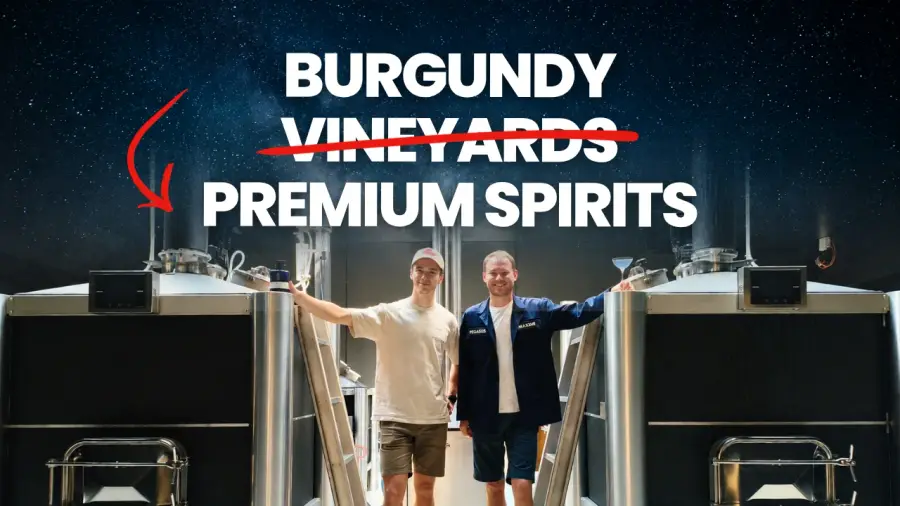
For the first time in our history, I’m bringing you a special episode about beer. So we set off to meet Cédric of the L’Instant beers. He looks back at the beer landscape in France and around the world, at the reasons that drove him, along with his two partners, to create the brewery, and at the developments to come. The L’Instant beers are, in fact, in the middle of a crowdfunding campaign to grow with new tanks. So you can give them a big hand (and receive some lovely rewards) by following this link. If you like this kind of new episode, tell me in the comments and I’ll be delighted to bring you more. Until then, enjoy listening.
Can you start by introducing yourself?
My name is Cédric Brotier. I’m at the head, along with two companions, of L’Instant brewery: a craft brewery located in the Île-de-France region. We recently moved to Pontault-Combault. We do brewing work focused on the style of our beers, we take the beer drinker travelling. So, we address two types of audience: the connoisseur who’s looking for a quality beer, and the enthusiast who wants to travel and discover that beer goes far beyond being named by its colour.
Can you tell us more about the idea of creating L’Instant?
We officially started in 2016, but production really began at the start of 2017. For us, there was a real search for professional meaning with this project. We were once flatmates at Sciences Po Dijon, which is a programme that’s part of Sciences Po Paris. We joined Paris for the Master’s. After all those studies, I landed in a job that didn’t fulfil me from a professional point of view, even if some might have considered it enviable. One of my other friends, Benoit Fleuret, drifted from one job in music to another. He was at a communications agency: so it was all very intangible. Beer came along to show us that you could work and find fulfilment at work. There was a weariness in our professional paths, and beer fit in just like that. The meeting of passion and the desire to do something else gave rise to L’Instant. The idea came after a beer-and-cheese tasting.
How do the first days of L’Instant go?
The brewing-training landscape in France is a bit barren, even if there are people trying to revive it. The natural entry point for many people is to buy a brewing kit that contains the recipe and the ingredients. That would have been the easy approach, but at the time we got started it was much less accessible. So we read a book on how to brew your own beer as an amateur and we bought the minimum equipment that seemed necessary to brew our own beer. The first day is apocalyptic. It was at Benoit’s, in the kitchen of his flat in the 15th arrondissement. It was a mess, but the more mistakes you make when starting out, the fewer you make later. We were really amateurs at that point, we had no intention at all of selling our production. That first beer was more or less drinkable. It gave us the urge to make more, because we love the process of creating a beer. We never let go of it again.
Can you say a word about the beer landscape in France?
It’s a fairly complex market to grasp. There are the beers everyone knows, which are the industrial beers everyone knows, that we buy in the supermarket. It’s very concentrated in big companies that are the majors of beer. It’s a very standardised product. Then, there are two types of craft beer. On one hand, you find traditional craft beer with classic recipes, not seeking innovation in the recipes but working the local-proximity angle. Finally, there’s the market share that’s exploding hugely and that L’Instant belongs to. It’s the craft scene with that artisanal side and at the same time working on styles that aren’t necessarily known to the general public. You find IPAs, Stouts, Berliner Weisse. These are a great many styles that the general public still doesn’t know much about. The majority of players in this market have annual growth in the double or triple digits. This development of the beer market started earlier in other countries than in France. France has the big problem, but also the big advantage, of having a very strong and highly valued wine sector. That gives us the advantage of being used to tasting, to questioning what we drink, to trying to pair the product with a dish. Then it slightly holds back the appeal of other tasting products like beer. We could see the two on the same level. The United States experienced an explosion of the craft scene from the 1980s by reviving old beer styles.
Is the notion of terroir important in beer?
Terroir is an essential notion in wine because we work from a single, unique raw material: the grape. For beer, we work with four different ingredients: water, malt, yeast and hops. The notion of terroir in beer is important for each of these elements. Depending on where we’re located and where we source from, we won’t have the same water, nor the same hops. When you buy a bottle of wine, you know which wine estate it comes from and you can know the precise origin of the wine. For beer, there are both the producers of the raw materials and the brewer. There’s one more element in the chain, so we have an approach to terroir that’s different, because the brewer is further downstream in the value chain. It isn’t mandatory for the big industrial players, but we always indicate where it’s produced and in which tank. As for the origin of the raw materials: we can indicate it, but it’s sometimes a bit complicated. We can indicate a region, but it’s often difficult to go further on the label.
How should I taste a beer? In wine there’s a ritual for how to drink wine; is there a similar ritual for beer?
We’re going to apply exactly the same ritual as for wine. We call on exactly the same senses as for a wine tasting. So you need a suitable glass, we’ll call on sight, we’ll naturally put our sense of smell to work, and so on. We’re on exactly the same process. The only difference for beer is that we’re not going to spit (whereas you can spit out the wine during a tasting). There’s an element that’s important in beer, which is bitterness, and for that we need to swallow. That’s fairly important in many beer styles.
Where should I buy my beer?
I recommend favouring passionate people. They’re generally independents. There are beer cellars that make a sharp selection of what they offer and that will be able to steer and guide you. You can also go to multi-tap bars with several beers on draught every day, which let you really taste and discover beer in all its aspects. In those bars you can often ask for a small-glass tasting to try several beers. You can go and check on our website for all the points of sale we work with, and they’re all passionate. If I can name a few Parisian spots, I’d say Pai Pai for example, near Bastille, is a really lovely place, and Bierocratie in the 13th in terms of cellars.
Can you age a beer? Like ageing a bottle in a wine cellar?
Yes, it’s possible, but it isn’t always recommended. The majority of styles don’t age well. The hops give a taste that fades with age. So, the closer to the moment of production you drink them, the better. On the other hand, there are styles that keep, generally those with the highest alcohol level. We can think of certain traditional Belgian styles with triples or quadruples that have an ageing potential that can be interesting. There are other beer styles, with Lambic and Gueuze in particular, notably from a brewery well known to enthusiasts called Cantillon, on which you can work the ageing. So yes, it’s possible, but if you buy an ordinary beer near where you live, there’s little chance it’ll improve over time.
Can you give us a few keys for putting together food and beer pairings?
It’s still fairly similar to wine, since we call on the same senses and the same skills. You can always do matching or contrasting pairings. For example, with a fairly fresh fish and small vegetables, you can head towards a fairly dry style with a few citrus notes. At L’Instant, when we make a salmon gravlax, we always pair it with our Hoppy Saison. With a nice dense dark beer, you can eat a dessert: that’s the matching pairing. For example, a chocolate fondant and an imperial stout that smells nicely of chocolate and coffee. You can also look for things that cut through. The Hoppy Saison I paired with the salmon, you can also try it on a raclette to avoid feeling too heavy. It’s a choice for the sommelier, the beer expert. I’m above all a brewer and I really like working with people who know these subjects well, but what’s certain is that the playground is enormous.
Are there rankings in beer?
There aren’t really any appellations, because we’re downstream in the value chain. Origin can’t be a criterion of the appellation. On the other hand, there are many competitions in beer, more or less serious, so you have to be careful. In France, there’s the France Bière Challenge or the competition of the French brewery museum. In these competitions, beers are ranked by style. What matters is to know whether the beer matches the expected style. A consumer who opens an IPA expects a certain number of things. There’s a directory of beer styles: the BJCP. For each style, it lists what the beer should resemble. That’s what beer benchmarks are built on.
Can you say a word about your range of beers?
We have an infinite space for creativity, since we produce recipes. We have a permanent range with a lovely panel of flavours:
- The Hoppy Saison: a fairly light beer that drinks very well on a terrace in summer;
- A beer that recalls the Alsace terroir, with hops that grow in Alsace;
- An IPA we’re very proud of, very fruity and very aromatic;
- A rye triple for all the enthusiasts who came to beer through Belgian beer;
- A Hefeweizen: a wheat beer (that is to say a white beer) that’s fairly gentle and easy to drink.
- A dark beer: in winter, often an imperial milk stout.
Then we have a series of one-off beers with the World of Hops. We make beers in which we let hop terroirs express themselves. The last one we made is designed with South African hops.
In a few words, there are four of you at the moment?
Yes, there are three founding partners: two operational full-time, and one who kept his full-time job. We recruited an employee who handles sales. Our production evolves from year to year. The first year it was tiny, we’d made 38 hectolitres to test the market. The goal this year is 1,000 hectolitres. To reach that production capacity, we’re running a crowdfunding campaign that will let you put down your own tanks.
A crowdfunding campaign to let L’Instant grow
To enable the brewery’s growth, we need to buy our brewing equipment. Everyone’s support is therefore precious to secure the funding of this project. We’re running a campaign with contributions from 10 to 3,000 euros and very nice rewards such as beers, goodies, but also beers for life, discounts for life, the chance to do a custom brew, invitations to tasting evenings, and so on.
Do you have a book to recommend to me about beer?
Of course. It’s a little doorstop that you can dip into depending on the topics you feel like looking at. So I invite you to read Les saveurs gastronomiques de la bière.
Buy Les saveurs gastronomiques de la bière
You can also follow the publications of Guirec Aubert and Élisabeth Pierre, which are generally of very high quality.
What’s your latest favourite tasting?
When you’re a brewer you taste an enormous amount of things. It’s hard to find ones that stand out. The last one that comes to mind is from a friendly brewery. It’s one of the best breweries in France, called Hoppy Road. It was a Pastry Gose. It’s a German beer style that they reworked, and it was a killer.
Who do you recommend I interview for the next episodes?
There are lots of quality people, but I recommend Adrien Lorieux, who’s one of the two managers of the PaiPai. On top of knowing beer well, he knows wine very well, and his passion is trying to build bridges between the two. It’s thanks to him that we aged beers in Chardonnay barrels. Follow the L’Instant beers:
Amazon links on this page are affiliate links. They cost you nothing extra, and they help me keep this going.