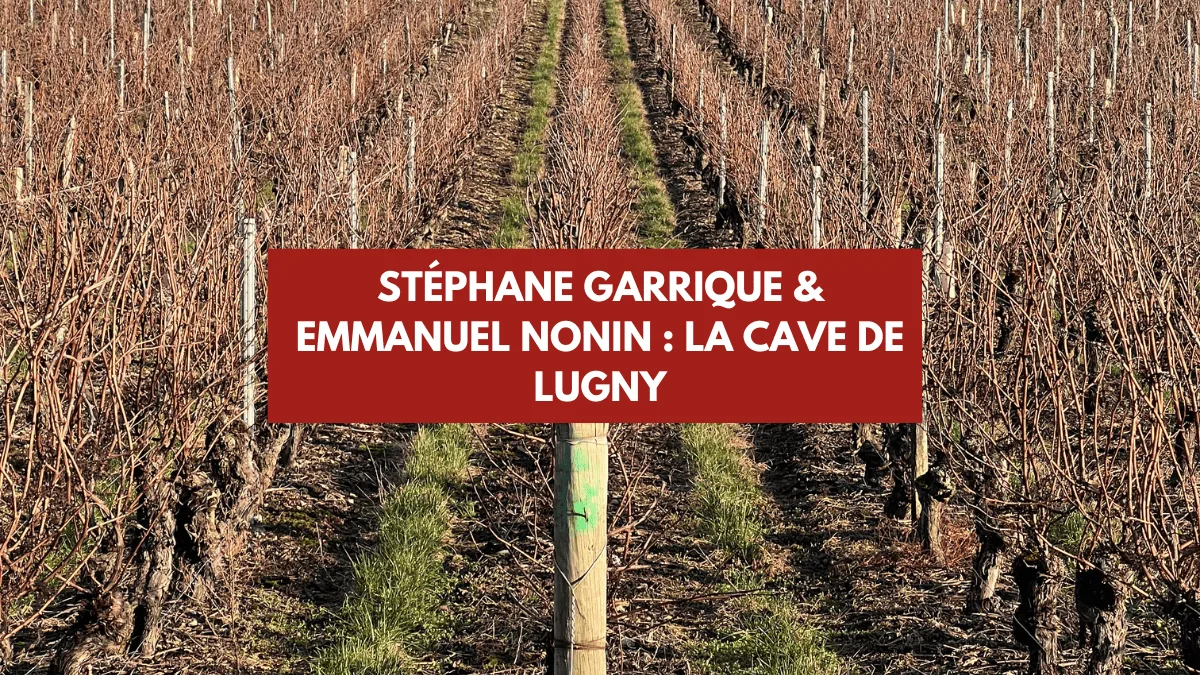
In the heart of the Mâconnais, north of Mâcon, stands the Cave de Lugny, a cooperative cellar emblematic of the region. This interview takes us to meet Stéphane Garrigue, director of the cellar, and Emmanuel Nonin, winemaker and administrator, who share with us their passion for wine and their attachment to this unique terroir.
Stéphane Garrigue, with rich and varied experience in the wine world, in both France and the United States, tells us about his journey and his return to roots in the cooperative world. Emmanuel Nonin, for his part, talks to us about his commitment as a cooperative winemaker and his love for the land and the vineyards.
Before we begin, we’ll talk a lot about Chardonnay but if you’re looking for a cap that shows your love for the other Bourguignon grape variety:
Throughout this discussion, we discover the history of the Cave de Lugny, founded in 1926, and its central role in producing quality wines, notably the famous Chardonnay. We also explore the specifics of the Mâconnais terroir, the challenges and successes of the cooperative cellar, as well as the innovative initiatives put in place to promote biodiversity and sustainability.
This interview is an invitation to dive into the fascinating world of wine and to discover the men and women who, through their passion and know-how, contribute to the renown of the Cave de Lugny and the Mâconnais.
Antoine
Hi Stéphane, hi Emmanuel.
Stéphane Garrirgue, cave de Lugny
Hi Antoine.
Antoine
Thanks so much for having me here. I’m at the Cave de Lugny right now, in the Mâconnais, north of Mâcon. I arrived this morning, we did a tour of the vineyards together which was great. It allowed me to discover much more in detail this Mâcon terroir that I still know very poorly. I came only once before. For me, it’s really a lot of pleasure to come here. Plus, you have your back to it, but I have a superb view of the vineyards behind you, on the Charmes.
Stéphane Garrirgue, cave de Lugny
That’s it. That’s our lieu-dit, the Charmes.
Antoine
The lieu-dit, the Charmes, where we were earlier. Thanks so much for that. We’re going to talk about quite a few things, since you have both a personal history, both vast, but also a history of the cellar, a history of cooperation, of varied development, which is great. We have a lot of subjects to address. Before anything, as usual, can you start by introducing yourselves?
Introducing Stéphane Garrigue and Emmanuel Nonin of the Cave de Lugny
Stéphane Garrirgue, cave de Lugny
Yes, of course. Me, I’m Stéphane Garrigue. I’m the director of the Cave de Lugny since November 2022, so a bit more than two and a half years at the Cave de Lugny. I started in the wine world a bit before 2000, in 1998, it was the previous millennium. I left for the United States to work in wine, marketing French wines, but also wines from every region, in the United States first and then internationally. I lived in the United States for 10 years. That’s where I learned a lot about the wine world, its culture and its marketing. Then, I wanted, being a native of the south of France, Catalan by origin, to return to my roots. I returned to Perpignan precisely to work and discover the cooperative world within a cooperative cellar, a large grouping of cooperative cellars at the time which is still called Les Vignerons Catalans. A magnificent entity that introduced me to the cooperative model that fascinated me. I stayed there 10 years to then work within the Advini group and return, a bit more than two years ago, to the cooperative cellar, the Cave de Lugny, to find again certain values that had really touched me during my time at the Vignerons Catalans.
Stéphane Garrirgue, cave de Lugny
I find them again here, at the Cave de Lugny, among all these collaborators, these cooperators who make the life and the sociability, the mutualization of all the work that’s the hallmark of a cooperative cellar in Lugny.
Antoine
Cool. Thanks a lot Stéphane. We’ll dig deeper into this story right after, but since I have two interlocutors with me, so for the people listening, you just heard Stéphane, who is the director of the Cave de Lugny, and we have with us Emmanuel, who is a winemaker and who is also the well of knowledge of this cooperative cellar, from the exchanges I’ve been able to have and from the way they described what you do.
Emmanuel Nonin - Cave de Lugny
Hi Antoine, hi to our listeners. Well of knowledge, the word is a bit strong. I’m Emmanuel Nonin. For my part, I’m a cooperative winemaker since 2013 in full, you might say, because I set up in 2013 as a young cooperative winemaker. It’s been a bit more than 10 years now that I’ve been a producer at the Cave de Lugny and I’m also an administrator. That is, I take part in the decisions of the board of directors which is the representative organ and of decisions of the cellar. So if I took back the vineyards in 2013, knowing that now, I’m over 40, I had another life before. I worked in event agencies, in tourism agencies and in the wine world. I come from a humanities university background, history, geography, tourism. That led me to create in 2010 an event agency around wine and culture called Oenoculture. So in that capacity, I’m speaking to you as a CEO, manager of an event company and then a cooperative winemaker. So indeed, I studied the cooperative cellar, the vineyard, at the university level and I continue to do so.
Emmanuel Nonin - Cave de Lugny
And then, otherwise, I keep my feet in the soil, as they say.
Antoine
Is it still something you do today, this event and tourism company?
Emmanuel Nonin - Cave de Lugny
Indeed, yes, I’m speaking to you as a double professional. I split my time between the family business and tourism, cultural mediation around heritage culture, wine. Here, we are in the Mâconnais, a rich region between two abbey cities which are Tournus and Cluny, and further south, the former count and episcopal city which is Mâcon.
Antoine
How did you return to wine? You had this event company, you had all this university past, exactly, that you mention. What made you want to return to the land, to the vineyards?
Emmanuel Nonin - Cave de Lugny
That, it wasn’t at all obvious because my grandfather, Elie, who was a winemaker right here in Lugny, who was born in 1919, we’re talking in terms of civilization, it’s the end of the 19th century, the very beginning of the 20th century. My grandfather farmed the vineyards until death, you might say, until the 2000s. He asked himself the question of what would become of the vineyards, knowing that my father had had his own career, because my grandfather hadn’t left him much time to farm. My father took back the vineyards, you might say, a bit on short notice at the end of my grandfather’s career. When he asked himself what was the future of these vineyards, whether they were going to be given on lease or kept, farmed, as they say, in direct ownership in the family, I had to position myself. It was a period when I had finished most of my contracts and my studies in other companies. And then, I started thinking, creating a tourism, mediation, event structure. And besides, crossing my two experiences. A family experience, a university experience. Creating a structure dedicated to that and ensuring the family heritage. So, I had to go back to school. I went back to school at the VitiOeno in Beaune. So, it wasn’t necessarily natural, but it imposed itself a bit as obvious. I’d say a way of taking on the family heritage.
Stéphane’s experience in the United States: building a brand wine
Antoine
You, Stéphane, you started in wine more on the marketing side?
Stéphane Garrirgue, cave de Lugny
Yes. I’m from the Catalan country, I come from the Pyrénées-Orientales where you don’t have much choice in the Pyrénées-Orientales. You work either in tourism or in agriculture. And agriculture, obviously, is viticulture. So, I always bathed in this milieu with a choice, obviously, if possible, to work in viticulture which bathed my youth, of course, but especially go abroad. That was my first choice. So I managed to combine the two by working in the United States, marketing French and foreign wines in Florida specifically, and across the United States for many years. Then internationally, I stayed there 10 years and I had the chance to meet many people in the wine world. It taught me a lot. I had a blast rubbing shoulders with great winemakers. Antoine, your podcast is called the Wine Makers Show. I met great winemakers in the United States. The winemaker is an important figure there. I had the chance to work with big brands, with Bill Hardy, among others, for Hardys wines, people who worked with the Mondavi family. All that, it was fascinating, it taught me a lot. Then, the return to roots was also obvious.
Stéphane Garrirgue, cave de Lugny
An attachment, of course, to France and then to the values of cooperation afterward.
Antoine
What did you see in the United States that you found again or that you wanted to redo afterward in France?
Stéphane Garrirgue, cave de Lugny
The capacity that everything is possible, I find that in the United States, it exists and is maybe even more present than in France. I appreciated that. You can have little education, but be totally considered in the United States having the capacity to become someone. You can be a salesperson without being qualified as a car salesman. Someone who’ll sell products there is just as considered, even much more than in France. I find there’s a confidence given to the person in the United States that brought me a lot. I also benefited from that. I arrived in the United States, I was stammering English. I don’t even know how my employers hired me, but I was stammering English and I had to put myself on stages talking about our French wines to 200 American salespeople with my stammering English. I could see the smiles around me of these 200 people and I suspected my accent was terrible, but I think what they liked was the authenticity of what I, as a French person, could represent. I think that trained me a lot. I was trusted very quickly.
Stéphane Garrirgue, cave de Lugny
That’s what I was saying in the introduction about the United States. They told me: we trust you, get on the boards, go talk about our products. That’s what I did. I think it’s also a very good school of humility. Because when you arrive, you don’t speak the language, you’re facing big professionals, you have to talk to them about the product. Humility, it teaches you a bit to surpass yourself, to gain confidence in yourself. There you have it, it brought me a lot, in any case in my career development, that’s certain.
Antoine
I think it’s the case for many emigrations. When you emigrate to a place, you have no other option than to outperform the local market, because otherwise, they won’t give you a job and you go back home and it’s over. Your adventure is over.
Stéphane Garrirgue, cave de Lugny
I think you’re absolutely right. There’s another thing that drove me in the United States and that really marked me, for me, that accompanied me all the time, it’s telling myself: I’m French, I represent France. When people look at me, they see France. So, don’t mess up, Stéphane. Because I had this feeling of representing a whole country, a people, a culture, a viticulture. I told myself: you have to do better than if you were in France because you represent… People’s gaze, at the start, it was that. In any case, in the 2000s, a French person represented luxury, gastronomy, culture, fashion. So, we had to live up to this vision the Americans had. So, I forced myself to make the effort to learn, to speak correctly, to represent my country as best as possible. That, that also pushed me a lot. I felt I had to do maybe more than if I had been in France to work even better.
Antoine
Do you think it’s still the case today? In the United States?
Stéphane Garrirgue, cave de Lugny
I don’t know. I think things have changed a lot. I admit I look a bit with dismay at the evolution of American politics and I think there’s still an American withdrawal that, for me, saddens me a bit. It’s true that wasn’t especially the people I hung out with in the United States and I think of them, they must be despondent over everything happening in the United States. I think unfortunately, this withdrawal isn’t ideal for the United States which has always brought a lot of novelty, a lot of innovation. They still do it, but by closing in on themselves, I’m not sure that’s the best of things. So no, openness to immigration, me, I was an immigrant, simply. I think I was welcomed really with open arms. I’m less sure that’s the case now.
Stéphane Garrigue’s attachment to the cooperative model
Antoine
Then you return to the south of France? And there, you immediately take leadership functions?
Stéphane Garrirgue, cave de Lugny
Sales management at the Vignerons Catalans. Yes, there too, it’s also trust. Indeed, the director at the time, the president at the time trusted me. I was arriving from the United States. I knew wines a bit, obviously, since I had been in the milieu for 10 years, but I didn’t know the French market, I didn’t know retail. They trusted me, they told me: we believe in you, you’re missing things. You’re not entirely ready for the job, but we think you can do it. Go, here are the keys to the truck. I was trusted and I was able to market Catalan wines in France within retail. I didn’t know anyone. I stayed there 10 years, it went well. I worked on export afterward. I took over the sales management of all services. So yes, it was also a question of trust. I appreciated that too. I also try to give it back now to collaborators and to the people we hire at the Cave de Lugny.
Antoine
So the Cave de Lugny is what comes right after in your career?
Stéphane Garrirgue, cave de Lugny
Not right after, because after the Vignerons Catalans, it’s also the encounters. I met Antoine Leccia, whom I admired a lot as an entrepreneur in the wine world, who was able to develop magnificent brands. I come from a brand world too. The United States, that was it. It was wine, viticulture, but it was the brands that were worked like consumer products with the advantages and disadvantages. But we learned there to build brands. That’s also, I think, what Antoine Leccia knew how to do at Advini and that’s what brought me closer to him. Following an encounter, I had a proposal from Antoine to work with him at Advini and I joined him for five years. So, I did 10 years at the Vigneron Catalan, in the cooperative milieu, five years at Advini. Then, the return, I think my main wish was to return to the cooperative milieu, for which I really had an appetite, a particular attachment to that model, in any case.
Antoine
At Advini, were you also doing sales management?
Stéphane Garrirgue, cave de Lugny
Sales management France, export, trade, retail. I did a bit of everything at Advini, which was extremely enriching too. It was fascinating.
Antoine
And then, arriving at Lugny, did you already know the Mâconnais or was it a bit the first time you set foot in Mâcon, it was especially for Lugny.
Stéphane Garrirgue, cave de Lugny
I knew Bourgogne because precisely, Advini has beautiful houses in Bourgogne, very beautiful houses. There are several things that made me dream coming to the Cave de Lugny. It’s the cooperative model, I wanted to find it again, I already said it. But it’s also Bourgogne. I arrived in 2022, we had just finished the 2021 vintage. Everyone was looking for Bourgogne. Bourgogne, throughout the world, is the excellence of wine in the world without any comparison. Of course, the Bordelais, some great regions rise into the top 3 of regions recognized worldwide, anywhere in the world rather, we’ll present Bourgogne, everyone will say: I know this great vineyard. That, that’s fascinating. So, coming to Bourgogne, for someone who works in the wine world, I don’t want to say it’s the Grail, but not far. Bourgogne was clearly a desire and the cooperative milieu, a second desire. So there, the Cave de Lugny, it’s clearly the intersection of these two wishes, the cooperative world that I wanted to find again, and then the universe of Bourgogne, which is still at a qualitative level and a response to a demand totally in tune with the times.
We’ll talk about it, but when you rub shoulders with the greatest whites, the vineyard and the white wines clearly have the wind in their sails. Chardonnay is a wonderful grape variety. The Bourgogne name is a surfboard that everyone surfs in the viticulture world without problem. And the crémants too, we’ll talk, I hope, about the crémants which are also a know-how of the Cave de Lugny, which is fascinating.
The history of the Cave de Lugny
Antoine
Precisely, let’s dive into this Cave de Lugny. Maybe we can start with the history of this cellar. I think we decided earlier to say that it was the first Bourguignon cooperative cellar created and still in existence.
Stéphane Garrirgue, cave de Lugny
That’s it. We don’t want to offend anyone and I’ll ask my great friend Emmanuel to develop the history a bit, but we don’t want to offend anyone, but we think the Cave de Lugny is the oldest cellar in Bourgogne. We added earlier still in operation because there have been cellars in the north of Bourgogne, but they have disappeared since. I think the last in operation and the first created, it’s the Cave de Lugny, in 1926. We’ll talk a bit about the fact that cooperative cellars are much more present in Saône-et-Loire than in the rest of Bourgogne. I think in Saône-et-Loire, Emmanuel, you can confirm, but there are maybe more than ten cooperative cellars.
Emmanuel Nonin - Cave de Lugny
There are 17 cooperative cellars in Bourgogne. 14 cooperative cellars in Mâconnais-Saône-et-Loire.
Stéphane Garrirgue, cave de Lugny
To return to the history of the Cave de Lugny, a historic cellar, which will celebrate its centenary, created in 1926 with the creation of the first cooperative cellar in Lugny, then the following year, the creation of the cellar of Saint-Gengoux-de-Scissé. These two cellars came together, merged. Then, a bit later, in 1994, the Chardonnay cellar, a small mythical village not far from here, 6 kilometers from Lugny, joined the triptych and so formed this triptych Lugny, Saint-Gengoux-de-Scissé and Chardonnay.
I’m interrupting your reading for a few seconds, for a good cause.
Thanks to my podcast, I spend a lot of time in the vineyards and I have the chance to discover incredible things: from the most famous Domaines to very confidential places. What if I let you benefit from that?
If you want to build yourself a beautiful wine cellar, leave me your email.
Antoine
This cellar extends in the Mâconnais. What are the geographic limits? I’m afraid of saying silly things. I more or less remembered them. To the north, it’s Chardonnay, I think.
Emmanuel Nonin - Cave de Lugny
The Mâconnais, in part, is this natural region that corresponds to the Mont du Mâconnais, located in a triangle whose boundaries I gave earlier, Tournus to the north, to the south, Mâcon, which is still the administrative city, town, prefecture. Then, to the west, is Cluny. About, you have there, between these three towns, the distance is about twenty kilometers between each. There, you have the monts du Mâconnais and the Cave de Lugny, it drains precisely grapes and wine, you might say, between Tournus and Cluny.
Antoine
Can you tell us a bit about the terroirs, precisely, of what you have here at the Cave de Lugny? I had the chance to do a tour and so to situate, to see a bit, but for the people listening, can you tell us a bit about the structure, both the planted varieties, of course, but also the composition of the soils, the orientations, what we’ll find and the consequence on the profile of the wines we’ll have.
Emmanuel Nonin - Cave de Lugny
This question of terroirs in the Mâconnais is quite interesting because first, the Mâconnais is the largest Bourguignon vineyard in terms of hectares, more than 1,000 hectares. The geographic, topographic configuration isn’t so easy, because we don’t talk about the Côte Mâconnaise, we talk about the monts du Mâconnais. That implies that to discover this sub-region of Bourgogne, you have to go up hill and down dale. You have to climb a slope, cross a ridge, descend into a valley and climb back up another path to reach another little valley or another slope. The Cave de Lugny has the chance to be able to combine three types of exposures found in these monts du Mâconnais. That is, the orientated coasts, that is, those facing the east and the rising sun. Secondly, you have the back slopes that we, in our popular language, designate, and which is also the name of many cuvées in Bourgogne, designated by the “crêts,” these slopes that face the setting sun. Then, at the top of these crêts, of these back slopes, we have the plateaus. The plateaus, as their name indicates, rather flat relief, which see the sun a bit constantly all the time.
Emmanuel Nonin - Cave de Lugny
The Cave de Lugny combines these three types of exposures. Each of these exposures will offer a type of soil that’s particular to it. So, we can, if you want, Antoine, push a bit further on what makes the specificity. First, the vineyards orientated to the east, the orientated coast, will rather have very calcareous iron oxide soils, so red. Red soils. That is, the “terrains à rouges,” as the old-timers said, “terres à rouges.” We historically planted Pinot Noir and Gamay which need more heat. So, these are warmer soils. The back coasts, so the crêts, the vineyard exposed to the setting sun, is essentially constituted of limestone mixed with marls, clays which are often white, the white terrains, colder. This setting sun exposure contributes to this colder aspect of this part of the vineyard. Then, at the top of the back slope, are the plateaus whose soil structure is sometimes very stony calcareous, but which mix with more clayey passes, more loamy sometimes. You mentioned earlier the plateau of the Charmes, it’s typically this kind of terroir we have on these plateaus.
Emmanuel Nonin - Cave de Lugny
I’d say that the Cave de Lugny vineyard combines these three aspects of the terroir that can be found in the Mâconnais. It’s an exceptional case because we’re really here in the essence of what makes even the Mâconnais wines.
The Cave de Lugny: Chardonnay experts
Antoine
You’re the Chardonnay specialists. If I correctly remembered what we said earlier, it’s 90% of the production of the Cave de Lugny is Chardonnay. And you’re also the largest producers of Chardonnay in Bourgogne in volume, is that right?
Stéphane Garrirgue, cave de Lugny
It’s specific to our sector, especially since we are neighbors of a village we are very proud of and that you’ll talk about. But yes, to come back to the grape variety, indeed, Chardonnay, we usually say we’re completely in the heart of Chardonnay. Yes, 90% Chardonnay. And on 1,250 hectares, that means that’s more than 1,100 hectares of Chardonnay planted around us. So yes, I think we can boast a qualifier of Chardonnay specialist producer. In volume, I think indeed, given the size, we must be the first Chardonnay producer. We don’t market everything ourselves since we make bottles, but we make quite a few bottles, almost 6 million bottles. So that’s still important, but it’s not all our production and we have partners, Bourguignon partners who also source from our terroirs. So that’s also our pride, since big names also carry the wines of our region, so we’re very proud of it. And a little bit of Aligoté, but that’s really very, very confidential. After, we make a bit of Pinot Noir.
Stéphane Garrirgue, cave de Lugny
That represents in our case one of hundreds of hectares, a bit more. And Gamay too, of course, to make Mâcons Rouges with beautiful qualities too.
Antoine
Precisely, let’s come back to this village of Chardonnay. I had the chance to take my emblematic photo with the Chardonnay sign, the entrance sign of the village. If you come to Mâcon, take the car, pass by the Cave de Lugny and then head straight to Chardonnay because that way, you’ll have your photo with this beautiful sign. It’s a village that’s emblematic of the relationship between the region and its grape variety.
Emmanuel Nonin - Cave de Lugny
Yes, Antoine, it’s true that there, you did a bit of a pilgrimage. You’re not the only one to have your picture taken in front of the sign. That said, people expect to find a town, it’s a village of only 200 inhabitants. It’s a little-known village, but on the other hand, the name is famous worldwide for three reasons, because it’s a name in three dimensions. It corresponds first to a commercial brand. Secondly, it’s plant material, that is, it’s a grape variety, it’s a vine plant that’s widespread. It’s the most widespread white grape variety in the world, the most globe-trotting. Then, thirdly, it’s a village. This village still has the merit of having lent its name through usage to this white grape variety which is now the king grape variety in Bourgogne. I say now because the switch happens in 1973. In 1973, in Bourgogne, we produce as much white wine as red wine. Then, henceforth, we’re in a movement of whitening that’s always more important, Bourgogne whitens.
Emmanuel Nonin - Cave de Lugny
It’s now the Chardonnay grape variety that has taken, that has conquered the Bourguignon slopes. However, Chardonnay and Lugny are villages that have, very early, from the end of the 18th century, cultivated this white Chardonnay grape variety while everywhere else cultivated Gamay, which makes the famous Mâcon rouge, and which we needed to feed a very popular market, cafés in particular, and feed the workshops, and if we speak at the regional scale, the Creusot workshops because they are the great industrial center. This Gamay wine served by blending to slake a population, a working class. Then, from the end of the 70s, early 80s, we move to a pleasure wine and it’s the white wine that will win. The chance that we have, to be legitimate in making this Chardonnay in volume, is that indeed, we’re next to it, we’re even part of this village by having a cellar that depends on the Lugny group, in the village of Chardonnay, which has therefore lent its name.
The characteristics of a cooperative cellar
Antoine
The Cave de Lugny is a cooperative cellar. What makes the specificity of a cooperative cellar?
Stéphane Garrirgue, cave de Lugny
Yes, the cooperative model is a model where in the current economic or financial model, we’d say we have shareholders. Our shareholders, for us, are our winemakers. There are 150 families who are shareholders, they’re called cooperators, who participate, who are the owners of the Cave de Lugny. They come together and the objective of the Cave de Lugny is a mutualization of means. That’s what makes the strength, because we have the capacity… So each one is owner of his vineyard at different levels. There are big owners who have more than 50 hectares among us. Then, there are very small ones. There are even some who have subsistence parcels. So we really have everything in terms of surface. We really have everything in terms of surface, we have everything in terms of population too. We have young people, we have old people, we have retirees who still take pleasure in harvesting. We have larger structures, large operators. This diversity, I think, is also the strength of the Cave de Lugny. We mutualize the means, that’s certain.
Stéphane Garrirgue, cave de Lugny
It allows us to pool financial means to be able to buy the best tools. I hope you’ll have the opportunity to visit our cellar, our harvesting area. We make a lot of whites, we had to buy 21 presses and they’re presses of beautiful quality. We visited together our crémant production. We saw a disgorger. A disgorger allows us to finalize our crémant wines which are sparkling wines. We manage to invest in beautiful equipment that allows us to make wine of great quality. And maybe everyone, being alone, a small family with a few hectares, couldn’t afford equipment of such quality. So that’s really the strength. I think there’s a financial strength, since mutualization of means, I think there’s an intellectual strength too. And that’s what I find fascinating in this model, is that there’s a collaboration of ideas. We try to highlight it even more at the Cave de Lugny by participating in many reflections to improve wine quality, to improve the quality of the functioning of the group of cooperators. We try to have initiatives, to set up innovations.
Stéphane Garrirgue, cave de Lugny
Many come from our winemakers. We tasted together at noon a wine. You talked about Engrenages. Indeed, this Engrenages cuvée is an initiative of a winemaker. We proposed to a group of winemakers to express themselves to the end of the creation of a wine, since it’s true that the cooperative cellar allows cooperators to do what they like most, that is, being in the vineyards, being outdoors, taking care of their surface, their vineyards. It’s really their heritage that’s most dear to them and we let them do that, but maybe sometimes, some would like to go further, express themselves in vinification, express themselves in marketing, in creating labels. The Cave de Lugny offers opportunities, ideas to be able precisely to express themselves differently. We created a range called Un homme, un vin. We invite all cooperators who want to conceptualize from the start of wine creation to marketing under labels in their name, that they will have chosen themselves and they will market their wine according to the vinification model they will have chosen. We try to mutualize the means, mutualize the ideas and innovate together.
Stéphane Garrirgue, cave de Lugny
That’s why cooperative cellars show innovative products quite often.
Emmanuel Nonin - Cave de Lugny
To complete what our director just said, as a cooperative winemaker, we don’t sell our grapes to the cooperative cellar. Because it’s a recurring question. We’re often asked: we don’t sell our grapes to the cellar. That is, we are indeed co-owners of this cellar. I say that because you have the Champenois model where the operators sell the kilo of grapes. We can’t know how much we’ll be paid, since for us, it takes a year to make the wine and a year to sell it. So, we’re paid only when the wine is sold. That’s an important thing. And secondly, I’d say the cooperative cellar is still an agglomeration of family structures. Family structures that allow, as you reminded us, each one to express themselves.
Antoine
How do you, you, experience it as a winemaker? Did you know the cellar at the time you left to do your studies or did you see it really from afar? You weren’t especially aware of it?
Emmanuel Nonin - Cave de Lugny
Let’s say in the 90s, me, I was 90 early 2000, I was at school, I was at university, I saw it a bit from afar, but I saw the cooperative cellar as a kind of dinosaur. Besides since I had studied history, I clearly saw that it was a socialist tool since the founders of our cooperative cellars are all elected officials originally in the 1920s, SFIO. SFIO, it’s the French section of the workers’ international. They are Jaurès’ ideas being applied. I saw that as a model a bit out of time. There’s an old lady who’s been there for at the time more than 80 years, 70, 80 years, when I was still at school. Then, I saw that as something a bit… Almost a bit distant, because my grandfather didn’t have the relationship that we, our generations, in 2024, can have in this cooperative cellar.
Emmanuel Nonin - Cave de Lugny
It was the cooperative winemakers who, in person, would lend a hand for vinification operations, in particular. However, he talked about the cellar as a structure: there’s the cellar that does this, the cellar does that. And then, you felt he was a bit dispossessed of his production tool. What I noticed coming back to business is that the cellar, henceforth, had changed. It was in 2013, but it’s really a pivotal period where the cellar was evolving toward something else, a truly economic tool, a company. Actually, it’s an economic company like any other and which placed the human at the center of its project. I’d say what motivated me to enter the board of directors too, is to see how the cellar has been able to call upon its human resources, salary resources of course, but also with its own resources, that is, the men who constitute the cellar, the cooperative winemakers. So yes, the cellar, henceforth, I really see it as a tool of socialist cooperation, but without these contradictions. That is, we are a tool fully integrated in the globalized, capitalist economy of the 21st century, but we keep foundations.
Emmanuel Nonin - Cave de Lugny
People often say: the cellar, it does social. We do social among ourselves because when we need cash advances, the cellar, for example, is able to provide it to us. My grandfather, for example, already at the time, needed to buy a tractor. The president at the time, the founder, told him: I’ll lend you the money even from my own account. There’s no need to advance what you have at the cellar. This solidarity exists. And then, otherwise, we’re integrated into an economic and social system. The cellar is invested in societal terms because we are present in many events, we are partners of events, we are patrons. For me, the cooperative cellar is an actor of society.
Stéphane Garrirgue, cave de Lugny
I’d go even further. What fascinated me, I have a few examples to cite to you on the level of mutual aid that can exist between winemakers. I rarely saw that, but I discovered at the Cave de Lugny winemakers in difficulty who no longer had the capacity to operate. I have a particular example. A person who could no longer, due to physical problems, operate, no longer finish pruning. There, everyone mobilized. In one morning, they did what they call a “corvée.” I find the word is harsh, but it expresses what everyone did. I went there at 7:00 a.m., it was below 2 degrees. There were 35 winemakers ready to help this person prune the vine. In one morning, it was wrapped up, they did the few hectares and the person hosted us all at noon to do a big “machon.” That solidarity, mobilizing 35 winemakers to finish a job that the operator is unable to finish himself, I don’t see that in many other structures.
Antoine
When I listen to you and when I think about that with my outside point of view, necessarily, I have a bit of the impression that one of the big flaws, it’s a bit political what I’m going to say, but too bad, I’ll own it. One of the big flaws of mutual aid societies is that it creates free riders. Basically, you don’t especially have an interest in working if you know you can receive an income without doing anything. Roughly, it’s classic incentives. Here, in the cooperative cellar, it’s a bit the opposite because I have a bit of the impression that since each one is owner of the company, will be remunerated based on the global results of the company. And as each one crosses paths, I suppose, on his vineyards and can say: watch out, you haven’t done your pruning, where are you? Actually, everyone is held responsible for one another. So necessarily, it works.
Stéphane Garrirgue, cave de Lugny
It’s true, that’s exactly what you say. You’re right, but there’s also the fact, and that, it’s also one of the strengths of the cooperative cellar, is that people are accepted as they are, with their capacities and their deficits too. We want to involve as many people as possible. You said it, Emmanuel, we do many events, festivities, open houses. We want and we try to mobilize the maximum number of cooperators possible. However, we also respect the fact that some cooperators don’t want to be involved. It’s a choice. For us, the cooperative is a choice. You want to be involved and that’s all for the better. We want it and encourage it. However, if you want to stay in your corner, work your vineyard, see no one, because there are people who aren’t as social as us, who don’t want to go to the store to sell products, who don’t want to go to the bar to serve drinks. They want to stay quietly in their corner. The Cave de Lugny accepts it on the one hand and encourages it on the other. Do what you express yourself best in. I think that, that’s also a comfort.
Stéphane Garrirgue, cave de Lugny
It’s a comfort for our cooperators to say: I’m not obligated to go sell wine. I don’t have a sales temperament, I don’t have a communicator’s temperament. I want to work my vineyard, be quiet.
I’m interrupting your reading for a few seconds. Stay informed about the publication of upcoming episodes and access my list of 10 wine books to read by leaving me your email:
The Cave de Lugny: driver of regional life
Antoine
Precisely, you give me an opening on these subjects. You mentioned it a bit, you have a variety of events that are organized. It’s also a bit what Emmanuel, you were saying about the fact that the cellar does social, which means the cellar is involved in the society around us. Can you tell us a bit about precisely what’s happening here? We saw earlier some explanation panels, hiking trails, wine tourism circuits. Can you come back a bit to these subjects and make people listening want to come at what time and for what type of event.
Emmanuel Nonin - Cave de Lugny
There are two types of events. There are events that are internal to the life of the cooperative cellar, like the open houses mentioned, the festivals that we ourselves can organize. And then, there are external events, external to the structure, but in which the cellar is invested. These events external to the cellar can be cultural, musical, they can be sporting. Tonight, we have a rewards evening for a famous Bourguignon hike which is the Tournuscimes, which mobilizes more than 3,000 to 4,000 hikers every year. And tonight, as a partner, we’ll be at the prize-giving evening for the 100,000th walker, which is still not nothing. The sporting events for which the cellar is a partner, it’s the term of the contract, it’s confidential, but we invest in what each can find there and what the structures and associations might need. So, we make ourselves present. It can also be logistics.
Emmanuel Nonin - Cave de Lugny
So, sporting event, event linked to concert halls, cultural associations. That, it’s the case, especially in Mâcon. We have everything that is local associative life. For example, the Mâconnais associations, often, turn to the cooperative cellars, the Cave de Lugny, to certain Domaines. The Cave de Lugny, you have to say it answers the call quite often, until now, to help these associations live. Otherwise, there are internal events.
Stéphane Garrirgue, cave de Lugny
Those, they’re very important, Emmanuel, because it’s true that we try to multiply the number of events. Obviously, we have a social role already in the region and on the 20 square kilometers you talked about earlier. So, we try to be involved. We’re here in a rural environment, there aren’t many activities, there isn’t much economy, there isn’t much industry. We’re still a driving company in these 25 square kilometers, in this small surface. So we try to participate in and encourage all activities and cultural animations that are external to the cellar, indeed. However, we also have our activities. Among these activities, there are some that are recurring. Every Thursday, we open our cellar and welcome customers for precisely tastings, food and wine pairings, pairings with cheese, tastings of various and varied products. That, it’s every Thursday, once a month. And once a year, we have a music festival too.
Stéphane Garrirgue, cave de Lugny
There’s a Biodiversity group that wants to multiply biodiversity within our 1,200 hectares. There’s a youth group that tries to dynamize all the young people of the cooperative cellar. They had the initiative to set up a festival called Festival de la Tête dans le Cep, which takes place the 1st Saturday of July. And there, we manage to gather up to 1,000 people on the parking lot of our store. That, it’s conceived, imagined, animated by the winemakers of the cellar, piloted by the young people and supported by the elders. I find that wonderful. There are the young people who have an idea, they meet with 10, the cellar helps them, encourages them and we have employees and tools to accompany them. Then, when you have to lend a hand, as Emmanuel says, the elders are there. They don’t care about the festival, they don’t care about the music, but they love the conviviality, sharing the moment, gathering together and they come carrying the barriers at 5:00 a.m., setting up the stage the day before.
Stéphane Garrirgue, cave de Lugny
I find that, that’s part of the Cave de Lugny. It allows two things: cohesion between the employees and even the cooperators, and then the communication of our brand, of our know-how, because it’s also the opportunity to taste the quality of our Cave de Lugny wines. We haven’t talked about it enough, Antoine.
Antoine
It’s true we haven’t talked about it enough. We talked a lot about history. Just to finish on this event part, it’ll soon be the 100 years of the Cave de Lugny, it seems.
Stéphane Garrirgue, cave de Lugny
Exact, yes, totally. Indeed, 1926 plus 100, that makes 2026. So next year, it’s the centenary of the creation of the Cave de Lugny. We’ll have to be at the rendezvous. We were saying we were the first cooperative cellar of Bourgogne. We have to be at the level of our status, in all humility, but we’ll have to do some celebrations. We hope that the year 2026, throughout the year, we’ll try to create events with key moments. We’ll have three. I won’t reveal too much because we still have some surprises to reserve for our visitors in 2026. But the idea is that throughout the year 2026, we celebrate this wonderful history which is the history of the Cave de Lugny.
Antoine
If at the moment you’re listening to this podcast, you’re planning your 2026 vacations, your 2026 weekends. Take a little tour on the Cave de Lugny website or set yourself a reminder to go because it’s going to be it’s totally symbolic.
Emmanuel Nonin - Cave de Lugny
The cooperative cellars were created to respond to a problem. This problem is the problem of slow sales. In the 1920s, it’s the crisis, it’s the slow sales of wine. And if it’s bought, it’s bought at a derisory price. That’s why polyculture makes the operations live. And the cooperative cellar was created to respond to a problem and we realize that 100 years later, in fact, it’s not so much that the problem, is it there, is it no longer there? In any case, this idea of: we have to be together to be stronger, has fizzled out. And that, it’s totally interesting. Symbolically, it’s still strong to be able to celebrate these 100 years of a working tool whose vocation to last was perhaps inscribed in its birth, that is, to respond to a problem that was perhaps only conjunctural.
Emmanuel Nonin - Cave de Lugny
And then, finally, the problem transformed and the cellar became a tool in its own right which, not only is a bringer of solutions, but is a tool to conquer, dare I say, markets and maintain them, develop them.
The wines of the Cave de Lugny
Antoine
Let’s get to the wine. I had the chance to taste Engrenage at noon. I haven’t yet tasted the rest. We saw each other at Wine Paris a year ago, I had the chance to see a few bottles, but I haven’t yet tasted since we prioritized this podcast and we said: the most important is that we record the podcast. If I don’t taste everything today, it’s not a tragedy, we’ll have the opportunity to see each other again. That said, for the people listening, 1,200 hectares here, the majority in Chardonnay, we said it, with still a great variation in the types of wines you make.
Stéphane Garrirgue, cave de Lugny
A great variation, except we’re 100% appellation. The Cave de Lugny only produces appellation. A lot of white, obviously, with two trends, still wines, but also sparkling wines. The crémants are also very important. Since 1975, the crémants have been present at the Cave de Lugny, the date of the creation of crémants de Bourgogne. We were the first to create crémant de Bourgogne and we continue to do so. The crémants are still very important for us. It’s a beautiful part of our production. It’s almost 15,000 hectares out of the 85,000 of production. It’s significant. We market a good number, 1.2 million still, under our brand called Saint-Charny. You find Saint-Charny in cafés, hotels, restaurants. It’s a brand that’s dedicated to the restaurant trade throughout the world. That, it’s a real historic success of the Cave de Lugny. The crémants de Bourgogne which by the way have the wind in their sails and whose demand keeps growing and which we can no longer respond to. So, it’s also very positive.
I’m interrupting your reading for a few seconds.
I tasted the Crémants of the Cave de Lugny and I tell you about it in this article. It will be the opportunity to make up your mind about them and to invite you to discover them.
Stéphane Garrirgue, cave de Lugny
I see that in France and abroad. Yes, we have demands, in any case, that come from everywhere. I was with an Asian importer, just two days ago, who contacted me specifically for crémants de Bourgogne. So I was thrilled. Unfortunately, I can’t respond positively to him because our production is sold and pre-sold, so unfortunately, I can’t respond, but the fact is that the demand exists and in France, but in the world too, I think the cause is the same. The quality of this wine, I think consumers have finally discovered. Thanks to champagne, because champagne wanted to considerably increase their prices. Maybe some have turned away and went to look for substitutes. The substitute they found, it’s the crémant de Bourgogne. When they tasted it, they said: actually, it’s of an excellent level. An excellent level, the specifications also impose it. We’re at harvest the same way as Champagnes. We’re at a minimum aging of 12 months, so it’s still important. It’s important investments for the cellar, but it shows the quality of the product.
Stéphane Garrirgue, cave de Lugny
The crémants de Bourgogne clearly correspond to the needs for sparkling. Sparklings still have the wind in their sails. And then the champagnes that are starting to disconnect from a general consumer access. We benefit from that and so much the better. The crémants are one thing, but we also have all the still wines. The still wines, obviously, lots of Chardonnay on flagship appellations. We obviously make Bourgogne-Blanc and Mâcon-Village. It’s the bulk of our appellations. Then, we’ll get into a bit more confidential and very qualitative appellations like Mâcon-Lugny, Mâcon-Péronne and then Mâcon-Chardonnay. We talked about the village of Chardonnay, but all around Chardonnay, there’s an appellation called Mâcon-Chardonnay and we’re a big producer of Mâcon-Chardonnay. So all that, it’s very qualitative appellations, lots in white. We don’t only do that, we have Bourgogne rouge and we have Mâcons Rouges too, in range, specifically.
Stéphane Garrirgue, cave de Lugny
These are wine choices rather tense, rather quite lively. Or, when we go to the other side of the hill, it’ll be wines in the roundness, a bit more rich, a bit more opulent, with a beautiful amplitude. That’s the diversity of the wines of the Cave de Lugny, with the capacity to work them, which are allowed by this mutualization of means which is at the origin of our cooperative cellar.
The terroirs of the Cave de Lugny
Antoine
Precisely, can we go a bit into the detail of the lieu-dits you have?
Stéphane Garrirgue, cave de Lugny
Mâcon, name of village. Mâcon, name of village. There are almost 27 in the Mâconnais. We market a good number of them. The main ones being Mâcon-Lugny, Mâcon-Chardonnay, Mâcon-Péronne. We have the possibility to have all these appellations. When we go even into the detail of these appellations, some are more or less large, but we’ll go even into a smaller funnel that corresponds to specific terroirs. There, it’s lieu-dits we manage to identify with clear parcels on our maps. There, we create wines thanks to this parcel that correspond to a particular terroir typicity. And you said it, there are some that are well known. The one that made the cellar’s notoriety in the 70s, which was one of the first brands, if we can call it that, a brand wine before all the other brands, it’s the Mâcon Lugny Les Charmes. The Charmes, it made the notoriety of the Cave de Lugny. A bit by chance, I think chance did things well.
Stéphane Garrirgue, cave de Lugny
We had, like you this morning, visitors, American importers who arrive in the Mâconnais, who are lost in the Bourguignon fog, because a few hours before you arrived, it was complete fog. I think they thought maybe they were in côte d’or. They landed in the Mâconnais, in the fog. They said: can we taste the local wines? They tasted with the president at the time. They loved it, they said: that, it corresponds completely to what we want to do. It was the terroir of the Charmes. Why don’t you mark the Charmes on the label and we’ll sell it in the United States? There you go, it’s done. And since, we’ve seen, the Charmes, it’s not a small plateau. There are still almost 70, 80 hectares. Yes, 100 hectares. Almost 100 hectares on this lieu-dit, 100% of this lieu-dit is sold and pre-sold to the United States. Not only to the United States, United States, England, France, the three countries that consume the Mâcon, Lugny, the Charmes, and we don’t have any for the other countries.
Stéphane Garrirgue, cave de Lugny
It’s still also a beautiful success. I think we were talking about innovation at the Cave de Lugny, the Cave de Lugny was a pioneer in building brands abroad. A bit by chance, with these American importers who got a bit lost, but in the end, the Charmes, it’s a big Anglo-Saxon and French success in hotels and restaurants.
Antoine
How would you describe, you, precisely, the wines of the Cave de Lugny?
Stéphane Garrirgue, cave de Lugny
The diversity of terroirs means there’s a great taste diversity at the Cave de Lugny. We talked about the Charmes and there, we’ll find this amplitude, this richness, this roundness. And we’ll cross over, we’ll go to another appellation called Saint-Pierre. On that, we’ll have a different terroir. Emmanuel will tell us. There, we’ll have liveliness, tension. So, completely different profiles a kilometer and a half apart. So that’s the diversity of the Cave de Lugny products.
The commitments of the Cave de Lugny
Antoine
Are there subjects we haven’t evoked and that you absolutely wanted to evoke about the Cave de Lugny? Did we miss something?
Stéphane Garrirgue, cave de Lugny
We missed a lot of things. That’s why you have to come back.
Emmanuel Nonin - Cave de Lugny
I’d say that the cooperative cellar, its environment, are part of a tourist product. I was told that the question earlier was: for you, what is the cellar? The evolution that I’ve been able to see in my 40 years, is that in twenty years, we went from a pure production tool to a tool that is resolutely open to the world and open in a receptive way. When I say receptive, that is, people come to us to discover what they could see or hear thanks to podcasts, what we could see through photographs, because now, we’re in the civilization of the image. The Cave de Lugny, henceforth, is open to the vineyard for its visitors, to make him discover its environment, its way of working. We see that the cellar, henceforth, is also fully a tool, a gateway of discovery of a profession, of products, then of an environment. That’s what we try to do, the hiking trails.
Emmanuel Nonin - Cave de Lugny
What I mean by that is that there are many debates on alcohol-free wine, the new way of consuming. I find that the cellar can offer, even if you’re not a wine lover, can offer other products. Because talking about the cooperative cellar is talking about economy, globalization or local. Very local, the global, interesting themes. It’s talking about biodiversity, the stakes, because as soon as we act on the world we cultivate, we other winemakers, we have an impact. So, we won’t feel guilty, but it’s not always easy to lead production successfully without being too impactful. There’s a real philosophical problem in there. And then, making things discovered a bit differently. I tell you, a cellar, a production tool that is a gateway to other themes.
Emmanuel Nonin - Cave de Lugny
Wine maybe doesn’t correspond to all customers, but however, you can come to the cellar for other things.
Stéphane Garrirgue, cave de Lugny
I totally agree with you. The work of the cellar too, is to listen to society, the outside world, we who travel with our salespeople abroad, to be able to come back to the cooperators, tell them: here’s what’s happening and here’s how we have to adapt. And what do you think? Are you part of this project? And projects like that, we’ve led quite a few at the cellar. The cellar was also in 2014, I think, already engaged in CSR. We talk now about CSR, and after all, how do we say CSR, but since 1926, the cooperative cellar, it’s CSR, it’s societal. So already, a pioneer on that. As of an engagement with engaged winemakers. That, it’s important too because we see now that consumers, they’re expecting fair products, products where the social, where the employees are well treated, where working conditions are respected, where the environment is considered. I think there, the Cave de Lugny has always had this red thread, thanks to the Vignerons Engagés association too, which is for us important, this red thread of operation, both upstream at the level of the vineyards and at the level of our employees.
Stéphane Garrirgue, cave de Lugny
That, it’s commitments. The commitment to organic too arrives about ten years ago at the Cave de Lugny. So, it’s not a specificity of the Cave de Lugny, but it’s also the wish of certain winemakers who raised their arms during meetings saying: we, we also have this environmental conscience, we want to be attentive to the way we treat and work our soils, we want to do organic. So, we created, and that’s also our duty, to propose solutions to these winemakers to come together. We created a company called La Croix-Salin. The Domaine de La Croix-Salin was created at the initiative of these ten winemakers and they pooled their work to create two cuvées, the Domaine de La Croix-Salin in Mâcon village and also, more recently, in the Saint-Charny brand, which is our Crémant de Bourgogne brand. We respond to its expectations, its needs. Actually, the cellar, it’s an old lady, but very modern, finally.
Conclusion
Antoine
It’s a beautiful conclusion. I think you’ll have understood, if you don’t know where to come, come take a tour at the Cave de Lugny. I think it’s a beautiful message to pass on, precisely, to discover what’s happening here. It helps a lot to see the vineyards, to see what’s happening. For me, it’s always something dear to me. I think if you listen to this podcast, you’ll be very happy to come. From Paris, it’s super easy. From Lyon, I think, can’t be easier. From other places in France, it’ll be a bit harder, but you’ll make a stop somewhere. I have three questions left that are quite traditional in this podcast. The first is: do you have a recent favorite tasting?
Stéphane Garrirgue, cave de Lugny
A recent favorite tasting? I’ll tell you that right now, I’m very focused on one of our products called Saint-Pierre. It’s the Mâcon Lugny Saint-Pierre because precisely, I love its tension, its liveliness, its freshness, its aromatics. I admit it’s a pleasure product for me as an aperitif or with everyone. I think it’s quite recent for us. It’s been two years since we created this specific lieu-dit, Mâcon Lugny Saint-Pierre. It’s a product that suits me and that gets unanimous approval around me. So if I had to recommend it, that would be the one.
Antoine
Got it. Emmanuel?
Emmanuel Nonin - Cave de Lugny
The best tasting memory, obviously, isn’t linked to a bottle, but it’s linked to the environment in which we taste it and with the people we taste with. That’s why I don’t really have very specific memories, but the latest interesting sensation, a vintage 2013 crémant de Bourgogne from the Cave de Lugny, which was very astonishing in freshness. It’s true, it was in magnum, which plays a lot on the conservation of wine. But 2013, you see, we can age the wines of the Mâconnais, the crémants de Bourgogne, in particular.
Antoine
Do you have a wine book to recommend to me?
Emmanuel Nonin - Cave de Lugny
For my part, the book by Pascaline Lepeltier: Mille Vignes.
Antoine
And finally, who is the next person I should interview?
Stéphane Garrirgue, cave de Lugny
Since we stay in Bourgogne, I think I was recently with Frédéric Drouhin. We exchange quite regularly on wines, but also on the company. On the wines of the Joseph Drouin family, I think there’s… I have no comment to make since they’ve already been made for decades, on the quality of these wines, the Clos des Mouches, of course, but all the rest. I had a tasting with Frédéric, which was wonderful and he made me travel through Bourgogne magnificently.
Amazon links on this page are affiliate links. They cost you nothing extra, and they help me keep this going.