James Miles, who co-founded Liv-ex and has spent twenty-six years watching this market tick, said something this month that is worth reading twice. Fine wine, measured properly, has not been this cheap since 2014.
The working: prices have halved relative to the FTSE since 2022, and are down close to 40% in real terms over the same period. The Liv-ex Fine Wine 1000, which tracks a thousand wines from around the world, has fallen back through its 2020 low to levels last seen in 2015. His read is that the bottom is in, that the bid to offer ratio is back to something normal, and that trade this quarter is up by a third on 2025.
For anybody who makes or sells wine, that is a rough paragraph. For anybody who drinks it, it is the best news in years, and almost nobody is writing it that way.
First, the caveat, because it matters
This is the founder of a fine wine exchange telling people that fine wine is cheap, in a piece headlined as a question about whether to start buying. He is not a neutral party. Liv-ex makes money when the market trades, and the market trades when people believe the bottom is in.
Two more things worth holding on to. “Down 40% in real terms since 2022” is measured from a peak that was itself a bubble, inflated by pandemic-era stimulus, near-zero interest rates and a wave of buyers who had never bought wine before and were not really buying wine. Measuring the fall from the top of that always flatters the size of the fall. And a rising bid to offer ratio is a market-health signal, not a promise: markets that look like they have bottomed sometimes keep going.
None of which makes the underlying claim wrong. The index is real, the fall is real, and the fall is very large. We would just rather you knew who was saying it and why.
Why it fell
Four things happened at once, and they were not really about wine quality.
The money got expensive. When cash pays you four or five percent, an asset that pays nothing, costs money to store and insure, and cannot be sold quickly stops looking clever. A lot of the 2020 to 2022 buying was interest-rate arbitrage in a nice bottle, and it left when the rates changed.
China stopped. The demand that underwrote a generation of Bordeaux pricing has not come back, and the cultural moment that drove it, the banquet, the gift, the label as social proof, has largely gone. We wrote about the far end of that when the Hong Kong to Shenzhen smuggling routes quietly died: the grey market collapsed partly because nobody is paying a prestige premium worth smuggling for any more.
Tariffs. A 15% duty on EU wine into the United States, in place since August 2025, took a bite out of the world’s biggest fine wine market. US wine imports in the first half of 2026 fell 16.8% by volume and 25.2% by value.
And there was simply too much of it. Producers raised prices hard in 2021 and 2022 into a market that was already turning, and en primeur campaign after en primeur campaign failed to clear. Stock backed up through the chain.
The part where we say the unpopular thing
This is genuinely hard for producers. Estates that expanded on 2021 pricing are carrying costs against 2015 revenue. Négociants are sitting on stock bought high. Small growers who never played the speculation game at all are being repriced anyway, because the index does not care who was sensible.
We are not going to be glib about that, and we would rather nobody framed a producer’s bad decade as a consumer’s clever moment.
But both things are true at once, and the second one is the one no consumer publication is saying out loud.
“The market being down is terrible for the people who make this wine, and I know a lot of them. It is also, honestly, the best moment to drink well that I have seen since I started the show in 2018. If we cannot fix the crisis by ourselves, we can at least do the one useful thing available to us, which is to buy the wine and drink it. Every bottle you pull out of this market is a bottle that goes to somebody who wanted it instead of sitting in a bonded warehouse waiting to be flipped. Build the cellar. Now is the moment.” - Antoine
What “cheap” does and does not mean
Before anybody runs at a merchant with a printout of an index, three corrections.
An index is not a shelf price. Liv-ex tracks trade between merchants in bond, in cases, usually excluding duty and tax. What you pay in a shop has retail margin, duty and VAT stacked on top, and those did not fall.
Retail lags, badly. Shops bought their stock months or years ago at the old price, and they cannot always sell it below what they paid. The falls show up first at auction and in the trade, then slowly on shelves, then in restaurants last of all.
If you are in the United States, you did not get the discount. The 15% tariff landed on the same wines at roughly the same time the index fell, so the two mostly cancelled out. This window is much more real for European and Asian buyers than American ones, and pretending otherwise is not useful.
Where the value actually is right now
The falls have not been even. The money left the wines it had piled into hardest, so the discounts are largest exactly where the speculation was worst.
Mature Bordeaux. This is the clearest one. Classified growths from good but unfashionable vintages, already ten or fifteen years old, from a region nobody is speculating on. You are buying the cellaring somebody else paid for. Look at the vintages the market never got excited about rather than the famous ones.
Champagne, especially grower Champagne. Prestige cuvées repriced hard. More usefully, the gap between a famous non-vintage and an excellent grower bottle is as wide as it has ever been, and the grower bottle usually wins in a glass.
Northern Rhône and Piedmont’s second tier. Crozes-Hermitage, Saint-Joseph, Langhe Nebbiolo and Barbaresco’s less famous communes all sit in the shadow of names that were bid up and have now come off.
Rioja Gran Reserva. Ten years in a producer’s cellar, released ready to drink, priced like a wine that has not waited at all. Structurally the best value in mature red wine in Europe and it has been for years.
German and Austrian Riesling. Ages for decades, costs a fraction of white Burgundy, and has never been fashionable enough to bubble.
The exception, and it is a big one: Burgundy at village level and above has not really come back down, because its problem is not speculation, it is that there is physically very little of it and three consecutive short harvests have made that worse. Do not go looking for a bargain there. Go one region over.
How to build a cellar without pretending to be an investor
You do not need a cellar. You need a dark, quiet place that does not swing in temperature. A wardrobe on an interior wall beats a beautiful rack above a radiator, every time. Bottles on their sides, away from light and vibration, and that is genuinely most of it.
A version that works on a normal budget:
Set a monthly number and stick to it. Twenty or thirty euros a month, bought deliberately, will do more for your drinking in three years than one heroic splurge.
Buy in threes, not ones. One bottle teaches you nothing, because you drink it once and never find out what it was going to become. Three lets you open one now, one in three years and one much later. This is the single biggest difference between people who own wine and people who understand it.
Buy things that are already old. A mature bottle from a merchant’s back catalogue gives you the payoff immediately, and right now those are the bottles that fell furthest.
Never buy for resale. If you want an asset, buy an asset. The entire fee structure of the fine wine investment world exists to take the difference between the index and what you actually net, and it is very good at it.
Write down what you bought and when. Not for the value. So you drink it before it dies, which is the real risk in every private cellar in the world.
The honest summary
A market falling 40% in real terms is a story about capital leaving. It is not a story about the wine getting worse. The bottles in bond this month are the same bottles that were in bond in 2022, made by the same people, and they now cost what they cost in 2014.
That is the whole opportunity, and it is available to anyone with a wardrobe and a bit of patience. The people who did well out of the last cycle were mostly not the ones with a spreadsheet. They were the ones who bought three bottles of something good when nobody wanted it, and then had the enormous good sense to drink them.
Sources: The Drinks Business on James Miles and Liv-ex, Liv-ex, the fine wine market in Q1 2026, Vino Joy News on the Hong Kong to Shenzhen route, VinePair on the 15% EU tariff
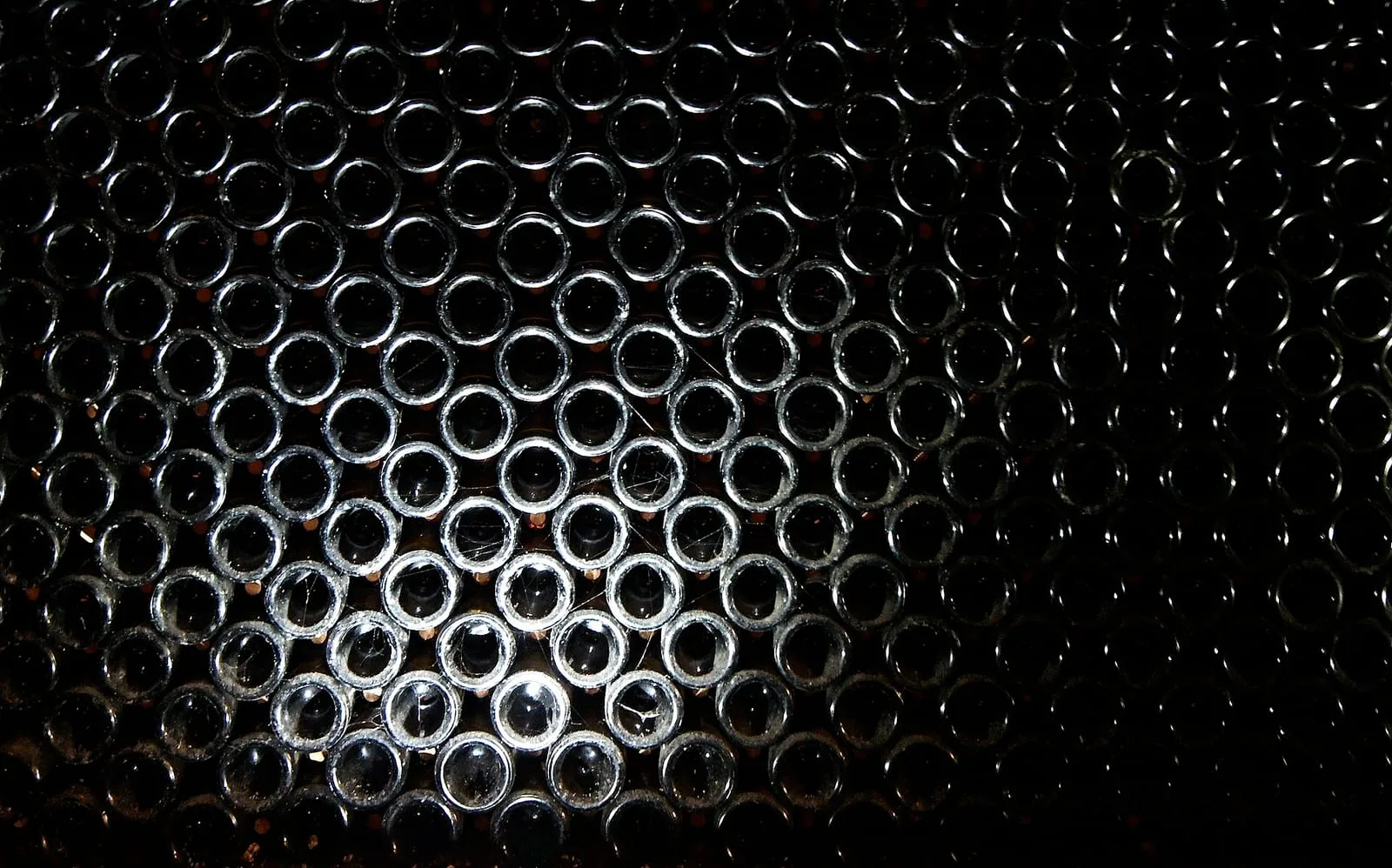
Hero photo: bottles binned in the cellar at Château de Pommard, Burgundy, by Jebulon, public domain, via Wikimedia Commons.